Employee engagement is frequently treated as a soft HR initiative, relegated to annual surveys and occasional recognition programs. This article makes a different case: engagement is a measurable performance driver with direct impact on output, retention, and profitability. The data is clear—organizations that systematically manage engagement see double-digit improvements in productivity, quality, and retention while reducing the hidden costs of absenteeism and turnover.
Key Takeaways
- Employee engagement measures emotional commitment to organizational goals—not just job satisfaction
- Highly engaged teams outperform disengaged counterparts by 18% in sales productivity and 23% in profitability
- Engagement reduces voluntary turnover by 21–51% depending on industry, saving recruitment and onboarding costs
- Disengagement increases errors by 32% and compounds retention costs across the organization
- Sustained engagement requires consistent measurement, action, and reinforcement—not a one-time initiative
What Is Employee Engagement?
Employee engagement is the degree to which employees are emotionally invested in their work, their team, and the organization's goals. It's not simply whether they're satisfied with their compensation or schedule. Gallup defines it as "the involvement and enthusiasm of employees in their work and workplace"—engaged employees treat the organization's success as their own, driving performance and innovation from within.
The distinction between engagement and satisfaction matters for HR strategy. A satisfied employee shows up and completes their tasks. An engaged employee takes initiative, advocates for the organization, and actively works toward shared outcomes.
Academic research goes further, defining engagement as "the harnessing of organization members' selves to their work roles; in engagement, people employ and express themselves physically, cognitively, and emotionally during role performances."
For HR and operations leaders, engagement isn't just a culture metric — it connects directly to business outcomes:
- Lower attrition and reduced replacement costs
- Higher individual and team output
- Fewer errors and improved quality metrics
- Better customer interactions and satisfaction scores
True engagement shows up in three ways: employees commit to staying and growing, they put in discretionary effort beyond the minimum, and they feel a genuine connection to the organization's purpose. Track all three, and engagement becomes a leading indicator — not a lagging one — for retention, productivity, and culture health.
How Employee Engagement Drives Productivity
The productivity advantages of engagement are tied to specific, trackable operational outcomes. Gallup's 2024 meta-analysis comparing top-quartile with bottom-quartile engagement business units has validated these links across thousands of organizations and multiple industries.
Higher Individual and Team Output
Engaged employees apply discretionary effort—the extra energy beyond minimum job requirements—which directly increases individual output and accelerates team-level goal achievement. This plays out in day-to-day workflows through employees who proactively solve problems, volunteer for challenging projects, and help colleagues succeed rather than simply completing assigned tasks.
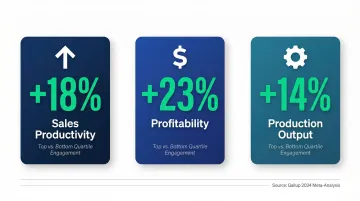
Top-quartile engaged business units achieve 18% higher sales productivity compared to bottom-quartile units. Production output is 14% higher and overall profitability is 23% greater. For high-volume operations, those percentages translate to substantial revenue gains year over year.
Engaged employees are closer to the work and surface better ideas faster, reducing slow decisions and rework cycles. McKinsey research demonstrates productivity improvements between 10% and 21% when organizations implement employee well-being and engagement interventions.
Key metrics this affects:
- Units produced per shift
- Sales revenue per employee
- Task completion rate
- Error rate and rework frequency
This advantage is especially significant in high-volume or fast-paced environments such as manufacturing, retail, and hospitality where small percentage gains in output translate directly to revenue.
Reduced Absenteeism and Presenteeism
Disengaged employees are more likely to take unplanned absences and, when present, operate at reduced capacity—a phenomenon called presenteeism. Neither shows up cleanly in standard reporting, which is why engagement measurement matters.
Top-quartile engaged business units experience 78% less absenteeism compared to bottom-quartile units. This translates directly to scheduling costs, overtime expenses, and service disruption for frontline-heavy industries.
Presenteeism costs are often higher than medical costs, representing 18% to 60% of all costs for major health conditions. A 2024 study found presenteeism costs tied to psychological distress reached $6,944 for women and $8,432 for men annually.
Addressing presenteeism requires more than attendance tracking. It requires measuring emotional investment through pulse surveys and regular feedback loops.
Key metrics this affects:
- Unplanned absence rate
- Sick-day frequency
- Self-reported productivity scores
- Overtime costs as percentage of payroll
This advantage is most acute in healthcare, catering, and logistics where coverage gaps have immediate operational consequences.
Quality of Work and Innovation
Engaged employees are more attentive, take greater ownership of outcomes, and are more likely to surface process improvements—resulting in fewer defects, higher service quality, and a steadier pipeline of operational innovation.
Gallup's data shows top-quartile engaged teams experience 32% fewer quality defects, 63% fewer safety incidents, and 58% fewer patient safety incidents (mortality and falls). Customer loyalty is 10% higher in highly engaged business units.
Psychological safety—a byproduct of engagement—enables employees to flag errors early rather than absorb them quietly. Research from Harvard and Google's Project Aristotle identified psychological safety as the most important component in successful, innovative teams. When employees feel safe, they report problems before they escalate and contribute improvement ideas without fear of criticism.
Key metrics this affects:
- Defect and error rate
- Customer satisfaction scores
- Number of improvement suggestions submitted
- Safety incident frequency
This advantage has highest impact in industries where quality failure carries regulatory or reputational risk—healthcare, food service, manufacturing, and financial services.
How Employee Engagement Improves Retention
Retention and productivity are not separate engagement outcomes—they reinforce each other. The financial cost of preventable turnover makes retention one of the strongest business cases for investing in engagement.
Lower Voluntary Turnover Rate
Engaged employees who feel connected to organizational purpose, recognized for their contributions, and supported in their development are far less likely to initiate a job search—even when the external market offers competing opportunities.
Gallup reports that top-quartile engaged units experience 51% less turnover in low-turnover organizations (≤40% annualized turnover) and 21% less in high-turnover environments. Replacement costs range from 33% to 200% of annual salary depending on role complexity.
Lower turnover directly reduces recruitment spend, shortens vacancy windows, and preserves institutional knowledge—especially for organizations with large frontline workforces where churn runs highest.
Industry-specific costs are substantial:
- Healthcare: Average cost of RN turnover is $61,110 per nurse
- Retail: Cost to replace a $10/hour retail employee averages $3,328
- Hospitality: US hospitality sector faces average turnover costs of $5,864 per hourly employee, with industry-wide annual losses exceeding $11B
The dollar impact is highest in industries with persistent labor shortages—hospitality, healthcare, and manufacturing—where open roles stay vacant longer and replacement pipelines are thin.
Key KPIs to track:
- Voluntary turnover rate
- Average employee tenure
- Time-to-fill open roles
- Recruitment cost per hire
Improved Onboarding Retention and Time-to-Productivity
Engagement is not just a retention mechanism for tenured employees—it begins at onboarding and directly affects whether new hires reach full productivity quickly and whether they pass the critical 90-day and one-year retention thresholds.
Organizations with strong onboarding processes improve new hire retention by 82% and productivity by over 70%. Yet over one-third of new hires quit within their first year, and 70% decide whether a job is the right fit within their first month—giving companies just 44 days on average to make a lasting impression.
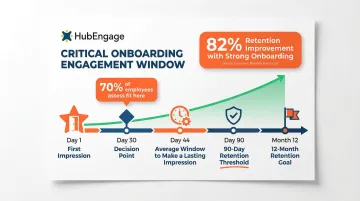
Engagement touchpoints during onboarding—recognition, clear goal-setting, peer connection—reduce the early-tenure doubt that drives attrition before an employee ever generates return on their hiring cost. Losing a new hire before they reach full productivity means absorbing recruitment fees, training hours, and a productivity gap with nothing to show for it.
This matters most for organizations that hire in volume or face seasonal surges—retail, hospitality, events, and catering.
Key KPIs to track:
- 90-day retention rate
- 12-month retention rate
- Time-to-full-productivity
- New hire engagement scores
Employer Brand and Talent Attraction
Engaged employees become internal advocates. Their authentic endorsements—shared on review platforms and social networks—attract higher-quality candidates and reduce dependence on costly external recruiting.
83% of job seekers research company reviews before applying, reading an average of six reviews before forming an opinion. Employers who raised their Glassdoor rating by just 0.5 points saw 20% more job clicks and 16% more apply starts.
Strong employer brands reduce cost-per-hire by 50%, and employee-shared posts generate 8x more engagement than corporate content. In industries fighting for the same frontline talent, that organic reach is a competitive advantage no recruiting budget can buy.
Key KPIs to track:
- Employee Net Promoter Score (eNPS)
- Referral hire rate
- Glassdoor/Indeed rating
- Offer acceptance rate
The compounding effect is most pronounced in tight regional labor markets: as employer reputation improves, each new hire brings lower acquisition cost and higher candidate quality—feeding a cycle that paid sourcing alone can't replicate.
What Happens When Employee Engagement Is Neglected
Disengagement doesn't show up as a single line item—it surfaces across multiple KPIs simultaneously. Gallup estimates the global productivity cost of disengagement at $8.9 trillion annually. For U.S. organizations alone, lost productivity reaches $2 trillion per year.
Operational consequences compound over time:
- Rising absenteeism and scheduling gaps that drive overtime costs and service disruptions
- Higher voluntary turnover and associated replacement costs that drain HR budgets
- Declining work quality and increased error rates that damage customer satisfaction and regulatory compliance
- Loss of institutional knowledge as experienced employees exit, taking expertise and relationships with them
- A culture of compliance rather than commitment that makes innovation and change management harder
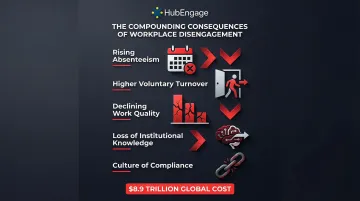
Disengagement is rarely sudden—it builds through unaddressed friction: poor communication, lack of recognition, no feedback loop, and unclear purpose. Those friction points accumulate quietly. McKinsey found that "mildly disengaged" workers — doing the bare minimum without quitting — make up roughly 32% of a typical workforce, dragging down productivity, well-being, and performance simultaneously.
Organizations that don't measure engagement can't detect the problem until it's already visible in attrition reports and performance data. At that point, recovery is slower and more expensive than prevention ever would have been.
How to Get the Most Out of Your Employee Engagement Strategy
Employee engagement delivers the most measurable value when applied consistently across the entire employee lifecycle—not deployed as a one-time survey or periodic campaign. Three conditions determine whether engagement programs consistently succeed:
Consistent communication that reaches employees where they work, regular measurement that tracks progress and identifies risks, and acting on insights rather than simply collecting them.
Practices That Translate Intent Into Outcomes
Successful engagement strategies include:
- Multi-channel communication that reaches both desk-based and frontline employees through mobile apps, email, SMS, digital signage, and workplace tools
- Recognition programs that are timely and tied to real behaviors, not just tenure milestones
- Pulse surveys that generate actionable data and are deployed quarterly or monthly, not just annually
- Learning opportunities that align with individual growth and organizational need
Gallup finds that 70% of the variance in team engagement is determined solely by the manager. When employees report to a manager in the top quartile of enablement, 50% are engaged compared to only 36% for bottom-quartile managers. This means engagement must be a manager-led operational discipline, owned at every level of the organization — not delegated solely to HR.
The Execution Gap and Platform Solutions
Platforms that unify engagement levers (communication, recognition, feedback, and analytics) into a single experience reduce the execution gap between strategy and day-to-day outcomes. For organizations with frontline and distributed workforces, delivering pulse surveys via SMS removes login friction and improves reach and response rates for shift-based teams.
HubEngage's AI-powered, gamified employee experience platform addresses this directly — HR and communications teams can reach employees across mobile apps, digital displays, email, and SMS from a single platform while tracking participation in real time.

The modular structure lets organizations start with specific capabilities (communications, recognition, or surveys) and add features as needs evolve, reducing implementation risk and consolidating tool costs.
Sustaining Engagement Over Time
Engagement must be reviewed on a recurring basis — not just measured annually. Leadership's willingness to act on feedback data is the single most important factor in sustaining engagement over time. Asking for feedback without following through causes engagement to decrease, creating cynicism that's harder to reverse than initial disengagement.
Engagement benefits compound when the practice is embedded into culture rather than managed as a project. Organizations that measure engagement quarterly, discuss it in leadership meetings, and tie it to manager performance see sustained improvements in productivity, quality, and retention that far exceed the gains from one-time initiatives.
Frequently Asked Questions
What are the benefits of employee engagement?
The core benefits include higher individual and team productivity, lower voluntary turnover, reduced absenteeism, improved quality of work, and stronger employer brand. Gallup and McKinsey research have consistently validated these outcomes across industries.
What are the benefits of employee engagement software?
Employee engagement software helps organizations systematically measure, recognize, and communicate with their workforce using real-time data and multi-channel reach. This results in higher participation in engagement programs and faster identification of at-risk employees.
How does employee engagement affect productivity and retention?
Engaged employees apply more discretionary effort, boosting output by up to 18% in sales productivity. They also feel more connected to their organization's purpose, reducing their likelihood of leaving by 21–51% depending on industry.
What are the key pillars of employee retention?
Retention is most reliably supported by meaningful recognition, clear growth opportunities, regular two-way communication, and a sense of belonging.
What are the main components (C's) of employee engagement?
The commonly cited engagement components are Connection (to the organization and its mission), Contribution (feeling that one's work matters), Commitment (emotional investment and intent to stay), and Communication (transparency and two-way dialogue). HR teams that address all four consistently tend to see the strongest engagement outcomes.