Introduction
Quiet employees aren't necessarily satisfied ones. Replacing a single employee costs approximately 33% of their annual wages, and 75% of voluntary turnover is preventable — meaning most exits could be stopped with the right insight at the right time. For median-size S&P 500 companies, disengagement and attrition already cost between $228 million and $355 million annually in lost productivity.
Most organizations already run satisfaction surveys. The breakdown tends to happen after: questions that miss the real issues, scores that go uninterpreted, and findings that never translate into action. This guide walks through all three — what to ask, how to score it, and how to turn results into a plan that actually reduces turnover.
Key Takeaways
- Employee satisfaction measures how content employees feel about their role, environment, management, and compensation (distinct from engagement, which tracks motivation)
- The five core areas to cover are role and workload, work environment, management and leadership, compensation and benefits, and growth opportunities
- ESI scores range from 0–100; scores above 75 indicate healthy satisfaction, while scores below 60 require immediate attention
- Surveys must be followed by visible action plans communicated back to employees within 60–90 days to maintain trust
- Anonymity, brevity, and multi-channel distribution prevent survey fatigue and improve response accuracy
What Is an Employee Satisfaction Survey (And How Is It Different From Engagement)?
An employee satisfaction survey is a structured feedback tool that measures how content employees feel about specific, concrete aspects of their work experience—pay, workload, management, culture, and growth. In short, it tells you whether employees' basic needs are being met.
The Satisfaction vs. Engagement Distinction
Satisfaction measures whether employees feel their basic needs are met. Engagement measures whether they're motivated to contribute discretionary effort. The two are not interchangeable.
Consider two scenarios. An employee satisfied with pay and benefits but disengaged from the mission will stay for the paycheck—but won't go above and beyond. An employee engaged with the mission but dissatisfied with compensation will burn out and leave.
Both matter. But they require different survey instruments and different interventions.
Research shows that satisfaction is about alignment between the job and an employee's expectations, while engagement is about emotional commitment and performance motivation. Treating a satisfaction problem with engagement tactics—or vice versa—wastes resources and lets the real problem compound: turnover stays high, morale erodes, and the underlying cause goes unaddressed.
Why HR Leaders Conflate the Two
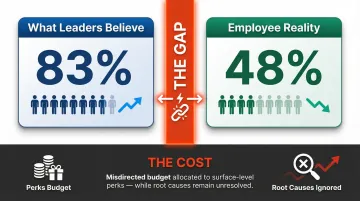
83% of leaders believe their workforce is fully engaged, but only 48% of employees categorize themselves as fully engaged, a significant gap that has real consequences. This gap often stems from what academics call the "jingle fallacy"—using engagement and satisfaction interchangeably, leading to misdirected organizational interventions. The result: organizations pour budget into perks and recognition programs while the actual driver of attrition—unmet expectations around workload, pay, or management—goes unresolved.
What Should an Employee Satisfaction Survey Include?
Effective surveys cover five to seven core topic areas, each targeting a different driver of satisfaction. The categories below serve as a question bank HR teams can draw from when building or refining their survey.
Role and Job Fit
These questions establish whether employees feel their skills are used well, their workload is reasonable, and their responsibilities are clear:
- Do you feel your skills and talents are well-utilized in your current role?
- Is your workload manageable and realistic?
- Do you have a clear understanding of your job responsibilities and expectations?
- Do you have the resources and tools you need to do your job effectively?
Work Environment and Culture
Culture questions often reveal early signals of retention risk by probing psychological safety, inclusion, team dynamics, and communication quality:
- Do you feel comfortable sharing your ideas and concerns with your team?
- Do you feel valued and respected by your colleagues?
- Does your team collaborate effectively to achieve goals?
- How would you rate the quality of communication within your department?
Management and Leadership
Manager relationship scores consistently predict overall satisfaction — which makes this category worth prioritizing:
- Does your manager communicate goals and expectations clearly?
- Does your manager provide regular, constructive feedback on your performance?
- Does your manager support your professional development?
- Do you trust your manager to act on your feedback?
Compensation, Benefits, and Recognition
Pay satisfaction is negatively related to turnover intentions, and raises specifically drive exit decisions more than base pay level alone. For context: compensation dissatisfaction accounts for 8.2% of exits, but career development (18.9%) and management behavior (9.7%) carry more weight — meaning pay matters, but it rarely acts alone.
- Do you feel your compensation is fair for the work you do?
- Are you satisfied with the benefits package offered by the organization?
- Do you feel your contributions are recognized and appreciated?
- How satisfied are you with opportunities for salary increases or bonuses?
Growth and Career Development
These questions are especially important for retaining high-potential employees:
- Do you have access to learning and development opportunities?
- Is the promotion and advancement process transparent and fair?
- Does your manager actively support your career goals?
Question Format Mix
Use both Likert-scale questions (1–5 or 1–7 ratings) for trackable trends and open-ended questions for qualitative context:
- Likert-scale questions enable composite scoring and trend tracking across survey cycles
- Open-ended questions capture the nuance behind ratings — why employees feel a certain way, what issues are emerging, and what they'd recommend
Including both formats gives HR teams numbers to act on and context to understand them.
How to Score Employee Satisfaction Survey Results (ESI and Beyond)
The Employee Satisfaction Index (ESI) is a composite scoring method typically calculated from three core questions:
- How satisfied are you with your workplace?
- How well does your workplace meet your expectations?
- How close is your workplace to your ideal workplace?
Employees rate each question on a 1-10 scale. The standard ESI formula is:
ESI = ((Mean Score - 1) / 9) x 100
This converts the average score to a 0-100 scale.
ESI Score Benchmarks
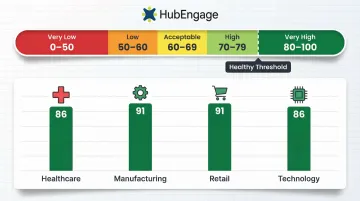
ESI scores range from 0-100, with the following thresholds:
- 80-100: Very high satisfaction
- 70-79: High satisfaction
- 60-69: Acceptable satisfaction
- 50-60: Low satisfaction
- 0-50: Very low satisfaction
Typically, an ESI above 75 indicates healthy satisfaction levels. Top 10% ESI scores by industry show meaningful variation:
| Industry | Top 10% ESI Score |
|---|---|
| Healthcare | 86 |
| Manufacturing | 91 |
| Retail | 91 |
| Technology | 86 |
Segment Beyond the Company Average
Averages can mask serious pockets of dissatisfaction. Break down scores by:
- Department: Are specific teams struggling?
- Tenure band: Are new hires or long-tenured employees less satisfied?
- Role type: Are frontline workers less satisfied than office employees?
- Manager: Do certain managers have consistently lower scores?
Once you've segmented, prioritize the groups with the lowest scores and highest headcount — those represent the greatest risk and the clearest opportunity for impact.
Identify Statistically Significant Trends
Not every score difference reflects a real pattern. Two thresholds guide reliable analysis:
- Minimum 5 responses per segment to protect confidentiality and ensure reliability
- +/- 5-point change at the department or company level is generally considered statistically meaningful
Differences smaller than these thresholds may reflect noise, not real change.
Use the First Survey as Your Baseline
The first data point isn't a verdict—it's a starting reference. Run subsequent surveys at consistent intervals — quarterly pulse checks or annual deep dives — and compare scores cycle over cycle to confirm whether changes are actually moving the needle.
How to Design and Distribute the Survey for Maximum Response Rates
Core Design Rules
- Keep surveys under 20 questions for periodic check-ins; reserve longer surveys for annual baselines
- Use plain conversational language—avoid HR jargon and academic phrasing
- Guarantee anonymity explicitly in the survey introduction
- Avoid double-barreled questions (e.g., "Are you satisfied with your pay and benefits?")—ask one thing at a time
- Keep surveys under 12 minutes—surveys longer than 12 minutes start to see substantial respondent break-off
Reaching Frontline and Deskless Workers
Email-only distribution systematically excludes frontline and deskless employees, skewing results. Traditional survey tools achieve only 5-30% response rates through email, while SMS surveys reach 40-50% participation—a gap explained by the fact that shift-based and hourly workers rarely have desk access or routine inbox habits.
Reaching employees through their preferred channels—mobile apps, SMS, digital displays—makes the difference between representative data and a skewed sample. HubEngage's multi-channel platform lets HR teams distribute surveys across mobile, web, SMS, and digital signage so every employee, desk or deskless, is included.

Tactics to Boost Response Rates
- Communicate the survey's purpose beforehand—explain why feedback matters and how it will be used
- Set a clear deadline—two weeks is standard
- Send a mid-point reminder—nudge employees who haven't yet responded
- Consider non-monetary incentives—recognition for participation or gamified points and badges
How to Build an Action Plan From Survey Results
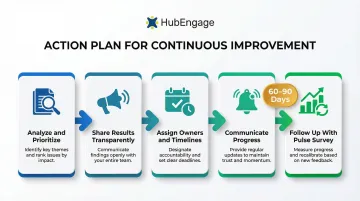
Step 1 — Analyze and Prioritize
Not every issue can be addressed at once. Rank findings by impact: prioritize items with the highest dissatisfaction scores that also affect the largest employee segments. Focus on changes that will move the needle for the most people.
Step 2 — Share Results Transparently
Closing the loop with employees is non-negotiable. Share key findings company-wide (not just to leadership), including:
- What you heard
- What will change
- What won't change and why
Hiding or softening results destroys survey credibility for future rounds. People are 12 times more likely to recommend their employer if they feel like their feedback is listened to and acted upon.
Step 3 — Assign Owners and Set Timelines
Translate each priority into a concrete owner, action, and deadline. Vague intentions like "we'll improve communication" erode trust. Specific commitments like "managers will hold monthly 1:1s by Q3" build it.
Step 4 — Communicate Progress
Employees need to see visible movement within 60–90 days of a survey closing, even if full solutions take longer. Regular updates via the channels employees already use keep momentum alive.
HubEngage's multi-channel platform lets HR teams push action plan updates through mobile, email, SMS, and digital displays simultaneously—so frontline workers get the same visibility as office employees.
Step 5 — Follow Up With a Pulse Survey
Send short pulse surveys (5–10 questions) 90–120 days after the action plan launches to measure whether interventions are working and whether satisfaction scores are trending in the right direction. Done quarterly, these check-ins confirm progress without survey fatigue—and give you the data to adjust course before small problems grow.
Common Mistakes That Undermine Employee Satisfaction Surveys
Surveying Without Acting
Running a survey and then going silent is worse than not surveying at all. It signals that leadership doesn't take feedback seriously and depresses future participation rates. If leaders conduct a survey but take no action on the results, employee engagement will likely decrease and turnover will increase.
What kills future participation isn't the survey itself — it's the silence that follows.
Treating All Employees as One Segment
Relying solely on company-wide averages can hide severe dissatisfaction in specific teams, locations, or demographic groups, leading to misdirected resources. Always segment by department, tenure, role type, and manager to identify where problems are concentrated.
Survey Fatigue From Poor Design
Surveys that are too long, too frequent, or use leading questions produce unreliable data and low completion rates. A few design principles prevent this:
- Frequency: Run quarterly pulse surveys (5–10 questions) plus one annual deep-dive (15–20 questions)
- Language: Keep questions conversational and free of HR jargon
- Length: Respect employees' time — if a survey takes more than 5 minutes, expect drop-off
- Neutrality: Avoid leading questions that nudge respondents toward a preferred answer
Frequently Asked Questions
How do you conduct an employee satisfaction survey?
Define goals, select question categories covering role fit, environment, management, compensation, and growth. Choose a distribution method that reaches all employees (mobile, SMS, email, digital signage), guarantee anonymity, set a two-week deadline, and plan to share results within 60 days.
What should an employee satisfaction survey include?
Cover five core topic areas: role and job fit, work environment and culture, management and leadership, compensation and benefits, and growth opportunities. Use a mix of Likert-scale questions (for tracking trends) and open-ended questions (for qualitative context).
What are some good employee satisfaction survey questions?
Strong examples include: "Do you feel your skills are well-utilized in your current role?" (role fit), "Do you feel comfortable sharing ideas with your team?" (culture), "Does your manager provide regular, constructive feedback?" (management), and "Do you feel your compensation is fair for the work you do?" (compensation).
What are Gallup's 12 questions and what do they measure?
Gallup's Q12 measures employee engagement (not satisfaction) across 12 items covering clarity of expectations, recognition, development, and belonging. Unlike satisfaction surveys that assess whether basic needs are met, the Q12 measures emotional commitment and motivation to contribute discretionary effort.
What is a good ESI (Employee Satisfaction Index) score?
An ESI score above 75 is considered healthy, indicating high satisfaction levels. Scores between 60-69 suggest acceptable satisfaction, while scores below 60 signal low satisfaction requiring immediate attention. The first survey establishes your organization's own baseline for comparison.
What are the 5 major components of job satisfaction?
The five elements are meaningful work, supportive work environment, fair compensation and benefits, growth and development opportunities, and work-life balance. Together, they cover the full range of what keeps employees committed — from daily environment to long-term career trajectory.