Introduction
Every HR leader and manager faces the same pressure: a valued employee is leaving, and the team needs to hear it from you before the rumor mill gets there first. When a resignation happens, teammates are 9.1% more likely to leave within 135 days—a phenomenon researchers call "turnover contagion."
Skip the formal announcement, and misinformation fills the gap fast. Studies show a significant share of employees learn about departures through workplace gossip rather than leadership, which breeds anxiety and erodes trust before you've had a chance to respond.
A clear, timely announcement protects team morale, builds trust in leadership, and gives colleagues a proper chance to say goodbye. This guide covers what to include, ready-to-use email templates for four common departure scenarios, and tips for tailoring your message by situation.
Key Takeaways
- Send departure announcements within 24–48 hours of confirmation, before rumors start
- Include the employee's name, last day, brief reason (if appropriate), transition details, and contact info
- Match your tone to the situation—voluntary resignations are warm, terminations stay factual
- Respect privacy by avoiding personal or legal details
- Use multiple channels to reach everyone, since email alone misses frontline and deskless workers
What Is an Employee Departure Announcement (and Why It Matters)
An employee departure announcement is a formal communication—typically an email—sent to staff, clients, or both, confirming that a team member is leaving and providing transition information. Done well, it shapes how remaining employees feel about leadership and whether they trust the organization enough to stay.
Why staying silent backfires:
When someone leaves without a formal announcement, word still gets out—just not from leadership. Research shows that 43% of laid-off employees and 44% of surviving employees hear about potential job cuts before any official action, with 34% learning through rumors. That information vacuum breeds anxiety and erodes trust fast.
The financial stakes are just as real.
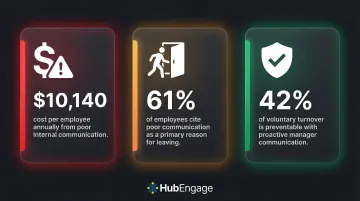
Poor internal communication costs companies the equivalent of $10,140 per employee annually, and 61% of employees considering leaving cite poor communication as a factor. When managers communicate proactively, 42% of voluntary turnover becomes preventable.
Four core benefits of timely announcements:
- Prevents misinformation from spreading through informal channels
- Demonstrates transparent leadership during uncertain moments
- Gives colleagues a proper chance to say goodbye
- Makes transition planning visible and organized
What to Include in an Employee Departure Announcement Email
Define Your Recipient Scope
For small teams, send company-wide. For large organizations, target the departing employee's team and adjacent teams who interact with them regularly. The scope should match the employee's organizational footprint—a frontline worker's departure may only need department-level distribution, while a senior leader's exit warrants broader reach.
Five Essential Elements
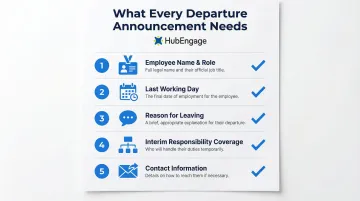
Every announcement must include:
- Employee's name and role - Be specific about their position
- Last working day - Provide the exact date
- Brief, approved reason for leaving - Only if appropriate and agreed upon
- Interim responsibility coverage - Name who will handle their work
- Contact information - Direct questions to a specific person
How Much Detail to Share
Always ask the departing employee what they're comfortable sharing before sending anything. - Voluntary departures: A single sentence about their next step is appropriate — "Sarah is joining a fintech startup as Director of Product."
- Terminations: Keep it factual and brief. Confirm the last day only; never explain the reason or use language that could expose the organization to defamation claims.
Craft an Effective Closing
Express genuine appreciation with at least one specific accomplishment: "Jordan led our Q3 product launch, which exceeded targets by 40%." Mention farewell events or gift collections if planned. Sign off from a named person—the manager or HR lead—rather than "the company" or a generic title.
Write Clear Subject Lines
Subject lines should be direct and informative:
- "A message about Jordan's departure"
- "Announcing Sarah's last day - March 15"
- "Team update: Alex's transition"
When in doubt, lead with the person's name — it signals urgency and gets opened faster than generic team updates.
Employee Departure Announcement Email Templates
Voluntary Resignation Announcement (Internal)
Subject: Announcing Sarah Chen's Departure
Dear Team,
I'm writing to let you know that Sarah Chen, our Senior Marketing Manager, has decided to pursue a new opportunity and will be leaving the company. Her last day with us will be Friday, March 15, 2024.
Sarah has accepted a position as Director of Product Marketing at a fintech startup, and while we're sad to see her go, we're excited for her next chapter.
During her three years with us, Sarah led our Q3 product launch, which exceeded targets by 40%, and built our content marketing program from the ground up. Her strategic thinking and collaborative spirit have been invaluable to our team's success.
Transition Details:
- Michael Torres will serve as interim Marketing Manager starting March 18
- For ongoing projects, please reach out to Michael at michael.torres@company.com
- Sarah will be available through March 15 to support handoff activities
We'll be hosting a farewell lunch for Sarah on Thursday, March 14 at 12:30 PM in the main conference room. Please join us to wish her well.
Thank you, Sarah, for your contributions and dedication. We wish you all the best in your new role.
Best regards,
Jennifer Park
VP of Marketing
Involuntary Departure / Termination Announcement (Internal)
Subject: Team Update - Staff Change
Dear Team,
I'm writing to inform you that Alex Rodriguez will be leaving the company effective Friday, February 23, 2024.
Transition Details:
- Jamie Lee will assume responsibility for Alex's current projects starting Monday, February 26
- For any questions or immediate needs, please contact Jamie at jamie.lee@company.com or reach out to me directly
Thank you for your understanding during this transition.
Best regards,
David Kim
Director of Operations
Retirement Announcement (Internal)
Subject: Celebrating Robert Martinez's Retirement
Dear Team,
After 28 years of dedicated service, Robert Martinez, our VP of Engineering, has decided to retire. His last day with us will be Friday, April 30, 2024.
Robert joined us in 1996 as a Software Engineer and built the technology foundation that powers our business today. He led the development of our flagship platform and established the technical standards that still guide our work.
Along the way, he mentored generations of engineers and served as a trusted advisor through nearly three decades of company growth.
Some of Robert's career highlights include:
- Leading the 2015 platform migration that reduced infrastructure costs by 60%
- Building our engineering team from 12 to 120 people
- Earning three patents for innovations in data processing
- Serving as a trusted advisor to three CEOs across nearly three decades
Transition Details:
- Lisa Chen will step into the VP of Engineering role effective May 1
- Robert will be available through April 30 to support the leadership transition
- For technical questions during this period, please contact Lisa at lisa.chen@company.com
We're hosting a retirement celebration for Robert on Thursday, April 25 at 3:00 PM in the main auditorium. Please join us to share memories and wish him well. We'll also be collecting messages for a memory book—please send your notes to hr@company.com by April 20.
Robert, thank you for 28 years of innovation, leadership, and friendship. Enjoy your well-earned retirement.
Warm regards,
Maria Santos
CEO
Client-Facing Departure Announcement
Subject: Your New Point of Contact at [Company Name]
Dear [Client Name],
I'm reaching out to inform you of a transition in your account team. Jordan Williams, who has been your primary contact, will be leaving our company effective March 10, 2024.
We want to assure you that your service will continue without interruption. Effective immediately, Taylor Anderson will be your new Account Manager. Taylor has been with our company for six years, specializing in [relevant area]. We've already briefed them on your account, and they're fully prepared to support your needs.
Your New Contact Information:
- Taylor Anderson, Senior Account Manager
- Email: taylor.anderson@company.com
- Phone: (555) 123-4567
- Available Monday-Friday, 8:00 AM - 6:00 PM EST
Taylor will reach out within the next two business days to introduce themselves and schedule a brief call to discuss your current projects and any upcoming priorities.
If you have any immediate questions or concerns, contact Taylor directly or reach out to me.
We're committed to making this transition seamless for you, and we look forward to continuing our work together.
Best regards,
Chris Johnson
Director of Client Services
chris.johnson@company.com
(555) 987-6543
How to Tailor Your Announcement by Departure Type
Match Tone to Circumstance
Retirement and voluntary resignations sit at the "celebratory/warm" end of the spectrum. Mutual separations require neutral language. Terminations demand the most restraint—just the facts, no elaboration.
Decision guide:
- If the departure is the employee's choice → lead with appreciation
- If it's the company's decision → lead with transition information
The Termination Scenario: What to Say and What NOT to Say
Avoid words like "let go," "terminated," or any phrases implying wrongdoing. A neutral statement—"[Name] will be leaving the company effective [date]"—is sufficient.
Never include:
- Reasons for termination
- Performance issues
- Disciplinary history
- Subjective or emotional language
Legal review of termination announcements is advisable to prevent defamation claims and protect the dignity of everyone involved.
High-Visibility Departures
Senior leaders and long-tenured employees require more detailed announcements, possibly a personal note from the CEO or department head. These warrant multi-channel delivery beyond email to ensure everyone receives it.
Time the departure announcement to precede or align with any successor announcement. This signals continuity and prevents the kind of speculation that unsettles teams and undermines operational stability.
Client Communication Timing
Client-facing announcements should go out before or simultaneously with internal announcements—never after. Clients should not hear about their contact's departure from someone else first. The account manager or relationship owner should send or co-sign this message to maintain trust and continuity.
Best Practices for Sharing Departure Announcements
Timing Rule
Send the announcement as soon as the departure is confirmed and the employee is comfortable with it being shared—typically within 24–48 hours of the decision being finalized. Waiting creates speculation; sending too early (before the employee is ready) damages trust.
Before circulating via email, inform personal assistants, direct reports, and close colleagues face-to-face. For executive departures, send the formal announcement mid-morning (around 11 a.m., avoiding Fridays), allowing a few hours for personal rounds beforehand.
Match the Channel to the Workforce
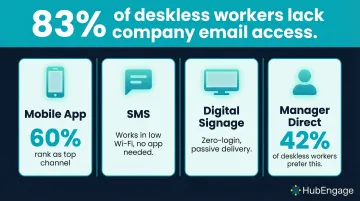
A single email will miss frontline, deskless, or shift-based employees who don't work at a desk. Deskless workers comprise 70-80% of the global workforce (2.7 billion people), yet approximately 83% lack access to company email.
Effective channels for reaching all employees:
- Most trusted by employees: Mobile apps — 60% rank them as their top communication channel
- Widest reach: SMS bypasses app downloads and works in low Wi-Fi environments
- Zero-login access: Digital signage delivers passive updates in breakrooms and on factory floors
- Preferred for critical news: 42% of deskless workers want updates delivered directly by their manager
A platform like HubEngage lets HR teams send an announcement once and auto-distribute it across mobile, email, SMS, and digital signage simultaneously — so no employee misses the message regardless of where they work.
Keep a Standardized Template Library Ready
Rather than drafting a new announcement from scratch each time, HR teams benefit from having pre-approved templates on file for each departure type. This reduces stress during an already sensitive moment and ensures legal and brand consistency.
Pre-built templates help smaller comms teams move faster without sacrificing quality — and many organizations now bundle these into ready-to-deploy kits that include narrative templates, FAQ builders, and checklists for each scenario.
Frequently Asked Questions
How do I write a staff announcement email about an employee leaving the company?
Include the employee's name, last day, a brief reason (if appropriate), who will cover their responsibilities, and a note of appreciation. Send it from the direct manager or HR within 24–48 hours of confirmation, using clear subject lines and specific transition details.
How do I announce to clients that an employee is no longer with the company?
Time the client announcement to go out before or alongside the internal one. Introduce the new point of contact by name with their contact details, and reassure clients that their work continues without interruption. The account manager or relationship owner should send or co-sign the message.
How do I professionally say that someone is no longer with the company?
Use neutral, factual phrasing such as "[Name] has left the company as of [date]" or "[Name] is no longer with [Company Name]." Avoid any language that implies fault, performance issues, or personal details that could expose your organization to legal risk.
How do I announce that an employee has resigned?
For voluntary resignations, the tone can be warm and appreciative. Share the employee's last day, share their plans if they've agreed to it, express gratitude for specific contributions, and invite colleagues to say goodbye at a farewell event if planned.
How do you announce the termination of an employee?
Keep termination announcements brief: state the last day and transition contact only, using neutral language like "[Name] will be leaving the company effective [date]." Avoid implying fault or giving a reason. Have legal review the message before sending to guard against defamation or privacy claims.