Introduction
Hybrid schedules, distributed teams, and rising employee expectations have reshaped what it takes to keep a workforce connected and productive. Organizations that rely on fragmented, legacy tools—separate platforms for communications, recognition, surveys, and learning—struggle to maintain alignment across locations and roles. Employees miss critical information, recognition programs stall, and HR teams spend hours managing disconnected systems.
While SaaS is often framed as an IT decision, its real impact shows up in how employees communicate, feel recognized, access learning, and perform daily work. When implemented effectively, it functions as a people strategy: creating conditions for engagement through consistent communication reach, visible recognition, real-time feedback, and accessible development opportunities.
This article breaks down six specific, measurable ways SaaS platforms drive engagement and productivity in practice:
- Multi-channel communication that reaches every employee
- Gamified recognition programs that build culture
- Real-time pulse surveys that surface insights before they become attrition signals
- Learning embedded in daily workflow
- Frontline workforce support that closes the equity gap
- Automation that frees HR teams from repetitive tasks
Key Takeaways
- SaaS employee engagement platforms unify communication, recognition, feedback, learning, and HR workflows into one accessible system
- Multi-channel delivery reaches frontline and remote workers through mobile apps, SMS, digital signage, and web portals
- Gamified recognition drives participation through points, leaderboards, and rewards—with the best platforms extending gamification across the full employee experience, not just a single feature
- Real-time pulse surveys replace annual feedback cycles, surfacing sentiment trends before they become turnover risks
- Consolidating fragmented tools into one platform cuts software costs, lifts adoption rates, and strengthens retention over time
What Is a SaaS Employee Engagement Platform?
A SaaS (Software-as-a-Service) employee engagement platform is a cloud-based system that gives employees and HR teams access to communications, recognition, surveys, learning, and analytics through any device, anywhere, without on-premise infrastructure. Unlike traditional software that requires installation and maintenance, SaaS platforms operate entirely online, with updates and improvements delivered automatically.
In the HR context, these platforms range from point solutions—single-function tools like survey software or rewards programs—to all-in-one platforms that unify the entire employee experience. Organizations increasingly favor consolidated platforms because they reduce tool fragmentation, lower costs, and improve employee adoption. Companies spend an average of $40 per user managing multiple disconnected platforms, creating unnecessary complexity and expense.
The purpose is to create conditions where employees feel connected, valued, informed, and supported. When implemented strategically, SaaS platforms eliminate the friction points that quietly erode engagement:
- Communication silos that leave employees out of the loop
- Inconsistent recognition that goes unnoticed or unrecorded
- Delayed feedback cycles that slow improvement
- Inaccessible learning that sits unused on a company server
Replacing those friction points with integrated, easy-to-use tools is what drives actual adoption—not just deployment.
The global employee engagement software market was valued at $1.22 billion in 2025 and is projected to reach $4.47 billion by 2034, with cloud-based solutions accounting for over 70% of market share. This growth signals a broader recognition that engagement is an ongoing operational priority, not an annual survey exercise—and that the right platform infrastructure makes the difference.
Six Ways SaaS Boosts Employee Engagement and Productivity
The six advantages below aren't abstract concepts. Each ties directly to outcomes HR and operations leaders track: retention rates, productivity metrics, communication reach, and participation rates. Organizations that implement these capabilities strategically see measurable improvements across the employee lifecycle.
Way 1: Multi-Channel Communication That Reaches Every Employee
Engagement breaks down when employees don't receive—or can't access—the information they need. SaaS platforms solve this by delivering communications across mobile apps, web portals, email, SMS, and digital displays from a single source. Rather than forcing communicators to manually recreate messages for each channel, platforms auto-format content for each delivery method, ensuring message reach without extra effort.
This capability is particularly critical for deskless, frontline, and shift-based workforces who don't sit at desks or check email regularly. 80% of the deskless workforce receives no digital internal updates, creating a massive communication gap. When organizations rely solely on email, they miss entire populations: 69% of organizations prioritize email for internal communications, but 54% of deskless workers have limited email access.
Why this matters: The cost is quantifiable. Ineffective communication costs organizations between $10,000 and $55,000 per employee annually, and large enterprises lose an average of $62.4 million per year from communication breakdowns. Employees spend 1.8 hours daily just searching for information across disconnected tools.
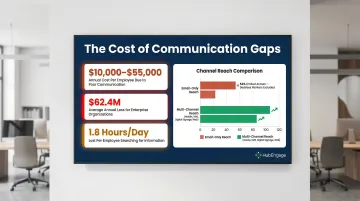
Multi-channel reach cuts this friction directly. Employees get critical updates through their preferred access point: a mobile app notification mid-shift, an SMS reminder, or a break room digital display.
KPIs impacted:
- Message open rates
- Employee reach percentage
- Time-to-information
- Communication acknowledgment rates
Highest impact for: Organizations with distributed, frontline, or multi-location workforces where a single channel misses large populations. Industries like healthcare, retail, hospitality, and manufacturing see the most immediate value.
Way 2: Recognition and Rewards Programs Powered by Gamification
Recognition is one of the most consistent drivers of engagement, but manual or infrequent recognition programs fail to create the habit and visibility needed to shift culture. SaaS platforms automate and scale recognition across peer-to-peer, manager-to-employee, and milestone-based moments, ensuring no achievement goes unnoticed.
Gamification makes participation intrinsically motivating, not just transactional. When platforms embed points, leaderboards, challenges, and achievement badges across the employee experience, recognition becomes a visible activity employees actively seek out.
Employees earn points for contributions, compete in challenges, and track their progress on leaderboards. The social visibility of that activity reinforces the behavior — which is exactly what sustains culture change over time.
HubEngage applies gamification across the entire employee experience — recognition, communications, surveys, and learning — rather than isolating it to a single feature. This platform-wide approach increases participation across multiple engagement programs at once, rather than moving the needle on just one.
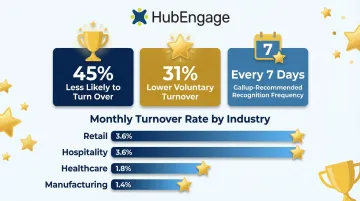
Why this matters: Employees who receive high-quality recognition are 45% less likely to have turned over after two years. Organizations implementing employee recognition programs experience 31% lower voluntary turnover. Frequency matters too: Gallup recommends recognition happen at least every seven days to maintain impact. Gamification makes that cadence sustainable without requiring constant manual effort from managers.
KPIs impacted:
- Recognition frequency per employee
- Employee participation rates in recognition programs
- Employee Net Promoter Score (eNPS)
- Voluntary turnover rates
Highest impact for: Industries with high turnover risk — retail (3.6% monthly quit rate), hospitality (3.6%), healthcare (1.8%), and manufacturing (1.4%) — where employees need daily reinforcement, not annual reviews.
Way 3: Real-Time Pulse Surveys and Data-Driven Decision Making
Annual engagement surveys arrive too late to prevent attrition. SaaS platforms enable HR leaders to run lightweight, frequent pulse surveys that surface sentiment trends before they become turnover signals, giving leaders a real-time read on teams, departments, and locations.
AI-powered analytics aggregate open-text responses and quantitative data into actionable insights, so leaders know exactly where to act. Platforms identify patterns — teams with declining sentiment, locations with rising dissatisfaction, or demographics at attrition risk — and surface these in real-time dashboards.
Pulse surveys cut the interval between feedback collection and implementation from one year to a few weeks or even days. 78% of organizations now conduct a listening event at least quarterly, up from 60% in 2022 — reflecting the broad shift toward continuous listening.
KPIs impacted:
- Employee Net Promoter Score (eNPS): scores between 10-30 are considered good; 50-70 are excellent
- Survey participation rate
- Time-to-insight (from survey close to actionable report)
- Manager response rate to feedback
Highest impact for: Organizations experiencing rapid growth, post-restructuring periods, or managing multiple locations or workforce segments where sentiment varies significantly by team or site.
Way 4: Accessible Learning and Development Embedded in Daily Workflow
When learning management is housed in a separate system employees rarely log into, development stalls. SaaS platforms that integrate learning within the same interface employees use for communications and recognition increase completion rates and tie development to visible career progress.
Mobile-first, self-serve learning — accessible during shift breaks, commutes, or off-peak hours — makes development possible for frontline workers who can't attend instructor-led sessions. Platforms deliver bite-sized modules directly to mobile devices, removing the need to schedule training around shifts or travel to a training center.
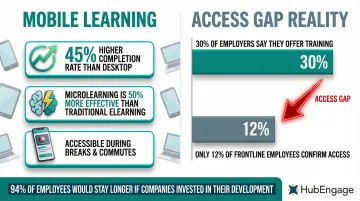
Why this matters: 94% of employees say they would stay at a company longer if it invested in their career development. Companies with strong learning cultures see 57% higher retention and 23% more internal mobility. Yet 30% of employers say they offer training outside the workplace, but only 12% of frontline employees confirm it's available to them — a stark access gap.
Mobile learning completion rates exceed desktop rates by 45%, and microlearning achieves completion rates 50% higher than traditional eLearning due to reduced time commitment.
KPIs impacted:
- Training completion rates
- Internal promotion rates
- Skills gap closure velocity
- Time-to-competency for new hires
Highest impact for: Organizations with compliance-heavy training requirements (healthcare, financial services) or a need to upskill large hourly workforces quickly (retail, manufacturing, hospitality).
Way 5: Support for Remote, Hybrid, and Frontline Workforces
The most disengaged employee populations are often the hardest to reach: remote workers who miss informal connection, and frontline workers who are offline or phone-only. SaaS platforms built with mobile-first design close this gap by ensuring a consistent digital employee experience regardless of location or work setting.
A single sign-on experience across mobile, web, and digital signage removes access barriers and creates equity in the employee experience. Everyone sees the same recognition feeds, announcements, and development resources, whether they work in a corporate office, a retail store, a hospital, or a plant floor.
Why this matters: Only 43% of deskless workers feel seen and appreciated at work, compared with 61% of desk-based employees. Among deskless workers, individual contributors show a 10% lower satisfaction score and 9% higher attrition risk than managers. With deskless workers comprising 70-80% of the global workforce — 2.7 billion people — this engagement gap represents a significant productivity and retention risk.
KPIs impacted:
- Engagement score disparity between deskless and desk-based employees
- Frontline turnover rates
- Mobile app adoption rates
- Communication reach across all employee segments
Highest impact for: Organizations with large frontline populations (healthcare, retail, hospitality, manufacturing) or hybrid workforces where remote employees risk feeling disconnected from company culture.
Way 6: Automation of Repetitive Processes That Free Up HR and Manager Time
SaaS platforms reduce the administrative burden of engagement programs by automating anniversary recognition, survey reminders, onboarding tasks, benefits notifications, and reporting. HR teams reclaim time previously lost to logistics and redirect it toward strategic work.
Automation also reduces errors and improves consistency across locations. Platforms handle birthdays, work anniversaries, and survey deadlines automatically — delivering notifications across all channels without manual tracking.
Why this matters: HR staff spend as much as 57% of their time on administrative tasks, leaving little bandwidth for strategic priorities. Human error rates in manual data entry range from 1-5%, and automated double-entry systems catch errors at a rate that makes manual visual checks look unreliable by comparison.
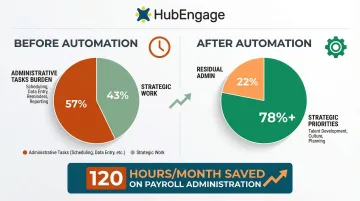
When organizations automate repetitive HR processes, they reclaim hundreds of hours annually. One PR and communications company saved 120 hours per month on payroll administration alone by shifting to an automated platform.
KPIs impacted:
- HR time spent on administrative tasks vs. strategic work
- Error rates in HR data and processes
- Time-to-completion for onboarding and offboarding
- Consistency of recognition and milestone celebrations across locations
Highest impact for: Organizations with limited HR staff relative to employee count, multi-location operations requiring consistent processes, or high-growth companies onboarding employees rapidly.
What Happens When SaaS Is Missing or Ignored
Fragmented or manual systems don't just create inconvenience — they create measurable damage. Without unified tools, organizations run into the same failure patterns repeatedly:
- Communication gaps leave some employees chronically uninformed while others receive duplicate messages
- Recognition only happens in person or during annual review cycles, leaving most of the workforce feeling unseen
- Survey data arrives too late to act on — by the time HR spots a problem, key employees have already resigned
Low employee engagement costs the global economy $8.8 trillion, or 9% of global GDP. Tool fragmentation is a direct accelerant of disengagement: employees spend 1.8 hours per day searching for information across disconnected tools, and 42% of workers report stress when trying to strike the right tone digitally.
The risk is highest for frontline and deskless workforces. Without accessible, mobile-first tools, these employees disengage quickly — and rarely return to full engagement. 53% of deskless workers feel burned out, and 43% are actively looking for new jobs, driving turnover rates well above the average in healthcare, retail, and manufacturing.
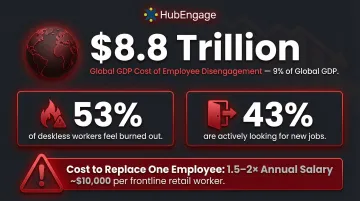
Replacing an employee costs 1.5 to 2 times their annual salary, with frontline retail employees costing nearly $10,000 each to replace. When fragmented systems prevent organizations from identifying and addressing engagement issues early, these costs multiply across the workforce.
How to Get the Most Value from a SaaS Engagement Platform
A SaaS platform delivers compounding returns only when adoption is driven intentionally. That means introducing it with clear communication about why it exists, what employees gain, and how participation is recognized — before anyone logs in for the first time.
Three practices separate organizations that see lasting results from those that watch adoption quietly stall.
Act on Feedback, Not Just Gather It
Organizations that run pulse surveys but never close the feedback loop — communicating what they heard and what they plan to do — see participation decay fast. Employees disengage when feedback feels performative. A SaaS platform surfaces the signals; management culture determines whether they lead anywhere.
Launch Core Features First, Then Expand
Activating every feature at launch overwhelms employees and stalls adoption. Organizations see stronger long-term uptake when they start with core channels — communications and recognition — then layer in surveys, learning, and gamification as habits form. HubEngage is built around modular hubs for exactly this reason, letting teams activate capabilities in phases based on readiness rather than forcing a full rollout from day one.
Establish Baseline Metrics Before You Launch
Without pre-launch benchmarks, it's impossible to measure what the platform actually changed. Capture baselines for:
- Employee participation rates
- eNPS scores
- Voluntary turnover rates
- Training completion rates
- Time saved on manual HR processes
Review these quarterly. When a metric stalls — say, training completion plateaus despite new content — that's the signal to investigate whether the delivery channel or the recognition loop needs adjustment, not just the content itself.
Conclusion
The six advantages of SaaS—communication reach, recognition and gamification, real-time feedback, embedded learning, frontline support, and process automation—don't operate in isolation. Unified in a single platform, each capability reinforces the others: a recognition moment surfaces in a communication feed, peer reactions drive social scores, and survey feedback shapes the next learning push.
Organizations that treat SaaS as an ongoing people strategy—reviewing data, acting on insights, and continuously expanding participation—will see sustained improvements in engagement, productivity, and retention. The platform provides the infrastructure; consistent follow-through turns that infrastructure into measurable culture change.
Frequently Asked Questions
What is a SaaS employee engagement platform?
A SaaS employee engagement platform is a cloud-based system that unifies communications, recognition, surveys, learning, and analytics into one platform accessible on any device. Unlike legacy or siloed on-premise tools, SaaS platforms deliver updates automatically and enable access from anywhere—critical for distributed and frontline workforces.
How does SaaS improve employee productivity?
SaaS reduces time lost to administrative tasks, information silos, and communication gaps. Employees gain faster access to what they need, and automation handles repetitive processes so teams can focus on meaningful work.
What features should a SaaS employee engagement platform include?
Look for these core capabilities:
- Multi-channel communications (mobile, web, email, SMS, digital signage)
- Peer and manager recognition programs
- Pulse surveys with built-in analytics
- Learning and development modules
- Mobile-first accessibility for frontline workers
The best platforms integrate all of this under one login, not as separate disconnected tools.
How does gamification in SaaS platforms boost employee engagement?
Gamification using points, challenges, leaderboards, and rewards converts passive participation into active habits. Employees engage more frequently when recognition, training completion, and survey responses feel rewarding rather than obligation-driven. Platforms that apply gamification across the entire experience, not just single features, see the highest participation rates.
Can SaaS platforms effectively support frontline or deskless employees?
Yes. Modern SaaS platforms with mobile-first design, SMS, and digital signage channels are specifically built to reach employees who don't sit at desks. These capabilities close the engagement gap between frontline and office-based workforces by ensuring consistent access to communications, recognition, and learning regardless of work location.
How do you measure the ROI of a SaaS employee engagement platform?
Start by establishing baselines, then track participation rates, eNPS scores, voluntary turnover, training completion, and time saved on manual HR tasks. Measure quarterly. Most organizations see ROI through lower turnover costs, productivity gains, and reduced software spending from tool consolidation.