Introduction
HR leaders face mounting pressure on three fronts: workforce health costs that climb 6% year over year, burnout affecting nearly half of all employees, and talent retention challenges that drain budgets through preventable turnover. Annual premiums for employer-sponsored family health coverage reached $26,993 in 2025, while 48% of employees globally report feeling burned out at work.
Employee wellness programs have emerged as a strategic response to these pressures — one with measurable business consequences when done right. Yet many organizations discover a gap between launching initiatives and seeing measurable business outcomes. Programs fail when treated as one-time launches rather than ongoing practices, when communication is inconsistent, or when participation remains low.
This article examines what the evidence actually says about wellness program impact on costs, performance, and people — with a focus on outcomes HR leaders can actually track and act on.
Key Takeaways
- Wellness programs cut employer healthcare costs and absenteeism through chronic disease screenings and lifestyle interventions
- Illness-related lost output costs $575 billion annually — well-designed wellness programs directly reduce that drag on productivity
- 63% of job seekers research benefits before applying, making wellness offerings a real recruiting factor
- Programs fail without consistent communication, strong participation, and regular iteration
- Success requires multi-channel communication, measurable KPIs, and continuous improvement based on employee feedback
What Are Employee Wellness Programs?
Employee wellness programs are structured workplace initiatives designed to support the physical, mental, and financial health of your workforce. Common program types include:
- Preventive health screenings and biometric checks
- Mental health resources such as EAPs and counseling access
- Fitness and activity challenges with participation incentives
- Financial literacy tools covering budgeting, debt, and retirement planning
- Stress management support through coaching or mindfulness programming
These initiatives operate through benefits packages, HR-led programming, digital platforms, or in-person sessions. They apply across industries, including organizations with large frontline or distributed workforces in healthcare, manufacturing, hospitality, and logistics.
Wellness programs are a means to a concrete outcome: healthier, more engaged, more productive employees. When designed well, they directly move the operational metrics that HR and leadership track — absenteeism, turnover, and productivity chief among them.
Key Benefits of Employee Wellness Programs
The advantages below are grounded in measurable operational outcomes tied to metrics HR and leadership teams monitor consistently. Results vary based on program design, participation rates, and how consistently programs are communicated and reinforced across the organization.
Benefit 1: Lower Healthcare Costs and Reduced Absenteeism
One of the most direct financial benefits is reduced employer healthcare spending—specifically costs tied to preventable chronic conditions such as diabetes, cardiovascular disease, and hypertension.
Wellness programs identify health risks early through biometric screenings and connect employees to lifestyle change programs that address diet, exercise, and stress management. Organizations with lab-integrated wellness programs routinely surface chronic disease risks that would otherwise go undetected until they become expensive claims.
The financial case is well-documented. While early meta-analyses suggested medical costs could fall by $3.27 for every dollar spent on wellness programs, more recent rigorous studies show the real value is in long-term chronic disease management and absence reduction. The CDC estimates that obesity costs U.S. employers $11.2 billion per year in missed work, while hypertension adds another $10.3 billion annually.
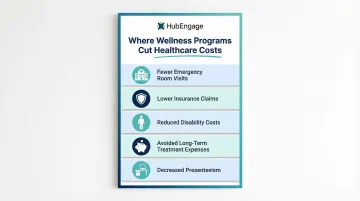
Chronic disease prevention translates to hard cost savings:
- Fewer emergency room visits
- Lower insurance claims
- Reduced disability costs
- Avoided long-term treatment expenses
- Decreased presenteeism (employees working while sick)
KPIs this affects: per-employee healthcare claims cost, absenteeism rate, disability claims frequency, presenteeism index, and total healthcare spend as a percentage of payroll.
This advantage is highest for organizations with large workforces in physical or high-stress roles—manufacturing, healthcare, hospitality, and logistics. Bureau of Labor Statistics data shows absence rates are highest in healthcare support (3.8%), service occupations (3.7%), and retail trade (3.4%).
Benefit 2: Higher Employee Productivity and Engagement
Employees who participate in wellness programs and maintain healthier habits are more productive. The secondary gain is harder to see on a spreadsheet but equally real: wellness programs build peer connections and a sense of belonging that reduce cognitive fatigue and improve day-to-day focus.
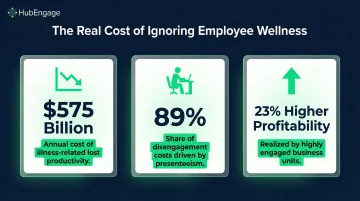
The productivity cost of ignoring this is steep. The Integrated Benefits Institute calculates that illness-related lost productivity costs employers $575 billion annually. For every dollar spent on healthcare benefits, another $0.61 disappears to absence, disability, and reduced output. Presenteeism—working while sick—accounts for up to 89% of disengagement costs, meaning most losses never show up in absenteeism reports.
Engagement follows from that investment. Employees who feel their employer cares about their health report higher job satisfaction—and Gallup's research shows that highly engaged business units realize 23% higher profitability and 14-18% higher productivity compared to disengaged ones.
KPIs this affects: employee engagement scores, productivity per employee, presenteeism rate, job satisfaction index, team collaboration metrics, and voluntary turnover rate.
This benefit is most pronounced in burnout-prone environments—call centers, healthcare settings, retail frontlines, and remote/hybrid teams—where energy levels directly shape service quality. In healthcare, 31% of nurses report they may leave direct patient care within the year. In contact centers, annual turnover has climbed to 31.2%.
Benefit 3: Stronger Talent Attraction, Retention, and Workplace Culture
Wellness programs have moved from "nice to have" to a hiring expectation. Candidates check for them, and current employees factor their existence into decisions about whether to stay.
The data backs this up. A Glassdoor survey found that 63% of job seekers look for benefits information in job ads, and 48% said attractive benefits would make them more likely to apply. Mercer research found that employers using the most well-being best practices had turnover rates 11 percentage points lower than those doing the least. Even employees who never use wellness benefits report higher satisfaction simply knowing they exist.
Beyond retention numbers, offering wellness benefits signals something about organizational values—that employees are treated as people, not headcount. That signal builds psychological safety and team cohesion over time.
The financial stakes of getting this wrong are high. Replacing employees costs 50-200% of annual salary across most roles. For bedside nurses, replacement runs $61,110 per hire. For call center agents, $10,000–$20,000. Gallup reports that 42% of employees who voluntarily left said their manager or organization could have prevented their departure.
KPIs this affects: voluntary turnover rate, time-to-fill open roles, offer acceptance rate, Employee Net Promoter Score (eNPS), and employer brand perception scores.
This benefit carries the most weight in competitive hiring markets and industries with chronic staffing shortages—healthcare, hospitality, manufacturing—where benefits differentiation is a tangible recruiting lever.
What Happens When Wellness Programs Are Neglected or Underfunded
Ignoring employee wellness sets off a chain of costs that build on each other:
- Rising healthcare claims as untreated chronic conditions worsen
- Increased absenteeism from stress, illness, and disengagement
- Burnout-driven attrition that accelerates recruitment spend
- Lost productivity from presenteeism — employees who show up but can't perform
A poorly communicated or underfunded wellness program is often worse than no program at all. It signals performative care, erodes trust, and keeps participation low enough that any ROI is impossible to achieve.
The cost of inaction is already showing up in premium data. KFF research found that 30% of large firms say chronic disease prevalence contributed "a great deal" to higher premiums, with another 39% saying it contributed "somewhat."
Those premiums are only part of the picture. A 2025 study estimates that employee disengagement and burnout cost employers between $3,999 and $20,683 per employee annually — representing 0.2 to 2.9 times the average cost of health insurance.
Organizations without effective wellness initiatives also lose ground in hiring. For frontline and distributed workforces — where candidates compare offers on benefits, not just base pay — a weak wellness offering contributes directly to higher offer rejection rates and faster post-hire turnover.
How to Maximize the Impact of Your Employee Wellness Program
The most effective wellness programs share three traits: they address multiple dimensions of well-being (physical, mental, financial, social), they are consistently communicated across the workforce, and they use data and feedback to continuously improve.
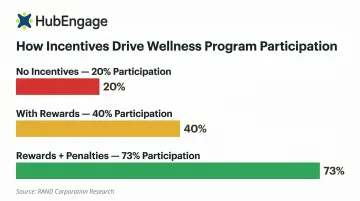
Participation drives ROI — and a wellness program employees can't find or access delivers nothing. RAND Corporation research found that median participation rates were 20% without incentives, 40% with rewards, and 73% when organizations combined rewards with penalties.
For organizations with large frontline, deskless, or distributed teams, reaching every employee through their preferred channel is essential. Platforms like HubEngage address this by delivering wellness communications across mobile apps, digital signage, SMS, and email — with gamification features that drive participation in wellness challenges and recognition programs.
One-click multi-channel distribution automatically formats content for each channel, so the same message reaches a warehouse worker via SMS and an office employee via mobile app without extra effort.
Best-practice frameworks:
The CDC Worksite Health ScoreCard emphasizes a comprehensive approach that includes:
- Leadership support with senior leaders acting as champions
- Strategic communication across multiple channels
- Multi-component design combining programs, policies, and environmental supports
- Ongoing evaluation using multiple data sources—employee health risks, medical claims, satisfaction surveys, and organizational climate assessments
Measure outcomes regularly using KPIs such as absenteeism rate, engagement scores, healthcare claims trends, and participation rates. Programs should evolve based on what's working rather than being treated as static annual initiatives.
Conclusion
Employee wellness programs deliver compounding business value when designed with intention—cutting healthcare costs, sharpening performance, and building a culture that attracts and keeps strong talent.
Execution determines outcomes. Programs that sustain impact share three traits:
- Consistent communication that keeps wellness visible year-round, not just at open enrollment
- Broad participation driven by accessible, inclusive offerings across all employee groups
- Regular measurement that ties program activity to healthcare costs, productivity, and retention data
Organizations that treat wellness as a strategic priority see real returns. Those that don't tend to find their programs quietly ignored.
Frequently Asked Questions
What are the benefits of employee wellness programs?
Employee wellness programs reduce healthcare costs, lower absenteeism, improve productivity, and strengthen talent retention. Effective programs deliver measurable ROI through reduced insurance claims, better engagement scores, and decreased voluntary turnover.
What are the key components of an employee wellness program?
Core components span multiple dimensions of well-being:
- Physical health screenings and fitness initiatives
- Mental health resources, including counseling and EAPs
- Financial wellness tools and literacy workshops
- Stress management programs such as mindfulness sessions
- Social connection opportunities that build workplace community
What are examples of wellness programs in the workplace?
Common examples include:
- Biometric screenings and health risk assessments
- Employee Assistance Programs (EAPs) with confidential counseling
- Fitness challenges with gamification and rewards
- Mental health days and flexible time off
- Nutrition coaching, financial literacy sessions, and mindfulness programs
What are best practices for workplace wellness programs?
Best practices include securing visible leadership buy-in and champion support, ensuring programs are inclusive and accessible to all employee types including frontline and deskless workers, measuring outcomes against defined KPIs, communicating programs through multiple channels (mobile, email, SMS, digital signage), offering incentives to drive participation, and continuously improving based on employee feedback and utilization data.
How can employers engage employees in wellness programs?
Participation improves when programs are promoted through channels employees already use daily, incentives are tied to participation milestones, and wellness activities address employees' actual health challenges. Gamification elements like points, badges, and leaderboards add friendly competition — and for frontline workers, mobile-first access is what makes that engagement possible at all.
How do you measure the ROI of an employee wellness program?
ROI is measured through reductions in healthcare claims, absenteeism, and voluntary turnover alongside gains in productivity metrics. Softer indicators — satisfaction scores, engagement survey results, and participation rates — round out the picture, capturing cultural impact that hard numbers alone can't show.