Introduction
Employee disengagement has reached crisis proportions. In 2024, global engagement fell to just 21%, down from 23% the previous year—a decline that costs the global economy $8.9 trillion annually, roughly 9% of global GDP. In the United States, engagement has sunk to its lowest level in a decade, with only 31% of employees engaged.
Gamification—applying game mechanics like points, badges, leaderboards, and challenges to everyday work—is one of the most proven approaches for reversing this trend. When designed thoughtfully, it taps into fundamental human drives for recognition, mastery, and social connection.
The result: measurably higher motivation for frontline, remote, and distributed teams alike.
This article covers 11 practical gamification ideas you can implement immediately, plus guidance on designing programs that lift participation rates, reduce attrition, and produce ROI your leadership team will notice.
Key Takeaways
- Gamification applies game mechanics (points, badges, leaderboards, challenges) to boost motivation and performance at work
- 89% of employees say gamification makes them feel more productive, and 88% report feeling happier
- The 11 strategies below cover recognition, training, wellness, and culture—built for in-office, remote, and frontline teams alike
- Effective gamification pairs extrinsic rewards with intrinsic motivators—purpose, autonomy, and a genuine sense of belonging
- Platforms like HubEngage make gamification scalable and trackable across your entire workforce
What Is Gamification in Employee Engagement?
Gamification integrates game elements—points, levels, leaderboards, badges, and rewards—into non-game work contexts like training, internal communications, and performance tracking. Rather than turning work into a video game, it makes progress visible, effort recognized, and participation rewarding.
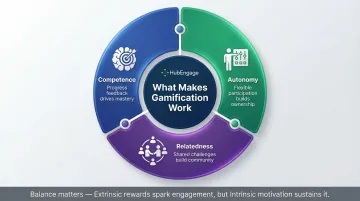
The psychology behind gamification draws from Self-Determination Theory, which identifies three core human needs that game mechanics are uniquely positioned to satisfy:
- Competence — clear progress feedback reinforces the drive for mastery
- Autonomy — flexible participation options give employees control over how they engage
- Relatedness — shared challenges and team-based activities build genuine community
The most effective programs balance extrinsic motivation (tangible rewards like gift cards) with intrinsic motivation (the inherent satisfaction of achievement and growth). Research shows that overreliance on external rewards can erode intrinsic motivation over time. SHRM warns that poorly designed gamification focused solely on rankings can undermine trust and morale. How you design the system—and whether it fits your culture—ultimately determines whether gamification energizes your workforce or backfires.
11 Brilliant Gamification Ideas for Employee Engagement
Not all engagement tactics hold attention for long. These 11 gamification ideas work because they tap into how people actually stay motivated — through progress, recognition, competition, and surprise.
Leaderboards and Friendly Competition
Visible performance rankings create healthy rivalry and validate effort. Leaderboards work best when they celebrate improvement over time, not just absolute top performers. Ranking only the highest achievers can demoralize the broader team and create unhealthy competition.
Consider multiple leaderboard categories: most improved, most consistent, best team player, or highest participation rate. This approach recognizes different types of contribution and gives more employees a chance to be celebrated. Rotate leaderboard themes monthly to keep participation fresh and inclusive.
Badges and Achievement Unlocks
Digital or physical badges make progress tangible. When employees can see their growth — a "30-Day Streak" badge, a "Peer Recognition Champion" badge, a "Safety Excellence" badge — it reinforces continued effort and creates visible status within the organization.
Badges tap into the psychology of collection and completion. Employees who earn three out of five badges in a series are driven to finish the set. For this to work, design badge systems with:
- Clear, published criteria for each badge
- Varied difficulty levels (easy wins alongside stretch goals)
- Visible display options on profiles or digital recognition walls
Points Systems and Redeemable Rewards
Employees earn points for completing tasks, hitting goals, or participating in programs, then redeem them for meaningful rewards. Variety in redemption options—gift cards, experiences, extra time off, charitable donations—drives broader participation because employees choose rewards that matter to them personally.
Recognition through points systems delivers measurable retention benefits. Longitudinal research tracking 3,500 employees found that well-recognized employees are 45% less likely to leave within two years. Points systems formalize recognition, ensuring it happens consistently rather than sporadically.
HubEngage integrates with Tango Card to offer domestic and global e-gift cards, allowing employees to redeem earned points for rewards that fit their preferences and lifestyles.
Team Challenges and Collaborative Competitions
Team-based challenges—sales blitzes, innovation sprints, customer feedback competitions—build camaraderie while driving business outcomes. Team formats reduce the pressure of individual rankings and work especially well for distributed or remote teams who need structured opportunities to collaborate.
Examples include:
- Cross-functional teams competing to generate the most process improvement ideas
- Department challenges to achieve the highest training completion rate
- Location-based competitions for customer satisfaction scores
- Charity fundraising challenges where teams compete to raise donations
Team challenges create shared goals and celebrate collective achievement, strengthening relationships across organizational boundaries.
Gamified Training Quests
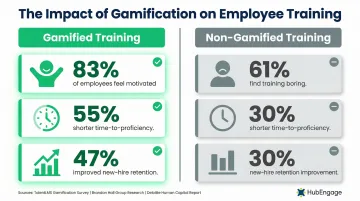
Transforming training modules into "quests" measurably improves knowledge retention and participation. 83% of employees who receive gamified training feel motivated, compared to 61% who find non-gamified training boring and unproductive.
Structure training as a journey with these elements:
- Unlockable levels tied to module completion
- Points awarded for quiz performance
- Badges for finishing each stage
- Narrative framing — compliance training becomes "missions," product knowledge becomes "exploration paths"
Research shows that 55% of organizations using gamification shortened time-to-proficiency compared to 30% without gamification, and 47% improved new-hire retention versus 30% of non-gamified programs.
HubEngage embeds gamification directly into learning activities through Micro-Learning Modules, enabling HR teams to track completion and engagement in one unified platform.
Recognition Walls and Peer Appreciation
Virtual or physical recognition walls allow employees to celebrate each other's wins publicly. Peer-to-peer recognition is particularly powerful: research shows it is 35.7% more likely to positively impact financial results than manager-only recognition. When recognition is integrated across the employee experience, employees show 26 times higher odds of planning to stay another year.
Recognition walls work across channels—mobile apps, intranet platforms, digital signage in break rooms, and email digests. Make recognition easy: simple templates, one-click submissions, and automated prompts ("Recognize a colleague who helped you this week") drive higher participation.
Mystery Rewards and Surprise Incentives
The "surprise and delight" mechanic keeps motivation high because employees know any strong effort could be recognized unpredictably. Spot bonuses, VIP parking, lunch with leadership, or surprise half-days off create excitement that predictable reward cycles cannot match.
Unpredictable rewards trigger stronger dopamine responses than expected ones. Employees don't game the system because they can't predict when rewards will come—they simply maintain consistent high performance. Balance mystery rewards with predictable recognition to satisfy both novelty-seeking and security-oriented employees.
Feedback Games and Interactive Reviews
Gamification reduces anxiety around performance feedback. Only 14% of employees strongly agree their performance reviews inspire them to improve, and nearly 60% find annual reviews stressful.
Interactive formats make feedback safer and more engaging:
- Anonymous visual feedback rounds where teams vote on priorities using interactive polls
- Peer feedback bingo where employees collect feedback from multiple colleagues
- 360-degree feedback presented as "skill radar charts" that employees unlock progressively
- Continuous micro-feedback through quick pulse surveys with gamified participation tracking
These formats shift feedback from a dreaded annual event to an ongoing, low-stakes dialogue.
Wellness Challenges
Team-based wellness gamification—step-count competitions, nutrition challenges, mindfulness streaks—delivers dual impact: improved physical health and stronger team cohesion. Wellness challenges work especially well for frontline and deskless workers who may lack access to traditional wellness perks like on-site gyms.
A global logistics provider with 45,000+ employees implemented a gamified wellness app, allowing participating employees to save up to 35% on benefits premiums based on engagement. Manufacturing company Emerson saw a 12% increase in well-being scores after launching comprehensive wellness initiatives driven by employee feedback.
Structure wellness challenges as team competitions with collective milestones. Celebrate progress publicly through leaderboards and recognition walls to create social accountability and encouragement.
Storytelling and Culture Challenges
Ask employees to share brief stories—a workplace win, a lesson learned, a photo of a project milestone—to build psychological safety and deepen cultural alignment. Storytelling challenges humanize colleagues and reinforce shared values without feeling forced.
Examples include:
- "Customer Hero" stories where employees share moments they went above and beyond
- "Failure Friday" posts where teams share lessons from mistakes
- Photo challenges capturing company values in action
- Video testimonials about why employees joined or what they love about their role
Gamify storytelling by awarding points for submissions, running themed monthly contests, spotlighting top stories in company newsletters, and recognizing contributors publicly on recognition walls. Organizations that do this consistently report stronger cultural alignment and higher voluntary participation in internal communications.
Company Trivia and Knowledge Competitions
Trivia is a simple, proven format for building company knowledge and team connection. Categories can cover company history, product knowledge, team milestones, industry news, or fun facts about colleagues.
Host trivia through:
- Live virtual events for remote teams
- Mobile app quizzes employees complete at their own pace
- Digital signage displays in common areas with rotating questions
- Team-based competitions where departments compete for the highest score
Trivia takes minutes to participate in, generates conversation, and builds knowledge without the pressure of formal training — which is exactly why participation rates tend to be high even among employees who disengage from other programs.
How to Implement Gamification That Actually Works
The most common mistake is treating gamification as a "bolt-on"—adding points or badges without aligning them to real business goals or employee motivations. Gamification must be designed around what employees actually care about, not just what's convenient for HR to track.
Start with a specific challenge: Low training completion? Poor communication open rates? Weak peer recognition? Choose mechanics that directly address that problem. If training completion is low, gamified learning quests with progress tracking and rewards make sense. If recognition is lacking, peer appreciation walls with points and badges drive participation.
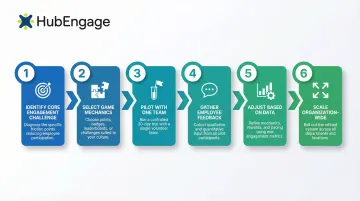
Follow a practical implementation checklist:
- Identify your core engagement challenge
- Select game mechanics that address it
- Pilot with one team or department
- Gather employee feedback early and often
- Adjust based on participation data
- Scale across the organization
Co-creating programs with employee input dramatically improves adoption. To get it right from the start, ask employees directly:
- What rewards feel meaningful to them
- Which recognition formats feel authentic vs. performative
- What challenges would genuinely motivate participation
Gamification built without that input rarely sticks. The same applies to access: frontline and deskless workers need delivery through SMS, mobile apps, and digital displays—not just intranet tools that desk employees rely on. When everyone can participate regardless of location or device, adoption scales naturally.
Measuring the ROI of Your Gamification Program
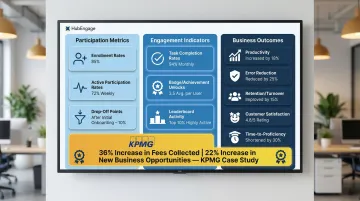
Track metrics in three categories to demonstrate value:
Participation Metrics:
- Enrollment rates in gamified programs
- Active participation rates (daily/weekly/monthly)
- Drop-off points where engagement declines
Engagement Indicators:
- Task completion rates (training, surveys, recognition)
- Badge collection and achievement unlocks
- Leaderboard activity and competition intensity
Business Outcomes:
- Productivity improvements
- Error reduction rates
- Retention and turnover rates
- Customer satisfaction scores
- Training time-to-proficiency
Once you've identified which metrics to track, connect them to financial impact by calculating downstream effects. If gamification boosts training completion by 25%, measure how that shifts error rates, onboarding time, or sales performance. A Harvard/Columbia study of KPMG's gamified training platform found that participating offices saw a 36% increase in fees collected and a 22% increase in new business opportunities.
Those numbers only hold if the program keeps moving. Rotate challenges quarterly, refresh reward options, and adjust mechanics based on actual participation data — not assumptions. Programs that go stagnant lose employee buy-in within months, so schedule regular reviews as a standing calendar item.
Conclusion
When gamification is designed with intention and tied to what employees actually value, it does something straightforward but powerful: it makes progress visible, effort recognized, and contribution meaningful. That shift—from work feeling invisible to work feeling purposeful—is what drives real engagement.
HubEngage embeds game mechanics across the entire employee experience—recognition, communications, surveys, learning, and social engagement—rather than bolting gamification onto a single feature. Points, badges, and leaderboards work platform-wide, giving HR and communications leaders a single place to launch, track, and scale these ideas without adding another tool to the stack.
Ready to put these ideas into practice? See how HubEngage works for organizations like yours.
Frequently Asked Questions
What is gamification in employee engagement?
Gamification brings game mechanics—points, badges, leaderboards, and challenges—into workplace activities like training, recognition, and communications. It makes progress visible, rewards effort, and taps into people's natural drive for achievement and connection.
What are the 4 types of employee engagement?
The four dimensions are cognitive (mental investment), emotional (organizational connection), physical (energy and effort), and social (relationships and belonging). Gamification supports all four — skill challenges build cognitive engagement, recognition drives emotional connection, wellness competitions boost physical participation, and team challenges strengthen social bonds.
Can gamification work for remote and frontline employees?
Yes. Gamification is highly effective for distributed and deskless teams when delivered through mobile-first channels like apps, SMS, and digital displays. These channels ensure all employees can participate regardless of location or device access, making gamification inclusive rather than limited to desk-based workers.
What are the biggest mistakes to avoid when implementing gamification at work?
The most common pitfalls are:
- Relying solely on extrinsic rewards while ignoring intrinsic motivation
- Skipping employee input during program design
- Creating competition that erodes collaboration
- Letting mechanics go stale without refreshing them
Co-create with employees and optimize continuously based on participation data.
How do you measure whether your gamification program is working?
Track participation rates, task completion rates, and behavior changes (increased peer recognition, higher training completion). Compare these against pre-gamification baselines. Measure business outcomes like retention and productivity over 3-6 months to assess long-term impact and ROI.
How long does it take to see results from workplace gamification?
Participation and engagement indicators often improve within weeks of launch as employees respond to new mechanics and rewards. Measurable business outcomes — retention improvements, productivity gains, error reduction — typically emerge over 3-6 months with consistent program management.