Introduction
Corporate wellness spending has become a standard HR budget line item, with the global market reaching USD 53.53 billion in 2024 and projected to grow to USD 63.90 billion by 2030. Yet one question HR leaders consistently ask is straightforward: how much does a corporate wellness program actually cost?
The answer is frustratingly broad: anywhere from $150 to over $1,200 per employee per year. This wide range reflects differences in program scope, company size, customization level, and vendor pricing, not program quality alone. A $300 program may cover the basics for a lean workforce; a $1,000 program typically adds clinical support, advanced analytics, and broader feature sets.
This guide breaks down the pricing tiers, the full cost components beyond the vendor fee, the factors that push costs up or down, and how to build a realistic wellness budget that matches your organization's actual needs.
Key Takeaways
- Typical cost range is $150–$1,200 per employee per year
- Key cost drivers: company size, program scope, customization, incentives, vendor pricing models
- Entry-level programs offer basic digital resources; premium tiers add biometric screenings, mental health support, and personalized plans
- The best-fit cost aligns with your workforce's needs and drives consistent participation
- Low participation inflates real costs: cost per engaged employee matters more than the headline price
How Much Do Corporate Wellness Programs Cost Per Employee?
There is no standard fixed price for a corporate wellness program. The per-employee cost reflects a combination of platform access, services, incentives, and administration. What one company pays may look substantially different from another's spend—even for similar headcount.
The key risk of misunderstanding this range: companies either underbudget and get a program employees ignore, or overbuy features their workforce never uses. Both outcomes waste money.
Here's how the cost tiers break down — and what you actually get at each level.
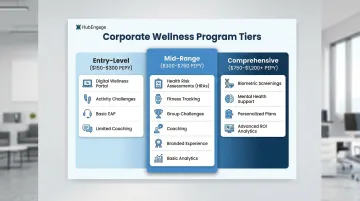
Entry-Level Programs ($150–$300 per employee per year)
Typical inclusions at this tier:
- Basic digital wellness portal with educational health content
- Simple step or activity challenges
- Employee Assistance Program (EAP) at the lower end of this tier
- Limited or no personalized coaching
This tier suits small businesses or organizations piloting their first wellness initiative with limited HR bandwidth and a need to control per-employee spend.
Mid-Range Programs ($300–$750 per employee per year)
Typical inclusions at this tier:
- Health risk assessments (HRAs)
- Fitness tracking integration
- Group wellness challenges
- Some coaching or workshop access
- Branded digital experience
- Basic analytics for HR
Mid-sized companies choose this range when they want to move beyond a checkbox wellness program and genuinely improve workforce health habits without a major budget commitment.
Comprehensive Programs ($750–$1,200+ per employee per year)
At this level, programs typically include:
- Biometric screenings, mental health support, and personalized wellness plans
- Fitness coaching and financial wellness modules
- Team competitions and deep integration with existing benefits plans
- Advanced analytics and ROI reporting
Larger enterprises with complex workforces, high healthcare claims, or industries where retention and productivity depend on workforce wellbeing — healthcare, manufacturing, financial services — tend to operate here.
Industry Benchmark: The frequently cited $742 per employee figure originates from a 2017 UnitedHealthcare survey measuring financial incentives alone — not total program operating costs. More recent data shows employers investing an average of $275 per employee in well-being budgets, with comprehensive programs that include incentives pushing total spend well above $1,000 per employee.
Key Factors That Affect Corporate Wellness Program Costs
Several variables — company size, program scope, customization level, and vendor structure — determine what you'll actually pay. Understanding each one helps HR leaders budget accurately from the start.
Company Size and Employee Count
Larger organizations benefit from volume pricing—per-employee rates generally decrease as headcount increases. Smaller companies often pay more per person for comparable features. A 50-employee organization may pay $400 per employee for a program that costs a 5,000-employee enterprise just $200 per employee.
Program Scope and Features
The breadth of services is the single biggest cost lever. A program covering only physical fitness costs a fraction of one that adds mental health support, financial wellness, biometric screenings, and coaching.
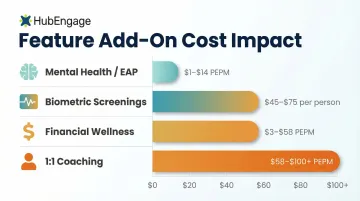
Feature Add-On Cost Impact:
- Mental Health/EAP: Basic EAPs run $1–$4 PEPM; high-touch versions with psychiatry networks reach $10–$14 PEPM
- Biometric Screenings: On-site screening events typically cost $45–$75 per person
- Financial Wellness Modules: Adding financial wellness pushes base digital costs ($3–$5 PEPM) into mid-range tiers ($12–$58 PEPM)
- 1:1 Coaching: Personalized coaching and advanced features move programs into the $58–$100+ PEPM range
Level of Customization
Off-the-shelf wellness platforms cost less and deploy faster but often deliver lower engagement. Custom-branded, tailored programs cost more but align better with workforce demographics and culture. Custom workshops, personalized plans, and employer-branded communications add meaningful cost but can significantly improve participation rates.
Participation Incentives
Incentivizing employees through gift cards, premium discounts, HSA contributions, or additional PTO can add $100–$300+ per participating employee annually. The tradeoff is worth examining: Research from RAND Corporation found that incentives boost participation by about 20 percentage points. In 2025, employers offered a median of $600 in well-being incentives per employee.
Vendor Pricing Models
Three main vendor pricing structures exist:
- Per-Employee-Per-Month (PEPM) flat rates: Predictable budgeting but may not reflect actual usage
- À la carte feature pricing: Pay only for what you use, but costs can balloon if not managed carefully
- All-inclusive annual packages: Simplifies budgeting but may include features you don't need
PEPM models make it easier to forecast annual spend, while à la carte models require careful governance to avoid scope creep.
Integration with Existing Health Plans
Programs integrated with group health insurance or HSA/FSA accounts can unlock premium discounts and reduce administrative overhead. That said, integration adds setup and ongoing management costs — budget for these upfront rather than treating them as an afterthought.
Full Cost Breakdown: Beyond the Per-Employee License Fee
The per-employee price quoted by vendors is rarely the true total cost. HR leaders who budget only for the platform fee often encounter shortfalls mid-year. Each of the following components adds to your actual spend:
| Cost Component | Type | Description |
|---|---|---|
| Platform/License Fee | Recurring (annual or monthly) | Base per-employee charge for platform access and core features |
| Setup & Implementation Fee | One-time | Onboarding, branding, integrations, and initial configuration |
| Incentive & Rewards Budget | Recurring | Based on participation targets; typically $100–$600+ per participating employee |
| Internal Staff Time | Recurring | HR hours spent promoting, administering, and reporting on the program |
| Content & Program Updates | Periodic | Workshops, guest speakers, refreshed challenge content, seasonal campaigns |
Use this checklist to build a complete budget before committing to a vendor:
- Multiply the platform fee by your total employee count for the base cost
- Add one-time setup/implementation fee
- Estimate participation rate (20–60%) and multiply by per-participant incentive value
- Set aside 2–5 HR hours per week for ongoing administration and promotion
- Reserve 10–15% of total budget for content updates and program refreshes
Low-Cost vs. High-Cost Wellness Programs: What's the Real Difference?
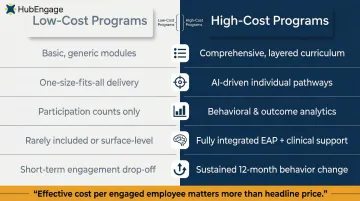
The gap between a $150/employee program and a $1,000/employee program goes well beyond features. Participation rates, employee experience, and measurable outcomes all shift significantly as you move up the investment curve.
| Dimension | Low-Cost Programs | High-Cost Programs |
|---|---|---|
| Feature Depth | Basic access to educational content | Holistic support: mental health, fitness, financial wellness, biometrics |
| Personalization | Generic plans and challenges | Tailored plans based on individual health data and goals |
| Analytics Capability | Limited reporting | Advanced ROI reporting with healthcare cost tracking |
| Mental Health Inclusion | Often absent or minimal EAP | Core component with counseling, therapy, and psychiatric support |
| Long-Term Retention Impact | Minimal measurable impact | Documented improvements in retention and productivity |
The Effective Cost Per Engaged Employee
The cheapest program isn't always the smartest financial decision. A $200/employee program where only 20% of employees participate carries an effective cost of $1,000 per active user — five times the headline price.
A $500/employee program with 60% participation, by contrast, delivers an effective cost of $833 per engaged employee with meaningfully better outcomes. When evaluating wellness programs, engagement rate matters as much as the per-employee price tag.
How to Estimate the Right Wellness Budget for Your Organization
The goal isn't to spend as little as possible—it's to match your investment to your workforce's actual health priorities and engagement patterns. Start with a simple needs assessment before vendor selection.
1. Number of Employees and Expected Participation Rate
- Total employee count: _____
- Industry average participation: 20–30% (without incentives), 40–60% (with incentives)
- Your estimated participation rate: _____%
2. Program Tier and Desired Features
- Entry-level ($150–$300 PEPY): Basic digital platform
- Mid-range ($300–$750 PEPY): HRAs, fitness tracking, group challenges
- Comprehensive ($750–$1,200+ PEPY): Biometrics, mental health, personalized coaching
3. Incentive Strategy and Estimated Per-Participant Incentive Value
- Median employer incentive: $600 per employee
- Your planned incentive value: $_____
- Total incentive budget: (Estimated participants × Incentive value)
4. Internal Admin Time Cost Estimate
- HR hours per week: _____ hours
- Hourly cost: $_____
- Annual admin cost: (Hours × 52 weeks × Hourly cost)
5. Integration or Setup Fees
- One-time setup fee: $_____
- Annual integration/maintenance fees: $_____
The Participation Rate Problem
If only 20–30% of employees engage with a program, the effective cost per active user is 3–5x the stated per-employee price. Factor this into vendor comparisons and prioritize programs with strong onboarding and communication support.
How HubEngage Supports Wellness Program Adoption
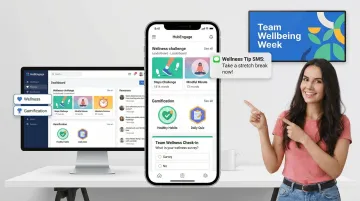
Platforms like HubEngage combine multi-channel communications, gamification, and engagement tools to support wellness program rollout across distributed and frontline teams. Consolidating wellness communications, recognition, surveys, and social engagement into one platform improves participation without adding separate tools.
HubEngage's mobile-first design, SMS capabilities, digital signage integration, and platform-wide gamification help organizations get more value from their per-employee wellness spend by reaching employees wherever they work.
What Most Employers Get Wrong About Wellness Program Costs
Focusing Only on the Vendor's Per-Employee Price Tag
Many organizations ignore incentive budgets, admin hours, setup fees, and the ongoing cost of keeping the program fresh and relevant. The headline price is just the starting point.
Treating Low Participation as Acceptable
According to industry research, average participation in wellbeing programs globally hovers at 20–30%. Many organizations pay for a wellness program that reaches only a fraction of their workforce, which dramatically inflates the real cost per engaged employee. Among large firms offering wellness programs in 2025, 46% offer incentives to boost participation—yet even with incentives, many programs struggle to break 40% engagement.
Choosing the Cheapest Option Without Evaluating Behavior Change Potential
Low-cost programs with poor UX, weak communications, and no gamification frequently see sub-20% engagement, making the ROI case impossible to build. A $150 program that no one uses delivers zero value.
Skipping ROI Measurement Entirely
Wellness programs that aren't tracked can't prove their value at budget renewal, making them vulnerable to cuts. The right vendor should provide analytics that connect participation to healthcare costs, absenteeism, and productivity metrics.
The classic claim that wellness programs return $3.27 per $1 spent comes from a 2010 meta-analysis. More recent randomized controlled trials found no significant differences in clinical health measures, healthcare spending, or absenteeism over three years.
Don't expect substantial short-term savings from reduced medical claims. Well-designed, properly measured programs do improve self-reported health behaviors, employee satisfaction, and retention — and those outcomes are worth tracking.
Frequently Asked Questions
How much does a wellness program cost per employee?
Most corporate wellness programs cost between $150 and $1,200 per employee per year. The range reflects differences in program scope, features, and company size. Entry-level programs with basic digital access sit at the lower end, while comprehensive programs with biometric screenings, mental health support, and personalized coaching reach the higher end.
How much do companies spend on employee wellness?
It varies widely, but the scale is significant: the global corporate wellness market reached USD 53.53 billion in 2024, and 83% of large firms offered wellness programs in 2025. Large enterprises may spend millions annually, though per-employee costs often drop at scale due to volume pricing.
How much is a wellness stipend?
Wellness stipends—employer-funded allowances employees can use for gym memberships, apps, or other wellness expenses—typically range from $500 to $1,500 per employee per year. Lifestyle Spending Accounts (LSAs), which often include wellness, averaged $1,200 per employee in 2025, with 64% of employers using all-inclusive LSAs rather than separate wellness stipends.
What is an employee wellness fee?
A "wellness fee" usually refers to the per-employee charge a wellness vendor bills an employer, commonly structured as a per-employee-per-month (PEPM) rate. This fee covers platform access and core program features but typically does not include incentives, biometric screenings, or administration costs, which are billed separately.
What is the average benefits cost per employee?
As of December 2025, benefit costs averaged $13.79 per hour worked (29.9% of total compensation), and average employer-sponsored health insurance reached $17,496 per employee. Wellness programs are a small fraction of that total but consistently deliver outsized ROI.
How do you calculate the cost of benefits for an employee?
Add up all benefit-related costs—health insurance premiums, retirement contributions, wellness programs, PTO value, and other perks—then divide by total employee count. For an accurate picture, include both direct vendor costs and internal admin time.