Introduction
Organizations spend roughly $19 billion annually on workplace wellness programs in the U.S. alone, yet many HR leaders struggle to justify these investments to the C-suite. The challenge? Returns often feel intangible or difficult to quantify beyond reduced healthcare premiums.
Wellness program ROI extends far beyond medical cost savings — it touches productivity, retention, workplace culture, and long-term business performance in measurable ways. One critical caveat: recent rigorous studies show no significant short-term medical savings after 18 months, challenging the foundational $3-to-$1 ROI claims many HR teams still cite.
This guide breaks down the full spectrum of wellness returns — direct and indirect — the critical distinction between ROI and VOI (Value on Investment), how to calculate and measure impact accurately, why most programs fail to deliver, and exactly how to fix that.
What Do Employee Wellness Programs Actually Include?
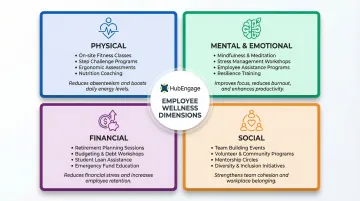
Employee wellness programs are structured employer-sponsored initiatives designed to support the physical, mental, financial, and social health of the workforce—not just gym discounts or fruit bowls in the breakroom. The breadth of what you offer determines what you can actually measure and improve.
The Four Core Wellness Dimensions
| Dimension | What's Included | Business Impact |
|---|---|---|
| Physical | Fitness challenges, biometric screenings, ergonomic assessments, gym subsidies, preventive care | Reduces chronic disease costs and workplace injuries |
| Mental & Emotional | EAP access, counseling, stress management workshops, mindfulness apps, mental health days | Cuts absenteeism; the CDC estimates depression alone costs US employers $17B+ annually in lost productivity |
| Financial | Financial literacy education, retirement planning support, debt resources, budgeting tools | Financial stress is one of the top drivers of presenteeism and distraction at work |
| Social | Team-building, peer support programs, community volunteering, connection initiatives | Stronger workplace relationships lower voluntary turnover rates |
The Frontline Equity Challenge
Organizations with large frontline, deskless, or distributed workforces—manufacturing plants, healthcare facilities, hospitality venues, retail stores—face unique challenges delivering these programs equitably. When wellness resources require desktop access or corporate email, 85% of frontline employees don't use them despite availability.
Inclusivity of design directly impacts ROI outcomes. Programs that reach only office workers miss the majority of the workforce in many industries, limiting both participation rates and measurable returns.
The Real ROI of Employee Wellness Programs: Direct Financial Returns
Healthcare Cost Savings
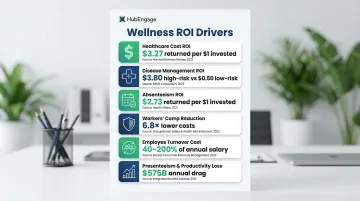
Healthier employees file fewer insurance claims and require less medical intervention, resulting in lower group healthcare premiums over time. The foundational 2010 meta-analysis reported medical costs fall by $3.27 for every dollar spent on wellness programs.
Recent randomized controlled trials found no significant short-term reductions in medical spending after 18 months, though. The disconnect? Not all wellness investments yield equal returns.
Disease management programs deliver $3.80 ROI per dollar invested, compared to just $0.50 for general lifestyle management. Programs targeting employees with chronic conditions — diabetes, hypertension, heart disease — generate far higher healthcare savings than broad fitness challenges.
Reduced Absenteeism
Sick days translate immediately to lost labor hours and productivity. The same 2010 study found absenteeism costs fall by $2.73 for every dollar spent on wellness programs.
The picture is more nuanced now. Rigorous studies rule out 84% of the effects reported in 112 prior studies on absenteeism reduction, suggesting earlier research overstated short-term gains.
Absenteeism reduction happens — it's just smaller and slower than many vendors claim. Expect modest improvements in year one, with compounding benefits over 2-3 years as health outcomes accumulate.
Workers' Compensation and Injury Claims
Employees in poor physical health file significantly more workers' comp claims — and those claims cost far more to resolve. Morbidly obese claimants incur medical costs 6.8 times higher than employees of recommended weight, according to NCCI research.
The duration gap is just as striking. Indemnity benefit periods run 5 times longer for obese claimants after controlling for injury type, industry, and demographics. This multiplier effect makes wellness programs addressing obesity, musculoskeletal health, and injury prevention powerful levers for reducing workers' comp exposure.
Reduced Turnover Costs
Employees who feel their employer invests in their well-being stay longer. Replacement costs range from 40% of salary for frontline employees to 200% for leaders and managers, according to Gallup.
More importantly, 42% of employees who voluntarily left their organization report their manager or organization could have done something to prevent it. Wellness programs signal organizational care — a meaningful retention lever when paired with manager support and visible leadership participation.
Productivity Gains
Healthy employees work faster, focus better, and take fewer unplanned absences. For every $1 spent on healthcare benefits, employers lose another $0.61 to illness-related absence and reduced work output — totaling $575 billion annually in the U.S.
The engagement dimension compounds this further. Actively disengaged employees cost the U.S. $1.9 trillion in lost productivity. Wellness programs that reduce health-related productivity drag and boost engagement deliver measurable per-hour labor value.
At a glance — direct financial returns from wellness programs:
| Return Driver | Key Stat | Source |
|---|---|---|
| Healthcare costs | $3.27 saved per $1 spent | Health Affairs (2010) |
| Disease management | $3.80 ROI per $1 vs. $0.50 for lifestyle programs | RAND |
| Absenteeism | $2.73 saved per $1 spent | Health Affairs (2010) |
| Workers' comp (obese claimants) | 6.8× higher medical costs; 5× longer indemnity | NCCI |
| Turnover replacement | 40–200% of annual salary per departure | Gallup |
| Productivity drag | $575B annual U.S. cost from illness-related absence | IBI |
Beyond ROI: The VOI (Value on Investment) Case for Wellness
The ROI vs. VOI Distinction
ROI measures direct financial returns—cost savings you can quantify in dollars. VOI (Value on Investment) captures broader organizational value that's real but harder to assign a precise dollar figure: culture strength, employer brand, trust, and engagement.
Most HR leaders undervalue wellness by focusing only on ROI. In fact, 62% of organizations now offer wellness benefits primarily to improve overall worker health and well-being, while only 28% do so primarily to control health costs. The strategic shift reflects recognition that wellness delivers value beyond the balance sheet.
Presenteeism—The Hidden Productivity Killer
Sick, stressed, or mentally depleted employees who still show up aren't fully working—they're present in body only. Presenteeism costs U.S. companies over $150 billion annually—far more than absenteeism—yet it's almost entirely invisible in traditional ROI calculations.
Wellness programs that address mental health, stress management, and chronic pain reduce presenteeism by helping employees work at full capacity when they're on the clock.
Talent Attraction and Employer Brand
Candidates are actively evaluating wellness benefits during the hiring process:
- 73% of professionals consider health and wellness offerings when choosing a job
- That figure climbs to 87% among workers ages 18–34
- Organizations with comprehensive wellness programs attract stronger applicant pools and reduce time-to-fill for critical roles
Culture, Trust, and Engagement Multiplier
Wellness programs signal what an organization actually values. When employees feel cared for as whole people, they stay longer, give discretionary effort, and recommend their workplace to others.
The performance numbers reflect this: the top 100 U.S. workplaces ranked by employee well-being outperformed the S&P 500 by 20% over a two-year period, and companies in high-trust cultures triple their stock market performance over time. Wellness investment pays back well beyond healthcare savings.
How to Measure Wellness Program ROI: A Step-by-Step Approach
Defining Your ROI Calculation
The standard wellness ROI formula is:
ROI (%) = [(Total Program Benefits – Total Program Costs) / Total Program Costs] × 100
Costs include:
- Program development and vendor fees
- Administration and HR staff time
- Incentives and rewards
- Technology platform subscriptions
- Biometric screenings and health assessments
Benefits include:
- Healthcare claim cost reductions
- Absenteeism savings (avoided lost labor hours)
- Productivity gains (reduced presenteeism)
- Turnover savings (avoided replacement costs)
- Workers' comp claim reductions
Example: If your wellness program costs $150,000 annually and generates $225,000 in combined healthcare savings, absenteeism reduction, and turnover avoidance, your ROI is 50%.
Short-Term vs. Long-Term ROI
Short-term ROI (6-12 months):
- Early morale boosts
- Immediate absenteeism reduction
- Increased program awareness and participation
Long-term ROI (3-5 years):
- Sustained healthcare savings
- Reduced chronic disease burden
- Compounding retention savings
- Cultural transformation
Most programs need 2-3 years to show their full financial return. Year-one gains are typically modest — the real payoff accelerates as health improvements and retention savings build on each other.
Key Metrics to Track
Quantitative Metrics:
- Healthcare claim costs per employee
- Absenteeism rate (sick days per employee annually)
- Employee turnover rate
- Workers' comp claim frequency and cost
- Productivity output measures (where trackable)
- Program participation rates
Qualitative/VOI Metrics:
- Employee engagement scores
- Wellness program satisfaction ratings
- Employer Net Promoter Score (eNPS)
- Culture survey results
Platforms like HubEngage help HR teams continuously gather this data through built-in pulse surveys, participation tracking, and real-time engagement analytics—making it easier to demonstrate ongoing program ROI to leadership.
Conducting a Cost-Benefit Analysis
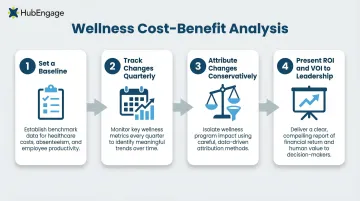
Once your metrics are in place, a four-step analysis turns raw data into a defensible ROI story.
- Set a baseline before launch — measure current healthcare costs, absenteeism rates, turnover, and engagement scores.
- Track changes quarterly or semi-annually, comparing each period against your baseline.
- Attribute changes conservatively — control for external factors like economic shifts and workforce demographics. Don't attribute 100% of improvements to the wellness program alone.
- Present findings using both ROI and VOI — pair dollar-value returns with culture and engagement data to build a complete case for leadership.
Why Wellness Programs Underperform—And How to Fix It
Low Participation Is the #1 ROI Killer
Most wellness programs fail not because of poor design, but because employees don't engage with them. EAP utilization rates historically hover around 5-10%, meaning 90-95% of employees never use available mental health resources.
Common causes:
- Lack of awareness (employees don't know programs exist)
- Inaccessibility for frontline or shift workers
- One-size-fits-all programming that doesn't resonate with diverse workforces
- Stigma around mental health and wellness participation
Organizations with deskless or distributed employees face a sharper participation gap. 85% of frontline employees do not use mental health benefits due to access barriers and stigma.
Multi-Channel Communication and Gamification Close the Gap
When employees receive wellness program updates through their preferred channel—mobile app, SMS, digital display, or email—and participation is reinforced through points, challenges, and recognition, engagement rates climb significantly.
For organizations with frontline or distributed teams, channel coverage matters as much as content. Platforms like HubEngage deliver wellness communications simultaneously across:
- Mobile apps and SMS for deskless workers
- Email and intranet for desk-based employees
- Digital signage for shared workspaces
Gamification—points, badges, and leaderboards—gives employees a reason to act. When workers earn recognition for completing health assessments, attending workshops, or hitting fitness milestones, participation shifts from passive awareness to consistent behavior.
The Leadership Buy-In Challenge
Without visible senior leadership support—both financial and participatory—wellness programs struggle to gain traction. If executives don't visibly participate, the workforce won't either.
Practical tip: Present wellness ROI data alongside strategic business metrics (retention costs, productivity losses, employer brand strength) rather than framing it purely as a health initiative. Position wellness as a business performance strategy, not an HR perk.
Best Practices to Maximize Your Wellness Program ROI
Personalize and Customize for Your Workforce
Conduct employee surveys and focus groups before designing or revamping a wellness program. Ensure offerings are relevant across job types, demographics, and health needs—what resonates with office workers may not reach warehouse or clinical staff.
Flexible delivery is essential:
- In-person workshops for on-site teams
- Digital resources for remote workers
- On-demand content for shift workers
- Mobile-first access for frontline employees
Tools like HubEngage's Survey Hub help organizations gather wellness preferences and feedback on an ongoing basis, so programs stay relevant as workforce needs shift.
Set Clear Goals and Measure from Day One
Organizations that define specific, measurable objectives before launch are far more likely to demonstrate meaningful ROI. Common targets include:
- Reduce absenteeism by 15% within 12 months
- Increase program participation by 40% within 6 months
- Improve employee engagement scores by 10 points within one year
Establish baselines, review cycles, and reporting cadences. Track progress monthly or quarterly, and adjust strategies based on data.
Build a Culture of Well-Being, Not Just a Program
The highest-ROI wellness investments are those embedded in organizational culture, where manager behavior, leadership messaging, and daily practices reinforce health and well-being as a core value — not just an HR initiative.
Companies on "Best Workplaces" lists consistently distinguish between two very different states:
- A wellness program: A set of benefits employees can access
- A wellness culture: A lived organizational commitment, visible in how managers lead and decisions get made
- The practical difference: Culture-driven programs see higher sustained participation because employees trust the company actually means it
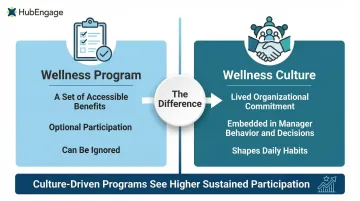
That distinction matters. A program can be ignored. A culture shapes daily behavior.
Frequently Asked Questions
What is the ROI for employee wellness programs?
Typical ROI ranges from $1–$3 saved per $1 spent on healthcare costs, with additional productivity returns. However, actual ROI depends heavily on program scope, participation rates, and how comprehensively returns are measured. Disease management programs deliver significantly higher ROI ($3.80 per dollar) than general lifestyle management ($0.50 per dollar).
How to measure ROI on wellness programs?
Use the core formula: [(Total Benefits – Total Costs) / Total Costs] × 100. Track healthcare costs, absenteeism, turnover, and productivity as key metrics. Measure short-term returns (6-12 months) separately from long-term gains (3-5 years), as wellness programs typically need 2-3 years to show full financial impact.
What is the average cost of a corporate wellness program?
Wellness program costs range from $36-$60 annually per employee for basic digital platforms to $700-$1,200+ for comprehensive programs with coaching, biometrics, and incentives. Mid-range programs typically cost $150-$700 per employee annually. Cost varies significantly by company size, program scope, and industry.
Do workplace wellness programs save employers money?
Yes, research consistently shows wellness programs reduce healthcare costs, absenteeism, and turnover. Savings are most pronounced with high participation rates and strong leadership support, measured over a multi-year horizon. Short-term savings may be modest, with compounding benefits emerging over 2-3 years.
Are employee wellness programs effective?
Effectiveness depends on design and implementation quality. Programs that are personalized, accessible to all employee types (including frontline and remote workers), and continuously promoted tend to show meaningful health and business outcomes. Generic or low-participation programs consistently underperform.
What are examples of employee wellness programs?
Common examples span all four wellness dimensions:
- Physical: fitness challenges, biometric screenings, gym subsidies
- Mental: EAP access, mindfulness apps, stress management workshops
- Financial: retirement planning, financial literacy sessions, debt management resources
- Social: team-building events, peer support groups, community volunteering programs