The numbers tell a sobering story. Only 21% of employees globally are engaged, costing the world economy $438 billion in lost productivity in 2024. Meanwhile, poor employee health costs organizations between $3.7 trillion and $11.7 trillion globally. For HR and people leaders managing diverse or distributed workforces, these aren't just statistics—they're urgent business challenges.
This guide covers the connection between engagement and wellbeing, the key drivers of each, proven strategies to improve both, and how to measure results that stick.
Key Takeaways
- Engagement (emotional investment in work) and wellbeing (holistic health) reinforce each other—address them together, not separately
- Disengaged employees experience higher stress, turnover risk, and lower productivity, making engagement a business priority
- Key drivers include purpose, manager relationships, recognition, growth opportunities, and transparent communication
- Effective wellbeing strategies cover physical, mental, social, and financial dimensions through programs employees can actually access
- Measure progress through pulse surveys, eNPS, participation rates, and real-time analytics, then close the loop by communicating actions taken
The Connection Between Employee Engagement and Wellbeing
Engagement and wellbeing aren't interchangeable, but they're deeply interdependent. Engagement refers to emotional commitment and discretionary effort at work, while wellbeing spans physical health, mental resilience, financial security, and social connection. Highly engaged employees report better wellbeing — and employees supported in their wellbeing show stronger engagement.
Poor wellbeing directly undermines engagement. Stress, burnout, financial anxiety, and loneliness erode the energy and motivation employees need to contribute meaningfully. Employees thriving in wellbeing are 72% less likely to experience frequent burnout and 49% less likely to actively seek new jobs. When wellbeing suffers, absenteeism rises, performance drops, and turnover accelerates.
Organizations treating engagement and wellbeing as a unified strategy—not two separate HR programs—see compounding benefits:
- Reduced turnover and recruitment costs
- Higher productivity and performance
- Stronger organizational culture
- Higher employee satisfaction scores
When these two priorities reinforce each other, the gains compound fast. Organizations that build both into a single strategy — rather than siloed programs — consistently outperform those that treat them as separate HR checkboxes.
Key Drivers of Employee Engagement
Purpose and Meaning
Employees who connect daily work to a broader mission are more engaged. 89% of Gen Z and 92% of millennials consider purpose very or somewhat important for job satisfaction.
Leaders should articulate "why this work matters" at team and individual levels—not just company-wide—through regular conversations, project briefings, and recognition that ties contributions to organizational impact.
Manager Relationships and Coaching Quality
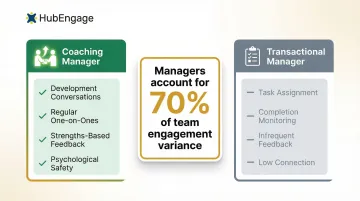
The manager-employee relationship is the strongest predictor of engagement. Managers account for 70% of the variance in team-level engagement. Coaching managers focus on development conversations, regular one-on-ones, strengths-based feedback, and psychological safety. Transactional managers simply assign tasks and monitor completion. Which type manages your teams largely determines whether people show up invested or just present.
Recognition and Appreciation
Consistent, timely recognition signals that contributions are visible and valued. Employees receiving high-quality recognition are 45% less likely to leave within two years. Meaningful recognition shares three traits:
- Specific — names the behavior, not just the person
- Frequent — not reserved for annual reviews or milestones
- Multi-directional — peer-to-peer, not just top-down
Generic or infrequent acknowledgment doesn't move the needle.
Growth and Development Opportunities
Employees who feel they're learning and advancing stay engaged. Yet agreement with "I have had opportunities to learn and grow" fell 11 points among younger workers between 2020 and 2025. Growth opportunities fall into two categories:
- Formal: training programs, mentorship, certifications
- Informal: stretch assignments, cross-functional projects, strengths-based work allocation
Clear Communication and Psychological Safety
When employees don't know what's expected, feel excluded from decisions, or fear speaking up, engagement suffers. Skills training highlighting psychological safety enabled one management team to achieve revenues 25% above yearly targets. Two-way communication—especially for distributed or frontline teams—forms the bedrock of engagement.
5 Strategies to Boost Employee Engagement
Build a Recognition-Rich Culture
Recognition should be frequent, specific, and multi-directional. Embed recognition into daily workflows through:
- Shout-outs in team channels and meetings
- Milestone celebrations (work anniversaries, project completions)
- Values-based awards that reinforce desired behaviors
- Gamification elements like points, leaderboards, and badges to sustain participation
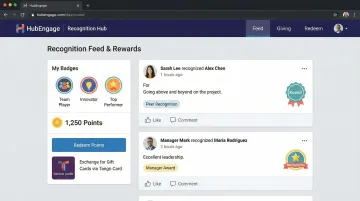
Platforms like HubEngage consolidate recognition, gamification, and communication in one place—making it practical to reach frontline and deskless employees, too. HubEngage's Recognition Hub lets managers and peers celebrate achievements publicly, with points redeemable for tangible rewards through Tango Card.
Prioritize Manager Enablement
Investing in managers delivers the highest-leverage engagement returns. Manager training focused on best practices can increase engagement by up to 22% and improve manager performance metrics by 20-28%.
Give managers:
- Coaching skills training (active listening, strengths-based feedback)
- Structured one-on-one frameworks
- Real-time feedback tools
- Team-level engagement survey insights for targeted conversations
When managers understand their team's specific engagement drivers, they can address issues before they escalate.
Create Open Feedback Loops
Employees disengage when feedback goes nowhere—continuous listening changes that. Move beyond annual surveys with:
- Pulse surveys every quarter to detect shifts in engagement
- Idea submission tools for crowdsourcing improvements
- Town halls with open Q&A sessions
- Anonymous feedback channels for sensitive topics
Most importantly, communicate what actions were taken based on feedback. Only 51% of employees say improvements were actually made following listening events, creating cynicism when feedback disappears into a void.
Invest in Meaningful Work Design
Align roles with individual strengths and interests where possible. Employees doing what they do best are less likely to disengage. Practical tactics include:
- Strengths assessments (CliftonStrengths, VIA Character Strengths)
- Skill-based project assignments
- Regular career conversations exploring interests and aspirations
- Job crafting opportunities to reshape roles around strengths
Even partial alignment—one or two projects that play to someone's strengths—can meaningfully shift how connected employees feel to their work.
Communicate Consistently and Across Channels
Engagement requires employees to feel informed and connected. This is especially critical for remote, hybrid, or shift-based workers who miss updates delivered only through email or intranet. Only 29% of non-desk employees are satisfied with internal communication quality, compared to 47% of desk-based employees.
Reach employees through the channels they actually use:
- Mobile apps for frontline workers
- SMS for urgent updates
- Digital signage in break rooms or production floors
- Email for desk-based staff
- Microsoft Teams or Slack for hybrid workers
HubEngage auto-formats messages for each channel and distributes them in one click—so no one is left out and your team isn't duplicating effort across platforms.
4 Strategies to Promote Employee Wellbeing at Work
Address All Four Wellbeing Dimensions
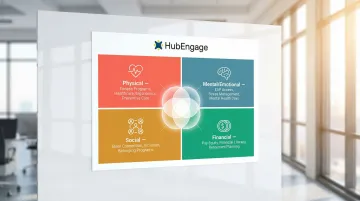
A meaningful wellbeing strategy goes beyond gym memberships. Address these four interconnected dimensions:
| Dimension | What It Includes |
|---|---|
| Physical | Fitness programs, healthcare access, ergonomic workspaces, preventive care |
| Mental/Emotional | EAP access, stress management resources, mental health days, psychological safety |
| Social | Team connection activities, inclusion initiatives, belonging programs, community engagement |
| Financial | Pay equity, financial literacy resources, retirement planning, emergency savings programs |
Employees have different needs. 50% of U.S. employees report major or moderate financial wellbeing issues, and 66% want more help from employers. Offer variety and flexibility, not one-size-fits-all programs.
Make Wellbeing Accessible and Visible
Well-designed programs fail if employees don't know they exist or can't easily access them. Best practices include:
- Promoting wellness initiatives regularly through multiple communication channels
- Ensuring accessibility for shift workers and those without desk access (mobile apps, SMS, digital signage)
- Using targeted communications to reach specific employee segments
- Highlighting success stories and participation milestones
HubEngage's multi-channel communications platform delivers wellness content through mobile apps, intranet, email, SMS, and digital signage, so shift workers and frontline employees receive the same wellness information as desk-based staff.
Foster a Culture of Psychological Safety and Inclusion
Wellbeing is shaped by whether employees feel safe being themselves at work, can speak up without fear, and experience genuine belonging. Globally, 12 billion working days are lost annually to depression and anxiety, costing $1 trillion in lost productivity.
Build this culture through:
- Inclusive team norms that value diverse perspectives
- Anti-stigma mental health messaging from leadership
- Visible leadership vulnerability (leaders sharing their own challenges)
- Clear processes for raising concerns without retaliation
- Manager training on empathy and active listening
Psychological safety also directly lowers the barrier to EAP utilization — employees who trust their environment are far more likely to actually use the support you've funded.
Set Clear Goals and Measure Wellbeing Outcomes
Wellbeing programs without clear objectives and success metrics tend to stall. Set measurable goals such as:
- Participation rates in wellness programs (target: 60%+ within six months)
- Absenteeism reduction (baseline vs. post-program)
- Stress self-reports from pulse surveys
- EAP utilization rates
- Financial wellness program engagement
According to WTW research, organizations with mature wellbeing programs see financial and human capital performance gains twice as high as those without. Tying wellbeing goals to business outcomes is what converts executive interest into sustained investment.
How to Measure and Sustain Engagement and Wellbeing Progress
Key Measurement Tools
Use a combination of these tools to track progress:
Employee Engagement Surveys (Annual and Pulse): Annual surveys establish baselines; quarterly pulse surveys detect shifts quickly. Since global engagement dropped from 23% to 21% in just one year, annual surveys alone are too slow to catch deteriorating trends.
Wellbeing Assessments: Cover physical, mental, social, and financial dimensions. Track trends over time — a single snapshot rarely tells the full story.
eNPS (Employee Net Promoter Score): Asks "How likely are you to recommend this organization as a place to work?" on a 0–10 scale. Subtract detractors (0–6) from promoters (9–10) to get your score. Above 50 is excellent; below 0 requires immediate action.
Participation Rates: Monitor uptake across recognition programs, wellness initiatives, and training. Low participation usually points to awareness gaps or access barriers — both fixable.
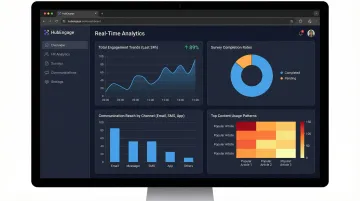
Platforms like HubEngage offer built-in survey capabilities and real-time analytics dashboards that surface engagement metrics, communication reach, and content usage patterns — giving HR leaders immediate visibility into what's working. Knowing the right tools is only half the equation. How you interpret and act on the data matters just as much.
Common Measurement Pitfalls to Avoid
Using "percent favorable" scores: Counting neutral responses as positive inflates results and masks real problems. Rigorous scoring distinguishes between "agree" and "strongly agree."
Over-relying on pulse surveys without follow-through: 71% of employees say survey results were shared and 59% say actions were created — yet only 51% report improvements were actually made. Measurement without visible follow-through erodes trust.
Treating engagement scores as ends in themselves: Scores are diagnostic tools, not targets. Focus on the conditions driving them — manager quality, recognition frequency, growth opportunities — rather than chasing numbers.
Pair quantitative scores with qualitative signals: manager conversations, exit interviews, and open-ended responses often surface what the numbers miss.
Embedding Engagement and Wellbeing into Operating Rhythm
Sustainability requires making engagement and wellbeing part of how the organization operates, not annual initiatives. This looks like:
- Quarterly team check-ins where managers review engagement data and adjust approaches
- Manager accountability for engagement outcomes in performance reviews
- Executive sponsorship with visible leadership participation in wellbeing programs
- HR policy integration where wellbeing isn't a "bonus" but embedded in benefits, leave policies, and work design
Organizations that treat engagement as infrastructure — not a campaign — are the ones that maintain momentum through leadership transitions, workforce changes, and economic pressure.
Frequently Asked Questions
What are 5 things that can be done to enhance employee engagement?
Five high-impact actions organizations can take:
- Build a recognition culture with frequent, specific appreciation
- Enable managers with coaching tools and team-level insights
- Create open feedback loops through pulse surveys and idea submissions
- Invest in growth opportunities aligned with employee strengths
- Ensure clear multi-channel communication that reaches frontline and remote workers
What are four strategies for promoting employee wellbeing?
Four strategies that address wellbeing holistically:
- Cover all four dimensions (physical, mental, social, financial) through diverse program offerings
- Make programs accessible via multi-channel promotion and mobile-first design
- Foster psychological safety so employees feel included and comfortable being themselves
- Set measurable wellbeing goals tied to business outcomes with regular progress tracking
What is the difference between employee engagement and employee wellbeing?
Engagement refers to emotional investment, discretionary effort, and commitment to work and organizational goals. Wellbeing refers to holistic health across physical, mental, social, and financial dimensions. Both are interconnected—employees with strong wellbeing are more likely to be engaged, and engaged employees tend to report better wellbeing.
How do managers impact employee engagement?
Managers are the single most influential factor in team-level engagement, accounting for 70% of variance in engagement scores. They shape whether employees feel seen, supported, valued, and clear on expectations. Enabling managers with coaching skills, structured one-on-one frameworks, and real-time feedback tools is essential to improving engagement at scale.
How can organizations measure employee engagement and wellbeing?
Use engagement surveys (annual and pulse), wellbeing assessments across four dimensions, eNPS to measure loyalty, and participation rates in programs. Measurement drives results only when paired with transparent communication of findings and visible action—real-time analytics dashboards help maintain ongoing visibility into trends.
What role does recognition play in employee engagement and wellbeing?
Regular, specific recognition strengthens employees' sense of value and belonging, directly boosting both engagement and wellbeing. It's most effective when embedded into daily workflows—peer-to-peer shout-outs, milestone celebrations, values-based awards—rather than reserved for annual reviews. Well-recognized employees are 45% less likely to leave within two years.