Introduction
The modern workplace is fragmented. Remote teams miss the hallway conversations that used to spark collaboration. Hybrid workers feel caught between two worlds.
Frontline employees—who make up over 80% of the global workforce—often operate completely disconnected from leadership and corporate communications. This isn't just a cultural problem; it's a business-critical gap that directly impacts retention, productivity, and operational performance.
While "social networking" typically brings to mind LinkedIn profiles and Facebook feeds, its most powerful application happens inside organizations. Internal social networking: the digital infrastructure that lets employees connect, share, and collaborate across departments and locations, has become essential for companies building cohesive cultures at scale.
This article breaks down five concrete benefits of workplace social networking, explains why each one matters to measurable business outcomes, and outlines what HR and communications leaders can do to unlock them.
Key Takeaways
- Internal social networks break down silos, enabling collaboration across departments and locations
- Multi-channel communication reaches every employee — not just those with a desk and inbox
- Social connection directly reduces turnover and strengthens engagement
- Peer learning and knowledge sharing accelerate skill development and cut time spent hunting for answers
- Real-time sentiment data gives leaders a continuous pulse on how employees actually feel
What Is Social Networking in the Workplace?
Internal social networking refers to digital platforms and channels within an organization that enable employees to interact, share information, collaborate, and build professional relationships—distinct from public-facing social media.
Common forms include:
- Company intranets and digital workplaces
- Employee mobile apps
- Instant messaging and chat tools
- Peer recognition feeds
- Shared project spaces and digital communities
Together, these tools create the channels through which communication flows, relationships form, and culture takes shape—especially at scale.
The real purpose is infrastructure. In distributed, hybrid, and frontline environments, organic connection rarely happens on its own. Internal social networking provides the structure that makes it possible.
5 Key Benefits of Social Networking in the Workplace
The five benefits below aren't abstract concepts. Each one maps directly to outcomes that HR leaders and operations teams actively track: retention rates, productivity metrics, communication effectiveness, and engagement scores.
Benefit 1: Stronger Employee Relationships and Cross-Team Collaboration
Internal social networking gives employees a structured way to build relationships beyond their immediate team—critical in distributed, frontline, or hybrid environments where organic connection doesn't happen naturally.
How it works in practice:
Employees can follow colleagues' updates, join interest-based groups, comment on shared wins, and participate in cross-functional discussions. These interactions create familiarity and trust that translate directly into better teamwork when collaboration is needed.
Platforms like HubEngage enable this through dedicated social hubs where employees share updates, celebrate milestones, and interact across the organization on a secure internal platform—complete with likes, comments, and shares that encourage ongoing participation.
Why it matters:
Research analyzing 61,182 Microsoft employees found that remote work caused a 9% drop in bridging ties and a 40% drop in collaboration time spent with those ties. When employees lose these "weak ties" across departments, collaboration networks become static and siloed, limiting innovation and cross-functional problem-solving.
Managers account for 70% of the variance in team-level engagement. Internal social platforms increase leadership visibility, allowing managers to scale their communication and recognition efforts across larger, more distributed teams.
Benefit 2: More Effective Internal Communication Beyond Email
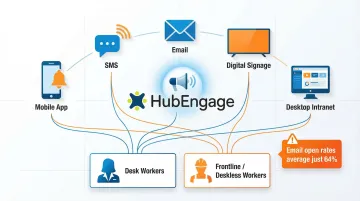
Email open rates in the workplace average just 64%, and phone-based communication misses distributed or deskless workers entirely. Internal social networking introduces a more dynamic, visible, and interactive channel that significantly increases the likelihood important messages are seen and acted on.
The operational shift:
Conversations happen in visible, searchable feeds rather than buried inboxes. Employees can react, respond, and flag content, turning one-way announcements into two-way dialogue. Multi-channel platforms deliver messages simultaneously across mobile apps, SMS, digital signage, and email—reaching employees wherever they work.
KPIs impacted:
- Message open and read rates
- Employee response time to critical communications
- Reduction in communication gaps for frontline or non-desk employees
This advantage matters most for multi-location organizations, shift workers, and companies managing large hourly workforces. Effective delivery of safety information via mobile apps can reduce occupational injuries by 31%, demonstrating the operational impact of closing communication gaps.
For frontline workers specifically, traditional email-only approaches fail to reach employees who lack corporate email addresses or consistent desktop access. Sixteen percent of U.S. adults are "smartphone dependent" for internet access, meaning mobile-first communication isn't optional—it's the only way to reach a significant portion of the workforce.
Benefit 3: Higher Employee Engagement and Reduced Turnover
Employees who feel socially connected to their workplace—to peers, managers, and organizational culture—are significantly less likely to disengage or leave. Social networking is a primary driver of that sense of belonging.
The mechanism:
Peer recognition, shared celebrations, leadership transparency, and informal interaction all happen naturally through internal social networks, creating emotional investment in the organization. When employees can publicly celebrate achievements, recognize colleagues' contributions, and see leadership communicating openly, they develop stronger ties to the company.
The financial case:
Gallup found that 42% of employees who voluntarily left their organization said their manager or organization could have done something to prevent their departure. The financial exposure is real:
- SHRM estimates replacing an employee costs 50%–200% of their annual salary
- Business units in the top engagement quartile achieve 23% higher profitability and 51% lower turnover in low-turnover organizations
- U.S. employee engagement sits at just 31%; global engagement at 21%
Each percentage point of engagement improvement translates directly into reduced attrition costs—making social connection one of the highest-ROI investments available to HR teams.
Benefit 4: Accelerated Knowledge Sharing and Professional Learning
Internal social networks create a living knowledge base where employees can post questions, share expertise, highlight resources, and learn from peers in real time—rather than waiting for formal training programs or searching through disconnected systems.
How this plays out:
Newer employees learn faster by observing and engaging with experienced colleagues. Employees in different roles discover career paths and internal opportunities they wouldn't otherwise know about. Subject matter experts can share insights once and have them remain searchable and accessible—rather than fielding the same question repeatedly across teams.
Why this matters for business outcomes:
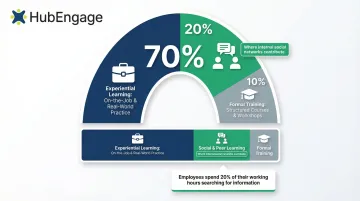
Employees spend on average 20% of their hours searching for information necessary to do their jobs effectively. A Forrester study on Stack Overflow for Teams found a 191% ROI over three years, driven by $2.3 million in time saved for employees searching for information and $9.5 million in time saved for subject matter experts providing knowledge.
The foundational 70:20:10 learning framework suggests that 70% of development occurs through experiential learning, 20% through social and peer learning, and 10% through formal training. Internal social platforms directly facilitate that critical 20% social learning component, reducing onboarding time and accelerating skill acquisition across the organization.
Benefit 5: Real-Time Insight into Employee Sentiment and Culture
Employee activity on internal social networks—the topics they engage with, the questions they ask, the content that generates conversation—gives HR and communications leaders continuous signals on workforce sentiment, culture health, and engagement levels.
The practical value:
Instead of relying solely on annual surveys, leaders can observe trending discussions, flag recurring concerns, and identify high-engagement moments in real time. This enables faster, more informed decisions about culture interventions, communication adjustments, and resource allocation.
Automated pulse surveys integrated into social platforms allow organizations to gather feedback continuously rather than once per year.
AI-driven analytics can detect sentiment, emotion, and friction across teams, surfacing burnout signals long before they escalate into turnover.
KPIs impacted:
- Employee satisfaction scores
- Survey participation rates
- Time-to-identify disengagement signals
- Response speed to emerging cultural issues
This benefit matters most during periods of organizational change, rapid headcount growth, or post-merger integration—scenarios where traditional annual surveys move too slowly to capture shifting sentiment. Organizations that regularly give employees a chance to share feedback through continuous listening platforms are twice as likely to retain those workers as organizations that do not use such tools.
What Happens When Internal Social Networking Is Absent
When employees lack a structured internal network, departments operate in silos, communication reaches only those with email access, and informal culture-building happens by accident—or not at all.
Gallup estimates that low employee engagement costs the global economy $8.9 trillion, or 9% of global GDP. The two-point drop in global engagement in 2024 alone erased $438 billion in productivity.
At the organizational level, silos compound the damage. McKinsey found that overly siloed organizations duplicate up to 35% of decisions across functions and burn thousands of hours on manual reporting.
Without internal social infrastructure, the consequences stack up over time:
- Alignment breaks down as the organization grows
- Cultural problems go undetected until they're costly to fix
- Frontline workers get cut off entirely when email and desktop intranets are the only channels available
How to Get the Most Value from Workplace Social Networking
The benefits of internal social networking compound when the platform is accessible to all employees—including frontline and deskless workers. Mobile-first access is non-negotiable for organizations with distributed teams.
Prioritize Accessibility and Adoption
Three out of four enterprise customers achieve active usage rates over 70% when they combine personalized information with practical services like shift schedules and payslips. Employees without email access will install an internal app on their personal phones when it makes their workday easier.
Build In Incentives for Participation
Social networking adoption is highest when organizations actively encourage participation through recognition, leadership visibility, and gamified engagement. Employees need a reason to show up beyond obligation.
Platforms like HubEngage are built for this: combining multi-channel reach (mobile, web, SMS, digital displays) with platform-wide gamification and peer recognition to drive consistent participation across the workforce.
The research supports the approach. A 2025 meta-analysis found that gamification produces a significant effect size of 1.326 on learning outcomes—evidence that game design elements measurably improve engagement and behavioral outcomes at work, not just in classrooms.
Act on What the Network Reveals
Treat employee sentiment data and engagement trends from the platform as operational intelligence. Review it regularly, respond to patterns, and act visibly on what you learn so employees know their voices matter. Without that response, even the best social networking platform becomes just another ignored communication channel.
Conclusion
Social networking in the workplace serves as the infrastructure through which communication flows, culture gets built, knowledge spreads, and employees feel connected to something larger than their individual role.
The five benefits covered—relationships, communication, engagement, learning, and insight—don't operate in isolation. Investing in internal social networking strengthens all of them at once, and the benefits reinforce each other over time.
Organizations that treat social connection as a strategic priority see measurable results across:
- Talent retention — employees who feel connected are less likely to leave
- Productivity — faster knowledge-sharing reduces delays and redundant effort
- Culture durability — shared norms and trust survive team changes and growth
- Distributed team cohesion — remote and frontline workers stay aligned, not sidelined
The shift doesn't require a complete overhaul. For most organizations, it starts with giving employees a consistent, accessible place to connect—and building the habit from there.
Frequently Asked Questions
Frequently Asked Questions
What are the benefits of social networking in the workplace?
Internal social networking strengthens employee relationships, improves communication reach beyond email, and accelerates peer-to-peer learning. It also increases engagement and retention while providing real-time insights into workforce sentiment—directly impacting productivity and business performance.
How can social networking be used in the workplace?
Organizations implement internal social networking through employee apps, intranet platforms, peer recognition tools, and group messaging channels—enabling connection across roles, locations, and departments through secure, purpose-built platforms.
What are the advantages of using social networking for communication in the workplace?
Social networking creates visible, two-way communication channels that outperform email for reach and engagement. It's especially valuable for frontline and deskless employees who are often excluded from traditional email-based flows, giving them real-time access to interaction and feedback.
What are the positive impacts of social media on employee performance?
Internal social networking improves access to information, accelerates peer learning, and strengthens collaboration. The result: less time searching for answers and faster problem-solving—both of which translate directly to higher job performance.
What are the four pillars of employee relations?
The four pillars are communication, recognition, development, and trust. Internal social networking actively supports all four by creating channels for dialogue, visibility for achievements, opportunities for learning, and transparent leadership that reinforces trust.