Introduction
Internal communications has evolved from a support function into a strategic business imperative. Yet most organizations are still fighting fragmented tools, missed messages, and employees who feel excluded from company dialogue.
The numbers reflect it: low employee engagement costs the global economy $8.9 trillion, or 9% of global GDP, according to Gallup's 2024 research. In the United States alone, employee engagement fell to 31% in 2024, the lowest level in a decade.
The employee intranet is frequently cited as the fix, but its real value is rarely explained beyond generic talking points like "it centralizes information." This article breaks down what that actually means for day-to-day operations, engagement, and leadership visibility. You'll discover the specific, measurable advantages a modern employee intranet delivers for internal communications, from reach and alignment to what it costs organizations that skip it.
Key Takeaways
- A modern employee intranet is a private hub where employees communicate, access information, and engage across devices and locations
- Real value comes from multi-channel message delivery, two-way dialogue, and analytics that show leaders what's actually landing
- Organizations without intranets suffer from information silos, inconsistent messaging, and high time-waste—employees spend 1.8 hours daily just searching for information
- Consistent use, active leadership participation, and acting on analytics data drive the biggest results
- Today's intranets reach employees via mobile apps, SMS, digital signage, and AI-powered search—channels traditional strategies miss for frontline workers
What Is an Employee Intranet?
An employee intranet is a secure, private digital platform that gives employees a single place to receive company communications, access information, collaborate, and engage—regardless of their role, location, or device. Unlike public websites or external tools, intranets are accessible only to authorized staff, making them the secure foundation for internal information exchange.
Modern intranets fit into day-to-day operations across all departments, not just IT or HR. They handle everything from CEO announcements and policy documents to shift updates and peer recognition. Use cases span the entire organization:
- Frontline workers access safety protocols on their phones
- Remote teams collaborate through integrated messaging
- HR leaders track engagement metrics in real-time dashboards
The real value lies in what it enables: fewer missed messages, faster decision-making, stronger culture, and a workforce that feels informed and connected. For distributed teams especially, that translates directly into better alignment and lower turnover risk.
Key Advantages of an Employee Intranet for Internal Communications
The advantages below are grounded in operational outcomes that HR, communications, and operations leaders are accountable for—not abstract ideals. Each maps to metrics organizations already track.
Advantage 1: Multi-Channel Delivery That Closes the Communication Gap
The core communication problem in most organizations isn't content quality—it's reach. Emails get ignored, bulletin boards go unread, and frontline workers without company email addresses are structurally excluded from most communication strategies. Research from the 2025 International Employee Communication Impact Study reveals that only 9% of non-desk employees are very satisfied with internal communication, and 63% of employees considering leaving cite poor internal communication as a contributing factor.
A modern intranet solves this by delivering the same message simultaneously across mobile apps, web, SMS, email, and digital displays—auto-formatted for each channel so communicators don't need to rebuild content for every platform. Platforms like HubEngage offer one-click multi-channel publishing across all five channels, which is particularly significant for frontline, deskless, and distributed teams who may never check corporate email.
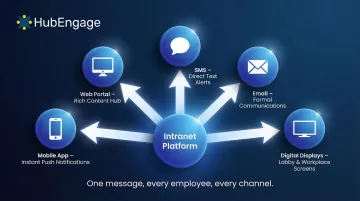
Why this is an advantage:
Reaching every employee—not just desk workers—with consistent, timely information directly reduces the errors, safety incidents, and policy violations that stem from communication gaps. In healthcare, poor communication contributed to approximately one quarter of patient safety incidents according to a 2025 systematic review. In manufacturing, OSHA cited 2,546 violations under Hazard Communication standards in 2025, keeping it near the top of workplace violations.
When messages fail to reach the right people, organizations pay for it in rework, missed deadlines, compliance issues, and disengaged staff. A survey of 400 companies with 100,000 employees each reported an average loss of $62.4 million per year because of inadequate communication to and between employees.
KPIs impacted:
- Message open/read rates
- Time-to-information for frontline staff
- Policy compliance rates
- Reduction in communication-related errors or incidents
When this advantage matters most:
This is most critical for organizations with large frontline or shift-based workforces—healthcare, hospitality, manufacturing, retail—where traditional email-only approaches structurally exclude significant portions of the workforce. If your employees don't sit at desks, they need communication infrastructure that meets them where they work.
Advantage 2: Two-Way Communication That Builds Engagement and Trust
A traditional intranet is a broadcast tool—leadership talks, employees listen. A modern employee intranet changes the communication dynamic entirely by enabling bottom-up and lateral communication alongside top-down messaging.
This works in practice through features like comment threads on announcements, pulse surveys, idea submission portals, peer recognition programs, and discussion forums—all within the same platform. Employees who feel heard are more engaged, more productive, and less likely to leave. Research shows that business units whose managers are responsive to employee feedback experience about 30% less attrition.
The feedback loop extends to operational decision-making: when leadership can see real-time sentiment through pulse surveys and engagement data, they make better decisions faster, rather than relying on annual surveys that reflect how people felt 12 months ago. Qualtrics research from 2026 found that employees whose companies ramped up listening reported higher engagement, stronger intent to stay, better well-being, and greater inclusion.
Why this is an advantage:
Two-way communication turns employees from passive recipients into active participants. When people can respond to announcements, submit ideas, and recognize peers, they develop psychological ownership of the workplace—which directly impacts retention and productivity.
Organizations should aim for minimum 70% participation on annual surveys. According to Perceptyx research, response rates below 50% are a red flag indicating severe employee disengagement or distrust in the feedback process. Top-performing organizations achieve 72-88% participation on annual census surveys and 55-81% on frequent pulse surveys.
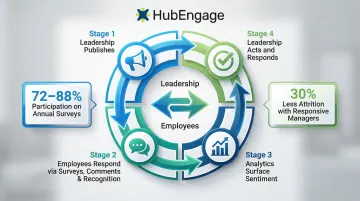
KPIs impacted:
- Employee engagement scores
- Survey participation rates
- Voluntary turnover rate
- eNPS (Employee Net Promoter Score)
- Recognition activity rates
When this advantage matters most:
Two-way communication becomes especially high-stakes during periods of organizational change—restructuring, acquisitions, policy shifts—where misinformation spreads quickly and trust erodes if employees feel they can't respond or aren't heard.
Advantage 3: Analytics and Visibility That Turn Communication Into Strategy
Most internal communications programs operate blind. Messages go out, but communicators rarely know if they landed—who read what, where engagement dropped, or which content formats actually drove action.
A modern intranet changes that with real-time dashboards giving HR and communications leaders direct visibility into:
- Open rates by department or location
- Content engagement trends and format performance
- Survey completion rates
- Search queries (which reveal what employees can't find)
- Recognition activity across teams
Still, Gallagher's State of the Sector 2026 report reveals that 70% of communicators are stuck tracking basic outputs like opens and clicks, while only 12% consider how communications drive business impact.
Why this is an advantage:
Communication analytics shift internal comms from a cost center to a measurable function. When leaders can quantify reach, engagement, and downstream impact on productivity or retention, they can justify investment, adjust strategy in real time, and demonstrate ROI to the C-suite.
Organizations with high strategic maturity scores—codified, active, and data-backed strategies—were at least 3.5x as likely to report increased engagement, according to Gallagher's research. By contrast, functions that measured only activity reported just 41% exceeding targets.
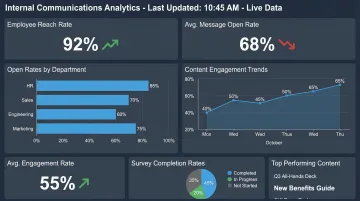
Organizations without communication visibility can't detect early warning signs: declining engagement in a specific department, low adoption of a new policy, or a segment of employees consistently unreached by company messages.
KPIs impacted:
- Message reach rate
- Content engagement rate
- Intranet adoption rate (DAU/MAU)
- Time-to-information
- Employee satisfaction scores tied to communication
- HR program participation rates
When this advantage matters most:
Analytics-driven communication is most valuable at scale—organizations with 500+ employees, multiple locations, or diverse workforces where leadership cannot rely on informal pulse-checks or floor walks to gauge how communication is landing.
What Happens When an Intranet Is Missing or Ignored
Organizations without centralized communication infrastructure suffer predictable and costly symptoms:
Information lives everywhere and nowhere. Email threads, shared drives, and personal folders become the default repositories—there's no single source of truth. Employees waste time searching, make decisions based on outdated data, and managers field the same questions repeatedly.
Email threads, shared drives, and personal folders become the default repositories—there's no single source of truth. Employees waste time searching, make decisions based on outdated data, and managers field the same questions repeatedly.
The cost adds up fast: McKinsey research found knowledge workers spend 1.8 hours every day—9.3 hours per week—just searching for information. IDC puts the figure even higher at 2.5 hours per day, or roughly 30% of the workday.
Messages get routed through too many informal channels. Group chats, personal phones, and verbal handoffs create inconsistency—the same policy is understood differently by different teams, and compliance suffers. Gartner reports that 47% of digital workers struggle to find information needed to effectively perform their jobs.
Employee frustration builds silently. Without a feedback mechanism, leadership is the last to know about culture problems, engagement dips, or team dysfunction—often finding out through exit interviews or turnover spikes.
Tool sprawl creates a hidden tax. Organizations that rely on fragmented tools—separate email platforms, chat apps, HR systems, document storage—pay multiple subscriptions, manage multiple login points, and have no unified view of communication activity. According to Gartner, the average desk worker now uses 11 applications, up from six in 2019.
That number is worse at the edges: 40% of workers use more than the average, and 5% juggle 26 or more apps daily.
How to Get the Most Value from Your Employee Intranet
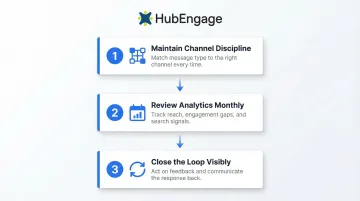
The intranet delivers compound value over time—but only when three conditions are met consistently. All three are ongoing operational disciplines, not one-time setup tasks.
1. Maintain consistent channel discipline. Establish a channel-message matrix that matches message type to the right channel—urgent safety update, culture story, policy change—so employees build reliable habits around where to find what. An intranet becomes the source of truth only when communicators treat it as one, every time. HubEngage supports this with AI-assisted content creation and automated multi-channel publishing, reducing the effort of staying consistent.
2. Review analytics on a monthly cadence. Track which content drove action, which segments had low reach, and which searches returned no results. These signals reveal content gaps and strategy adjustments—not just vanity metrics. Ragan Communications research from 2026 found that 63% of communicators were unsatisfied with their ability to measure employee sentiment—a gap most organizations still need to close.
3. Close the loop visibly. Running surveys without acting on them is the fastest way to kill intranet engagement. When leadership responds to what employees raise through the platform—and communicates that response back—participation compounds over time. Employees engage more when they can see their voice actually matters.
Conclusion
A modern employee intranet transforms internal communications not by replacing human connection, but by giving organizations the infrastructure to make communication consistent, inclusive, and measurable—across every team, location, and role.
The advantages build on each other: broader reach creates the trust that makes two-way dialogue possible, and that dialogue generates the data that sharpens strategy over time. All three require ongoing practice—not a one-time launch. Organizations that treat their intranet as living infrastructure rather than a static portal see measurable gains in engagement, retention, and productivity that grow stronger the longer they commit to it.
Frequently Asked Questions
What is an employee intranet?
An employee intranet is a private digital platform accessible only to an organization's staff, used to centralize communications, share documents, and enable collaboration. It secures sensitive company data while giving employees a single destination for workplace resources.
Is intranet internal or external?
An intranet is strictly internal—accessible only to employees or authorized users—unlike a public website or extranet. That restricted access makes it a secure channel for confidential documents, sensitive company data, and employee-specific communications.
Are intranets still relevant?
Yes, modern intranets are increasingly valuable given the rise of remote, hybrid, and frontline workforces. Today's platforms have evolved far beyond document repositories—they now integrate AI, mobile access, gamification, and real-time analytics to drive engagement and reach employees wherever they work. Forrester research identifies five key trends shaping the market: the rise of genAI, enhanced automation, deeper analytics, personalized content, and more support for frontline employees.
What are the best internal communication tools?
The best tools depend on workforce needs, but unified employee experience platforms that combine intranet functionality with mobile apps, SMS, email, digital signage, recognition, and analytics—such as HubEngage—offer the most comprehensive reach, especially for frontline and distributed teams.
What is digital communication in the workplace?
Digital workplace communication is any structured exchange of information between employees using digital tools—email, messaging apps, video, and intranet platforms. An intranet centralizes these channels into one measurable system, making messaging consistent and accessible organization-wide.
Should internal comms sit in HR?
Placement varies by organization—internal comms can sit in HR, marketing, or as its own function. What matters more than org chart placement is alignment: HR, comms, and operations need shared access to the same communication infrastructure and data so messaging is consistent and employee-focused across all teams.