Introduction
Modern organizations face a familiar set of operational challenges: fragmented communication tools, disconnected workforces spread across locations and shifts, and information buried in email threads that no one can find when they need it. For companies with hybrid teams, remote employees, and especially frontline workers without regular desktop access, these gaps create real friction—missed announcements, inconsistent messaging, and employees who feel left out of the conversation.
Many organizations turn to company intranets to solve these problems. Intranets are often positioned as the fix-all solution that will centralize information, improve engagement, and keep everyone connected. The reality is more nuanced.
The actual value of an intranet—and its real limitations—only becomes clear after implementation. Some become indispensable digital hubs. Others turn into abandoned portals that employees ignore entirely.
This article breaks down the concrete operational and employee experience benefits of a company intranet, the genuine drawbacks to watch for, and how to extract maximum value from one before you invest.
Key Takeaways
- A company intranet centralizes information, communication, and tools for employees across all locations and roles
- Advantages include streamlined communication, higher engagement, easier knowledge access, and stronger support for distributed teams
- Disadvantages include poor adoption rates, implementation costs, and the real risk of becoming an underused, forgotten tool
- Intranets deliver ROI when they're mobile-accessible, actively maintained, and tied to measurable engagement outcomes
- Modern intranet platforms drive sustained adoption through multi-channel reach, AI-powered search, and built-in engagement features
What Is a Company Intranet?
A company intranet is a private, internal digital platform that gives employees a single place to access information, communicate, collaborate, and engage—separate from the public internet. Think of it as your organization's digital headquarters: a secure space where employees find what they need without hunting through email threads, shared drives, or asking colleagues.
Intranets are typically used for:
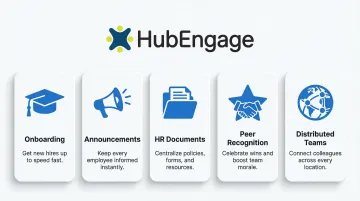
- Onboarding new hires with training materials and checklists
- Distributing company-wide announcements and policy updates
- Storing HR documents, benefits information, and org charts
- Enabling peer recognition and employee feedback
- Supporting distributed teams across multiple locations
These use cases share a common thread. A well-built intranet reduces friction—it removes the guesswork around where to find policies, who to contact, or what the latest company update says. Done right, the same information reaches a desk worker in headquarters and a frontline employee on the floor, without either one having to chase it down.
Key Advantages of a Company Intranet
Each advantage below maps directly to operational outcomes that HR leaders, internal communications teams, and operations managers are responsible for measuring.
Advantage 1: Centralized Information and Faster Knowledge Access
One of the most immediate advantages of an intranet is eliminating the "where do I find that?" problem. Instead of scattering HR documents, policies, training materials, org charts, and announcements across email threads, shared drives, and Slack channels, an intranet puts everything in one searchable location.
How this works in practice:
Employees can self-serve routine requests—benefits info, PTO policies, onboarding checklists—without contacting HR. This frees up HR teams for strategic work and reduces wait times for employees who need answers now, not tomorrow.
Why it matters:
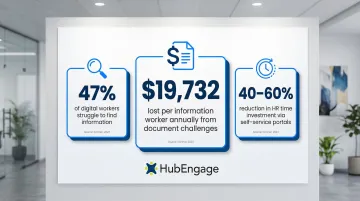
47% of digital workers struggle to find information needed to effectively perform their jobs, according to a 2023 Gartner survey of 4,861 employees. The financial impact is significant: businesses lose up to 21.3% of productivity due to document-related challenges, translating to an average cost of $19,732 per information worker annually.
For a mid-size organization with 500 information workers, that's nearly $10 million in lost productivity each year—just from employees searching for information.
KPIs impacted:
- HR ticket volume
- Average time-to-information
- Employee self-service rate
- Onboarding time-to-productivity
Where this pays off most:
Organizations with large headcounts, multi-location operations, or high employee turnover (retail, hospitality, manufacturing) where consistent access to the same information is critical. Self-service HR portals through an intranet can reduce HR time investment by 40-60%, with ticket deflection rates of 30-60% once adoption matures.
Advantage 2: Improved Internal Communication and Employee Engagement
An intranet creates a structured channel for two-way communication: leadership announcements and town halls alongside employee recognition, pulse surveys, and peer-to-peer acknowledgment. This replaces the one-way, inbox-cluttering nature of email-only communication.
How engagement features work:
Modern intranets include recognition walls, polls, surveys, and gamified participation that turn passive information consumers into active contributors.
When employees can recognize peers publicly, comment on announcements, and respond to pulse surveys within the same platform, they're more likely to read and act on what gets posted.
Why it matters:
Gallup's meta-analysis of 112,312 business units found that teams in the top quartile on employee engagement saw 23% higher profitability, 18% higher productivity, and 18-43% lower turnover compared to bottom-quartile teams. Well-connected teams also experience a 20-25% increase in productivity, according to McKinsey.
KPIs impacted:
- Employee engagement scores
- Communication open rates
- Recognition participation rate
- Voluntary turnover rate
Where this pays off most:
Companies experiencing cultural fragmentation, post-merger integration challenges, or declining engagement scores, where rebuilding the connection between leadership and employees is a priority. 77% of information workers who access their intranets at least weekly express satisfaction with them, according to Forrester research.
Advantage 3: Supporting Frontline, Remote, and Hybrid Workforces
Traditional communication methods (email, desktop portals) inherently exclude deskless and frontline employees who lack regular computer access. A mobile-first intranet closes this gap by putting company resources on the device employees already carry.
How mobile accessibility enables reach:
Mobile-accessible intranets push real-time updates, safety alerts, shift communications, and recognition to warehouse workers, healthcare staff, retail associates, and field teams simultaneously with office employees. This eliminates the two-tier communication problem where desk workers get information first and frontline teams hear about it days later, or miss it entirely.
Why it matters:
Approximately 80% of the global workforce, or about 2.7 billion workers, are deskless or frontline. Yet 80% of deskless workers report not receiving adequate communication from their employers. Furthermore, 32% say their organizations communicate less effectively with them than with office-based staff, and 51% feel their employers see them as expendable.
That gap shows up in the numbers: higher turnover, safety incidents tied to missed communications, and lower engagement scores that drag down overall productivity.

KPIs impacted:
- Message reach rate for non-desk employees
- Frontline retention
- Safety incident communication speed
- Overall platform adoption rate
Where this pays off most:
Industries with large hourly or shift-based workforces (manufacturing, healthcare, hospitality, retail, energy) where communication gaps directly affect operations, compliance, and safety. HubEngage addresses this through multi-channel delivery across mobile app, SMS, and digital displays, designed to reach employees wherever they work.
Common Disadvantages of a Company Intranet
Every technology investment carries trade-offs, and intranets are no exception. Understanding these disadvantages upfront helps organizations plan better implementations and avoid the pitfalls that cause intranets to fail.
Low Adoption and the "Digital Graveyard" Problem
The most common intranet failure mode isn't technical: employees simply don't use it. Without intentional onboarding, habit-building incentives, and ongoing content freshness, intranets quickly become abandoned portals that employees bypass in favor of email or messaging apps.
Industry reports cite that 90% of intranet projects fail due to poor user experience, low adoption, and lack of engagement. Only 13% of employees use their company intranet daily, while 31% rarely or never use it. The result: the same communication problems the intranet was meant to solve, plus the sunk cost of an unused platform.
Implementation and Maintenance Costs
Beyond licensing fees, organizations face setup costs, customization, IT integration, content governance, and ongoing administration. For smaller organizations, these costs can outweigh the benefits if the platform is underutilized.
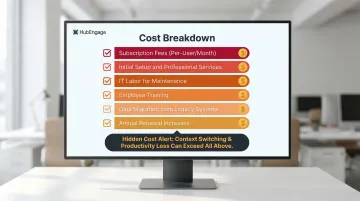
Cost drivers include:
- Subscription fees (per-user/month)
- Initial setup and professional services
- IT labor for maintenance
- Employee training
- Data migration from legacy systems
- Annual renewal increases
Organizations must also budget for hidden costs like context switching. Constantly toggling between different applications costs over 20 minutes to get back on track after being interrupted, with at least 45% of people less productive while context switching. A poorly integrated intranet that doesn't consolidate tools actually makes this problem worse.
Information Overload Risk
Without proper content governance and audience segmentation, an intranet can replicate the noise problem it was meant to solve. When every department treats it as a broadcast channel, employees get flooded with irrelevant updates and tune out entirely.
Security and Access Control Complexity
Because intranets contain sensitive HR and operational data, misconfigured permissions or inadequate security protocols can expose confidential information, particularly in organizations where roles change frequently. Managing role-based access and compliance with data protection regulations requires ongoing IT oversight and audit trail maintenance—gaps in any of these areas can create real liability.
What Happens When Companies Skip the Intranet (or Use an Outdated One)
Without a centralized intranet, compounding communication problems emerge. Employees rely on informal channels—group chats, word-of-mouth—for critical information, leading to inconsistent messaging, compliance risks, and confusion during organizational changes.
The cost of disengagement is substantial. Gallup's 2023 State of the Global Workplace report found that employees who are not engaged or actively disengaged cost the world $8.8 trillion in lost productivity, equal to 9% of global GDP.
Regulatory exposure is another serious consequence. When employees route work conversations through personal apps, organizations lose the audit trail regulators require. Recent enforcement actions illustrate the stakes:
- In 2025, the UK's Financial Conduct Authority reviewed 11 wholesale banks and identified 178 breaches of internal communication policies via off-channel communications, with 41% involving senior managers
- The SEC has heavily penalized financial institutions for failing to preserve work-related communications on employees' personal devices, treating those records as the primary means of monitoring compliance
The risks don't disappear just because an intranet exists. Legacy platforms—outdated SharePoint deployments, rarely updated portals—create many of the same problems. Employees distrust the content, stop visiting, and the platform becomes a liability rather than an asset.
How to Get the Most Value from Your Company Intranet
Intranet ROI is not automatic—it depends on three operational disciplines:
1. Consistent content governance
Assign content owners per department, establish a review cadence, and enforce unpublishing processes for outdated pages. Nielsen Norman Group found that employees completed tasks significantly faster on intranets following a centralized content-management model (average 78 seconds) compared to a distributed model (average 123 seconds).
2. Multi-channel reach
Successful intranets extend beyond desktop web portals to include mobile apps, SMS notifications, and digital signage. Frontline and remote employees need the same access as office workers — channel diversity is what makes that possible.
3. Measurable engagement tracking
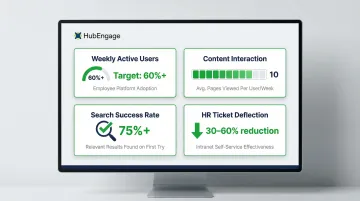
Track adoption with purpose, not just volume. Review engagement analytics quarterly to identify where participation is falling short. Standard KPIs include:
- Weekly Active Users (WAU): Target 60%+ of employees
- Content interaction: 10 pages viewed per user per week
- Search success rate: At least 75%
- HR ticket deflection: 30-60% reduction in routine support tickets
Adoption ultimately determines whether an intranet delivers value or collects digital dust. Platforms built around gamification, personalized news feeds, and mobile-first access outperform traditional static portals because they give employees a reason to return. HubEngage takes this further with platform-wide gamification — applied across communications, recognition, surveys, and learning — designed to drive sustained participation, not just first-week logins.
Treat the intranet as an ongoing program rather than a one-time deployment. Technology alone doesn't create engagement—intentional design, consistent governance, and measurement do.
Frequently Asked Questions
What is the purpose of a company intranet?
A company intranet serves as a centralized internal platform for communication, information access, HR self-service, and employee engagement. It keeps employees informed and connected regardless of location or role.
What are the benefits of a company intranet?
Core benefits include streamlined internal communication, faster access to information, improved employee engagement and recognition, support for distributed workforces, and reduced reliance on fragmented tools like email chains and shared drives.
How do intranets benefit employees within an organization?
Intranets give employees self-service access to HR resources, visibility into company news and leadership updates, tools to connect with peers, and a single place to find what they need without interrupting colleagues or managers.
Are intranets still relevant today?
Yes, modern intranets are more relevant than ever, particularly for organizations with remote, hybrid, or frontline workforces. Current platforms now include AI search, mobile apps, gamification, and multi-channel communication — a far cry from the static portals of a decade ago.
What is the benefit of communicating with staff through the use of the intranet?
Intranet-based communication reaches employees across locations simultaneously and creates a documented, searchable record of announcements. It also enables two-way dialogue through comments and surveys, improving message consistency in ways email or verbal communication rarely achieves.
How much does a company intranet cost?
Costs vary widely depending on platform, company size, and feature requirements—ranging from basic deployments to enterprise platforms with AI, mobile, and integrations. For example, Microsoft Viva Suite starts at $12.00 per user/month, while enterprise platforms with broader capabilities typically require custom quoting. Factor in licensing, setup, administration, and training when comparing options.