Introduction
The modern workforce has transformed significantly: remote teams, distributed locations, and frontline-heavy operations now define how most organizations operate. This shift has exposed critical weaknesses in traditional top-down communication models, where emails go unread, intranet portals sit unused, and critical information never reaches the employees who need it most.
The business case for internal social networking platforms shows up in hard metrics: lower turnover costs, faster information flow, and stronger organizational culture. According to Grammarly's 2023 State of Business Communication report, poor communication costs U.S. businesses $1.2 trillion annually—roughly $12,506 per employee.
Those numbers make the investment decision straightforward for most HR and communications leaders.
This article breaks down the concrete investment rationale: the business case, the KPIs affected, and what companies risk when they leave this communication gap unaddressed.
Key Takeaways
- Internal social networking platforms create private, secure digital spaces for employee communication and collaboration
- Companies invest to close communication gaps, boost engagement, and retain institutional knowledge across dispersed teams
- ROI is tangible: lower turnover, faster information reach, higher participation rates, and consolidated tool costs
- Without a dedicated platform, teams fragment across disconnected tools — and engagement quietly erodes
- Platforms that pair multi-channel reach with gamification and AI see the strongest adoption and measurable returns
What Is an Internal Social Networking Platform?
An internal social networking platform is a private, organization-only digital space where employees communicate in real time, share updates, join groups, collaborate on projects, and access company information—without the noise or risk of public social media.
These platforms serve organizations across industries and workforce types:
- Office and remote teams needing a central communication hub
- Frontline workers in manufacturing, retail, and hospitality
- Distributed staff across hospitals, service venues, and field sites
Wherever employees work, internal social networks ensure information travels fast and reaches everyone who needs it.
The platform is infrastructure, not an end in itself. What organizations are really after is better communication, stronger culture, and employees who feel connected to the company. Internal social networks make those outcomes achievable at scale—especially for organizations where email alone fails to reach large portions of the workforce.
Key Reasons Companies Are Investing in Internal Social Networking Platforms
Each reason below ties directly to measurable operational or business outcomes. The investment is driven by cost reduction, efficiency gains, retention improvement, and competitive pressures—not cultural trends.
Breaking Down Communication Silos Across a Distributed Workforce
In organizations with remote, hybrid, or frontline employees, critical information routinely fails to reach the people who need it. Email chains don't reach deskless workers, intranet portals go unvisited, and informal knowledge stays trapped in departments.
A centralized, searchable, real-time communication layer—accessible via mobile, web, or digital displays—ensures a single message reaches every employee in their preferred format simultaneously. That matters when the alternative is fragmented tools that leave critical information stranded.
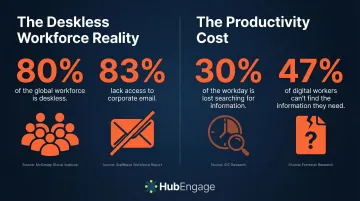
The productivity cost of fragmentation is well-documented. Research from IDC found that knowledge workers lose up to 30% of their workday (2.5 hours) searching for information across disconnected systems. Gartner puts the problem in sharper relief: 47% of digital workers can't find the information they need to do their jobs effectively.
The gap hits hardest for deskless employees. 80% of the global workforce is deskless, yet 83% of those workers lack a corporate email address. In industries where safety protocols and compliance updates are non-negotiable, that exclusion creates real operational risk—not just inconvenience.
KPIs impacted:
- Message delivery and read rates
- Time-to-information for frontline teams
- Compliance incident rates
- Reduction in communication tool spend
- Intranet adoption rates
This matters most in manufacturing, healthcare, retail, and hospitality—any setting where shift-based or geographically dispersed teams can't rely on email as a primary channel.
Driving Employee Engagement, Retention, and Workplace Culture
Employee engagement isn't just about satisfaction surveys—it's about whether employees feel connected, recognized, and part of something larger than their individual role. Internal social networking platforms directly influence this by giving employees a voice, a community, and visibility into the organization.
Social feeds, peer recognition, interest-based groups, and two-way communication tools replace passive top-down broadcasting with daily participation. Culture becomes something employees experience—not just a statement in the employee handbook.
The financial stakes are significant. Gallup's 2025 State of the Global Workplace report shows global engagement fell to just 21% in 2024, costing the global economy $8.9 trillion in lost productivity. In the U.S., disengaged employees account for an estimated $1.9–$2 trillion in annual productivity loss.
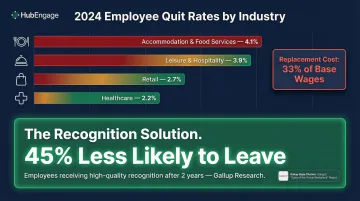
Turnover compounds the problem. BLS JOLTS data for 2024 shows annual quit rates running high across key industries:
- Accommodation and food services: 4.1%
- Leisure and hospitality: 3.9%
- Retail trade: 2.7%
- Healthcare: 2.2%
With the Work Institute estimating replacement costs at 33% of base wages, even a modest reduction in voluntary turnover delivers measurable financial return.
Recognition mechanics accelerate that return. Platforms using gamification—points, badges, and leaderboards tied to participation—drive sustained adoption beyond initial rollout. Peer-reviewed research confirms that game design elements improve competence satisfaction and perceived task meaningfulness. And Gallup found that employees receiving high-quality recognition are 45% less likely to have left after two years.
KPIs impacted:
- Employee engagement scores
- Voluntary turnover rate
- eNPS (employee Net Promoter Score)
- Participation rates in company programs
- Peer recognition frequency
- Time-to-productivity for new hires
This pays off fastest in high-turnover environments or organizations managing multi-location workforces where employees rarely interact with leadership directly—retail, hospitality, and healthcare being the clearest examples.
Accelerating Knowledge Sharing and Reducing Operational Drag
Organizations bleed institutional knowledge when it stays trapped in departments, buried in email threads, or disappears when experienced employees leave. Internal social platforms create a living knowledge layer—searchable, persistent, and accessible to everyone.
Threaded discussions, searchable group archives, document sharing, and AI-powered search let employees find answers without escalating to a manager or submitting a help ticket. That reduction in bottlenecks compounds across every team, every day.
The productivity opportunity is larger than most organizations realize. Beyond the 2.5 hours lost daily to information search, employees spend an estimated 28% of their workweek managing email—much of it redundant. Harvard Business Review research puts the total cost of knowledge mismanagement at an average of 25% of annual revenue.
AI-powered search closes that gap faster than traditional knowledge bases. The results from early adopters are concrete:
- Forrester's TEI study of Zendesk's AI knowledge base found organizations automated 30% of inquiries, cut handle time by 3 minutes per interaction, and reduced new hire onboarding time by 67%
- SAP customers using Coveo AI Search achieved 80%+ self-service success rates
Both outcomes feed directly into onboarding efficiency. APQC benchmarking data puts the median new hire time-to-productivity at 35.5 calendar days—a number that drops significantly when institutional knowledge is searchable and accessible from day one.
KPIs impacted:
- Average time to find internal information
- Help desk ticket volume
- New hire time-to-productivity
- Knowledge retention rate after employee departures
- Reduction in redundant email volume
Fast-growing organizations onboarding at scale, companies with skilled-role turnover, and teams where cross-functional collaboration drives delivery will feel this impact most acutely.
What Happens When Companies Skip This Investment
Organizations relying on fragmented or legacy communication tools face compounding consequences. Email overload, messages that never reach frontline workers, critical updates buried in inboxes, and knowledge siloed in departments with no shared access point — these aren't isolated inefficiencies. They're patterns that erode performance, culture, and compliance simultaneously.
Fragmentation Is Getting Worse, Not Better
Gartner found that the average desk worker uses 11 applications daily, up from 6 in 2019. Microsoft's 2025 Work Trend Index reveals that employees are interrupted every 2 minutes by meetings, emails, or pings—totaling 275 interruptions per day. This fragmentation doesn't just frustrate employees; it creates measurable productivity loss and operational risk.
The Downstream Costs Add Up Fast
Disengagement compounds into attrition, attrition drives up hiring costs, and poor communication leads to slower decision-making and a culture where employees feel uninformed and disconnected from leadership. According to a 2023 study, 86% of employees and executives cite poor collaboration and communication as a key reason for workplace failure.
Recruiting Suffers Too
The communication gap also shows up in hiring. Deloitte's 2025 Gen Z and Millennial Survey found that 44% of Gen Zs and 45% of millennials have left a role they felt lacked purpose, and roughly 40% have rejected potential employers based on personal ethics or beliefs — including how companies treat and communicate with their employees.
The cultural signal companies send through their internal infrastructure matters to candidates before they even apply.
Regulated Industries Face the Steepest Penalties
Poor internal communication infrastructure creates severe operational risks where compliance is non-negotiable. The May 2024 ransomware attack on Ascension hospitals locked providers out of electronic health records, forcing staff to revert to paper workflows and resulting in delayed lab results, medication errors, and lapses in patient safety checks.
In financial services, the SEC and FINRA levied over $3 billion in combined penalties between 2021 and 2025 against firms for off-channel communication recordkeeping failures. When communication infrastructure is left unmanaged, the costs aren't just operational — they're regulatory.
How to Get the Most from Your Internal Social Networking Platform
The investment pays off not from deploying the platform, but from how consistently it's adopted and actively used. Adoption requires the platform to meet employees where they are—mobile-first, multi-channel—rather than requiring them to adjust to the tool.
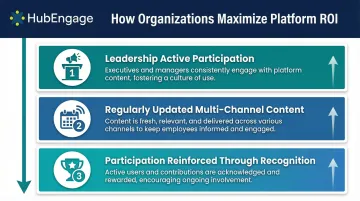
Organizations see the highest returns when three behaviors are consistent:
- Leadership actively participates – Leaders must visibly use the platform, share updates regularly, and demonstrate its strategic importance
- Content is regularly updated across channels – Employees need fresh, relevant content that makes checking the platform worthwhile
- Participation is reinforced through recognition – Gamified incentives that reward employees for engaging with updates, completing surveys, or sharing knowledge build consistent habits
Those behaviors only stick when the platform itself removes friction. Platforms that combine multi-channel reach (mobile, web, email, SMS, digital displays), gamification, and AI-powered search consistently outperform single-channel tools on adoption. HubEngage, for instance, combines internal social networking with communications, recognition, surveys, and AI-assisted search in one platform—auto-formatting content for each channel so employees access it through whichever method they already use. For frontline and distributed teams, that kind of seamless access is often the difference between a tool people use and one they ignore.
Conclusion
Investing in internal social networking platforms is, at its most practical level, investing in organizational effectiveness: reaching every employee, building a connected culture, and stopping the compounding costs of disengagement before they accumulate.
The gains compound over time. Companies that start with consistent internal communication see improvements in engagement first, then retention, then productivity — each building on the last as more employees rely on the platform as their primary connection to the organization.
The stakes are concrete: poor communication costs the U.S. economy $1.2 trillion annually, and global disengagement costs $8.9 trillion. Platforms like HubEngage exist precisely to close that gap — giving HR and communications teams the tools to reach every employee, regardless of role or location, before those costs take hold.
Frequently Asked Questions
What is an internal social network?
An internal social network is a private, secure digital platform restricted to an organization's employees, designed for communication, collaboration, and knowledge sharing. Unlike public social media, it operates within controlled security parameters and focuses exclusively on workplace connections and organizational information.
What are the benefits of internal social networking platforms for companies?
Key benefits include improved communication reach (especially for frontline workers without email access), stronger employee engagement and culture, reduced knowledge silos, faster information discovery, and lower costs from consolidating fragmented communication tools into a single platform.
What is the role of social media in internal communication?
Internal social media brings familiar engagement mechanics—feeds, groups, reactions, messaging—into a secure workplace context. This makes communication feel participatory rather than passive, which means employees are far more likely to read, react to, and act on company information rather than scroll past it.
What are the advantages of using social networking for a business?
Advantages include breaking down departmental silos, enabling real-time peer-to-peer and top-down communication, and capturing institutional knowledge in searchable formats. Together, these create a culture of transparency that supports retention and productivity while reducing the drag of information fragmentation.
What is an example of an internal social network?
Examples include Microsoft Viva Engage (formerly Yammer), Workplace by Meta, Slack, and all-in-one platforms like HubEngage. The best choice depends on whether the organization needs a standalone messaging tool or a unified platform that combines communications, recognition, and engagement in one place.
What are the 3 C's of engagement?
The 3 C's of engagement are Connection, Contribution, and Communication. Internal social networking platforms support all three — employees gain a community, a voice, and reliable channels to stay informed about what matters most to the organization.