Introduction
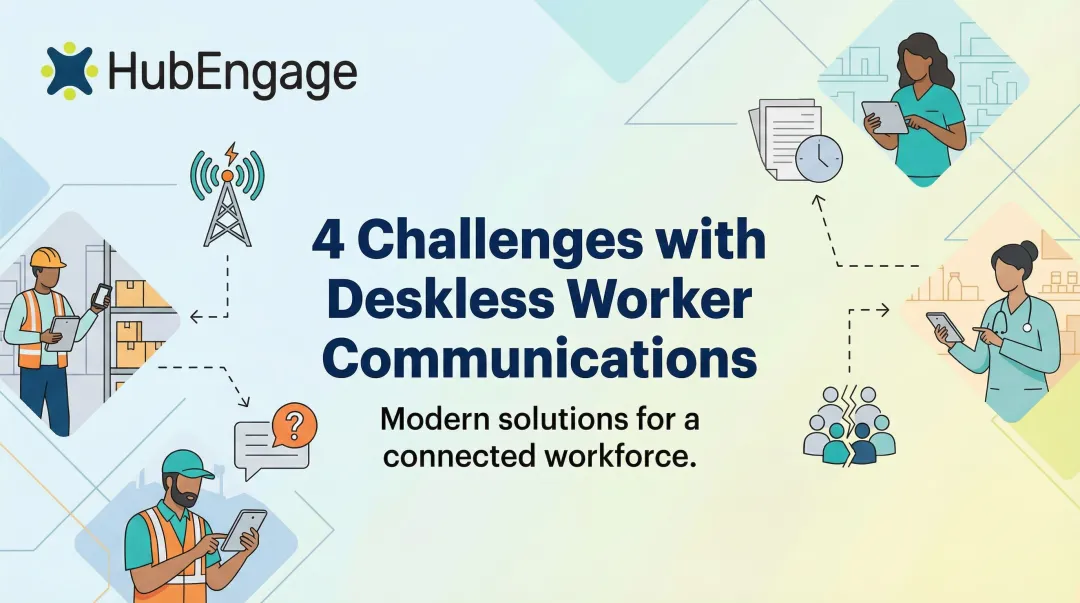
Roughly 80% of the global workforce—approximately 2.7 billion people—doesn't sit at a desk to do their jobs. Yet most employee engagement strategies are designed for office workers with email access, desktop computers, and predictable 9-to-5 schedules. The result is a costly blind spot: organizations invest heavily in engagement tools that never reach the majority of their workforce, leaving frontline employees feeling invisible and disconnected from company culture.
The consequences are measurable. Gallup's research shows that business units in the top quartile of engagement see an 81% reduction in absenteeism, a 64% reduction in safety incidents, and a 23% increase in profitability compared to the bottom quartile.
Yet frontline workers are precisely the group most disconnected from these gains. Only 29% of deskless workers are satisfied with their internal communications, compared to 47% of desk-based employees — a gap that shows up directly in retention, safety, and performance.
What follows covers why deskless engagement is uniquely challenging — and the practical, research-backed strategies HR and communications leaders can implement immediately to fix it.
Key Takeaways
- Deskless workers represent 80% of the global workforce but face significant communication barriers and cultural disconnection
- Office-centric engagement tools fail frontline employees who lack desktop access or work non-standard hours
- Effective strategies include mobile-first platforms, gamified recognition, two-way feedback, and leadership visibility
- Reaching workers via mobile app, SMS, and digital signage ensures no message gets missed
- Track app engagement, recognition activity, and operational outcomes to measure what's working
Who Are Deskless Workers and Why Their Engagement Matters
Deskless workers are employees who perform their jobs at a physical location or on the move and do not require a desk or computer to complete their core tasks. This population includes:
- Manufacturing and warehouse workers
- Nurses and healthcare professionals
- Retail associates and cashiers
- Hotel staff and hospitality workers
- Truck drivers and delivery personnel
- Construction workers
- Field service technicians
- Restaurant and food service employees
The Business Case for Frontline Engagement
Deskless employees are often the customer-facing representatives of a brand. Their engagement level directly determines customer experience quality, safety compliance, and operational efficiency. The data proves the connection:
| Business Outcome | Performance Difference (Top vs. Bottom Quartile Engagement) |
|---|---|
| Absenteeism | 81% reduction |
| Safety Incidents | 64% reduction |
| Quality Defects | 41% reduction |
| Profitability | 23% increase |
| Productivity | 18% increase |
| Turnover | 18% reduction |
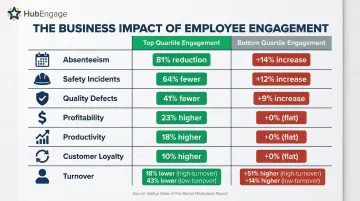
Source: Gallup Q12 Meta-Analysis (112,312 business units, 2.7 million employees)
The Joy Gap
Boston Consulting Group research shows that enjoying work meaningfully reduces deskless worker attrition — yet most frontline employees aren't there yet. The key findings:
- Enjoying work cuts deskless worker attrition by 62%, vs. 49% for office workers
- Non-manager frontline employees score 10% lower on joy and carry a 9% higher attrition risk than their managers
- Nearly 75% of their time goes to "neutral" tasks — neither fulfilling nor frustrating — where small redesigns to how work is structured and recognized can shift engagement measurably
Why Deskless Employee Engagement Is Uniquely Challenging
Shift-Based Schedules Fragment Communication
Unlike office workers who share common schedules and physical spaces, deskless employees operate across different shifts, locations, and time zones. Colleagues may never meet face-to-face, making community-building and consistent communication genuinely difficult. A message sent during first shift may never reach third shift workers, creating information gaps that erode trust and engagement.
The Technology Access Gap
Most engagement tools assume employees have desktop or laptop access. Deskless workers often don't. According to research, 62% of deskless workers are dissatisfied with their workplace technology, and 65% received no new tech during the pandemic. Additionally, 78% consider technology availability when choosing a job, making inadequate tools a primary driver of turnover.
Disconnection from Leadership and Culture
Deskless employees rarely interact with senior leadership or corporate headquarters. Without regular exposure to company mission, vision, and values, they feel invisible. A 2025 Staffbase study found that only 29% of non-desk employees are satisfied with internal communication quality.
That gap shows up in how workers actually receive information. Axonify's 2024 research shows only 74% of frontline employees find organizational communication helpful, compared to 89% of managers and executives.
Top-Down Communication Structure
Many frontline environments still rely on bulletin boards, printed memos, or manager word-of-mouth. The consequences compound quickly:
- Messages arrive inconsistently depending on which manager delivers them
- Employees have no channel to share concerns or ideas upward
- Critical updates get filtered, delayed, or lost between shifts
- Two-way feedback is structurally absent
High-Toil, Low-Joy Work Composition
BCG research shows that deskless individual contributors spend more time on low-joy tasks compared to managers. A large portion of their work sits in a "neutral" zone—neither enjoyable nor unpleasant—a design problem, not a workforce problem. Small shifts in how tasks are structured, recognized, or contextualized can meaningfully change how that work feels.
Proven Strategies to Boost Deskless Employee Engagement
Prioritize Mobile-First, Multi-Channel Communication
Reaching deskless workers requires meeting them on devices they already use—their personal mobile phones—rather than expecting them to log into desktop systems. A mobile-first strategy includes:
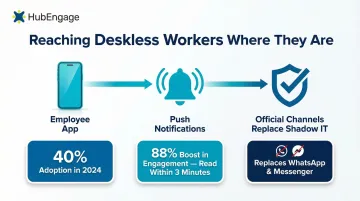
- Dedicated employee apps that create a consistent communication home base on iOS and Android, accessible anytime. Company-provided app usage grew to 40% in 2024, up from 15% in 2023.
- Push notifications that boost employee app engagement by 88%, with 65% of users returning to an app when push is enabled. Messages are typically read within three minutes—versus 22% of emails. Use SMS for shift changes, safety warnings, and urgent alerts.
- Official channels that displace shadow IT: Despite growing adoption, 28% of retail workers still use WhatsApp or Facebook Messenger to coordinate with colleagues—creating compliance risks and information silos that official tools eliminate.
Implement Gamified Recognition Programs
A 2024 study in ScienceDirect found that game mechanics—points, badges, leaderboards, progress bars—significantly improved knowledge retention and job performance among 110 employees on a gamified training platform. The takeaway: making participation feel rewarding drives better results than making it mandatory.
Build recognition across two layers:
- Manager-to-employee recognition — shoutouts, spot awards, and milestone acknowledgments that tie individual contributions to company values
- Peer-to-peer recognition — public appreciation from coworkers that gives deskless employees visibility they rarely get otherwise. Gallup and Workhuman research tracking nearly 3,500 employees found that well-recognized employees were 45% less likely to turn over after two years and 65% less likely to be actively job hunting.
Create Two-Way Feedback Channels
One-directional communication fails frontline workers. Without mechanisms to voice concerns, share ideas, or report issues, deskless employees disengage quickly. Practical tools include:
- Pulse surveys: Quick, regular check-ins that measure sentiment and identify concerns before they become crises
- Anonymous feedback channels: Digital suggestion boxes that encourage honest input without fear of repercussion
- Mobile-accessible forms: Surveys and feedback tools that work on phones, not just desktops
Close the loop. Collecting feedback means nothing unless employees see what leadership heard and what changed as a result. Without visible action, trust erodes and participation drops.
Equip and Empower Frontline Managers
Direct supervisors are the most important communication channel for deskless workers. Employees want to hear important information from their direct manager, not just corporate broadcasts. However, leaving message delivery entirely to managers without support creates variability in communication style, thoroughness, and timing.
Give managers a system—not just an expectation:
- Communication toolkits with key messages and talking points
- Easy-to-use digital tools for cascading announcements
- Templates that ensure consistency across locations
- Training on facilitating two-way conversations
That structure lets managers deliver messages consistently while adding team-specific context and answering questions their people actually care about.
Increase Leadership Visibility
Close the gap between the C-suite and frontline workers through:
- Regular video messages: Short, authentic updates from executives that humanize leadership
- Virtual town halls: Mobile-accessible Q&A sessions where employees can submit questions
- Leadership site visits: In-person appearances at frontline locations that signal respect and interest
- Ask-me-anything sessions: Open forums that make executives accessible and transparent
When executives show up—literally or digitally—frontline workers get a concrete signal that decisions aren't made in a vacuum.
Redesign Work to Reduce Toil and Increase Meaning
BCG found that a significant portion of deskless work sits in a "neutral" category—neither enjoyable nor unpleasant. Small operational redesigns can shift this balance:
- Rotate tasks to reduce monotony and build new skills
- Enable more employee-customer interaction for relationship-building
- Provide visible connections between daily tasks and company mission
- Involve employees in process improvement decisions
- Recognize contributions that directly impact customer satisfaction
Building a Multi-Channel Communication Stack for Deskless Teams
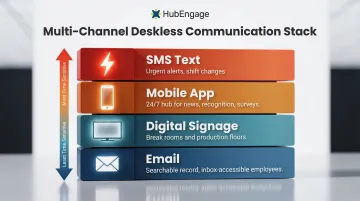
No single channel reaches every deskless worker reliably. An effective engagement strategy requires multiple coordinated touchpoints:
- Mobile app — the daily hub for news, peer recognition, surveys, and resource access, available 24/7 for shift workers who need information after hours
- SMS text messaging — delivers shift changes, safety warnings, and urgent announcements that need immediate attention, even if employees haven't opened the app
- Digital signage — displays announcements in break rooms, production floors, and common areas, reinforcing mobile messages during shift transitions
- Email — serves employees with occasional inbox access and creates a searchable record of official communications
The Value of Platform Consolidation
Managing multiple tools creates complexity and cost. A 2024 Forrester Total Economic Impact study analyzing a composite organization with 60,000 employees (75% frontline) found that consolidating legacy systems into a unified platform yielded 228% ROI over three years, including:
- $7.8 million in legacy system savings from retiring outdated intranets, translation services, and survey tools
- $2.4 million from a 0.5% improvement in frontline retention and reduced recruitment costs
- $1.7 million in efficiency gains from 50% time savings for HR and communications teams
Those savings come directly from eliminating tool fragmentation. HubEngage consolidates communications, recognition, surveys, and gamification into one platform that reaches frontline teams via mobile, SMS, digital displays, and more. Content auto-formats for each channel, so HR publishes once and every touchpoint updates automatically—no manual republishing required.
AI-Powered Assistance
AI-powered assistants help employees instantly find HR policies, schedules, and company resources without calling a manager or searching outdated documents. For shift workers, that means getting answers at 11 PM without waiting for a manager's callback. Research shows that 75% of frontline workers are dissatisfied with their workplace technology—making reliable, self-service access a measurable advantage in both retention and daily productivity.
How to Measure the Success of Your Deskless Engagement Program
Track the Right Metrics
Unlike office workers where email open rates are meaningful, deskless engagement measurement should include:
- Login frequency across your app or platform — a baseline signal of daily adoption
- Push notification open rates, showing whether critical messages are actually reaching workers
- Pulse survey response rates, which indicate how willing employees are to share feedback
- Peer recognition volume, tracking how often employees acknowledge each other's contributions
- Content interaction rates, revealing which announcements and updates employees actually engage with
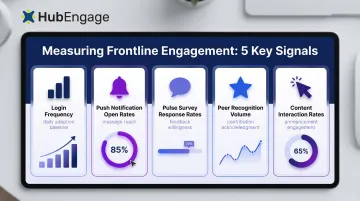
These metrics provide a real-time view of engagement health rather than waiting for annual surveys.
Connect Engagement to Operational Outcomes
Tracking these signals matters most when they connect to business results. Gallup's research shows that highly engaged workforces deliver measurable operational improvements:
- 81% reduction in absenteeism
- 64% reduction in safety incidents
- 41% reduction in quality defects
- 18% improvement in productivity
Turnover is another direct measure. According to the U.S. Bureau of Labor Statistics, voluntary quit rates vary significantly by industry:
| Industry | Monthly Quit Rate |
|---|---|
| Leisure and Hospitality | 4.3% |
| Retail Trade | 2.7% |
| Total Private Average | 2.2% |
| Construction | 1.7% |
| Manufacturing | 1.3% |
If your frontline turnover exceeds these benchmarks, engagement improvements can deliver substantial cost savings through reduced recruitment and training expenses.
Build a Feedback Cadence
Consistent measurement requires a structured cadence — not just one-off surveys when problems surface:
- Quarterly pulse surveys to catch emerging issues before they escalate
- Monthly platform analytics reviews to spot trend shifts and adjust tactics quickly
- Annual engagement audits for comprehensive year-over-year benchmarking
When these three rhythms work together, you move from reacting to problems after the fact to spotting the early signals — and addressing them while there's still time to act.
Frequently Asked Questions
What are deskless workers?
Deskless workers are employees who perform their jobs at a physical location or on the move and don't require a desk or computer—including nurses, retail associates, manufacturing workers, truck drivers, and hospitality staff. They represent approximately 80% of the global workforce.
What are the top 5 drivers of employee engagement?
The five most commonly cited drivers are:
- Clear communication from leadership
- Recognition and appreciation
- A sense of belonging and community
- Opportunities for growth and development
- Feeling that one's work has meaning and impact
For deskless workers, all five require deliberate delivery through channels they can actually reach.
How do you communicate with employees who don't have access to email?
Use mobile-first alternatives: SMS text alerts, a dedicated employee app, push notifications, and digital signage in shared spaces. Frontline managers can also relay key messages directly. Choose channels based on where employees actually spend their workday.
What is the biggest challenge in managing a deskless workforce?
Communication access and cultural disconnection are the core challenges. Without a shared digital workspace, deskless workers can feel invisible to the organization—which drives disengagement and turnover when left unaddressed.
How does gamification help engage frontline workers?
Gamification applies mechanics like points, badges, leaderboards, and challenges to communication, training, and recognition—making participation feel rewarding rather than obligatory. For deskless employees who often feel overlooked, it creates a consistent, visible sense of progress that sustains engagement over time.
How can HR measure employee engagement for deskless workers?
Track practical metrics including app engagement rates, pulse survey participation, peer recognition activity, absenteeism trends, and voluntary turnover rates. These operational signals often provide a more accurate picture of frontline engagement than traditional annual survey methods .