Introduction
Most engagement surveys fail not because organizations struggle to collect data, but because nothing meaningful happens after results arrive. Survey dashboards fill with scores, comments pile up in spreadsheets, and employees wait for change that never comes. The real challenge isn't the survey itself—it's what happens next.
Without a structured action plan, survey data becomes a trust-eroding exercise. Research shows that 65% of employees say their organizations fail to take effective action on survey results, and more than 1 in 4 U.S. workers report there's no follow-up whatsoever. When employees share honest feedback and see nothing change, cynicism grows and future participation drops.
This article walks through exactly how to build an action plan that converts survey findings into visible workplace improvements—from preparing before results arrive, to executing step-by-step changes, to avoiding the common mistakes that stall progress.
Key Takeaways
- An action plan converts survey findings into prioritized, time-bound commitments with clear owners—without one, surveys are wasted effort
- Key steps: analyze results collaboratively, limit focus to 1-3 priority areas, assign clear owners, and communicate the plan company-wide
- Action plans fail most often due to lack of communication, unclear ownership, and trying to fix everything at once
- Sustained follow-up via pulse surveys and progress updates is what separates organizations that improve engagement from those caught in survey-fatigue cycles
What to Prepare Before Building Your Action Plan
Preparation determines how quickly and credibly an organization can move from results to action. Organizations that deliver results to managers within two weeks maintain stronger trust in leadership than those that take a month or more. Delays erode confidence regardless of data quality—employees interpret silence as indifference.
Stakeholders to Involve Early
Identify who needs to participate in action planning before the first meeting:
- HR leadership for organization-level themes and systemic issues
- Department managers for team-specific priorities and frontline context
- Employee representatives or champions to ground decisions in day-to-day reality and surface root causes
Data You Need Ready
Gather these data inputs before your first action planning session:
- Overall survey scores by category/driver (recognition, growth, communication, safety, belonging)
- Department or team breakdowns showing where scores vary
- Comment themes summarized by topic
- Year-over-year trend comparisons (if available)
- Demographic cuts revealing disparate experiences across employee segments
With this data ready, discussions stay focused and teams can move to prioritization without waiting on follow-up pulls.
How to Create an Employee Engagement Survey Action Plan: Step-by-Step
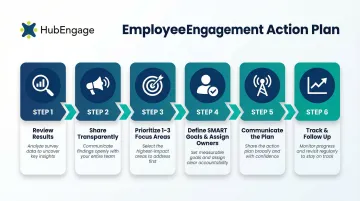
Step 1: Review and Analyze Results as a Leadership Team
Before sharing results broadly, HR and leadership should review findings across key engagement drivers—recognition, growth, communication, safety, belonging, and others. Look for patterns, not just low scores. Distinguish between organization-wide issues that require systemic change and team-specific challenges that individual managers can address.
Separate what's within leadership's direct control from what requires budget, resources, or structural decisions. This distinction shapes what gets added to the action plan and prevents teams from committing to changes they can't realistically deliver.
Step 2: Share Results Transparently with All Employees
Timely communication of survey results matters more than most organizations realize. Employees who submitted feedback expect to see it acknowledged, even when results are unflattering. Timely communication of survey results matters more than most organizations realize. Employees who submitted feedback expect to see it acknowledged, even when results are unflattering. Only 71% of employees say their organization shares survey results, and just 51% report seeing actual improvements.
A strong results-sharing communication includes:
- Summary of key themes—both strengths and opportunities
- Leadership's honest interpretation of what the data reveals
- Commitment to follow-up with specific timelines
- Acknowledgment of areas where scores fell short
Avoid score dumps without context. Employees need to understand what the numbers mean and what the organization plans to do about them.
Step 3: Prioritize 1-3 Focus Areas Collaboratively
Trying to act on every low-scoring area simultaneously dilutes resources and leads to superficial change. Best practice is limiting the action plan to 1-3 high-impact focus areas per cycle.
Use these criteria to narrow your focus:
- Areas with the lowest scores that impact day-to-day employee experience
- Issues with the highest business impact (turnover, productivity, customer satisfaction)
- Changes that are realistically achievable within the plan window (3-6 months)
Involve employees and managers in this prioritization through team discussions or focus groups. Bottom-up input ensures you're addressing root causes, not just what leadership thinks matters.
Step 4: Define SMART Goals and Assign Clear Ownership
Apply the SMART framework (Specific, Measurable, Achievable, Relevant, Time-bound) to every action item. Instead of "improve communication," the goal becomes "launch bi-weekly manager-led team updates for all departments by March 15, with completion tracked monthly."
Each action item must have a named owner—not a department, but an individual. Organizations that equip managers to create and track specific action plans see engagement gains in 59% of cases, compared to just 28% for those without structured ownership.
Consider assigning non-manager team members as Action Item Leaders (AILs) to build grassroots accountability:
- AILs take ownership of specific deliverables, reducing burden on managers
- They confirm resources are in place before deadlines, not after
- Their involvement signals that action isn't just a leadership exercise
Step 5: Communicate the Action Plan to Every Employee
Once ownership is set, the plan needs to reach everyone—not just those with inboxes. Cover what was heard, what the organization will do about it, who is responsible, and by when—through channels that reach desk-based and deskless employees equally.
Challenge: 60% of frontline workers ignore corporate emails, and many lack regular access to intranet systems. Organizations with distributed or shift-based workforces face significant barriers to ensuring everyone receives the same message.
Platforms like HubEngage address this by pushing communications simultaneously across mobile apps, email, SMS, digital displays, and web. Frontline and distributed employees get the same message as corporate teams—without relying on managers to manually pass it down the chain.
Step 6: Track Progress and Follow Up Consistently
Communicating the plan is only the start. Without visible follow-up, employees reasonably assume nothing has changed. Ongoing follow-up looks like this in practice:
- Monthly or quarterly check-ins with action item owners
- Visible progress updates shared back to employees
- Documentation of what's been completed versus what's still in progress
- Adjustments when initiatives aren't delivering expected results
Use pulse surveys as a quick tool to measure whether actions are shifting employee perception over time. A 3-5 question pulse sent 60 or 90 days after plan launch signals whether interventions are landing or need refinement.
Key Variables That Determine Whether Your Action Plan Succeeds
Even well-designed action plans regularly fail—not because intentions were wrong, but because a handful of controllable factors were overlooked.
Communication Frequency and Reach
A one-time announcement of the action plan is rarely enough. Employees need repeated, multi-format touchpoints to stay aware of progress. Silence between plan launch and visible outcomes creates the perception that nothing is happening, eroding trust built during the survey process.
The gap is especially pronounced for frontline, shift-based, and distributed workers. 72% of frontline workers do not fully understand their company's strategy, and many prefer hearing updates from their direct manager rather than a head-office broadcast.
Multi-channel strategies—mobile apps, SMS, digital signage, and manager-led team meetings—ensure everyone stays informed regardless of work location.
Accountability Structures
Action plans that assign vague departmental responsibility ("HR will address this") produce notably lower completion rates than plans with named individual owners and defined reporting checkpoints. Assigning specific Action Item Leaders (AILs) to individual goals is the top predictor of future team engagement.
Clear accountability means everyone knows:
- Who owns each initiative
- What success looks like for that initiative
- When progress will be reviewed and reported
Psychological Safety Around Feedback
Employees will only engage authentically with action planning discussions if they trust that their input was confidential. 47% of employees say they often or occasionally feel pressured to withhold feedback when completing engagement surveys, and 37% do not believe surveys are ever truly anonymous.
Leaders must actively reinforce confidentiality—especially when discussing sensitive themes from survey comments. Avoid speculation about who said what, and focus on patterns rather than individual responses.
Leadership Visibility and Commitment
Action plans carry more weight when senior leaders are visibly involved, not just HR. In 2025, confidence in senior leadership claimed a top spot as a driver of employee engagement, and 82% of respondents say the CEO is ultimately responsible for trust leadership at the company.
CEOs and business heads should communicate results, own specific initiatives, and reference survey actions in all-hands meetings or company-wide messages. When engagement improvement is siloed in HR rather than modeled by executives, it signals that the work isn't a true business priority.

Common Mistakes That Undermine Survey Action Plans
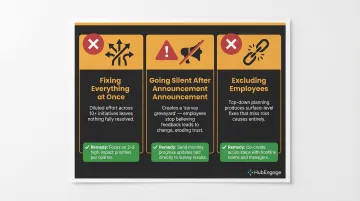
Even well-intentioned action plans fail. These are the three patterns that consistently get in the way:
Trying to fix everything at once: Action plans with 10+ initiatives signal a lack of prioritization to employees. Spreading organizational effort across too many items means none achieve meaningful progress before the next survey cycle — pick two or three issues and address them thoroughly.
Announcing the plan but going silent: The "survey graveyard" dynamic occurs when organizations share results and a plan, then never update employees on progress. This erodes trust faster than not having shared anything at all. Silence signals that the plan was performative, not genuine.
Excluding employees from the process: Action plans built entirely by HR and senior leadership without employee input often address surface-level complaints rather than the underlying reasons people are disengaged. Structured team-level discussions are essential for accurate diagnosis and genuine buy-in.
How to Sustain Momentum After the Plan Launches
Most action plan momentum fades within 60–90 days without deliberate structures to keep it alive. Build regular progress reviews into existing meeting cadences — team standups, manager one-on-ones, all-hands meetings — so the plan stays visible without becoming a separate workstream.
Three practices make the difference between plans that stick and plans that stall:
Celebrate wins, including small ones. Recognition signals that the survey process leads to real change — and it drives future participation. The most memorable recognition most often comes from an employee's manager (28%), followed by a high-level leader or CEO (24%). HubEngage's recognition tools can spotlight teams or individuals whose contributions drove action plan outcomes, making progress visible across the organization.
Close the loop before the next survey launches. Send a formal update summarizing what was accomplished, what's still in progress, and what carries into the next cycle. This earns the trust needed for employees to keep giving honest feedback. When employees feel a company acts on feedback well, engagement more than doubles compared to workers who feel it isn't.
Frequently Asked Questions
What is the action plan for employee survey?
An employee survey action plan is a structured document that translates survey findings into specific initiatives with clear owners, deadlines, and success metrics. It turns survey findings into visible workplace improvements rather than stalling at the analysis stage.
What is the role of communication in employee engagement?
In the context of a survey action plan, communication ensures employees know their feedback was received, what will change as a result, and whether the organization followed through. That transparency is what builds lasting trust.
What is the difference between an engagement plan and a communications plan?
An engagement plan defines what changes will be made to improve the employee experience, while a communications plan defines how and when those changes (and progress updates) will be shared with employees. Both are necessary components of effective survey follow-up.
How many focus areas should an employee engagement action plan include?
Best practice is 1–3 priority areas per action plan cycle. Limiting scope improves execution quality and signals genuine commitment — too many initiatives at once dilutes all of them.
How long does it take to implement an employee engagement survey action plan?
The initial plan should be shared within two weeks of survey close to maintain trust. A full action plan cycle typically runs 3-6 months, with pulse surveys used mid-cycle to measure whether actions are having the intended effect.
How do you get managers involved in the action plan process?
Managers should receive team-level results, be equipped with discussion guides for team conversations, and own at least one action item. When managers have skin in the process, engagement improvement becomes a shared organizational effort — not a task delegated solely to HR.