Introduction
Despite growing investment in employee wellness programs, many organizations are flying blind—launching benefits and initiatives without asking employees what they actually need.
The numbers expose this disconnect: while 82% of employers offer Employee Assistance Programs, only 21% of employees strongly agree their organization cares about their overall wellbeing.
Lost productivity from low engagement costs the global economy $438 billion annually. Yet when employees strongly agree their organization cares about their wellbeing, they're 4.4 times more likely to be engaged and 73% less likely to experience burnout.
This guide delivers 50 ready-to-use employee wellness survey questions, organized into six key dimensions, plus a framework and best practices to help HR leaders translate survey findings into targeted programs that actually move the needle.
Key Takeaways
- Employee wellness surveys measure how supported employees feel across physical, mental, financial, and social dimensions
- Effective surveys cover 5-6 core categories without exceeding 10-20 questions per deployment
- Multi-channel delivery reaches frontline and deskless workers that email-only surveys routinely miss
- Acting on findings and closing the feedback loop is what turns survey data into real change
- Gamification and incentives drive higher participation rates and more honest responses
What Is an Employee Wellness Survey?
An employee wellness survey is a structured set of questions designed to assess how employees feel about their health, work environment, and overall wellbeing. Unlike traditional engagement surveys that focus solely on job satisfaction, wellness surveys cover four dimensions: physical, mental, social, and financial wellness.
These surveys matter because wellness directly impacts business outcomes. Research shows that business units in the top quartile of engagement experience 51% less turnover in low-turnover organizations compared to bottom-quartile units. Separately, workplace wellness programs reduce medical costs by $3.27 for every dollar spent.
Wellness survey data enables proactive, employee-centered program design rather than reactive benefit offerings. Instead of guessing which wellness initiatives will resonate, HR leaders can identify specific pain points—whether it's financial stress, burnout, lack of mental health support, or poor work-life balance—and allocate resources accordingly.
The 5 Pillars of Wellbeing: Building Your Survey Framework
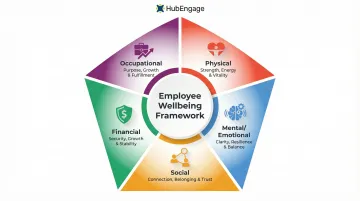
A comprehensive wellness survey requires a strategic backbone. The five pillars framework—physical, emotional/mental, social, financial, and occupational wellbeing—provides that structure. Each pillar maps to a distinct dimension of the employee experience and should be represented in survey design.
Each pillar covers a distinct area of employee health:
- Physical: Energy levels, sleep quality, fitness access, and whether the work environment supports health
- Mental/Emotional: Stress, anxiety, burnout, and access to mental health resources
- Social: Peer relationships, belonging, and connection within teams
- Financial: Money-related stress, compensation adequacy, and benefit satisfaction
- Occupational: Purpose, workload, role clarity, and growth opportunities
Mapping survey questions to these five pillars ensures comprehensive coverage and helps HR leaders identify which specific dimension is underperforming. Vague engagement scores tell you something is wrong; this framework tells you where. An employee struggling with financial anxiety needs different support than one experiencing social isolation or physical exhaustion.
50 Employee Wellness Survey Questions by Category
These 50 questions are organized into six categories covering physical health, mental wellbeing, work-life balance, engagement, culture, and financial wellness. Select the questions most relevant to your workforce — you don't need to use all 50. For scaled questions, a 5-point Likert scale (Strongly Disagree to Strongly Agree) works well; yes/no or open-text formats suit the rest.
Physical Health (Questions 1–8)
These questions assess how well your organization supports employees' physical health — from energy and sleep to fitness resources and ergonomics.
- On a scale of 1-5, how would you rate your overall energy levels during a typical workday?
- Does your work schedule allow you to get adequate sleep (7-8 hours per night)?
- How often do you engage in physical activity or exercise during a typical week? (Never / 1-2 times / 3-4 times / 5+ times)
- Does your employer provide adequate support for fitness and physical wellness? (gym access, wellness stipends, etc.)
- Do you have access to nutritious food options during your working hours?
- On a scale of 1-5, how well does your physical work environment (ergonomics, safety, comfort) support your health?
- Are you aware of the health benefits and wellness resources your employer offers?
- Have you used any employer-provided health benefits or wellness programs in the past 6 months?
Mental Health & Stress Management (Questions 9–17)
This category surfaces stress levels, awareness of mental health resources, and whether your culture normalizes asking for support — often the hardest data to collect through informal channels.
- On a scale of 1-5, how stressed do you feel about your workload and deadlines?
- How often do you experience feelings of anxiety or overwhelm at work? (Never / Rarely / Sometimes / Often / Always)
- Are you aware of the mental health resources available to you (EAP, counseling, therapy)?
- Have you ever used your employer's Employee Assistance Program (EAP)?
- I feel comfortable discussing mental health concerns with my manager. (Strongly Disagree to Strongly Agree)
- My organization creates an environment where mental health is treated with the same importance as physical health.
- I am confident my employer would support me through a difficult mental health period.
- Does your workplace culture discourage or stigmatize discussing mental health challenges?
- What mental health support or resources would be most valuable to you? (Open-text)
Work-Life Balance & Burnout (Questions 18–25)
Burnout is one of the leading drivers of turnover. These questions help identify whether employees can truly recover between work periods or whether boundaries are quietly eroding.
- I am able to disconnect from work outside of my scheduled hours. (Strongly Disagree to Strongly Agree)
- My current workload is manageable within my available working hours.
- How often do you feel emotionally exhausted or burned out from your job? (Never / Rarely / Sometimes / Often / Always)
- Does work regularly intrude on your personal or family time?
- On a scale of 1-5, how satisfied are you with your current flexible work arrangements or schedule options?
- My organization actively supports me in maintaining healthy boundaries between work and personal life.
- I have enough time to recharge and recover between work periods.
- In the past month, have you worked during scheduled time off or vacation days?
Job Satisfaction & Engagement (Questions 26–33)
Engagement and satisfaction directly influence retention. This category reveals whether employees find meaning in their roles and whether they're at flight risk — before they hand in their notice.
- I find my daily work meaningful and purposeful. (Strongly Disagree to Strongly Agree)
- My role expectations and goals are clearly defined and communicated.
- I feel valued and recognized for my contributions at work.
- How likely are you to recommend this organization as a great place to work to a friend or colleague? (0-10 scale)
- I see clear opportunities for growth and career advancement in this organization.
- My skills and talents are being fully utilized in my current role.
- Have you seriously considered leaving this organization in the past 6 months?
- What would make you feel more engaged and satisfied at work? (Open-text)
Workplace Relationships & Culture (Questions 34–42)
Culture and relationships shape daily experience more than most policies do. These questions assess trust, belonging, psychological safety, and how well lived values match stated ones.
- On a scale of 1-5, how would you rate the quality of your relationship with your direct manager?
- I feel psychologically safe to speak up, ask questions, or raise concerns without fear of negative consequences.
- I feel a strong sense of belonging within my team and the broader organization.
- My co-workers are collaborative and supportive rather than competitive or divisive.
- I trust that leadership acts with transparency and integrity.
- Do you have at least one close friend or trusted colleague at work?
- The organization's stated values align with my personal values.
- I am treated with respect regardless of my role, background, or identity.
- How would you describe the overall culture of your team or department? (Open-text)
Financial Wellness & Benefits (Questions 43–50)
Financial stress is a significant but under-measured drag on productivity. This final category gauges compensation adequacy, benefits awareness, and whether employees feel equipped to handle financial uncertainty.
- On a scale of 1-5, how much does financial stress affect your concentration or productivity at work?
- My current compensation adequately covers my living expenses and financial obligations.
- On a scale of 1-5, how satisfied are you with your overall benefits package (health insurance, retirement, PTO)?
- Are you aware of any financial wellness resources or tools your employer offers (financial planning, counseling, education)?
- Have you used any employer-provided financial wellness resources in the past year?
- I feel financially secure enough to handle unexpected expenses or emergencies.
- My employer does enough to support my long-term financial security and retirement planning.
- What financial wellness support would be most valuable to you? (Open-text)
Best Practices for Running Your Employee Wellness Survey
Guarantee Anonymity and Communicate It Clearly
Employees will only answer honestly if they trust their responses cannot be traced back to them. Explicitly state confidentiality in survey introductions, avoid demographic questions that could identify individuals in small teams, and consider using a third-party platform to reinforce trust. When employees don't believe their input is truly anonymous, response rates drop and data become less reliable.
Keep Surveys Focused and Frequency-Appropriate
There's a trade-off between comprehensive annual surveys and shorter pulse surveys run quarterly or monthly. Best practices recommend a combined approach: one fuller wellness survey annually (15-20 questions), with targeted pulse check-ins (5-10 questions) in between. Survey fatigue is real—large enterprises should aim for 72-88% response rates for census surveys and 55-81% for pulse surveys.
Reach Every Employee, Especially Frontline and Deskless Workers
Traditional email-only surveys systematically exclude hourly, field-based, or manufacturing workers who lack regular desktop access. Deskless workers make up 80% of the global workforce, yet email-based surveys yield response rates as low as 5-30% for this demographic.
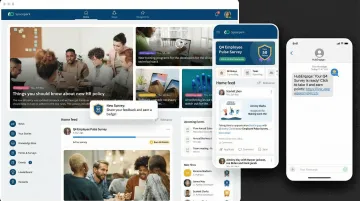
Mobile-first, multi-channel delivery closes that gap. Platforms like HubEngage distribute surveys across mobile apps, SMS, digital signage, web portals, and tools like Microsoft Teams. Built-in gamification — points, badges, and rewards — gives employees an extra reason to participate, lifting response rates across the full workforce.
Share Results with the Team
Closing the feedback loop is what keeps survey credibility intact. If leaders conduct a survey but take no action on the results, employee engagement will likely decrease and turnover will increase. Share high-level findings organization-wide within 2-4 weeks of survey close, acknowledging what you heard and outlining next steps.
How to Act on Employee Wellness Survey Results
Prioritize and Categorize Findings
Segment survey results by team, department, or role to surface localized issues rather than relying solely on organization-wide averages. Identify 2-3 high-impact areas to address immediately. Spreading effort across too many priorities at once dilutes resources and delays meaningful change.
Platforms with built-in analytics, like HubEngage, can auto-surface trends and flag engagement risks in real time, helping HR teams act on evidence rather than guesswork.
Build a Visible Action Plan and Track Progress
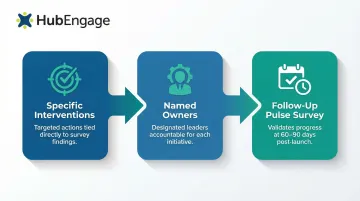
Share a concrete plan responding to survey results—naming specific actions, owners, and timelines. A strong action plan typically includes:
- Specific interventions tied directly to survey findings
- Named owners responsible for each initiative
- A follow-up pulse survey at 60-90 days to validate progress
Closing this loop demonstrates that feedback drove real change, which builds trust and increases participation in future surveys.
Connect Wellness Data to Broader Talent Outcomes
The action plan doesn't end with fixing immediate issues. Wellness survey trends—especially scores on burnout, belonging, and satisfaction—are leading indicators of attrition risk. Tracking these metrics over time gives HR leaders a measurable business case for continued wellness investment.
Well-recognized employees are 45% less likely to have changed organizations two years later, illustrating how wellness and retention strategies directly reinforce each other.
Frequently Asked Questions
What are examples of employee wellness survey questions?
Good wellness survey questions span six categories: physical health, mental health, work-life balance, job satisfaction, workplace relationships, and financial wellness. Each category targets distinct signals—from sleep quality and stress levels to recognition, belonging, and compensation adequacy.
What are the 5 pillars of employee wellbeing?
The five pillars are physical, mental/emotional, social, financial, and occupational wellbeing. A strong wellness survey covers all five to give HR leaders a complete picture of workforce health.
How can employers prioritize employee mental health?
Start by normalizing mental health conversations through leadership behavior and transparent communication. Pair that with visible EAP or counseling access, and run regular pulse surveys to catch burnout signals before they drive turnover.
What are the 5 C's of retention?
The 5 C's are Compensation, Culture, Career growth, Connection, and Care/wellbeing. Wellness surveys are one of the most direct tools for measuring how well an organization delivers on "Care" and "Connection"—key drivers of voluntary attrition.
How often should you conduct employee wellness surveys?
Conduct one comprehensive annual wellness survey (15–20 questions) supplemented by shorter quarterly pulse surveys (5–10 questions). Regular, lightweight check-ins maintain visibility into wellbeing trends without causing survey fatigue.
How do you increase employee participation in wellness surveys?
Communicate the purpose upfront and guarantee anonymity through clear confidentiality policies. Use mobile-friendly, multi-channel delivery to reach frontline workers, and consider gamification to boost completion—HubEngage, for example, uses points, badges, and rewards to drive higher survey participation.