Introduction
Most organizations invest heavily in leadership training, yet managers remain the most under-leveraged communication asset in the workplace. Simply passing information down the chain isn't the same as communicating in a way that builds engagement and genuine commitment — and the data makes that gap impossible to ignore.
84% of organizations rely on managers for communication, yet 3 in 5 report that manager communication falls below expectations. Separately, Gallup finds that 70% of the variance in team engagement ties directly to management.
That's the core problem: the people with the most influence over engagement are consistently falling short in the skill that drives it most.
This post breaks down what high-impact manager communication actually looks like — covering the habits, structures, and behaviors that shift teams from informed to genuinely engaged.
Key Takeaways
- Manager communication is the most direct lever organizations have to drive engagement—yet most default to one-way information-sharing
- Engaging communication is two-way, timely, emotionally aware, and channel-appropriate
- Biggest mistakes: over-relying on email, skipping active listening, and failing to connect daily work to organizational purpose
- Structured check-ins, recognition conversations, and multi-channel delivery increase message reach and employee responsiveness
- Measure open rates, survey sentiment, and behavioral signals to identify gaps and adjust your approach
Why Manager Communication Is the Engine of Employee Engagement
Managers occupy a unique position in the organizational communication ecosystem. Unlike executive communications or company-wide broadcasts, manager communication is personal and directly relevant to the employee's daily work and future — which is precisely why it moves the needle on engagement in ways top-down communications cannot.
The Difference Between Communicating and Engaging
Communication drives engagement when it creates psychological safety, a sense of being seen, and clarity about how an individual's work connects to broader goals. Broadcasting information achieves the first part — informing — but fails at the second: engaging. Employees who feel informed but not engaged will comply. They won't commit.
Where Employees Rely on Managers Most
Research shows employees rely on managers most for three critical communication domains:
- Strategy, vision, and purpose (55% employee understanding)
- Values, behaviors, and culture (63% employee understanding)
- Organizational change and M&A activity (36% employee understanding)
These areas demand more than a forwarded email. They require context, dialogue, and interpretation. Managers who simply relay information miss the opportunity to help employees understand what it means for them — and that gap is even sharper for frontline teams.
The Deskless Worker Multiplier Effect
For organizations with large frontline or deskless workforces — manufacturing, healthcare, hospitality — reliance on managers for communication is even higher, yet only 10% of non-desk employees in the U.S. are very satisfied with internal communication at their workplaces. As the proportion of deskless employees increases, the performance gap between expectation and delivery widens further.
The Business Cost of Poor Manager Communication
The numbers make the stakes clear. Global employee engagement fell to 21% in 2024, with lost productivity costing the global economy $438 billion.
**Manager engagement directly drives team engagement** — which drives productivity. Organizations that invest in manager communication capability consistently outperform those that treat it as an afterthought.
What Makes Manager Communication Actually Engaging
Engaging manager communication is two-way (not broadcast-only), consistent (not sporadic), contextualized (tied to the employee's specific role and concerns), and human (not corporate or scripted). Let's break down what that looks like in practice.
Clarity and Consistency
Employees need to understand not just what is being communicated but why it matters to them personally. Managers who connect the "what" to the "why" improve message retention and motivation.
Practical application:
- Use plain language and avoid jargon
- Deliver consistent messages across team touchpoints
- Explicitly link information to how it affects the employee's role
- Follow up to confirm understanding
Just 46% of employees clearly know what is expected of them at work, down 10 points from 2020. This clarity crisis stems directly from communication gaps at the manager level.
Active Listening as a Communication Skill
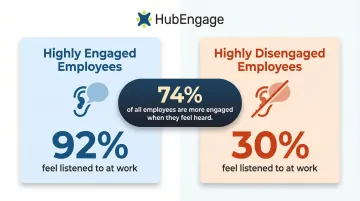
Active listening — paraphrasing, asking follow-up questions, acknowledging emotion — is a measurable communication behavior with direct engagement consequences. 74% of employees report being more engaged and effective when they feel heard at work.
That gap widens sharply at the extremes: 92% of highly engaged workers feel listened to, compared to just 30% of highly disengaged workers.
What it looks like in practice:
- Paraphrase what you heard: "So what you're saying is..."
- Ask clarifying questions: "Can you tell me more about that?"
- Acknowledge emotion: "I can see this is frustrating for you"
- Resist the urge to immediately problem-solve—sometimes people need to be heard first
Psychological Safety and Honest Dialogue
Managers who create space for questions, disagreement, and honest feedback build the trust that makes all subsequent communication more credible. Contrast this with managers who communicate directives without inviting dialogue—this creates compliance but not engagement.
Psychological safety doesn't mean avoiding difficult conversations. It means employees trust they can speak up without fear of punishment or embarrassment.
In practice, psychological safety looks like:
- Responding to pushback with curiosity, not defensiveness
- Acknowledging mistakes openly, including your own
- Inviting dissenting views before finalizing decisions
- Separating the message from the messenger when feedback is critical
That foundation of trust also shapes how recognition lands — which is why it's one of the highest-leverage communication behaviors available to managers.
Recognition as a Communication Act
Timely, specific recognition communicated by a direct manager is one of the highest-impact engagement behaviors available. It communicates "I see you," "your work matters," and "you belong here" simultaneously.
Well-recognized employees are 45% less likely to have changed organizations two years later. Yet more than half of U.S. employees either do not receive recognition at all or receive recognition that doesn't satisfy any quality criteria.
Recognition should be:
- Specific and linked to behaviors or outcomes (not generic "great job")
- Timely (not saved only for formal review cycles)
- Connected to company values or strategic goals when relevant
- Public when appropriate, private when sensitive
Communication Mistakes Managers Make That Disengage Employees
Managers often have good intentions but fall into predictable patterns that erode trust and engagement over time. Understanding these patterns is the first step to correcting them.
Over-Relying on One-Way, Top-Down Communication
Treating communication as delivery rather than dialogue is one of the most common traps. Managers who only cascade information from leadership—without creating space for questions or feedback—signal that employee voices don't matter.
Add a structured Q&A or reaction round to team meetings and all-hands messages. Even a simple "What questions do you have?" followed by genuine listening shifts the dynamic from broadcast to conversation.
Inconsistency and Communication Gaps
Silence or irregular communication—especially during periods of change or uncertainty—sends a message employees almost always read negatively. 58% of employees prefer to receive communications about the personal impacts of change directly from their supervisors, yet managers go quiet precisely when employees need to hear from them most.
Consistent, even brief touchpoints do more for engagement than infrequent, high-production communications. A weekly team update or a short check-in builds trust through regularity alone.
Failing to Connect Messages to Meaning
Communicating tasks and deadlines without tying them to team purpose or organizational direction leaves employees without context for why their work matters. Employees who strongly agree that their job description aligns with the work they do are 2.5 times more likely to be engaged.
Make it a habit to explicitly link daily priorities to team goals and company mission. Every substantive communication should answer one question: "Why does this matter?"
Using the Wrong Channel for the Message
Channel mismatch—sending sensitive feedback over chat, cascading urgent safety updates by email, or sharing complex policy changes verbally without written follow-up—undermines both the message and trust in the manager.
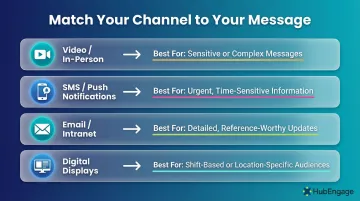
A simple channel selection framework:
- Sensitive or complex messages: In-person or video
- Urgent, time-sensitive information: SMS or push notifications
- Detailed, reference-worthy updates: Email or intranet
- Broad awareness for shift-based teams: Digital displays
Strategies to Communicate Like an Engaging Manager
Structured Regular Check-Ins
Brief, consistent 1:1 or team check-ins are among the most powerful engagement tools available. These aren't status meetings — they're conversations designed to surface how employees are feeling, what obstacles they face, and whether they feel connected to team direction.
Simple check-in framework:
- What's going well?
- What's challenging?
- What do you need from me?
Done consistently, this practice creates psychological safety, surfaces issues early, and demonstrates that the manager values the employee's perspective. Employees whose managers hold regular one-on-one meetings are more likely to be engaged at work.
Cascade with Context, Not Just Content
When sharing organizational news or directives, managers should translate leadership messages into what they mean for the specific team, invite reactions, and close the loop by following up on questions raised. Done well, this makes the manager a trusted interpreter of organizational direction — not simply a message-passer.
How to cascade with context:
- Share the leadership message
- Explain what it means for your team specifically
- Invite questions and reactions
- Follow up on unresolved concerns
- Connect the message to team priorities
Make Recognition a Communication Habit
The same consistency that makes check-ins and cascading effective also applies to recognition. Build it into regular communication rather than saving it for annual reviews. Employees recognized for goal contribution are 5 times more likely to feel personally invested in company initiatives.
Practical recognition habits:
- Call out specific contributions in team meetings
- Send brief personal messages when someone goes above and beyond
- Use available recognition tools to ensure acknowledgment is visible and timely
- Be specific: "Your analysis of the customer data helped us identify the root cause" beats "Great job on that project"
Channels and Tools That Help Managers Reach and Engage Employees
Choosing the right channel is not just a logistics decision—it directly affects whether communication lands, especially for frontline, deskless, or distributed teams. 69% of organizations rely primarily on email while more than half (54%) of deskless workers have limited email access.
The Channel Spectrum
Match channel to message type and audience:
| Channel | Best For |
|---|---|
| In-person or video | Emotionally sensitive or complex messages |
| Email and intranet | Detailed, reference-worthy updates |
| SMS and push notifications | Urgent or time-sensitive information |
| Digital displays | Shift-based or location-specific audiences |
69% of retail associates cite in-person as a top method for receiving information, while 50% prefer texts or phone calls. Meanwhile, direct managers are the most-trusted source of information, according to 59% of U.S. respondents.
Multi-Channel Platforms Simplify Manager Communication
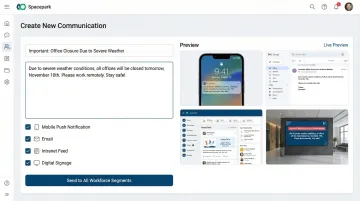
Platforms like HubEngage enable managers and communications teams to reach employees across all of these channels from a single interface—with mobile apps, digital signage, email, and SMS. The platform auto-formats content for each channel, so managers don't need to manually reformat or redistribute the same message across different platforms.
This matters most for managers overseeing frontline or distributed teams. When a message goes out, each audience receives it through the channel that actually reaches them:
- Frontline employees get push notifications on their phones
- Remote workers see it in email or on the intranet
- Employees in physical locations see it on digital displays
Measuring the Impact of Manager Communication
Without feedback signals, managers can't know whether their communication is landing—and organizations can't identify which managers need support.
Signals to Track
Quantitative metrics:
- Message open/read rates
- Survey participation rates
- Pulse survey sentiment scores
- Recognition activity frequency
- Channel engagement breakdowns
Qualitative signals:
- Themes from 1:1 conversations
- Questions raised in team meetings
- Voluntary feedback and comments
- Employee-initiated communication
Large enterprises can expect census survey response rates between 72% and 88%, with pulse surveys ranging from 55% to 81%. When a team consistently falls below these ranges, that's a signal worth investigating — low participation often reflects unclear messaging, low trust, or a disconnect between what managers say and what employees experience.
Building Accountability Systems
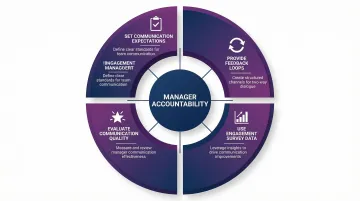
Tracking signals is only half the equation. HR and communications leaders also need structures that hold managers accountable for acting on what the data reveals. A lightweight accountability system typically includes:
- Setting expectations for communication frequency and channel usage
- Providing feedback loops to managers on how their teams are responding
- Using engagement survey data to identify communication-related drivers of satisfaction or dissatisfaction
- Evaluating managers on communication quality, not just operational results
Managers who are evaluated on their ability to communicate are more than twice as likely to meet and exceed expectations. If communication isn't measured, it won't be managed — adding it to performance criteria is one of the highest-leverage changes an organization can make.
Frequently Asked Questions
What is good communication between managers and employees?
Good manager-employee communication is two-way, consistent, and emotionally aware. It involves active listening, clear and contextualized messages, and regular touchpoints that make employees feel informed, heard, and valued.
How to improve communication between managers and employees?
Establish regular check-ins and train managers in active listening. Create structured feedback channels and use multi-channel tools to reach all employees regardless of role or location. Track outcomes and hold managers accountable — communication quality is a leadership metric, not a soft skill.
How should managers communicate with employees?
Managers should communicate proactively, clearly, and through the appropriate channel for the message type—prioritizing dialogue over broadcast, and always connecting information to relevance for the team. Consistency and context matter more than polish.
What are the 5 important communication skills for leaders?
Active listening, clarity and conciseness, empathy, the ability to give and receive feedback, and consistency. Together, these skills determine whether employees follow a manager out of obligation or genuine trust.
What are the 7 C's of managerial communication?
Clear, Concise, Concrete, Correct, Coherent, Complete, and Courteous. Managers who apply this framework consistently find that fewer messages need to be re-sent, clarified, or walked back.
What communication flows from a manager to employees?
Downward communication typically covers goal-setting, performance feedback, operational updates, policy changes, and recognition. How well managers handle this flow determines whether employees feel informed and aligned — or left guessing.