The stakes are higher than ever. With 80% of the global workforce—approximately 2.7 billion people—classified as deskless, and 83% of these workers lacking corporate email addresses, traditional desktop intranets simply can't reach everyone. Meanwhile, organizations are paying for multiple overlapping tools with poor integration and high costs. The question isn't which category to choose—it's how to build a digital workplace that serves your entire workforce.
Key Takeaways
- Traditional intranets centralize content and resources; EXPs drive engagement, culture, and personalized experiences
- The gap between the two is closing fast, driven by personalization, two-way communication, deeper analytics, and mobile access
- Three forces accelerate convergence: AI-powered tech, employee expectations for consumer-grade tools, and pressure to consolidate software costs
- For frontline or distributed workforces, desktop-only intranets fail to reach everyone
- The smartest move is a single platform that handles both content infrastructure and active employee engagement
Intranet vs. Employee Experience Platform: Quick Comparison
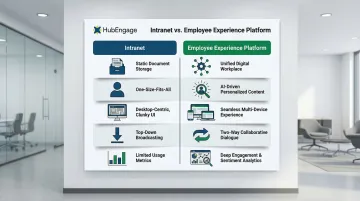
Choosing between an intranet and an employee experience platform (EXP) comes down to one question: are you storing information, or shaping how employees actually experience work? The table below lays out the key differences.
| Intranet | Employee Experience Platform | |
|---|---|---|
| Primary Purpose | Centralized hub for documents, policies, and company resources | Shapes the full employee journey — communication, recognition, feedback, learning, and culture |
| Personalization | Same content pushed to all employees, regardless of role or location | Role-based, location-specific experiences tailored to each employee |
| User Experience | Often requires IT support to maintain and update | Intuitive, mobile-first interface built for minimal technical upkeep |
| Communication Direction | Top-down, one-way broadcasts | Two-way dialogue through surveys, social feeds, and recognition |
| Analytics | Basic metrics (page views, downloads) | Deep insights on engagement, content performance, and employee behavior |
What Is a Corporate Intranet?
A corporate intranet is a private, internal network that enables organizations to share news, store documents, and provide access to company systems. Born from static 1990s portals, intranets have evolved considerably — but their core DNA remains information-centric.
Modern intranets have moved well past their "place content goes to die" reputation. Today's cloud-based versions integrate with productivity suites like Microsoft 365 and Google Workspace, support mobile access, and offer personalization features.
Forrester's Workforce Surveys show that intranet satisfaction among information workers increased from 66% in 2019 to 77% in 2023 — a clear sign this modernization is landing with employees.
Yet intranets still prioritize information architecture over employee engagement. The core design goal is findability — not participation.
Use Cases of an Intranet
Intranets excel in specific organizational scenarios:
- Policy and document repositories for compliance-heavy industries
- Employee directories and organizational charts
- IT help portals and service request systems
- Company news hubs for announcements and updates
- Onboarding resource libraries for new hires
Intranets remain dominant in larger enterprises and regulated industries like healthcare and financial services, where structured information governance is critical.
That strength becomes a constraint, however, when workforces extend beyond the desk. Traditional intranets require desktop access and corporate email addresses — two things frontline workers typically don't have.
What Is an Employee Experience Platform?
An employee experience platform is a unified, engagement-centric digital ecosystem that goes beyond information sharing to actively shape how employees feel, connect, and grow within an organization. EXPs cover communication, recognition, surveys, learning, and cultural alignment in one place.
Six core capabilities distinguish a true EXP from an intranet:
- Personalized content delivery based on role, location, and preferences
- Real-time recognition and rewards for peer-to-peer and manager appreciation
- Two-way feedback and surveys to capture employee sentiment
- Social collaboration and community features for employee-to-employee connection
- Learning and onboarding journeys with progress tracking
- Deep analytics and engagement insights that connect participation to business outcomes
EXPs are built for the full workforce—not just desk-based employees. With mobile-first design, they reach frontline, remote, and deskless workers who may never log into a desktop intranet. This is crucial when 80% of the global workforce is deskless and 62% of deskless workers report limited computer access during work hours.
Unlike intranets that treat participation as passive, EXPs use gamification—points, leaderboards, badges, and challenges—to drive active participation across communications, surveys, recognition, and learning. This connects engagement mechanics to measurable cultural outcomes. Platforms like HubEngage apply gamification across the entire employee experience, not just isolated features, which is what separates genuine EXPs from tools that bolt on a leaderboard.
Use Cases of an Employee Experience Platform
These capabilities translate most directly into business outcomes in a handful of high-stakes scenarios:
- High-turnover industries (hospitality, retail, manufacturing) where engagement directly impacts retention
- Large distributed workforces requiring consistent communication across locations
- Post-merger culture integration where building connection is critical
- Companies prioritizing retention as a measurable business goal
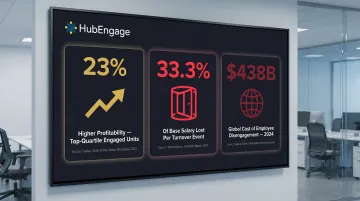
Gallup's Q12 Meta-Analysis found that top-quartile engaged business units achieve 23% higher profitability and 51% lower turnover in low-turnover organizations.
The cost of getting this wrong is just as concrete. Employee turnover runs approximately 33.3% of base salary, and Gallup estimates disengagement cost the global economy $438 billion in 2024. For organizations with large frontline or distributed workforces, an EXP is less a nice-to-have and more a retention strategy with a measurable price tag attached.
Key Differences That Still Set Them Apart
Despite convergence, meaningful differences remain between intranets and EXPs.
Content vs. Experience Orientation
Intranets are fundamentally content management systems. Success means employees can find the right document. EXPs measure success differently: participation rates, sentiment scores, recognition activity, and cultural alignment. These different orientations drive different design choices throughout the platform.
One-Way vs. Two-Way Communication
This distinction matters profoundly. Intranets push information down; EXPs create channels for employees to push back. Employee voice features that signal the organization is listening include:
- Pulse surveys and open Q&As
- Social reactions and comments on posts
- Peer-to-peer recognition
These capabilities build psychological safety and directly affect engagement and retention.
Depth of Analytics
The analytics gap between the two is significant:
Intranet reporting typically covers:
- Page views and unique visitors
- Document downloads
EXP reporting adds:
- Engagement rates by department
- Content resonance scores
- Survey sentiment trends
- Recognition frequency and program participation
Richer data lets HR and communications leaders make proactive, data-driven decisions.
Frontline and Mobile Accessibility
This is often the decisive factor for organizations with large non-desk workforces. Traditional intranets require a company email address and desktop login—many frontline workers have neither. EXPs with native mobile apps, SMS reach, and digital signage capabilities close this gap and ensure equity of information access across all employee types.
Browns Shoes, a retailer with 2,400 employees across 70+ stores, deployed a mobile-first, bilingual intranet and achieved an 88% adoption rate, eliminating email-heavy workflows and providing frontline workers reliable access to real-time information.
Maintenance and Adoption
Intranets are often plagued by outdated content and low adoption because maintaining them requires technical resources. EXPs are designed to encourage ongoing participation through engagement loops—gamification, recognition, and personalized feeds—making adoption ongoing without heavy IT overhead.
Why the Lines Are Blurring: 3 Drivers of Convergence
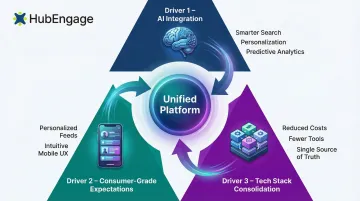
Three powerful forces are accelerating the convergence of intranets and EXPs, creating a new category of unified platforms.
Driver 1 — AI Is Reshaping Both Categories
AI capabilities are rapidly being added to both intranets and EXPs, making them functionally more similar. Modern intranets now offer AI-powered search that answers questions in natural language rather than returning a list of links. EXPs use AI for content creation, automated communications, and predictive analytics.
Gartner predicts that 40% of enterprise applications will be integrated with task-specific AI agents by the end of 2026, up from less than 5% in 2025. Both platforms are becoming smarter, more personalized, and more proactive—closing the gap between "storing information" and "delivering the right information at the right moment."
HubEngage's AI Assistant reflects this shift directly. Employees get instant answers and can locate company resources on their own, while HR and communications teams use the same tool for content creation and automated email drafting. One platform, two distinct user needs — no separate tools required.
Driver 2 — Employees Expect Consumer-Grade Experiences
Employees bring their expectations from consumer apps—social media, streaming, e-commerce—into the workplace. They expect personalized feeds, intuitive interfaces, instant search, and mobile access.
A Gartner survey of 5,141 employees found that only 23% of digital workers are completely satisfied with their work applications, down from 30% in 2022. This dissatisfaction has forced intranet vendors to adopt EXP-style features—while EXPs have had to build more robust content infrastructure.
Deloitte reports that organizations with the most compelling workforce experiences generated 22% higher engagement and were four times more likely to retain employees compared to organizations with less compelling experiences. That retention gap alone is enough to push most organizations to rethink their digital workplace stack.
Driver 3 — Organizations Are Consolidating Their Tech Stacks
Companies are paying for multiple overlapping tools—a separate intranet, a recognition platform, a survey tool, a mobile comms app—with poor integration and high total cost of ownership.
According to Asana's Anatomy of Work Index, employees use about 10 different applications per day, switching between them roughly 25 times — and research cited by Conclude.io puts the true toggling cost at nearly 4 hours per week lost to reorientation alone.
A Forrester Total Economic Impact study for Workvivo modeled a composite organization with 60,000 employees (75% frontline) and found that consolidating disparate communication channels and decommissioning legacy intranets resulted in $7.8 million in cost savings over three years.
Unified platforms that combine intranet and EXP capabilities reduce software spend, eliminate context-switching, and create a single source of truth.
The Result: A New Category Is Emerging
The market is converging on a new type of platform that doesn't fit neatly into either the "intranet" or "EXP" bucket—a unified employee communications and experience platform that handles content architecture AND engagement mechanics.
This convergence reflects a genuine shift in how organizations think about the digital workplace: as a holistic, continuous employee experience rather than a series of disconnected tools.
Choosing a Unified Platform That Does Both
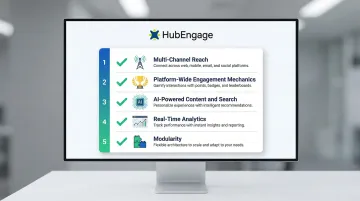
When evaluating a unified intranet + EXP solution, prioritize five core capabilities:
1. Multi-channel reach (mobile app, web, email, SMS, digital signage) so every employee gets the message regardless of role or location
2. Platform-wide engagement mechanics like gamification and recognition, built into the platform rather than added as afterthoughts
3. AI-powered content creation and search to reduce administrative burden
4. Real-time analytics that connect engagement data to business outcomes
5. Modularity—the ability to start with core capabilities and expand as your needs grow, on one platform
Do We Need Both?
For most organizations, the real question isn't intranet or EXP. It's finding a single platform that handles both and evolves with your needs.
HubEngage's modular approach exemplifies this. Organizations can deploy intranet, mobile app, recognition, surveys, and digital signage from one platform — then add capabilities as priorities shift. There's no need to stitch together point solutions or face a costly migration down the road.
A Practical Decision Framework
If your primary challenge is information access and document management for a desk-based workforce, a modern intranet may be a sufficient starting point. But if you have frontline workers, high turnover, engagement gaps, or a need to build culture across distributed teams, you need EXP capabilities — and a platform that bundles both makes that expansion seamless.
The unified approach delivers tangible benefits:
- Consolidated software costs across fewer vendor contracts
- Reduced context-switching for employees navigating multiple tools
- Consistent analytics across all engagement activities in one dashboard
- A single platform that serves your entire workforce, wherever they work
Conclusion
The question is no longer "intranet or EXP?" but "how do we build a digital workplace that gives every employee—desk-based or frontline, remote or on-site—the information, connection, and recognition they need to do their best work?"
The convergence of these two categories is already reshaping technology decisions. Organizations that choose a unified platform now avoid the cost and disruption of retrofitting disconnected tools later.
The real measure of any platform is simpler: will your entire workforce actually use it, every day? Feature counts don't matter if frontline employees never open the app or desk workers route around the tool entirely. Choose for adoption, not capability lists.
Frequently Asked Questions
What is the main difference between an intranet and an employee experience platform?
Intranets are primarily content repositories focused on information access and storage, while employee experience platforms are engagement-centric systems designed to personalize communication, recognize contributions, and shape company culture across the full employee lifecycle.
Do I still need an intranet if I have an employee experience platform?
Many modern EXPs now include intranet functionality—document management, company news, knowledge bases—making a separate intranet redundant. The key is evaluating whether your chosen EXP has the depth of content management features your organization requires.
Are employee experience platforms replacing intranets?
EXPs are absorbing intranet functions while adding engagement, analytics, and mobile capabilities on top. For most organizations, the practical result is one unified platform rather than two separate tools.
Which is better for frontline or deskless workers — an intranet or an EXP?
Traditional intranets are poorly suited for frontline workers who lack desktop access or company email addresses. EXPs with native mobile apps, SMS delivery, and digital signage capabilities are far better equipped to reach and engage this workforce segment.
How does gamification improve employee engagement on these platforms?
Gamification—points, leaderboards, badges, and challenges—turns passive content consumption into active participation. This drives higher adoption across communications, surveys, recognition, and learning while reinforcing the behaviors and values you want to build.
What should I look for when choosing between intranet and EXP vendors?
Focus on these criteria when evaluating vendors:
- Multi-channel reach: mobile, email, SMS, and digital signage in one platform
- Mobile-first design: essential for frontline and deskless workforces
- Built-in engagement mechanics: gamification and recognition as core features, not add-ons
- AI-powered search and analytics: for smarter content delivery and actionable insights
- Modular architecture: lets the platform grow with your needs without a full migration