That's a missed opportunity. The promotion announcement itself is where you can build morale, inspire the broader team, and reinforce what career growth looks like at your company. This post solves two critical problems: knowing what to include in a promotion announcement and how to deliver it effectively across a diverse workforce—especially when your team includes remote workers, frontline employees, and people who rarely check email.
Key Takeaways
- Every promotion announcement needs the employee's name, new role, key achievements, responsibilities, start date, and a congratulations prompt
- Timing matters—inform close team members privately before the company-wide announcement
- Use consistent format and tone across all announcements to avoid perceived favoritism
- Multi-channel delivery (email, intranet, SMS, digital signage) reaches frontline and remote workers, not just desk employees
- Done well, promotion announcements signal to your whole team that growth is visible, real, and attainable
What Is a Promotion Announcement (and Why It Matters)
A promotion announcement is a formal communication shared after an employee accepts a new role, sent before their start date. It recognizes their achievement and informs the organization of the change—who they'll report to, what shifts in responsibilities look like, and what's expected going forward.
The announcement serves a dual purpose: celebrating the individual's success while keeping the team informed about organizational changes. When done well, it answers practical questions (Who's my new manager? Who's backfilling this role?) and sets a cultural tone about how your company values internal growth.
That cultural tone carries real retention weight. Employees who received high-quality recognition in 2022 were 45% less likely to have left their job by 2024, according to Gallup and Workhuman research.
A promotion announcement is a recognition touchpoint — and when teams see transparent reasoning and consistent celebration of achievement, it signals that advancement is real and attainable. That signal shapes whether people invest in their own growth at your company or start looking elsewhere.
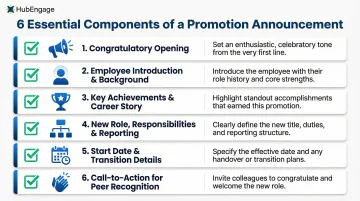
What to Include in a Promotion Announcement
Congratulatory Opening
Lead with genuine enthusiasm. "We're thrilled to announce…" or "Please join us in congratulating…" sets a celebratory tone rather than an administrative one. This signals to the promoted employee—and the rest of the team—that the organization values this achievement.
Employee Introduction and Background
Include the employee's full name, previous title, department, and tenure. For larger organizations where employees may not know each other, a brief professional bio builds context and makes the announcement feel personal rather than templated. This is especially important for cross-departmental promotions or when announcing to a company-wide audience.
Key Achievements and Career Story
Dedicate 2–3 sentences to the specific contributions, projects, or milestones that led to this promotion. This section does the most work — it shows the team what promotable behavior looks like and provides transparent reasoning for the decision.
When people understand why someone was promoted, they're more motivated to pursue similar achievements. Research from Harvard Business Review shows that when people believe promotions are managed effectively, they are more than twice as likely to give extra effort at work and to plan a long-term future with their company. That's why specificity matters: reference actual projects, measurable results, or leadership moments rather than generic phrases like "consistent dedication" or "strong work ethic."
New Role, Responsibilities, and Reporting Structure
Clearly state:
- The new title
- What the employee will now own
- Who they will report to (or who will report to them)
- Whether they will move teams or locations
- If someone is backfilling their previous role
This clarity prevents confusion and helps colleagues understand how the change affects workflows and team structure.
Start Date and Transition Details
Give a firm date so colleagues can plan accordingly—especially relevant when the promoted employee is taking over a team or moving to a new department. Invite team members to reach out with questions before the transition. Giving colleagues at least a week's notice before the effective date makes handoffs noticeably smoother.
Call-to-Action for Peer Recognition
Close the announcement by explicitly inviting colleagues to congratulate the promoted employee and suggest the channel to use (e.g., reply to this email, comment on the intranet post, or send a message on the team channel). This turns a one-way update into shared recognition — and reinforces the habit across the team.
Promotion Announcement Template and Examples
Reusable Email Template
Use this template as a starting point, then customize the details to match your company's tone and the employee's story.
Subject Line: Congratulations to [Employee Name] on Their Promotion to [New Title]
Greeting: Team,
Paragraph 1 — Introduction + New Title: We're excited to announce that [Employee Name] has been promoted to [New Title], effective [Start Date]. [He/She/They] will be joining the [Department Name] team and reporting to [Manager Name].
Paragraph 2 — Achievements + New Responsibilities: Over the past [X years/months], [Employee Name] has [specific achievement or project]. [His/Her/Their] work on [specific example] resulted in [measurable outcome]. In this new role, [Employee Name] will be responsible for [key responsibilities], and we're confident [he/she/they] will continue to drive [specific goal or outcome].
Paragraph 3 — Congratulations Call-to-Action: Please join us in congratulating [Employee Name] on this well-deserved promotion. Feel free to reach out to [him/her/them] directly via [preferred channel] or reply to this email with your congratulations.
Closing: [Your Name] [Your Title]
Note: Customize the template to reflect your company's tone—whether formal or conversational. Always verify all details (name spelling, title, pronouns, start date) with the promoted employee before publishing.
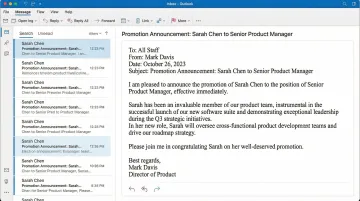
Sample Email Example 1: Individual Contributor to Manager
Subject: Congratulations to Sarah Chen on Her Promotion to Engineering Manager
Team,
We're thrilled to announce that Sarah Chen has been promoted to Engineering Manager, effective April 15. She will be leading our Backend Infrastructure team and reporting to VP of Engineering, Michael Torres.
Over the past three years, Sarah has consistently delivered high-impact projects that strengthened our platform's reliability. Her leadership on the database migration project reduced query response times by 40% and eliminated recurring downtime that affected thousands of users. She also mentored four junior engineers, three of whom have since been promoted.
In her new role, Sarah will oversee a team of eight engineers, set technical direction for our infrastructure roadmap, and work closely with product leadership to align backend capabilities with business priorities.
Please join us in congratulating Sarah on this well-deserved promotion. Feel free to reach out to her on Slack or reply to this email with your congratulations. If you have questions about team structure or reporting lines, Sarah will be hosting a team Q&A on April 12 at 2 PM.
Best, Michael Torres VP of Engineering
Sample Example 2: Cross-Departmental or Executive Promotion
Subject: Announcing Marcus Williams' Promotion to Vice President of Sales
Dear Team,
I'm pleased to announce that Marcus Williams has been promoted to Vice President of Sales, effective May 1. Marcus will oversee our North American sales organization and report directly to me.
Marcus joined our company five years ago as a Regional Sales Director and has consistently exceeded revenue targets while building a culture of accountability within his teams. Under his leadership, the Western region grew annual recurring revenue by 65% and achieved a 92% customer retention rate—the highest in the company. He also championed our customer success partnership model, which has since become a best practice across all regions.
In his new role, Marcus will lead our national sales strategy, expand our enterprise customer base, and work closely with marketing and product teams to accelerate go-to-market initiatives.
Please join me in congratulating Marcus on this promotion. For our customers and partners, Marcus will continue to be a key point of contact for strategic accounts, and we'll be sharing this news externally via LinkedIn and our company newsletter later this week.
Sincerely, Jennifer Park Chief Revenue Officer
Intranet/Messaging Platform Post Example
Slack/Teams Post:
🎉 Big news, team! 🎉
Congrats to Alex Rodriguez on his promotion to Senior Product Designer! Over the past two years, Alex redesigned our mobile checkout flow (boosting conversion by 18%) and led the accessibility overhaul that earned us a WCAG AAA rating.
Starting June 1, Alex will be leading design for our new enterprise product line. Drop a 🎉 or comment below to congratulate him!
Best Practices for Delivering Promotion Announcements
Set Expectations Before the Announcement
Promotion decisions shouldn't surprise employees. When organizations maintain clear promotion criteria and communicate career paths regularly through performance reviews and development conversations, announcement day becomes a celebration rather than a controversy. Employees should already understand what skills, behaviors, and achievements lead to advancement—so when a colleague is promoted, it reinforces those expectations rather than creating confusion or resentment.
Inform Close Team Members First
Notify the promoted employee's direct colleagues—especially those who may now report to them—before the company-wide announcement goes out. This prevents the awkwardness of learning major team structure changes via mass email and gives affected employees time to process and ask questions. A brief one-on-one or small team meeting can address concerns and set the tone for a smooth transition.
Personalize Every Announcement
Avoid copy-paste announcements that swap only the name. Each announcement should reference at least one specific achievement or project that made this person stand out. Generic language signals to employees that the recognition is hollow, not genuine.
When employees see that promotions are tied to clear, specific contributions, they're more likely to trust the process and stay motivated.
Keep Format and Length Consistent
All promotion announcements at a company should follow the same approximate length and structure. A 50-word email for one person and a five-paragraph narrative for another sends an unintentional message about whose promotion mattered more. Consistency demonstrates fairness and reduces the risk of perceived favoritism—research published in MDPI Sustainability links workplace favoritism directly to job stress and turnover intentions.
Time Announcements Strategically
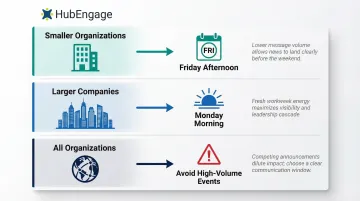
Announce promptly after the promotion is finalized to prevent word-of-mouth rumors, but choose the right moment in the week. Timing depends on company size and context:
- Smaller organizations: Friday afternoon works well, giving teams the weekend to reflect and connect
- Larger companies: Monday morning sets a motivating tone for the week ahead
- All organizations: Avoid major company events, crises, or high-volume periods when the message may get buried
How to Reach Every Employee with Your Announcement
Choosing the right channel matters as much as crafting the right message—especially for organizations with distributed teams, frontline workers, or employees without regular email access. Relying solely on email means a significant portion of the workforce may never see the announcement. Approximately 70% of the current US workforce is concentrated in frontline jobs, and over 83% of frontline workers don't have a corporate email address.
Channel Options Matched to Audience Type
- Email works best for desk-based teams who check it regularly — use it for detailed announcements with supporting context and links
- Team meetings suit small or co-located groups, allowing for real-time Q&A and a personal touch
- Company newsletters extend reach as a follow-up, especially when paired with a primary channel
- Intranet posts invite interaction — employees can comment, react, and engage with the announcement directly
- SMS or digital displays are essential for frontline and deskless workers: SMS hits phones directly, while screens in break rooms, production floors, or retail locations catch everyone else
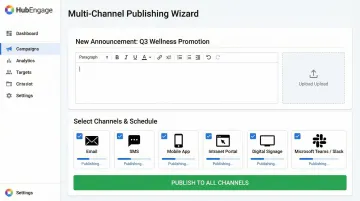
HubEngage lets HR teams publish the same promotion announcement across all these channels at once — email, mobile apps, SMS, intranet, digital signage, and Microsoft Teams or Slack — with content automatically formatted for each. One post, every employee reached, no manual reformatting.
External Announcements
Internal reach handled, senior-level promotions often warrant an external moment too. Sharing the news on LinkedIn or via a press release shows customers, partners, and prospective hires that the company develops talent from within — a visible signal of the culture you're building.
Frequently Asked Questions
How do you announce a promotion internally?
Internal promotion announcements can be made via email, team meetings, company intranet posts, or messaging platforms like Slack or Microsoft Teams. The best channel depends on company size, workforce distribution, and the seniority of the role—with multi-channel delivery recommended for larger or distributed organizations.
Should promotions be announced company-wide?
Most promotions benefit from a company-wide or department-wide announcement to recognize the individual, inform the team of organizational changes, and model what career growth looks like. The scope of the announcement should match the scope of the role and the number of employees affected by the change.
Who should send a promotion announcement email?
In small businesses, the owner or direct manager typically sends it. In larger organizations, HR or a department head sends it. For executive-level promotions, a senior leader or board member may be appropriate to signal the significance of the role.
When should you send a promotion announcement?
Announcements should go out promptly after the promotion is finalized and accepted—but ideally after close team members have been privately informed. Time the announcement thoughtfully within the work week to maximize visibility and engagement.
How do you announce a promotion to remote or frontline employees?
Reaching non-desk or remote workers requires going beyond email. SMS messages, mobile app notifications, digital signage, and intranet posts ensure the announcement reaches employees wherever they work.
Is a 20% raise for a promotion reasonable?
Promotion salary increases typically range from 10–20% depending on the industry, role scope, and internal pay equity. That said, recent Mercer data projects the average one-level promotion increase in 2026 at just 8.7%—down from historical norms—so benchmarking against current SHRM data is worth the effort.