Introduction
Most organizations have clearly defined company values displayed on their websites and break room walls. Yet research reveals a troubling gap: 82% of executives rate their organizational culture as "good or excellent," while only 47% of individual contributors agree. That perception gap is costly. When leadership believes the culture is strong while employees experience something different, the disconnect shows up in retention rates, engagement scores, and productivity.
Culture surveys bridge this gap, but not all surveys deliver value. Generic engagement checklists that ask employees to rate their "overall satisfaction" miss the nuances that matter. A targeted culture survey surfaces honest perceptions of mission alignment, inclusion, leadership behavior, and workplace norms. Those are the dimensions that predict whether people stay, perform, and recommend your organization to others.
This guide gives you 10 ready-to-use survey questions organized by cultural dimension, along with practical tips for running the survey and a framework for acting on results. Whether you're diagnosing culture company-wide or tracking progress after a specific initiative, these questions help you measure what matters.
Key Takeaways
- Reveal the gap between the culture leadership believes exists and what employees actually experience day to day
- Focus on five dimensions: values alignment, leadership behavior, inclusion, team communication, and recognition
- Reach frontline and deskless workers by delivering surveys across mobile, SMS, email, and digital displays — not just desktop email
- Act on results within 1-2 weeks — surveys that go unanswered signal to employees that their feedback doesn't matter
- HubEngage's Survey/Forms Hub lets you deploy culture surveys across all channels at once, so no employee group gets left out of the conversation
Why Culture Surveys Matter More Than You Think
Culture isn't a "nice-to-have" perk. Organizations where employees feel connected to their culture see measurable business outcomes:
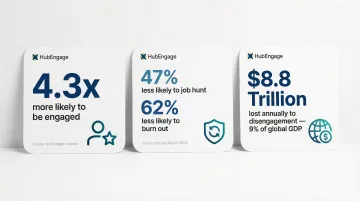
- Employees are 4.3x more likely to be engaged at work
- They're 47% less likely to be job hunting and 62% less likely to burn out
- Disengagement costs the global economy $8.8 trillion annually — roughly 9% of global GDP
Relying on informal observation or exit interviews alone creates a reactive feedback loop. By the time problems surface through attrition or declining morale, the damage is done.
Relying on informal observation or exit interviews alone creates a reactive feedback loop. By the time problems surface through attrition or declining morale, the damage is done. Roughly 70-80% of exit interviews are conducted internally by HR, leading to biased answers because employees fear burning bridges.
Fewer than a third of executives can name a specific action taken as a result of an exit interview. Proactive culture surveys catch misalignment early, before it drives turnover.
That raises a practical question: what kind of survey should you run? Culture surveys and engagement surveys serve different purposes. Engagement surveys measure how motivated and emotionally invested employees feel — the outcome of your cultural efforts. Culture surveys diagnose whether employees' lived experience actually matches your organization's stated values, norms, and leadership behaviors. Culture surveys act as the diagnostic instrument; engagement serves as the report card. The questions in this guide target the diagnostic side — the root causes, not just the symptoms.
10 Employee Survey Questions About Culture, Organized by Theme
These 10 questions surface high-impact cultural signals across five core dimensions. The mix of Likert scale (1–5) and open-ended formats generates both quantifiable trend data and qualitative insight you can't capture with numbers alone.
Mission and Values Alignment
Question 1: "On a scale of 1-5, how clearly do you understand how your daily work connects to our company's mission and values?"
Low scores here signal that purpose hasn't been communicated beyond onboarding decks — and that predicts disengagement. While 85% of executives report living their purpose at work, only 15% of frontline managers and employees say the same. That gap directly impacts both retention and performance.
Question 2: "How often do you observe our stated company values reflected in leadership decisions and actions?"
The gap between espoused values and enacted values is one of the fastest ways to erode cultural trust. Research shows only 40% of employees perceive that their peers are aware of the organization's vision, mission, and values. Boosting behavioral integrity strengthens commitment to espoused values across the organization.
Leadership and Psychological Safety
Question 3: "On a scale of 1-5, how comfortable do you feel raising concerns or sharing ideas with your manager without fear of negative consequences?"
Psychological safety is one of the strongest predictors of team performance and innovation. Google's Project Aristotle concluded that psychological safety is the top predictor of team effectiveness; individuals on teams with stronger psychological safety are less likely to leave, bring in more revenue, and are rated as effective twice as often by executives. Use the results to identify which teams or departments have a climate of fear versus openness — then dig into manager behavior, not just team dynamics.
Question 4: "On a scale of 1-5, how fairly and transparently do you feel decisions are made that affect your work?"
Perceived fairness in decision-making directly impacts trust in leadership and willingness to go above and beyond. A meta-analysis found that procedural justice strongly correlates with trust (rc = .61) and organizational citizenship behaviors. Pair this question with a follow-up open-ended prompt for departments scoring below 3 to understand specific fairness concerns.
Inclusion and Belonging
Question 5: "How valued and respected do you feel as a member of this organization, regardless of your background or role?"
Belonging is distinct from diversity programming. Where DEI metrics track representation, this question measures whether inclusion is actually felt day-to-day. A high sense of workplace belonging leads to a 56% increase in job performance and a 50% reduction in turnover risk.
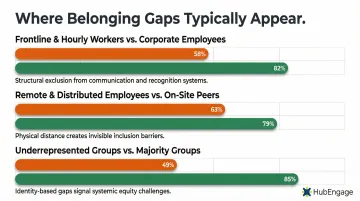
Watch for score gaps by workforce segment:
- Frontline and hourly workers consistently score lower than corporate employees
- Remote or distributed employees often feel less visible than on-site peers
- Score disparities between groups reveal structural blind spots, not just individual perceptions
Question 6: "How well does our organization act on its commitment to creating an equitable and inclusive workplace?"
Stated DEI intentions and perceived follow-through are not the same thing — this question measures the latter. The share of U.S. workers reporting a positive personal impact from DEI initiatives fell from 57% in 2024 to 50% in 2025, with a credibility gap between executive perception (62% positive) and employee perception (48% positive). Response gaps between demographic groups reveal exactly where promises aren't translating into felt inclusion.
Team Dynamics and Communication
Question 7: "On a scale of 1-5, how effectively does your team collaborate and share information to achieve shared goals?"
Team cohesion is a cultural indicator. When collaboration is poor, it often signals unclear norms, siloed departments, or a competitive rather than cooperative internal culture. 67% of collaboration failures are due to silos, and cross-functional processes can consume 40–65% of managerial time due to accountability gaps.
Question 8: "How well-informed do you feel about important company updates and decisions that affect your work?"
Communication gaps are among the most common culture complaints, especially in organizations with large frontline or distributed workforces. Manager effectiveness is the #1 communications risk, identified by 87% of respondents, and for frontline-heavy organizations, that concern is twice as acute. Low scores here pinpoint exactly where messages are breaking down — whether that's at the manager layer, the channel, or the content itself.
Recognition and Well-being
Question 9: "How consistently does your manager or the organization recognize and appreciate your contributions?"
Recognition is a direct driver of belonging and retention. Employees receiving high-quality recognition are 45% less likely to leave the organization after two years. Employees who don't feel adequately recognized are twice as likely to quit within the next year, making this one of the clearest leading indicators of near-term attrition risk.
Question 10 (open-ended): "What is one thing our organization could change to make this a better place to work?"
Placed last, this question captures what no scale can: the specific cultural pain points employees actually care about most. Responses frequently surface priorities HR hadn't considered — and often point directly to where the highest-scoring quantitative questions are masking real friction.
Best Practices for Designing Your Culture Survey
Set a clear objective before writing a single question. Is the goal to benchmark culture company-wide, diagnose a specific team issue, or track improvement after a culture initiative? The objective shapes which questions to include, the scale used, and how often to survey.
Question design dos and don'ts:
- Use plain, jargon-free language accessible to all employees
- Avoid double-barreled questions (e.g., "Do you trust your manager and feel heard?")
- Keep the survey to 10-15 questions to prevent fatigue
- Always include at least one open-ended question to capture nuance
Surveys longer than 12 minutes start to see substantial respondent break-off, and an additional hour of survey time increases the probability of a respondent skipping a question by 10-64%.
Anonymity is non-negotiable. Employees who don't trust confidentiality give inflated positive responses, making the data useless. Clearly communicate anonymity protocols before the survey launches, including who will see results and at what aggregation level.
Most organizations use minimum group sizes of 5–10 respondents for reporting. If thresholds are too low, employees fear identification; if too high, leaders lose visibility into problem areas.
Getting Maximum Participation — Especially from Frontline Teams
One of the most overlooked challenges in culture surveys is low response rates among non-desk workers—manufacturing, healthcare, retail, hospitality employees who don't have regular email access or company laptops. Approximately 80% of the global workforce (2.7 billion people) is "deskless", yet most enterprise surveys rely on email, systematically excluding the employees whose cultural experience matters most.
Best practices for promoting and delivering the survey:
- Communicate purpose and anonymity in advance via manager briefings or team meetings
- Set a clear deadline and send reminders through multiple channels
- Frame participation as an investment in improving their workplace, not a performance check
- Deploy surveys across multiple channels simultaneously
Channel choice has a direct impact on who actually responds:
| Delivery Method | Response Rate |
|---|---|
| Email only | 10–15% |
| QR codes in break rooms | 20–40% |
| SMS delivery | Up to 67% higher than email |
| Mixed-access (kiosks, QR, SMS) | 84–85% among frontline staff |
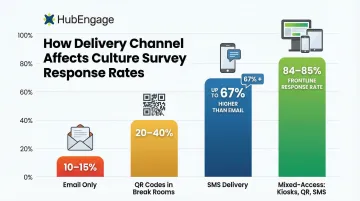
The data is clear: the more access points you offer, the more representative your results become.
HubEngage's Survey/Forms Hub addresses this by deploying culture surveys across mobile app, SMS, email, web portal, and digital displays simultaneously. Every employee gets the survey in the channel that works for them—whether that's a QR code in the break room or a push notification on their phone—so your response data reflects your whole workforce, not just the desk-based portion of it.
Turning Survey Results into Action
The single biggest trust-killer after a survey is silence. Employees who complete a survey and hear nothing assume nothing will change, and participation rates drop sharply in future cycles. Organizations should share high-level results within 1-2 weeks after the survey closes to maintain momentum and demonstrate swift action.
Action-planning process:
- Identify the 2-3 lowest-scoring areas that have the highest organizational impact
- Assign ownership for each improvement initiative to specific leaders or teams
- Set measurable milestones with clear timelines and success metrics
- **Schedule a follow-up pulse survey** in 6-12 months to measure progress on the same questions
Small, visible changes acted on quickly build more trust than large promises with no near-term evidence. When leaders ask what employees think but fail to translate input into concrete actions, the value of feedback diminishes and employees stop responding.
Share results with context, not just raw data—explain what the scores mean and what leadership will do next.
That communication step is where many organizations fall short. HubEngage's multi-channel platform lets you push survey summaries back to employees through the same channels you used to collect feedback: mobile app notifications, digital displays in break rooms, email updates, or SMS messages. Employees see their input reflected in leadership's response, which is what keeps participation rates strong in future cycles.
Frequently Asked Questions
What are 5 good survey questions and answers?
Five effective culture survey questions, each targeting a distinct dimension:
- "How clearly do you understand how your daily work connects to our mission?" (values alignment)
- "How comfortable do you feel raising concerns with your manager?" (psychological safety)
- "How valued do you feel regardless of your background or role?" (inclusion)
- "How effectively does your team collaborate?" (team dynamics)
- "What is one thing we could change to make this a better place to work?" (open-ended improvement)
What are the four C's of company culture?
The four C's of company culture are Communication (how information flows), Collaboration (how teams work together), Connection (how employees relate to purpose and each other), and Commitment (how invested employees are in organizational success). Mapping survey questions to each dimension gives you structured coverage of the factors that drive engagement.
What is the difference between a culture survey and an engagement survey?
Engagement surveys measure how motivated and emotionally invested employees feel in their work—the outcome of your cultural efforts. Culture surveys assess whether employees' lived experience aligns with the organization's stated values, norms, and leadership behaviors—the diagnostic that explains why engagement is high or low. Both are valuable but serve different purposes: culture surveys diagnose the problem, engagement surveys measure the result.
How often should you run an employee culture survey?
Run a comprehensive culture survey annually, supplemented by shorter pulse surveys quarterly or semi-annually to track progress on specific initiatives. Frequency should balance the need for current data against the risk of survey fatigue.
How do you increase culture survey response rates for frontline or deskless employees?
Communicate purpose and anonymity in advance through manager briefings and shift meetings. Deploy surveys via multiple channels—SMS, mobile app, QR codes in break rooms, and digital displays—rather than email alone. Keep surveys short (10-15 questions maximum), and have managers actively encourage participation during team meetings. Platforms like HubEngage enable simultaneous multi-channel deployment, ensuring frontline workers can complete surveys on their phones during breaks regardless of email access.