Introduction
HR leaders face a persistent tension: organizations invest heavily in perks, competitive pay, and engagement programs — yet motivation still erodes. According to Gallup's 2024 State of the Global Workplace report, actively disengaged employees cost the global economy $8.8 trillion in lost productivity annually, equivalent to 9% of global GDP.
Measuring motivation is the first step to fixing it. A well-run employee motivation survey is a diagnostic tool — one that tells you exactly where energy is leaking and why. This guide delivers a categorized question bank, a ready-to-use template, and a practical framework for turning survey data into action. Frontline and distributed employees get special attention here, since they're routinely left out of traditional survey programs.
TLDR:
- Motivation surveys pinpoint what drives or diminishes performance — distinct from engagement or satisfaction scores
- Cover 8 core drivers: purpose, manager support, recognition, growth, autonomy, workload, team culture, and pay fairness
- Use 12-15 core questions for trend tracking plus 5-10 rotating questions based on organizational priorities
- Deploy via multiple channels — mobile, SMS, digital signage — to reach every employee, not just desk workers
- Share results within 2-3 weeks and commit to action — silence after a survey damages trust more than skipping it
What Is an Employee Motivation Survey (and Why Does It Matter)?
An employee motivation survey is a structured questionnaire that helps organizations understand what drives or diminishes employees' willingness to perform, contribute, and stay. It differs from engagement surveys (which measure emotional commitment) and satisfaction surveys (which measure contentment with job conditions). It differs from engagement surveys (which measure emotional commitment) and satisfaction surveys (which measure contentment with job conditions). Understanding that distinction is what makes motivation surveys worth running separately.
The Business Cost of Unmeasured Motivation
The financial impact is severe. Business units in the top quartile of employee engagement see 23% higher profitability, 18% higher sales productivity, and 51% less turnover compared to bottom-quartile teams. Yet most organizations don't systematically measure the drivers behind these outcomes.
Intrinsic vs. Extrinsic Motivators
Motivation surveys cover two distinct categories — and both matter for an accurate picture:
Intrinsic motivators (internal rewards):
- Purpose and meaningful work
- Autonomy and decision-making freedom
- Growth and development opportunities
- Recognition and appreciation
Extrinsic motivators (external rewards):
- Compensation and benefits
- Job security
- Working conditions
- Organizational policies
Research based on Self-Determination Theory shows that intrinsic motivation is the strongest predictor of both job satisfaction and engagement, while external rewards alone don't reliably predict performance. That said, compensation still functions as a baseline requirement — employees won't engage with higher-level motivators if they feel underpaid.
The Key Motivation Drivers Your Survey Should Cover
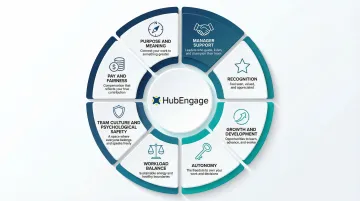
Eight core motivation drivers consistently predict employee performance and retention. Covering all eight ensures your survey captures the full picture — rather than focusing too heavily on one area while missing others.
The 8 Core Motivation Drivers:
- Purpose and Meaning — Understanding how work contributes to organizational goals and creates impact
- Manager Support and Quality — The quality of leadership, feedback, and day-to-day management
- Recognition and Appreciation — Acknowledgment of good work and contributions
- Growth and Career Development — Opportunities to learn, develop skills, and advance
- Autonomy and Empowerment — Freedom to make decisions and own your work
- Workload and Work-Life Balance — Manageable workload and sustainable work practices
- Team Culture and Psychological Safety — Respectful relationships and feeling safe to speak up
- Pay, Benefits, and Fairness — Fair compensation and equitable treatment
Why Systems Beat Isolated Perks
McKinsey's 2024 research found that motivation depends on a coherent, connected framework spanning goal setting, performance reviews, feedback, and rewards. Organizations that treat each element in isolation consistently see weaker motivation outcomes than those running integrated systems.
The Core + Add-On Survey Structure
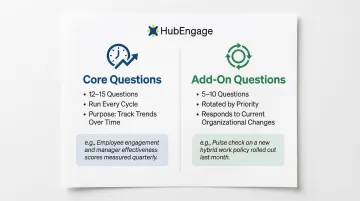
A practical structure keeps two question pools separate:
| Question Type | Volume | Purpose |
|---|---|---|
| Core questions | 12–15 | Consistent across every cycle for trend tracking |
| Add-on questions | 5–10 | Rotated based on current priorities (leadership changes, restructuring, new initiatives) |
This approach balances reliable trend data over time with the flexibility to respond to what's happening in your organization right now.
30 Employee Motivation Survey Questions (by Category)
These 30 questions span the eight dimensions most closely tied to motivation decline — from purpose and pay fairness to psychological safety. All questions use a standard 1-5 Likert scale (1 = Strongly Disagree, 5 = Strongly Agree) with an optional "Not Applicable" choice, plus 1-2 open-text questions at the end.
Purpose and Meaning
- I understand how my work contributes to our company's goals.
- My role feels meaningful and worthwhile.
- I am clear on how my work benefits our customers or stakeholders.
- I feel motivated by the purpose of this organization.
Leadership and Manager Support
- My manager cares about my wellbeing.
- My manager provides clear direction and expectations.
- I receive useful feedback from my manager.
- My manager supports me when I raise concerns or challenges.
- Leadership communicates clearly about priorities and changes.
Recognition and Appreciation
- I receive recognition when I do good work.
- Recognition here feels genuine and timely.
- Good performance is acknowledged fairly across the organization.
Growth and Career Development
- I have opportunities to learn new skills.
- I am encouraged to develop professionally.
- I understand what I need to do to grow or progress here.
- My development goals are supported by my manager.
Tip: Categories 5–8 (Autonomy through Pay & Fairness) tend to surface the most actionable gaps — these are the areas where low scores most often translate directly into turnover risk.
Autonomy and Empowerment
- I have enough freedom to decide how I do my work.
- I am trusted to make decisions within my role.
- I can suggest improvements to how work is done.
- I feel empowered to take ownership of my work.
Workload and Work-Life Balance
- My workload is manageable most of the time.
- I have the time I need to do my work properly.
- Work processes here support productivity rather than slow it down.
- The way we work allows for a healthy balance between work and personal life.
Team Culture and Psychological Safety
- I feel respected by my coworkers.
- My team works well together.
- I feel comfortable being myself at work.
- I feel safe speaking up or sharing different views.
Pay, Benefits, and Fairness
- My pay feels fair for my role and performance.
- Decisions about pay, benefits, and opportunities are applied fairly.
A Ready-to-Use Employee Motivation Survey Template
This template is a curated 20-question version of the question bank above, organized into the same eight categories. Most HR practitioners cap surveys at 20–25 questions — enough to capture meaningful data without triggering survey fatigue.
Survey Introduction Statement: "Your feedback is anonymous and will be used to improve your experience at work. Please answer honestly — your responses help us understand what's working and what needs attention."
Purpose and Meaning (2 questions)
- I understand how my work contributes to our company's goals. (1-5 scale)
- My role feels meaningful and worthwhile. (1-5 scale)
Leadership and Manager Support (3 questions)
- My manager cares about my wellbeing. (1-5 scale)
- My manager provides clear direction and expectations. (1-5 scale)
- I receive useful feedback from my manager. (1-5 scale)
Recognition and Appreciation (2 questions)
- I receive recognition when I do good work. (1-5 scale)
- Recognition here feels genuine and timely. (1-5 scale)
Growth and Career Development (3 questions)
- I have opportunities to learn new skills. (1-5 scale)
- I am encouraged to develop professionally. (1-5 scale)
- I understand what I need to do to grow or progress here. (1-5 scale)
Autonomy and Empowerment (2 questions)
- I have enough freedom to decide how I do my work. (1-5 scale)
- I feel empowered to take ownership of my work. (1-5 scale)
Workload and Work-Life Balance (3 questions)
- My workload is manageable most of the time. (1-5 scale)
- I have the time I need to do my work properly. (1-5 scale)
- The way we work allows for a healthy balance between work and personal life. (1-5 scale)
Team Culture and Psychological Safety (3 questions)
- I feel respected by my coworkers. (1-5 scale)
- My team works well together. (1-5 scale)
- I feel safe speaking up or sharing different views. (1-5 scale)
Pay, Benefits, and Fairness (2 questions)
- My pay feels fair for my role and performance. (1-5 scale)
- Decisions about pay, benefits, and opportunities are applied fairly. (1-5 scale)
Open-Text Questions
- What most affects your motivation at work?
- What one change would improve your day-to-day experience?
Customization Note: Core vs. Add-On Questions
Core questions (keep every cycle for trend tracking):
These map to your highest-signal categories — run them consistently so you can compare scores over time:
- Purpose and Meaning (both questions)
- Manager provides clear direction
- I receive useful feedback from my manager
- I have opportunities to learn new skills
- My workload is manageable most of the time
- I feel respected by my coworkers
- I feel safe speaking up
- My pay feels fair
- Both open-text questions
Add-on questions (rotate based on current priorities):
Swap these in when a specific theme — career development, workload, or team dynamics — needs deeper investigation in a given cycle.
Keep demographic fields to department and role level only — never individual identifiers — to protect anonymity.
Deploying Your Survey at Scale
One common deployment challenge: frontline and deskless workers often don't have regular computer access, so email-only surveys miss a significant portion of your workforce. HubEngage's built-in survey module addresses this directly — it auto-formats and delivers surveys across mobile apps, SMS, email, and digital signage so no employee segment is excluded from the feedback loop.
Survey Frequency Recommendations
Quarterly pulse surveys: Use 12-15 core questions to track trends and catch issues early.
Annual deep survey: Deploy the full 20-25 question template to capture the complete picture.
High-turnover industries: For retail, hospitality, or manufacturing where frontline turnover is high, run monthly pulses with 5-8 questions to catch problems before they compound.
How to Act on Employee Motivation Survey Results
The survey is only valuable if results are analyzed and shared back. When employees complete a survey and hear nothing back, trust erodes faster than if you'd never asked.
The Post-Survey Communication Loop
Share high-level findings with all employees within 2-3 weeks of closing the survey. Explain what HR heard and commit to specific actions. That follow-through gap is wider than most HR teams realize: while 71% of organizations share survey results, only 51% of employees see tangible improvements from their feedback. Closing that gap is what separates surveys that build trust from surveys that drain it.
Identify Priority Areas Using Score-Based Triage
Urgent (below 3.0/5.0): Categories scoring below this threshold require immediate attention.
Improvement opportunities (3.0-3.8): Mid-range scores flag areas for focused improvement.
Maintain and celebrate (above 3.8): High scores should be recognized and sustained.
Break down results by department and role level to spot team-specific patterns rather than relying solely on company-wide averages.
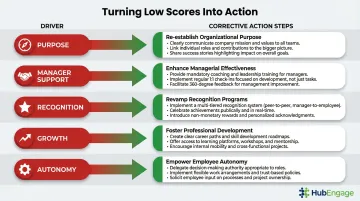
Map Low Scores to Specific Actions
Low purpose/meaning scores:
- Connect individual roles to company goals in team meetings
- Share customer success stories that show impact
- Clarify how each role contributes to strategic priorities
Low manager support scores:
- Invest in manager coaching and leadership development
- Implement structured 1:1 meeting frameworks
- Train managers on giving constructive feedback
Low recognition scores:
- Introduce or improve peer and manager recognition programs
- Make recognition timely (within 24-48 hours of achievement)
- Ensure recognition is specific, not generic
Low growth scores:
- Build individual development plans into performance conversations
- Create clear career pathways and skill progression frameworks
- Offer learning opportunities aligned with employee goals
Low autonomy scores:
- Audit decision-making processes and remove unnecessary approval layers
- Delegate more authority to frontline roles
- Clarify which decisions employees can make independently
The Feedback Multiplier Effect
McKinsey's research found that only 21% of employees who have no development conversations feel motivated, compared to 77% of those who receive ongoing feedback. Survey action works the same way. When employees see their input translated into real changes, participation rates climb in future surveys — and so does the quality of the feedback you receive.
Best Practices for Designing and Running Your Survey
Anonymity and Trust Are Non-Negotiable
Survey anonymity is essential for honest responses. Employees who fear identification will self-censor on the questions that matter most. To protect anonymity in practice:
- Collect only department and role-level demographics (not individual identifiers)
- State the anonymity policy clearly in the survey introduction
- Reinforce it in manager communications before launch
Note: 33% of employees state they would only report sensitive issues like harassment if they could do so anonymously, which shows why this policy must be communicated — not just assumed.
Prevent Survey Fatigue
Cap survey length:
- Annual surveys: 20-25 questions maximum
- Pulse checks: 5-10 questions maximum
- Use primarily Likert-scale questions with only 1-2 open-text fields
Timing matters: Schedule surveys away from peak workload periods such as end-of-quarter or seasonal rushes — particularly important for retail, hospitality, and manufacturing teams.
Data quality declines after 10-12 minutes. Research shows that in surveys longer than this, respondents answer questions positioned later faster, shorter, and more uniformly, degrading data quality.
Reach All Employees, Not Just Desk Workers
Keeping surveys short and well-timed only matters if employees can actually access them. Many programs fall short here: they rely on email-only delivery, which cuts out frontline, warehouse, and field employees who don't have corporate email access.
Coverage gap: Frontline and deskless workers comprise 70% to 80% of the global workforce (approximately 2.7 billion people), yet 54% of deskless workers have limited email access.
Deploy surveys via multiple channels:
- Mobile apps for on-the-go completion
- SMS text messages for immediate reach
- Kiosk-style digital displays in break rooms and common areas
- QR codes posted in physical locations
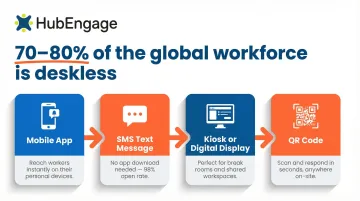
Organizations that add even one non-email channel consistently see higher participation rates — and more accurate data — from their hourly and field teams.
Frequently Asked Questions
How do you measure employee motivation?
Employee motivation is measured through structured surveys using Likert-scale questions across key drivers (purpose, recognition, growth, manager support, autonomy, workload, fairness), combined with trend tracking over time and open-text responses to surface the "why" behind the scores.
What are the top 3 motivators for employees?
Research consistently identifies meaningful work, recognition and appreciation, and growth opportunities as the top three intrinsic motivators. Fair compensation acts as a baseline — it must be met before those intrinsic drivers can fully take effect.
What is the 5 point Likert scale for motivation?
A 5-point Likert scale runs from 1 (Strongly Disagree) to 5 (Strongly Agree), with 3 as the neutral midpoint. It's the standard choice for motivation surveys because it captures nuance, completes quickly, and generates quantitative data you can track across cycles.
How often should you run an employee motivation survey?
Run a full 20–25 question survey annually, supplemented by quarterly pulse surveys (10–12 questions) to track trends and catch issues early. High-turnover industries like hospitality or manufacturing should add monthly pulses of 5–8 questions.
Should employee motivation surveys be anonymous?
Yes — anonymity is essential for honest responses, particularly on sensitive topics like pay fairness and manager effectiveness. Limit demographic fields to department and role level only; never collect individual identifiers.
How many questions should an employee motivation survey have?
Use 20–25 questions for a full motivation survey and 5–10 for a pulse check. Exceeding 25 questions leads to survey fatigue and lower-quality responses. A mix of Likert-scale questions with 1–2 open-text questions at the end balances data quality with completion rates.