This article examines the biggest shifts shaking up employee survey platforms right now, what leading vendors are building in response, and what HR leaders need to know when evaluating or upgrading their survey tools.
Key Takeaways
- AI-native platforms compress survey analysis from weeks to hours, delivering insights before the data goes stale
- Survey credibility crisis deepens: 35% of employees believe their companies don't act on results, undermining trust and participation
- Continuous pulse-based listening with anonymity safeguards replaces annual engagement surveys as the new standard
- Mobile-first, multi-channel delivery is mandatory for reaching the 70-80% of workers who are deskless
- The strongest platforms connect survey data directly to retention risks and manager behavior, closing the gap between listening and action
The State of Employee Surveys in 2025: Key Industry Shifts
The employee engagement software market reached approximately $1.2 billion in 2025, with directional growth estimates ranging from 6.8% to 16.4% CAGR through 2030. The stakes are high: Workday's $700 million acquisition of Peakon in 2021 and Culture Amp's $1.5 billion unicorn valuation signal that employee listening platforms have become core infrastructure for enterprise HR strategy.
Engagement Evolves from Concept to Data-Driven Priority
William Kahn formally defined employee engagement in 1990 as "the harnessing of organization members' selves to their work roles." Today, that qualitative HR concept has evolved into a measurable business priority with direct links to productivity, turnover, and profitability. Organizations routinely tie engagement scores to retention forecasts, productivity benchmarks, and quarterly business reviews.
The Credibility Crisis Threatening Employee Listening
The central challenge platforms must solve is trust. 65% of employees in 2023 said organizations don't take effective action on survey results; while that number improved to 35% in 2025, it still represents more than one in three employees who view surveys as performative exercises rather than genuine listening tools.
This credibility gap creates a vicious cycle: employees disengage from surveys when they perceive results are ignored, which degrades data quality and makes it harder for HR to identify real problems.
Business Insider reporting reveals that workers increasingly self-censor out of fear of retaliation. 46% of employees who raised concerns faced personal disadvantage, and 34% cited fear of jeopardizing their job. This "survey snitchware" anxiety erodes both data quality and employee trust in HR.
The Platform Convergence Reshaping the Market
Standalone survey tools are increasingly replaced by integrated solutions that unify recognition, communication, performance management, and surveys into comprehensive employee experience platforms. This convergence reflects a fundamental shift: organizations want feedback systems that connect directly to action infrastructure—not just data collection endpoints.
The integrated platforms gaining traction in 2025 typically combine:
- Pulse surveys and annual engagement tracking
- Recognition and rewards tied to survey participation
- Performance management workflows connected to feedback data
- Multi-channel delivery across mobile, email, SMS, and digital signage
- Analytics dashboards that surface actionable trends, not just scores
AI-Native Surveys: The Biggest Platform Innovation of 2025
"AI-native" in the context of employee surveys means platforms built from the ground up to analyze open-text responses, surface themes, predict sentiment trends, and recommend actions—all in real time. Unlike vendors that bolted AI onto existing survey tools as an afterthought, AI-native platforms treat machine learning as foundational architecture rather than a feature add-on.
Recent platform launches reflect how quickly this approach is spreading:
- Remote launched AI-native Surveys on September 16, 2025, adding AI-powered survey creation, sentiment detection, and theme highlighting
- Workday Peakon added AI comment summaries across 60+ languages through its Illuminate capabilities
- Leapsome embedded AI across surveys, reviews, and an AI copilot that helps managers draft responses and flag at-risk employees
Core AI Capabilities Emerging Across Leading Platforms
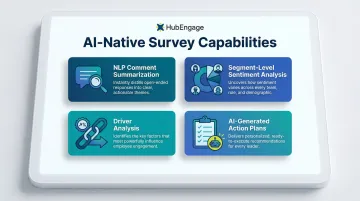
Four capabilities are becoming standard across AI-native platforms:
- NLP comment summarization — automatically surfaces recurring themes from open-text responses, eliminating manual review of hundreds of comments
- Segment-level sentiment analysis — detects engagement patterns by team, tenure, department, or demographic to pinpoint where issues concentrate
- Driver analysis — links engagement scores to outcomes like turnover or productivity, clarifying which factors actually move the needle
- AI-generated action plans — delivers specific, contextualized next steps to managers rather than generic recommendations
The Speed Advantage: From Weeks to Hours
Qualtrics reports that Allstate compressed survey analysis from weeks to 48 hours using AI comment summaries, delivering executive-ready insights while feedback remains relevant. This time compression matters: quarterly business reviews can now incorporate fresh employee sentiment data rather than presenting months-old results that no longer reflect current reality.
Manager Enablement: Democratizing Survey Data
AI isn't just for HR analytics teams anymore. Platforms now use AI to help managers draft personalized feedback responses, identify employees at risk of disengagement, and receive nudges for coaching conversations. This shifts who acts on survey data—moving insights from centralized HR reports to distributed manager action.
HubEngage exemplifies this platform-wide approach. The platform's AI Assistant helps employees find information and answers questions instantly, while also supporting HR and communications teams with content generation, survey insights, and engagement analytics—all from a single unified platform.
Tackling Survey Fatigue: What Platforms Are Doing Differently
Survey fatigue isn't just about employees ignoring surveys—it actively degrades data quality, reduces trust in HR, and signals a breakdown in the feedback loop. Perceptyx benchmarks show census response rates of 72-88% for large enterprises versus pulse rates of 55-81%, indicating that frequency alone doesn't determine participation.
From Volume to Value: Contextual Survey Triggers
Leading platforms are moving away from long, infrequent surveys toward shorter, more frequent pulses. The more significant shift is toward contextual, trigger-based surveys that ask employees for feedback at meaningful moments:
- Post-onboarding surveys after the first 30, 60, or 90 days
- Post-training feedback when learning is fresh
- Post-project pulse surveys following major initiatives
- Organizational change surveys after restructuring or leadership transitions
This shift from calendar-scheduled to event-triggered surveys increases relevance and reduces the sense that surveys exist to serve HR's administrative needs rather than capture genuine employee experience.
Anonymity Architecture Rebuilding Trust
Platforms are building sophisticated anonymity protections that signal to employees their candor is protected:
- Minimum response thresholds (typically 5-10 responses) before team-level data is revealed
- Anonymous follow-up conversations between managers and respondents
- Separated visibility controls that distinguish HR admin access from manager access
- Aggregated reporting that prevents identification through demographic filtering
Gallup notes that perceived anonymity matters as much as actual anonymity—when employees don't believe their input is truly anonymous, response rates drop and data becomes less reliable.
Gamification as an Emerging Response to Fatigue
Incentivizing survey participation through points, rewards, or recognition increases completion rates. Platforms are now embedding surveys into gamified engagement systems where participation carries tangible value.
HubEngage takes this platform-wide: completing surveys earns points redeemable for recognition or rewards, making feedback a natural part of the employee experience rather than an obligatory HR task.
Mobile-First and Multi-Channel Survey Delivery: The New Standard
Approximately 70-80% of the global workforce is deskless, concentrated in healthcare, retail, manufacturing, hospitality, and logistics. These employees do not have regular access to company email or desktop computers, meaning traditional survey delivery excludes them by default.
Multi-Channel Delivery Standard
Top platforms now deliver surveys via:
- Mobile apps with native iOS and Android support
- SMS text messages with survey links
- Email for desk-based employees
- Digital display screens in break rooms and production floors
- Web intranet for flexible access
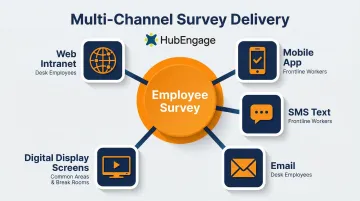
What ties these channels together is auto-formatting: the platform adapts survey content for each delivery method automatically, so HR teams build the survey once and distribute everywhere. HubEngage applies this through its multi-channel reach capability, handling formatting optimization across mobile, email, SMS, and digital displays without manual rework.
Practical Implications for Platform Selection
Organizations with distributed or frontline workforces should prioritize survey platforms with:
- Native mobile apps (not just mobile-responsive web forms)
- SMS delivery capabilities for text-based survey invitations
- Offline-capable surveys that sync when connectivity returns
- Multi-channel analytics showing which delivery methods drive highest response rates
Desktop-only tools systematically exclude the employees most likely to be disengaged and least likely to be heard. That gap in coverage means workforce listening data reflects only the employees already easiest to reach.
Turning Survey Data into Action: The Retention Connection
The most common and costly failure mode in employee surveys is collecting feedback but failing to act on it—or acting without communicating what changed as a result. This "black box" problem drives declining participation and growing cynicism. Business Insider notes that by the time a concern appears in a survey, it has usually already tried to reach management through other channels.
Building Action Infrastructure into the Survey Loop
Leading platforms embed action capabilities directly into survey workflows:
- Structured action plan templates give managers a clear framework for responding to team feedback — no guesswork on next steps
- Automated follow-up pulse surveys check in after an action is taken to confirm impact and show employees their input mattered
- Manager accountability dashboards track whether leaders are reviewing results, building action plans, and closing the loop with their teams
- Integration with recognition and communication workflows lets HR trigger appreciation campaigns or targeted messaging directly from survey insights
HubEngage's platform architecture illustrates this integration: survey insights can flow into the Communications Hub to announce changes, the Recognition Hub to celebrate teams that surfaced valuable feedback, or the AI Assistant to help managers craft personalized responses.
The Retention Connection
When action infrastructure is in place, the retention results follow. A Quantum Workplace case study shows ODW Logistics reduced voluntary turnover from 31–51% down to 14.33% after implementing a full engagement survey and pulse cycle tied to concrete action strategies.
Consistent follow-through on survey feedback builds the kind of trust that keeps people around:
- Demonstrates that leadership genuinely values employee input
- Builds confidence that speaking up leads to real change
- Establishes credibility through visible follow-through
- Strengthens employees' connection to the organization
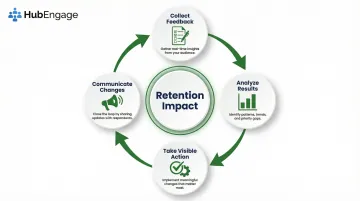
When organizations close the feedback loop consistently, surveys stop being a compliance exercise and become a retention tool.
Frequently Asked Questions
Do pulse surveys work?
Yes, pulse surveys work when organizations act on results. Short, frequent surveys yield higher response rates and fresher data than annual surveys, but their effectiveness depends entirely on closing the loop with visible action and communication back to employees. Quantum Workplace research shows quarterly surveying aligns with 71% engagement rates, though monthly cadences risk over-surveying.
What are the statistics for employee satisfaction in 2025?
According to Gallup's 2025 State of the Global Workplace report, only 21% of employees globally are engaged while 17% are actively disengaged. In the United States, engagement fell to 31% in 2024—the lowest level in a decade—a drop that translates directly into measurable productivity and retention costs.
What is the biggest challenge with employee engagement surveys?
Survey fatigue and lack of follow-through are the two biggest challenges. When employees believe results are ignored, participation drops and data quality suffers. Modern platforms address this by building action workflows directly into the feedback loop, so employees see their input driving real change.
How often should you run employee surveys?
A practical cadence combines three types:
- Pulse surveys monthly or quarterly for regular temperature checks
- Lifecycle surveys at key moments like onboarding or exit
- Engagement surveys annually for comprehensive baseline measurement
Frequency matters less than consistency. Perceptyx benchmarks suggest cadence should match your organization's capacity to act on results, not an arbitrary schedule.