Introduction
Employee disengagement has reached crisis levels. Global engagement fell to just 21% in 2024, costing the world economy an estimated $438 billion in lost productivity. In the United States, engagement sank to a decade-low of 31%, with each percentage-point drop representing approximately 1.6 million disengaged workers.
Gamification software applies behavioral science to the daily work experience—embedding motivation, recognition, and progress signals directly into how people communicate, learn, and collaborate. When designed well, it engages core human drives like autonomy, competence, connection, and purpose, turning routine tasks into experiences that produce measurable business outcomes.
This guide covers what gamification software is, which features matter most, proven use cases across the employee lifecycle, common implementation pitfalls, and how to evaluate and deploy a solution that delivers ROI.
Key Takeaways
- Gamification applies game mechanics—points, badges, leaderboards, challenges—to workplace activities, boosting engagement, productivity, and retention
- The most effective platforms embed gamification across the entire employee experience, not just isolated features
- Top use cases: onboarding, training, peer recognition, performance tracking, and wellness programs
- Avoid misaligned incentives, overreliance on competitive leaderboards, and deploying without diagnosing root causes first
- Prioritize platforms with multi-channel delivery, platform-wide gamification, and analytics tied to retention and productivity metrics
What Is Gamification Software for Employee Engagement?
Gamification software applies game design elements—points, badges, leaderboards, progress bars, challenges, and instant rewards—to non-game environments like the workplace. These mechanics transform routine tasks into structured, motivating experiences that drive measurable participation and performance.
The Psychological Foundation
Effective gamification is rooted in Self-Determination Theory (SDT), which identifies three psychological needs that fuel intrinsic motivation:
- Autonomy: Employees feel in control of their actions and goals
- Competence: They experience a sense of skill growth and effectiveness
- Relatedness: They feel genuinely connected to their colleagues and the organization
When gamified systems help employees feel in control, capable, and connected, they shift from externally driven compliance to intrinsically motivated engagement.
Surface-Level vs. Platform-Wide Gamification
Surface-level gamification adds a single game mechanic to one feature—a leaderboard inside a training module or a badge for survey completion. This approach delivers limited impact because it treats gamification as decoration rather than infrastructure.
Platform-wide gamification embeds game mechanics across communications, recognition, surveys, learning, and social engagement. Employees earn points for reading announcements, recognizing peers, completing training, and contributing to discussions. This comprehensive approach creates a unified engagement ecosystem where every interaction reinforces positive behaviors.
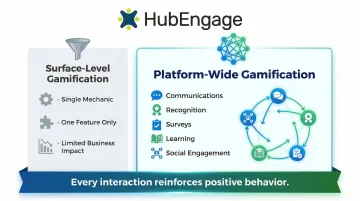
HubEngage, for example, applies gamification across every touchpoint in its multi-channel platform—from mobile apps and web intranets to email, SMS, and digital signage—so employees encounter consistent engagement mechanics regardless of how they access company communications. That reach is what separates platforms that change daily behavior from those that simply add a feature.
Key Features to Look for in Gamification Software
Core Game Mechanics and Reward Systems
Foundational mechanics include:
- Points: Quantify participation and progress toward goals
- Badges: Recognize specific accomplishments and milestones
- Leaderboards: Create performance visibility and healthy competition
- Challenges/Quests: Drive focused activity over defined time periods
Each mechanic targets a different motivational driver. Research shows that badges, leaderboards, and performance graphs positively affect competence need satisfaction and perceived task meaningfulness.
Reward systems must go beyond digital badges. Whether employees find gamification genuinely rewarding—or just performative—comes down to redemption options: gift cards, experiences, peer recognition moments, and charitable contributions all serve different preferences.
70% of employees say recognition is most meaningful when personalized, making reward variety essential for diverse, multi-generational workforces. HubEngage partners with Tango Card to deliver flexible reward catalogs—e-gift cards, wellness packages, and charitable donations—so employees can redeem points for what actually matters to them.
Multi-Channel and Mobile Accessibility
Gamification only works if employees can participate through channels they actually use. The deskless workforce is massive—and largely underserved by most platforms:
- 80% of the global workforce (2.7 billion people) are deskless workers
- 64% face smartphone restrictions on production floors
- Only 23% believe they have adequate technology to do their jobs effectively
Frontline and deskless workers need gamified experiences delivered via mobile apps, SMS, or digital displays—not just web portals. Platforms that auto-format content across mobile, web, email, SMS, and digital signage remove participation barriers and ensure gamification drives adoption organization-wide.
HubEngage's multi-channel architecture enables organizations to reach every employee—whether at a desk, on a factory floor, or in the field—through their preferred channel, ensuring frontline workers aren't excluded from recognition and engagement programs.
Analytics and Performance Tracking
Real-time dashboards showing participation rates, points earned, and challenge completion are now expected in any serious platform. What separates strong tools from weak ones is how well they connect engagement activity to business KPIs—training completion rates, employee retention, productivity metrics, and survey response rates.
Analytics that show whether gamification actually moves those numbers let HR teams optimize continuously—and give leadership the ROI evidence they need.
Top Use Cases: How Gamification Transforms the Employee Lifecycle
Gamification isn't one-size-fits-all. It applies at every stage of the employee journey. Below are the five highest-impact use cases.
Onboarding New Hires
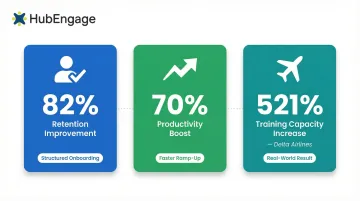
Employees decide if a job is the right fit within 44 days of their start date. Gamified onboarding—milestone-based quests, points for completing modules, progress bars through orientation stages—reduces early disengagement and helps new hires become productive faster.
Structured onboarding improves retention by 82% and productivity by 70%. The numbers hold up in practice, too. Delta Airlines gamified its customer service representative onboarding and achieved a 521% increase in training capacity, a 21-day reduction in training time, and a 19% productivity improvement.
Training, Compliance, and Learning & Development
Gamified microlearning—short quizzes, interactive challenges, level-based progression—increases knowledge retention and compliance completion versus traditional passive training.
A 2020 meta-analysis found gamification has significant effects on cognitive (g = 0.49), motivational (g = 0.36), and behavioral (g = 0.25) learning outcomes. Deloitte Leadership Academy saw a 47% increase in returning users weekly after adding leaderboards, badges, and personalized goals. Content was completed 75% faster.
The retail sector shows similar results. Target's "Checkout Champions" program awarded points for speed and customer conversation quality, cutting checkout times by 35% and reducing cashier turnover by 45%.
Peer Recognition and Culture Building
Peer-to-peer recognition reinforces company values and builds belonging, particularly for distributed or frontline teams who may not interact with managers daily.
Employees receiving high-quality recognition are 45% less likely to leave after two years. When recognition is fulfilling, authentic, personalized, and equitable, employees are nine times as likely to be engaged.
Gamified recognition—awarding points or badges for peer shoutouts, displaying achievements on social walls—makes recognition visible, frequent, and culturally embedded. HubEngage's Recognition Hub lets employees celebrate colleagues publicly while earning points redeemable for tangible rewards, keeping the recognition cycle active and consistent.
Performance and Goal Tracking
Leaderboards and team-based scoring keep employees aligned to KPIs—sales results, customer satisfaction, ticket resolution, safety records—while creating healthy competition.
Leaderboards function like difficult goals, motivating participants to performance levels near the top of the board. Microsoft's "Compete" platform used fantasy sports-style team drafts and points for CRM data quality, resulting in 10% higher sales and 30% improved CRM data.
One design risk to watch: Purely competitive individual rankings can trigger interpersonally harmful behavior and unethical gaming when stakes are high. Balance them with team-based challenges to keep competition constructive.
Wellness and Burnout Prevention
Wellness challenges—step contests, mindfulness streaks, healthy habit quests—use gamification to build lasting habits and reduce burnout, particularly in high-stress frontline environments like healthcare, hospitality, and manufacturing.
46% of health workers reported burnout in 2022, up from 32% in 2018. A 2-year workplace wellness study incorporating gamification (team challenges, tracking, leaderboards) found sustained clinical improvements across multiple measures:
- Systolic blood pressure dropped 1.3 mmHg
- Perceived stress fell 17%
- Insomnia severity declined 16%
- General fatigue decreased 10%
Benefits of Gamification Software for Employee Engagement
The financial impact of disengagement is staggering. Replacing an employee costs 50% to 200% of their annual salary, factoring in direct replacement costs and lost productivity.
Gallup's 11th Q12 Meta-Analysis quantifies the ROI of high engagement:
| Business Outcome | Top Quartile vs. Bottom Quartile |
|---|---|
| Profitability | 23% higher |
| Productivity (Sales) | 18% higher |
| Turnover (High-Turnover Orgs) | 21% lower |
| Turnover (Low-Turnover Orgs) | 51% lower |
| Safety Incidents | 63% lower |
| Absenteeism | 78% lower |
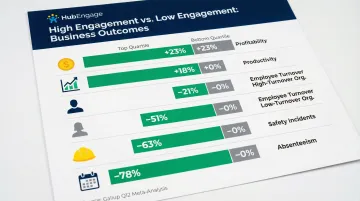
Gamification software drives these outcomes by making the everyday work experience more participatory. The mechanics that produce results include:
- Points and leaderboards that encourage consistent participation in communications and training
- Badges and milestone rewards that reinforce behaviors tied to safety, attendance, and quality
- Challenges and streaks that keep recognition programs active rather than episodic
- Social feeds and peer recognition that build the connection driving lower turnover
Platforms like HubEngage apply gamification across communications, recognition, surveys, and learning — not just a single feature — so the engagement lift compounds across every interaction employees have with the platform.
Common Pitfalls to Avoid When Implementing Gamification Software
Misaligned Incentives That Reward the Wrong Behaviors
When gamification rewards easily quantifiable metrics—lines of code written, tickets closed per hour—rather than quality outcomes, employees optimize for the scoreboard instead of business value.
The Wells Fargo customer fraud scandal resulted from product sales goals that incentivized employees to act against customers' best interests. A support team incentivized purely on speed will see customer satisfaction decline as agents rush through conversations.
Design incentives around outcomes that matter—customer satisfaction scores, quality metrics, problem resolution—not just volume.
Over-Indexing on Individual Leaderboards
Purely competitive leaderboards can demoralize lower performers, incentivize gaming the system, or create toxic environments—especially in teams already under pressure.
Research on workplace unethical behavior shows organizational environments heavily influence ethical choices. Competition against rivals invokes psychological stakes that can increase unethical behavior and unsportsmanlike conduct.
Counter this by mixing formats:
- Balance individual rankings with team-based challenges and shared goals
- Rotate team compositions periodically to prevent entrenched rivalries
- Reward collective progress, not just individual output
One-Size-Fits-All Gamification That Alienates Employees
Some employees find certain formats—trivia, scavenger hunts, public rankings—uncomfortable or irrelevant to their role. Gamification pushed top-down without accounting for team preferences or cultural differences risks disengaging the very people it was meant to motivate.
Segment your approach by team, role, and preference. Offer multiple pathways to recognition and rewards, not just one gamified experience.
Deploying Gamification Without First Diagnosing Root Causes
Gamification layered on top of unaddressed disengagement drivers—poor management, lack of psychological safety, unclear purpose—will not fix those problems and may breed cynicism.
Use pulse surveys or listening tools to understand what employees actually need before designing engagement programs. Gamification works best as an accelerant for a culture that's already improving—not a substitute for fixing the conditions that drive disengagement.
How to Choose and Implement Gamification Software
Define Your Engagement Goals Before Selecting a Platform
The right platform depends on what problem you're solving. Map challenges to specific use cases:
- If onboarding is the issue: Prioritize LMS-style gamification with milestone tracking
- If recognition is the issue: Prioritize peer rewards and social walls
- If you need to reach frontline workers: Prioritize mobile-first, multi-channel delivery
Define success metrics—training completion rates, first-year retention, eNPS scores—before committing to a vendor.
Evaluate Platform Scope: Standalone Feature vs. Fully Embedded Gamification
Point-solution gamification tools address narrow problems—sales leaderboards, wellness apps—but create tool fragmentation and cap overall engagement gains.
Fully integrated platforms like HubEngage apply gamification across communications, recognition, surveys, learning, and social engagement in one place. This drives higher adoption, consolidates tools, and gives HR teams a complete view of engagement across the entire employee experience.
Organizations consolidating multiple tools into HubEngage typically reduce software costs while increasing employee participation across engagement programs.
Rollout Strategy: Start Small, Then Scale
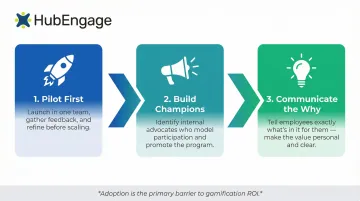
Adoption is the primary barrier to gamification ROI. A structured rollout addresses this before it becomes a problem:
- Pilot first — launch in one team or department, gather feedback, then refine before scaling
- Build champions — identify internal advocates who model participation and promote the program
- Communicate the why — tell employees what's in it for them, not just what the program does
Measure, Iterate, and Connect to Business Outcomes
Gamification success cannot be measured by participation alone. Track how engagement activity connects to downstream business metrics:
- Training completion rates
- First-year retention
- Employee Net Promoter Score (eNPS)
- Productivity indicators
- Absenteeism
Use platform analytics to continuously optimize program design as team needs evolve. HubEngage's analytics dashboards enable HR teams to track participation, measure channel effectiveness, and connect engagement activity to business KPIs for data-driven refinement.
Frequently Asked Questions
What is the best gamification tool for employee engagement?
The best tool depends on your specific goals, workforce type, and existing tech stack. Platforms offering gamification across the full employee experience—communications, recognition, learning, and surveys—deliver broader and more measurable impact than point solutions that address only a single use case.
What is an example of gamification in HR?
Common examples include new hires earning points and badges for completing onboarding milestones, employees accumulating reward points for peer recognition redeemable for gift cards, and sales teams competing on leaderboards tied to monthly revenue targets.
What companies use gamification for employee engagement?
Gamification spans industries including healthcare, retail, hospitality, financial services, manufacturing, and technology. It's especially common in organizations where engagement, compliance training, or retention are strategic priorities—from frontline-heavy operations like hotels and catering companies to enterprise tech firms.
Is employee engagement part of ESG?
Yes. Employee engagement falls under the "S" (Social) pillar of ESG, relating to workforce well-being, fair treatment, retention, and workplace culture. The SEC requires registrants to describe human capital resources and management objectives when material to understanding the business. Investors and regulators increasingly view employee engagement metrics as material disclosures.
What are the key features to look for in gamification software?
Essential features include core mechanics (points, badges, leaderboards, challenges), a meaningful reward catalog, real-time analytics tied to business KPIs, mobile and multi-channel access for all workforce types, and the ability to embed gamification across multiple engagement programs rather than a single use case.
How do you measure the ROI of gamification for employee engagement?
Track key metrics before and after implementation: participation rates, training completion, eNPS scores, turnover, and productivity. Connect those trends to business outcomes using your platform's analytics, then quantify savings from reduced attrition or faster onboarding.