Introduction
Poor internal communication isn't just a morale issue—it's a measurable drain on profitability. Ineffective communication costs U.S. businesses approximately $12,506 per employee every year, according to research by Grammarly and The Harris Poll. Multiply that across your workforce, and the numbers become staggering.
Yet most organizations still treat internal corporate communication in abstract terms: mission, culture, alignment. They rarely connect it to day-to-day outcomes like retention, productivity, or project success — even though the connection is direct and measurable. This article breaks down what internal corporate communication actually is, how it drives tangible business results, and what goes wrong when organizations leave it as an afterthought.
Key Takeaways
- Internal corporate communication is the structured exchange of information across all levels of an organization—top-down, bottom-up, and horizontal
- It directly improves employee engagement, retention, goal alignment, and how quickly teams adapt to change
- Poor internal communication costs businesses thousands of dollars per employee each year—through lost productivity and higher turnover
- Communication works best when it's consistent, two-way, and reaches employees through the channels they already use
What Is Internal Corporate Communication?
Internal corporate communication is the process of distributing information—formally and informally, digitally and in-person—among employees, teams, management, and stakeholders within an organization. It's distinct from external or marketing communication, which targets customers, investors, or the public.
This encompasses multiple directions and formats:
- Top-down directives from leadership to employees
- Bottom-up feedback from employees to management
- Peer-to-peer coordination between departments or colleagues at the same level
- Structured campaigns around change, culture, or crisis
Internal communication is an operational function. Its purpose is to ensure every employee has the right information to do their job, understands how their work connects to company goals, and feels part of the organization. Get it right, and it stops being an overhead function—it becomes what holds execution together.
Key Advantages of Internal Corporate Communication
Each advantage below ties to an outcome businesses track—employee retention, productivity, speed of change, or cost—not abstract cultural ideals.
Employee Engagement and Productivity
Informed employees are more engaged, and engaged employees consistently outperform their disengaged counterparts. Business units in the top quartile of employee engagement see 18% higher productivity in sales and 14% higher productivity in production records compared to bottom-quartile units, according to Gallup's 2024 Q12 Meta-Analysis.
Regular, clear communication creates this advantage. Employees understand how their role connects to company goals, feel recognized, and take initiative rather than waiting for direction. When employees report that leadership communication is "very clear," they are three times as happy in their roles compared to those who state communication is not clear at all.
Why this is an advantage:
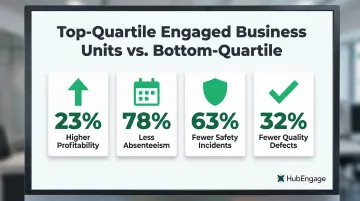
Engagement directly reduces absenteeism, lowers error rates, and increases output per employee. Top-quartile engaged business units achieve 23% higher profitability, 78% less absenteeism, 63% fewer safety incidents, and 32% fewer quality defects compared to bottom-quartile units. Disengaged employees represent a measurable drag on organizational performance. Leadership teams that communicate well see downstream savings in re-hiring, retraining, and missed deadlines.
KPIs impacted:
- Employee engagement scores (eNPS)
- Productivity per employee
- Absenteeism rates
- Project completion rates
- Quality of work output
Employee Retention and Reduced Turnover
Employees who feel informed, heard, and valued through consistent communication are significantly less likely to leave. 63% of employees who are considering leaving their jobs cite poor internal communication as a contributing factor, according to Staffbase and YouGov's 2025 International Employee Communication Impact Study.
The cost of replacing an individual employee ranges from 50% to 200% of their annual salary, depending on role and seniority. Reducing turnover by even a small margin has compounding financial impact. The stakes are highest in industries where communication breakdowns are most common: retail, hospitality, healthcare, and manufacturing.
Based on 2025 annual average quit rates from the U.S. Bureau of Labor Statistics:
- Accommodation and food services: 4.2%
- Leisure and hospitality: 3.9%
- Retail trade: 2.6%
- Health care and social assistance: 2.0%
- Manufacturing: 1.4%
KPIs impacted:
- Employee turnover rate
- Cost-per-hire
- Time-to-fill vacancies
- Employee satisfaction scores
- Tenure/length-of-service averages
Organizational Agility and Change Management
Companies able to communicate change quickly and clearly (whether a new process, a leadership transition, or a market pivot) execute change initiatives faster and with less resistance than those with poor communication infrastructure.
Structured internal communication creates this advantage. Leaders who consistently share the "why" behind decisions and use aligned messaging across channels reduce uncertainty and build the trust needed for employees to adapt. A transformation is 5.8 times more likely to be successful at organizations where CEOs communicate a compelling, high-level change story, and 6.3 times likelier when senior leaders share aligned messages about the change effort, according to McKinsey research.
Why this is an advantage:
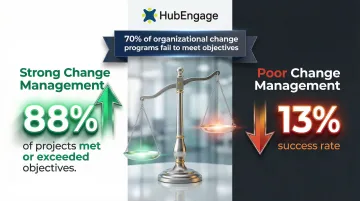
McKinsey research shows roughly 70% of organizational-change programs fail to meet their objectives. Failed change initiatives — caused in large part by poor communication — waste significant resources. Projects with excellent change management met or exceeded objectives 88% of the time, compared to only 13% for those with poor change management. Strong communication infrastructure protects ROI on transformation efforts.
KPIs impacted:
- Change adoption rate
- Time-to-implementation for new initiatives
- Resistance/escalation rates during transitions
- Employee confidence scores during change cycles
What Happens When Internal Communication Breaks Down
Poor internal communication produces measurable operational consequences, not just morale issues:
Misalignment and rework: Employees operating on outdated or inconsistent information make decisions that don't align with current priorities, leading to wasted effort and repeated work.
Unchecked rumors: When official channels go quiet, employees fill the gap with speculation — damaging trust and belonging. The spread of false and misleading messages online cost the global economy an estimated $78 billion in 2019.
Higher attrition, especially among high performers: 36% of voluntary leavers never discussed their intent to resign with anyone, and 44% of those who did bypassed their direct manager entirely. High performers — who are generally 400% more productive than average employees — are often the first to disengage when communication fails.
Difficulty scaling: What works informally at 50 employees collapses at 500. As organizations grow, communication breakdowns multiply — and without formal structures, consistency and alignment erode as headcount grows.
How to Get the Most Value from Internal Corporate Communication
Internal corporate communication works best when it is consistent (not just during crises), two-way (not broadcast-only), and channel-appropriate. Employees must receive information through the channels they actually use, especially frontline and deskless workers who rarely sit at a desk.
Three practical conditions for maximum value:
- Messages are tied to business context so employees understand the "why"
- Feedback loops exist so communication flows upward as well as down
- Outcomes are measured—open rates, engagement scores, survey participation—so teams can iterate
The data makes the stakes clear—and points directly to where most organizations fall short:
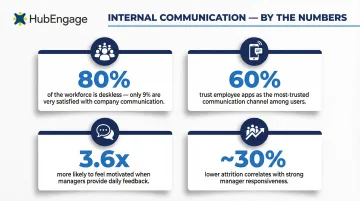
- 80% of the global workforce (roughly 2.7 billion people) is deskless, yet only 9% of those workers are very satisfied with how their company communicates
- Email and manager conversations remain the top information sources (51% and 47%, respectively), but employee apps are the most-trusted channel among those who have access (60%)
- Daily feedback from managers makes employees 3.6x more likely to feel motivated to do outstanding work—compared to annual feedback
- **Manager responsiveness to feedback** correlates with roughly 30% lower attrition in those business units
Closing this gap requires the right infrastructure. HubEngage addresses the execution challenge by delivering one-click multi-channel reach across mobile, email, SMS, and digital signage—with analytics to measure impact and gamification to drive consistent participation across organizations of any size.
Conclusion
Internal corporate communication is not a soft initiative but a business-critical function with measurable returns. Its impact on engagement, retention, and organizational agility ties directly to cost, performance, and culture.
The organizations that treat communication as an ongoing, data-informed practice—not a one-time announcement or crisis response—are the ones that build workforces that are aligned, resilient, and genuinely harder to walk away from.
Frequently Asked Questions
What is corporate internal communication?
Corporate internal communication is the structured process of sharing information among employees, teams, management, and stakeholders within an organization. It spans both formal channels (emails, announcements, newsletters) and informal ones, with the goal of informing, aligning, and engaging the workforce.
Why is internal communication important in the workplace?
It directly impacts employee engagement, retention, productivity, and the organization's ability to execute change. Poor internal communication carries measurable costs in lost productivity and elevated turnover—approximately $12,506 per employee annually in U.S. businesses.
What are the three types of internal communication?
The three foundational types are top-down (leadership to employees), bottom-up (employee feedback and input to leadership), and horizontal/peer-to-peer (communication between departments or colleagues at the same level).
What is effective internal communication?
Effective internal communication reaches employees at the right time, through the right channel, with information that's relevant to their role. It's two-way by design — employees should have a clear path to ask questions and share feedback, not just receive information.
What are some examples of internal communication?
Common examples include company-wide announcements, team newsletters, manager check-ins, town halls, onboarding materials, employee surveys, recognition programs, change management updates, and crisis communications.
What is the difference between HR and internal communications?
HR manages employee lifecycle functions (hiring, benefits, compliance, performance), while internal communications is responsible for the flow of information across the organization. In practice, the two functions often overlap, especially around culture, change management, and employee engagement.