Introduction
Most internal messages never reach their intended audience. Only 50% of employees agree that their organization's internal communications are clear and engaging, despite 80% of leaders believing otherwise. The gap is widest among frontline workers — the 80% of the global workforce without a desk — where only 9% report being "very satisfied" with internal communications.
The cost is concrete. Poor internal communication drains $438 billion annually from the global economy through lost productivity, disengagement, and turnover.
A one-time email blast isn't a campaign. A true internal communication campaign is a structured, intentional effort to inform, align, and engage employees over time using the right messages, channels, and formats. This article breaks down campaign types, creative strategies proven to lift engagement, a step-by-step planning framework, and how to measure impact.
TLDR:
- Structured campaigns work: sponsored projects are 79% likely to meet objectives vs. 27% without
- Frontline workers need multi-channel delivery (mobile, SMS, digital signage), not just email
- Gamification, peer recognition, and leadership video consistently increase participation
- Real-time analytics enable mid-campaign adjustments that protect budget and improve outcomes
- Manager toolkits amplify reach by turning supervisors into trusted messengers
What Are Internal Communication Campaigns (and Why They Matter)
Internal communication campaigns are coordinated, goal-driven efforts by HR or communications teams to deliver specific messages to employees across one or more channels. Unlike reactive announcements or scattered emails, campaigns follow a structured approach with defined objectives, segmented audiences, sequenced content, and measurable outcomes.
The business case is urgent. Companies lose thousands of dollars per employee annually due to ineffective communication—a single employee earning $50,000–$100,000 loses 35+ working days per year, equivalent to $10,140 in lost salary. Multiply that across your workforce, and the financial impact can reach millions annually for mid-size companies. Strong campaigns directly affect alignment, morale, retention, and productivity.
That financial drain connects directly to an alignment problem: 27% of leaders believe staff are fully aligned with business goals, but only 9% of employees agree. This gap typically stems from leaders assuming volume equals clarity—sending more messages rather than better ones.
Creative, structured campaigns close this gap by delivering messages employees actually see, understand, and act on. With 63% of employees citing poor communication as a factor in seeking new jobs, the ROI on getting this right extends well beyond productivity.
5 Types of Internal Communication Campaigns to Know
Before choosing creative tactics, identify what kind of campaign you're running. The five core types are:
- Ongoing culture/alignment campaigns — Reinforce values, mission, and strategic priorities through storytelling and recognition
- Employee engagement and participation campaigns — Drive survey completion, program enrollment, or community involvement
- Recognition and appreciation campaigns — Celebrate achievements, milestones, and peer contributions to build belonging
- Change management campaigns — Support adoption of new systems, policies, or organizational shifts with sequenced messaging
- Crisis or onboarding campaigns — Ensure rapid comprehension, compliance, and safety during emergencies or new hire integration
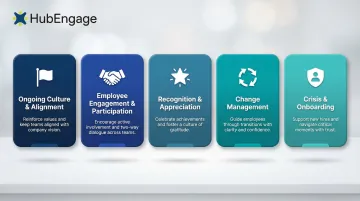
The most effective organizations layer campaign types strategically. A change management campaign accelerates adoption when paired with a recognition campaign celebrating early adopters. Culture campaigns, meanwhile, deepen when leadership storytelling runs alongside peer-to-peer recognition — the two reinforce each other in ways neither achieves alone.
Channel selection follows directly from campaign type. Crisis campaigns demand push notifications, SMS, and digital signage for immediate reach. Culture campaigns thrive on video storytelling, employee spotlights, and social posts that build emotional connection over time. Getting that match wrong — sending a safety alert via a weekly newsletter, for instance — erodes both urgency and trust.
Creative Campaign Strategies That Actually Engage Employees
Gamification Across the Campaign
Applying game mechanics—points, leaderboards, badges, challenges, and rewards—to internal campaigns dramatically increases participation rates. This isn't limited to training modules. Gamification works across recognition programs, survey completion, reading company updates, and participating in campaign activities.
A Columbia Business School study found gamified employee training increased fees collected by 35.8%, new clients by 16.3%, and opportunities from new clients by 22.3%. The key: leaders must actively nurture participation, not just install the mechanics.
HubEngage's platform-wide gamification makes this possible across every campaign touchpoint—from mobile app interactions to digital signage. Employees earn points for viewing content, acknowledging messages, completing surveys, and recognizing peers. Points drive adoption through leaderboards (competition), gift card redemption (tangible rewards), and badge collections (status recognition).
Recognition is the natural next layer. Once employees are engaged through game mechanics, peer-driven appreciation sustains that momentum.
Peer-to-Peer Recognition Campaigns
Programs like "Cheers From Your Peers" let employees nominate each other for awards tied to company values. Why does this work? Peer validation is often more motivating than top-down recognition. Employees who receive high-quality, frequent recognition are 45% less likely to turn over after two years, potentially saving a 10,000-person company up to $16.1 million annually.
Recognition campaigns build culture over time by making appreciation visible, frequent, and driven by everyone—not just managers. When recognition is consistent, authentic, and personalized rather than performative, employees are 4x as likely to be engaged.
Leadership Storytelling and Video Content
Regular, informal leadership video updates—recorded on a smartphone, not in a broadcast studio—are among the most humanizing and high-engagement campaign formats. When leaders communicate directly and authentically, employees feel trust and connection with the organization.
Video doesn't require production budgets. A two-minute message from the CEO explaining why a new policy matters, or a plant manager celebrating safety milestones, lands differently than a policy email ever could. In 2025, 2.2 billion communications were sent through the Poppulo platform, with leadership, wellbeing, and health & safety dominating send volume—proof that employees crave leader visibility.
Employee Spotlight and User-Generated Content Campaigns
Campaigns that invite employees to share their own stories, milestones, role changes, or personal achievements on an internal platform deliver dual benefits: employees feel seen and valued, while employees create content organically, without burdening the comms team.
Employee-generated content helps teams feel less siloed and creates a greater sense of belonging, which leads to more engaged and productive employees. Spotlights work especially well when paired with recognition programs and social feeds where colleagues can comment, celebrate, and share.
Multi-Channel Delivery for Frontline and Deskless Workers
A campaign relying only on email will miss large portions of the workforce—particularly frontline, manufacturing, or field employees who rarely sit at a desk. Frontline workers comprise almost 80% of the global workforce, yet they're the least likely to receive timely communications.
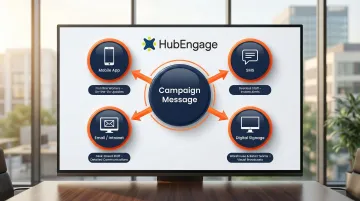
A multi-channel approach uses:
- Mobile apps that reach employees during shift transitions, on the floor, or in the field
- SMS for urgent alerts when every minute counts
- Digital signage on shop floors and in break rooms, where employees naturally gather
- Email and intranet for desk-based staff who live in their inbox
HubEngage's one-click multi-channel publishing auto-formats content for each channel, ensuring frontline workers on the factory floor receive the same message as office staff—just in the format that works for them.
Interactive Moments That Create Two-Way Dialogue
One-way broadcasts don't build culture—they just fill inboxes. Campaigns need touchpoints where employees can react, respond, or participate. Tactics include:
- Pulse surveys embedded in newsletters or mobile apps
- Polls asking employees to vote on decisions or preferences
- Live Q&As with leaders where employees submit questions in real time
- Themed competitions like naming contests, photo challenges, or trivia
68% of employee app users assess their organization's crisis communication as "excellent" or "good", compared to 52% across all channels—proof that interactive, mobile-first engagement drives satisfaction.
How to Plan an Internal Communication Campaign Step by Step
Step 1 — Define Goals and Segment Your Audience
Every campaign must start with SMART objectives tied to a business outcome: increase survey participation by 25%, improve awareness of a new policy to 80%, or drive recognition program sign-ups by 500 employees. Vague goals like "improve engagement" won't guide decisions or measure success.
Then segment employees meaningfully—by role, location, work environment, or digital access. A single message for all employees rarely works. Desk workers may prefer email and intranet, while frontline employees need mobile apps and SMS. While 75% of communicators agree tailoring messaging is critical, only 20% do it regularly.
Step 2 — Craft a Clear, Memorable Message Architecture
Develop two or three core messages that any employee could repeat after reading once. When building those messages, keep three principles in mind:
- Keep it brief — if the message requires a glossary, it's too complex
- Make it relevant — connect to what employees already care about: their team, their growth, or the company's mission
- Test before launch — run your message architecture past a small employee group before full rollout
Step 3 — Choose Channels That Match How Your Audience Works
The channel should serve the audience, not default to whatever is easiest for the sender. Match delivery to how each group actually works:
- Mobile apps and SMS for frontline workers without regular computer access
- Email and intranet for desk employees who check messages throughout the day
- Digital signage for break rooms, lobbies, and shop floors where employees gather
- Video for leadership communications that require emotional connection
Only 29% of non-desk employees are satisfied with internal communication quality, compared to 47% of desk-based employees. That gap exists almost entirely because of channel mismatch.
Step 4 — Build a Campaign Calendar with Intentional Sequencing
Sequenced rollout matters. Start with a leadership message that sets context, followed by audience-specific content, mid-campaign reinforcement with fresh stories or reminders, and a closing message that celebrates outcomes.
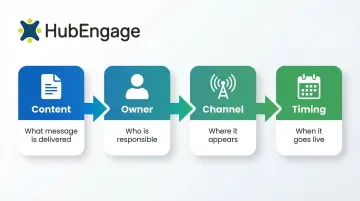
A campaign calendar maps:
- Content (what message is being delivered)
- Owner (who is responsible for creation and approval)
- Channel (where the message will appear)
- Timing (when the message goes live)
When every touchpoint is planned in advance, campaign momentum builds naturally rather than stalling between sends.
Step 5 — Enable Managers as Campaign Champions
Managers are the most trusted communicators inside most organizations. Direct supervisors are the most trusted source of information — 57% of employees trust them "a great deal". Yet when employees feel executive leadership doesn't trust them, that manager trust drops to 43% and CEO trust falls to just 25%. The organizational context managers operate in shapes how much their words land.
Give managers ready-made toolkits: talking points, short videos, FAQ sheets, and pre-written messages they can customize for their teams. That support ensures the campaign message reaches every team instead of getting filtered out mid-chain.
How to Measure Campaign Effectiveness
Identify core metrics to track depending on campaign type:
- Open and read rates for email and app content
- Participation rates for surveys and polls
- Video view completion percentages
- Nomination or submission counts for recognition campaigns
- Attendance for live events
Choose metrics aligned with the campaign's stated goals, not just vanity metrics. 70% of internal comms teams still rely on basic output metrics (opens/clicks), ignoring outcomes like behavior change or business impact.
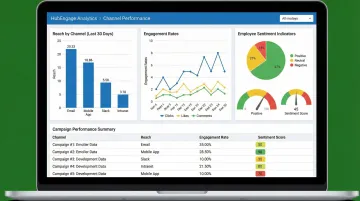
Tracking analytics during the campaign, rather than waiting for post-mortem reports, allows communicators to adjust messaging, redirect attention to high-performing content, and course-correct before the campaign ends. HubEngage's analytics dashboard provides channel-level visibility into reach, engagement, and employee sentiment — so teams can act on data while it still matters.
That optimization loop isn't complete until results are shared back with employees. Close it by reporting participation rates, wins, and stories of change. This signals transparency, validates employee contributions, and builds momentum for the next campaign. 71% of employees say their organization shares survey results, but only 51% report that actual improvements resulted—a 20-point "action gap" that erodes trust.
Frequently Asked Questions
What are internal communications campaigns?
Internal communication campaigns are structured, goal-driven efforts to inform, engage, and align employees using coordinated messages across specific channels and timeframes. Unlike one-off announcements, campaigns follow a strategic plan with defined objectives, segmented audiences, and measurable outcomes.
What are examples of internal communication initiatives?
Examples include a peer recognition program where employees nominate colleagues for values-based awards, a CEO video blog series explaining strategic priorities, a change management campaign supporting new policy rollout, and a gamified onboarding challenge for new hires.
What types of internal communication exist?
The eight main types span the full employee lifecycle:
- Leadership — executive updates and vision sharing
- Team — department-level coordination
- Peer-to-peer — recognition and collaboration
- Crisis — urgent safety or incident messaging
- Onboarding — new hire integration
- Change management — adoption support for new policies or systems
- Recognition — celebrating achievements
- Operational — policy and procedure updates
What channels are used for internal communication?
Key channels include mobile apps, email, SMS, intranet platforms, digital signage, tools like Slack or Teams, and virtual town halls. Effective campaigns combine several of these rather than relying on a single channel.
What are examples of effective internal marketing strategies?
Four approaches consistently drive results:
- Employee storytelling — spotlight individual achievements to humanize the brand
- Gamified participation — reward engagement with points and leaderboards
- Manager toolkits — equip supervisors to amplify key messages at the team level
- Values-based recognition — tie awards to company principles to build culture over time
What are the internal comms trends for 2026?
Five trends are shaping internal comms heading into 2026:
- AI-assisted creation — automated drafting and sentiment analysis at scale
- Platform-wide gamification — participation incentives across every communication touchpoint
- Frontline-first multi-channel delivery — reaching deskless workers via mobile, SMS, and digital signage
- Personalization at scale — segmentation tools that tailor messages by role, location, or tenure
- Real-time analytics — mid-campaign course corrections instead of post-mortem reporting