Introduction
The engagement crisis is real—and expensive. Global employee engagement fell to 21% in 2024, costing the world economy $438 billion in lost productivity. Meanwhile, manager engagement dropped from 30% to 27%, a worrying trend given that 70% of team engagement is directly attributable to the manager.
Most companies already have an intranet. The problem? Many fail to drive meaningful adoption or engagement. When intranets are built for the org chart instead of how employees actually work—desktop-only in a deskless world, one-size-fits-all in a personalized era—adoption peaks at launch and falls off within weeks, leaving a platform no one uses.
In 2026, distributed workforces, employees conditioned by consumer apps to expect instant and relevant information, and rising disengagement mean a poorly designed intranet damages both communication and culture. This article covers 6 proven intranet best practices that HR and communications leaders can apply to drive adoption, deepen engagement, and turn their intranet into a true employee hub.
Key Takeaways
- Build your intranet around a documented strategy with measurable goals—not just a launch-and-forget approach
- Let employees actively shape the intranet through feedback and co-design; intranets built in isolation miss the mark
- Multi-channel, mobile-first access ensures frontline and remote workers can reach the intranet from any device or location
- Personalization and interactive features like gamification move employees from passive visitors to active participants
- Use analytics to track engagement behavior, content performance, and participation trends — not just page views
Why Most Intranets Fail to Engage Employees
Most intranets were built to store information, not drive engagement. The gap between what they could do and what employees actually experience explains why so many sit unused. Here's why:
- Built for structure, not workflow: Intranets mirror the org chart instead of how employees actually work, creating navigation that makes sense on paper but frustrates users in practice
- No personalization: When employees see content irrelevant to their role, location, or department, they stop checking in
- Desktop-only in a deskless world: 70-80% of the global workforce is deskless, yet most intranets require desktop access and corporate email
- No reason to return: Without interactive features or fresh content, there's nothing pulling employees back after the first visit
The 6 best practices below address each of these failure points directly — so your intranet becomes a place employees actually want to use.
6 Intranet Best Practices for a More Engaged Workplace in 2026
Best Practice 1: Define a Strategy with Measurable Goals Before You Build
Launching an intranet without a documented strategy is the most common reason projects lose momentum. Without clear objectives, there's no way to prioritize features, allocate governance responsibilities, or prove ROI to leadership.
Key strategic questions every HR or communications leader should answer:
- What employee problems is this solving?
- Who owns the intranet—HR, IT, or internal communications?
- What does success look like in 90 days vs. 12 months?
- Which departments need their own content channels?
- How will we measure impact?
Metrics that should anchor your strategy:
- Employee adoption rate: Percentage of workforce actively using the intranet
- Average time-to-find-information: How quickly employees locate what they need
- Content engagement rate: Views, comments, shares, and interactions per post
- Survey participation: Response rates for pulse surveys and feedback forms
- Reduction in support tickets: Fewer help desk requests as self-service improves
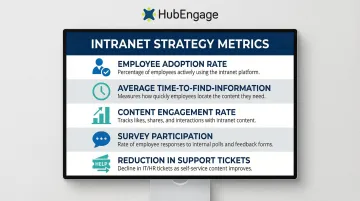
Research across 57 intranets found that having central management of intranet content is best for helping employees efficiently find information. Without baseline metrics established at launch, there's no way to identify what's working—or course-correct before adoption stalls.
Best Practice 2: Co-Design the Intranet with Employees, Not Just for Them
There's a critical difference between designing for employees and designing with them. When IT or HR builds the intranet in isolation, they often optimize for the org chart rather than real daily workflows, leading to navigation that frustrates users.
Practical ways to gather employee input:
- Pulse surveys: Ask what employees struggle to find and which resources they need most
- Focus groups with frontline teams: Understand how deskless workers access information today
- Shadowing employees: Observe how people in key roles navigate their workday
- Beta testing: Run a pilot with a cross-functional group before full rollout
Case in point: The Scottish Government performed user research, card sorting, and tree testing to understand employees' top tasks. By shifting their mindset "from functions to user needs," their intranet ranked in the top three for highest task-completion rates and lowest task times.
Feedback shouldn't stop at launch. Build a continuous feedback loop using in-platform surveys and regular usage analytics reviews so the intranet evolves alongside the workforce.
Best Practice 3: Go Multi-Channel and Mobile-First to Reach Every Worker
Here's the access problem: desk-based intranets exclude the majority of the workforce. 83% of frontline employees don't have a company email address, and 69% of organizations rely primarily on email while 54% of deskless workers have limited email access.
When intranets require desktop access or corporate email, they systematically exclude deskless workers—creating a sense of isolation and disconnection from company culture.
What a multi-channel intranet strategy looks like in practice:
The same content should be accessible via:
- Mobile app (iOS and Android)
- Web browser (desktop and tablet)
- Email digest (for those with email access)
- SMS text messages (for critical updates)
- Digital displays (in break rooms, factory floors, retail locations)
Auto-formatting content for each channel eliminates the manual effort of republishing. Employees receive the same message through their preferred channel—whether they're in the office, remote, or on the frontline—without communications teams having to manage separate distribution lists or formats.
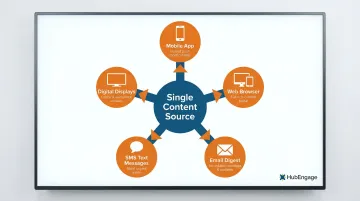
HubEngage is built around this model, with one-click publishing across mobile, web, email, SMS, and digital signage in a single workflow.
Best Practice 4: Personalize Content So Every Employee Sees What Matters to Them
A one-size-fits-all content feed is the enemy of engagement. When employees see content irrelevant to their role, location, or department, they stop checking in. 47% of digital workers struggle to find information needed to effectively perform their jobs.
Personalization makes the intranet feel like it was built for each individual employee.
How personalization works at scale:
Use employee attributes—role, location, department, tenure, shift—to surface:
- Targeted news relevant to specific teams
- Role-specific policies and resources
- Location-based announcements
- Onboarding content for new hires
This doesn't require IT intervention for each content piece. Modern cloud-native intranets are purpose-built to deliver personalized content automatically based on employee data synced from HRIS systems.
Personalization also applies to delivery: A warehouse associate on a factory floor and a remote knowledge worker both need the same critical update—but one checks a mobile app during a shift break while the other scans an email. Matching channel to employee context is what separates intranets that get read from those that get ignored.
Best Practice 5: Drive Participation Through Gamification and Recognition
Most intranets never close the engagement gap: employees may be able to find information, but there's nothing pulling them back to the platform. Gamification creates behavioral incentives that reward participation.
How intranet gamification works:
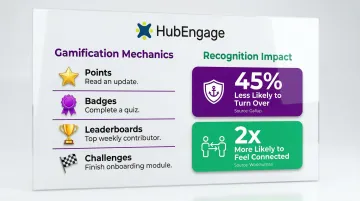
Attach points, badges, leaderboards, and challenges to actions like:
- Reading a company update
- Completing a training quiz
- Submitting a survey response
- Recognizing a colleague
This works because it taps into intrinsic motivation and social visibility. Research shows gamification produces meaningful effects on cognitive, motivational, and behavioral learning outcomes—particularly when competition is paired with collaboration rather than used in isolation.
Recognition drives retention:
When employees can publicly recognize peers directly within the intranet—tied to rewards or badges—it reinforces culture and belonging. Well-recognized employees are 45% less likely to have turned over after two years, according to Gallup's longitudinal data.
For remote and frontline workers, peer-to-peer recognition creates connections that top-down messaging can't replicate. Employees who receive peer recognition regularly are twice as likely to feel meaningful connections with coworkers—a gap that intranet-native recognition tools are positioned to close.
Best Practice 6: Use Analytics to Continuously Optimize the Employee Experience
Analytics are the feedback mechanism that keeps an intranet from becoming stale. Without behavioral data, content owners are guessing at what resonates. Analytics reveal which content drives action, which search terms return no results, and where employees drop off.
Three tiers of intranet analytics to track:
| Metric Tier | Examples | What It Shows |
|---|---|---|
| Adoption Metrics | Unique logins, active users, mobile vs. desktop usage | Whether employees are accessing the intranet at all |
| Engagement Metrics | Time on page, comments, shares, survey completions | Whether content is valuable and resonating |
| Outcome Metrics | Reduction in help desk tickets, pulse survey scores, onboarding completion rates | Whether the intranet is driving business value |
Analytics should trigger action, not just reporting:
- Schedule monthly content audits using platform data
- Flag content gaps where employees are searching for information that doesn't exist
- Use engagement trends to refocus the editorial calendar
- Identify which communication channels drive the highest engagement
Gartner warns that many traditional digital workplace metrics measure activity rather than outcomes. Organizations must shift from tracking page views to measuring outcome-driven metrics that prove the intranet's impact on employee experience and business value.
How to Measure Whether Your Intranet Best Practices Are Working
An "intranet health score" gives HR and communications leaders a single composite view of adoption, engagement, and outcome metrics — so you can tell at a glance whether the intranet is actually doing its job. Review it at regular intervals, not just at launch.
Common measurement mistakes to avoid:
- Tracking page views instead of active engagement — views don't tell you whether employees found what they needed or acted on it
- Measuring launch-day traffic instead of 90-day retention — initial curiosity is not the same as sustained adoption
- Skipping qualitative signals — employee feedback and intranet NPS surface pain points that usage numbers alone won't show
Recommended quarterly intranet review cadence:
- Data review: Pull adoption, engagement, and outcome metrics and look for trends, not just totals
- Governance check-in: Confirm content owners are keeping their areas current and accurate
- Content audit: Identify outdated content, gaps, and high-performing posts
- Employee pulse: Run a short survey specifically about intranet experience
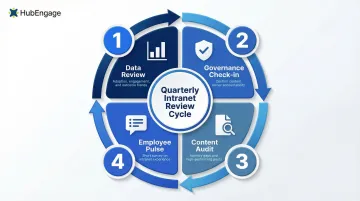
Without this cadence, engagement quietly stagnates. SWOOP Analytics' 2024 benchmarking found the median time employees spend reading intranet news is just 18 seconds per day, with most reading only one article a week. Active governance is what moves those numbers.
Conclusion
A successful intranet in 2026 is a living, multi-channel employee hub — built around measurable goals, shaped by employee input, and sustained through analytics, gamification, and continuous feedback.
The six best practices outlined here—strategy with measurable goals, co-design with employees, multi-channel mobile-first access, personalization, gamification and recognition, and continuous analytics—work together to create an intranet that employees actually use and value.
HubEngage is built for organizations that want to put all six of these best practices into action without stitching together multiple tools. As the first fully gamified, multi-channel employee experience platform, HubEngage combines a modern intranet with recognition, surveys, AI assistant, instant messaging, and analytics in one unified system. Whether you're reaching deskless workers via SMS and mobile apps or engaging remote teams through web and email, HubEngage ensures no employee is left out of the communication loop.
Explore a demo to see how HubEngage brings all six practices into one platform.
Frequently Asked Questions
What is the purpose of a corporate intranet?
A corporate intranet serves as a centralized hub for internal communications, knowledge sharing, employee resources, and culture-building. Modern intranets go beyond document storage to drive engagement through personalized content, social features, and mobile accessibility.
What are the key features of a good intranet?
Essential features include intuitive navigation, personalized content feeds, mobile access, robust search, social and recognition tools, analytics dashboards, and integrations with tools like Microsoft Teams and Slack.
How to make intranet more engaging?
Drive engagement through gamification (points, badges, challenges), peer recognition programs, personalized content tailored to role and location, interactive features like surveys and polls, and consistent fresh content published on a predictable schedule. Multi-channel accessibility—especially mobile-first design—also significantly boosts engagement among frontline and deskless workers.
Who should be responsible for a company's intranet?
Intranet ownership typically involves a cross-functional team: an HR or internal communications lead as the strategic owner, an IT administrator for platform management, and departmental content owners accountable for keeping their sections current. A single point of accountability at the leadership level is critical to ensure governance, content quality, and continuous improvement.
What are the intranet implementation guidelines?
Start by defining measurable goals and gathering employee input, then choose a platform and assign governance roles. Run a phased rollout with a pilot group, train content owners, and establish a measurement cadence before going org-wide. Post-launch feedback loops drive ongoing improvement.
What are the business values of intranet?
Measurable outcomes include less time searching for information, lower turnover, faster onboarding, fewer IT and HR support tickets, and stronger alignment between leadership messaging and frontline teams.