Introduction
HR and communications leaders face a harsh operational reality: employees are drowning in disconnected tools, buried information, and fragmented communication channels—and productivity is paying the price. Knowledge workers toggle between apps over 1,200 times per day, losing roughly four hours of productive time each week. Meanwhile, employees spend 1.8 to 2.5 hours daily just searching for information they need to do their jobs.
Intranets have long been discussed as communication tools, but their real productivity impact shows up in reduced search time, faster task execution, higher engagement, and fewer process bottlenecks. Organizations that stick with outdated or absent intranet solutions face measurable losses: wasted search time, communication gaps for frontline workers, and disengagement that chips away at output over time.
This article breaks down the specific, measurable ways modern intranets drive employee productivity—and the real cost of ignoring the problem.
Key Takeaways
- Modern intranets are productivity infrastructure—consolidating tools, information, and workflows into a single, searchable hub
- The biggest gains come from centralized knowledge access, consistent multi-channel communication, and engagement-driven discretionary effort
- Without a modern intranet, organizations absorb mounting losses: wasted search time, communication gaps, and disengagement
- Mobile-first design, AI-powered search, and gamification drive the employee adoption that turns a deployment into daily use
- Track KPIs like time-to-information, message reach rates, and participation scores to validate the investment
What Is a Modern Intranet?
A modern intranet is a centralized digital workplace platform that gives employees organized access to information, communication channels, tools, and people—from any device, at any time. It serves as the connective tissue between people, processes, and knowledge across every employee type: desk workers, remote teams, and frontline staff who never touch a corporate laptop.
Unlike legacy intranets that functioned as static document repositories, modern intranets are dynamic, mobile-accessible, and built to drive action. They deliver measurable business outcomes—including reduced attrition, faster onboarding, and productivity gains. That makes a modern intranet less of an IT checkbox and more of a strategic platform that grows with your workforce.
Key capabilities that separate modern intranets from their predecessors include:
- Mobile-first access for desk, remote, and frontline employees
- Dynamic content delivery that replaces static document storage
- Integrated communication channels across web, app, email, and SMS
- Measurable outcomes tied to engagement, retention, and productivity
Key Advantages of Modern Intranets for Employee Productivity
The advantages outlined below are grounded in operational outcomes tied to metrics HR and business leaders already track: time savings, error reduction, engagement rates, and retention.
Advantage 1: Centralized Information Access Eliminates Productivity-Killing Search Time
Modern intranets create a single, searchable source of truth for company policies, procedures, tools, and people. Instead of hunting through scattered drives, inboxes, and apps, employees get answers through role-based content delivery, smart search with auto-suggest, and AI-powered assistants.
Why this advantage matters:
McKinsey found that employees spend 1.8 hours every day—9.3 hours per week—searching and gathering information. IDC research estimates knowledge workers spend 2.5 hours daily, or roughly 30% of the workday, on the same task. For an enterprise employing 1,000 knowledge workers, this inability to locate and retrieve information wastes nearly $2.5 million per year.
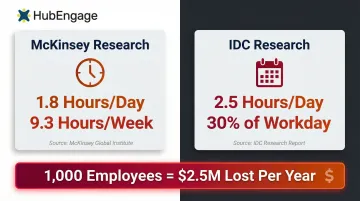
Eliminating search friction directly reduces context-switching, decision delays, and the mental load that erodes focused work time.
How it works in practice:
Platforms like HubEngage deploy AI-powered assistants that help employees find information, access company resources, and answer questions instantly. For example, Infosys's AI-based virtual assistant handled 919,075 employee questions with an 85% task completion rate, effectively eliminating a high volume of HR and IT support tickets.
KPIs impacted:
- Time-to-information
- Employee self-service rates
- IT/HR ticket volume reduction
- Hours saved per employee per week
When this advantage matters most:
High-volume operational environments—manufacturing, healthcare, hospitality, retail—where frontline workers need fast, accurate answers without desk access, and where outdated or unavailable information causes costly errors.
Advantage 2: Consistent Multi-Channel Communication Reaches Every Employee, Every Time
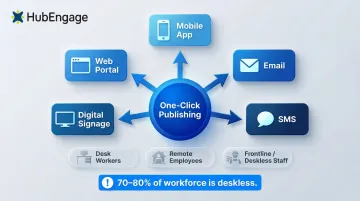
Modern intranets allow organizations to send the right message through the right channel—mobile app, email, SMS, digital signage, or web portal—so no employee is left out of critical communications, regardless of role or location.
Why this advantage matters:
Deskless workers account for 70-80% of the global workforce, yet 54% have limited or no corporate email access. When frontline employees lack access to timely updates, SOPs, and policy changes, the results can be catastrophic. In healthcare, communication failures contributed to 7,149 malpractice cases, resulting in $1.7 billion in costs and nearly 2,000 preventable deaths.
Ineffective communication costs U.S. businesses up to $1.2 trillion annually, or approximately $12,506 per employee every year in lost time. When everyone receives the same accurate information simultaneously, teams can act faster and with greater confidence.
How it works in practice:
Platforms that auto-format content for each channel eliminate the manual effort of recreating messages for different audiences. Delivery tracking and read receipts tell communicators exactly who has and hasn't received key information. HubEngage's one-click multi-channel publishing distributes messages across mobile apps, web, email, SMS, and digital signage simultaneously, with automatic formatting for each medium.
KPIs impacted:
- Message reach rates
- Policy acknowledgment rates
- Time-to-action on communications
- Reduction in miscommunication-related errors or rework
When this advantage matters most:
Organizations with distributed workforces, multiple locations, or large proportions of frontline/deskless employees—where a single-channel intranet (web-only) leaves significant portions of the workforce unreachable.
Advantage 3: Recognition, Gamification, and Engagement Features Convert Presence Into Performance
Modern intranets don't just inform employees—they actively engage them through recognition programs, gamified participation, surveys, and social features that build connection and motivation.
Why this advantage matters:
Global employee engagement fell to 21% in 2024, costing the world economy $8.9 trillion—9% of global GDP—in lost productivity. Gallup's Q12 Meta-Analysis shows that business units in the top quartile of engagement realize 14% higher productivity, 23% higher profitability, and 51% lower turnover compared to those in the bottom quartile.
The concept of discretionary effort is critical: engaged employees voluntarily bring more focus, initiative, and problem-solving to their work. Recognition, peer acknowledgment, and visible appreciation are among the most reliable triggers of that behavior. Companies with a recognition-rich culture have a 31% lower voluntary turnover rate, and replacing an employee costs between 50% and 200% of their annual salary.
How it works in practice:
HubEngage applies gamification across communications, recognition, surveys, social engagement, and learning activities — so routine touchpoints become motivating moments rather than ignored notifications. Employees earn points for viewing content, acknowledging messages, taking surveys, and recognizing peers, redeemable for leaderboard rankings, gift cards, and other rewards.
KPIs impacted:
- Employee engagement scores
- Voluntary turnover rates
- Participation in learning and communications programs
- Productivity per employee
When this advantage matters most:
High-turnover industries (hospitality, retail, healthcare) and organizations with large numbers of frontline employees who are often the most disengaged and hardest to reach through traditional communication methods.
What Happens When the Intranet Is Outdated or Absent
Organizations relying on legacy intranets or purely email-based communication experience measurable productivity losses. Employees spend excessive time searching for information, managers receive avoidable escalations, and critical updates fail to reach frontline workers on time.
The engagement cost is equally severe. Without recognition systems, social connection, or gamified participation, employees—especially those in high-turnover roles—disengage, reducing discretionary effort and increasing the likelihood of voluntary departure.
Tool fragmentation, siloed knowledge, and unreachable employees only compound as organizations grow, add locations, or shift to hybrid and remote models. The data reflects how widespread the problem is:
- Office attendance remains 30% below pre-pandemic norms, straining communication systems built for in-person work
- 47% of digital workers struggle to find the information needed to do their jobs effectively
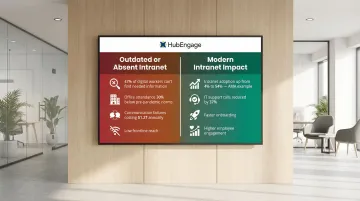
The upside of addressing these gaps is equally measurable. The American Medical Association saw daily intranet adoption jump from 4% to 54% after replacing a 12-year-old platform — and IT support calls dropped by 37% in the process.
How to Get the Most Productivity Value from Your Intranet
An intranet only improves productivity if employees actually use it. Organizations must prioritize mobile accessibility, intuitive design, and engagement mechanisms like gamification and recognition that make regular use genuinely rewarding.
Track the Right Metrics from Day One
Identify a small set of intranet KPIs—reach rates, search usage, participation in communications, and self-service resolution rates—and review them regularly. This tells you where the platform is delivering value and where adoption gaps exist. HubEngage's built-in analytics surface these insights automatically, without manual reporting overhead.
Keep the Experience Fresh
Intranet value compounds over time — but only if content stays accurate and channels are regularly reviewed for reach. Use employee feedback from surveys or engagement data to continuously refine the experience. Gartner recommends outcome-driven metrics to demonstrate digital workplace impact on business value, not just activity counts.
Recommended KPI Framework
Start with these three metrics to gauge adoption and business impact:
- Monitor zero-result searches to surface critical content gaps before they frustrate employees
- Aim for 60–70% monthly active usage — the benchmark for a healthy, well-adopted intranet
- Track ticket deflection to quantify how searchable knowledge bases and AI chatbots reduce routine HR/IT requests
Conclusion
Modern intranets are measurable productivity infrastructure. They reduce time waste, close communication gaps, and surface the discretionary effort that separates high-performing organizations from average ones.
Organizations that treat their intranet as an ongoing strategic investment — rather than a one-time IT project — see productivity, retention, and engagement gains compound as their workforce grows. The difference shows up in the numbers: faster onboarding, fewer hours lost to information searches, higher survey response rates, stronger culture scores. That's what modern intranet infrastructure, done right, actually delivers.
Frequently Asked Questions
What is the difference between a traditional intranet and a modern intranet?
Traditional intranets were static document repositories with limited accessibility, often web-only and rarely updated. Modern intranets are dynamic, mobile-first platforms with AI search, integrations, gamification, and multi-channel communication built to drive measurable employee outcomes like engagement, retention, and productivity.
How does a modern intranet reduce time wasted at work?
Modern intranets centralize information, tools, and communication into a single searchable hub, cutting the hours employees spend jumping between apps, hunting for documents, or waiting on answers to routine questions. That reclaimed time goes directly back into productive work.
Can a modern intranet improve productivity for frontline or deskless workers?
Yes, mobile-first intranets with SMS, app, and digital signage channels are specifically designed to reach frontline employees who don't have desk access. These platforms give deskless workers real-time information and eliminate the communication gaps that cause errors, delays, and rework in operational environments.
How do you measure the productivity impact of an intranet?
Start by establishing baseline KPIs at launch, then track:
- Time-to-information and intranet search usage
- Message reach rates and self-service resolution rates
- Employee engagement scores and voluntary turnover
Comparing these metrics at 3 and 6 months gives you a clear picture of ROI.
What intranet features have the biggest impact on employee productivity?
The features with the most direct day-to-day impact are AI-powered search, role-based content delivery, multi-channel communication, mobile accessibility, and recognition tools. Together, they cut search time, close communication gaps, and drive the discretionary effort that distinguishes engaged employees from disengaged ones.
How long does it take to see productivity improvements after implementing a modern intranet?
Quick wins like reduced search time and improved message reach typically appear within the first few weeks. Engagement improvements and turnover reduction usually become measurable within 3–6 months of consistent use.