Introduction
Most organizations today run employee communications across 4–6 separate tools—one app for messaging, another for email blasts, a different platform for intranet content, yet another for surveys, and a separate system for recognition. This fragmentation creates operational tension that HR and communications leaders know well: critical messages get missed, frontline workers are left out of important updates, and engagement stalls despite good intentions.
"Unified communication" often gets framed as an IT concern—VoIP systems, video conferencing, telephony infrastructure (UCaaS). But for HR and communications leaders, the real question is simpler: do employees actually receive, understand, and act on what you send them?
For frontline workers, field teams, and anyone without a desk, the gap between what leadership sends and what the workforce receives is where culture, compliance, and productivity take measurable hits.
This guide explains why a unified communication platform matters in practice for HR, communications, and operations leaders, and what measurable outcomes it delivers for workforce alignment, engagement, and retention.
Key Takeaways
- A unified communication platform integrates all internal employee communication channels—mobile, email, SMS, intranet, and digital displays—into a single system
- Core benefits include higher employee reach for frontline and deskless workers, lower software costs from tool consolidation, and stronger engagement and retention outcomes
- Fragmented tools create information gaps that steadily erode culture and productivity over time
- Organizations that unify communications see measurable improvements in employee participation, message reach, and response to engagement programs
- Benefits compound when the platform includes AI, analytics, and gamification to drive consistent adoption, not just message delivery
What Is a Unified Communication Platform?
A unified communication platform is a single system that brings together all the channels and tools an organization uses to reach, inform, and engage its employees—rather than managing each channel in a separate tool.
HR and internal communications teams use these platforms to distribute company news, policies, recognition, surveys, training updates, and operational alerts to every employee, including those without a desk or company email. The core purpose is closing the communication gap between leadership and employees across all roles, locations, and device preferences — so no message falls through the cracks.
When employees can receive communications through the channel most accessible to them, the likelihood that critical information actually reaches them increases significantly. Depending on the workforce, that might mean:
- Mobile app for frontline and field workers
- Email or web intranet for desk-based employees
- SMS for time-sensitive operational alerts
- Digital signage for employees on the floor or in common areas
This flexibility is what makes unified platforms effective across distributed teams — desk-based, remote, and frontline workers all get the same information, just through the right channel for their role.
Key Benefits of Unified Communication Platforms
The benefits below focus on operational and workforce outcomes, not just technical convenience. Each one ties directly to metrics that HR, communications, and operations leaders are already measured on.
Multi-Channel Reach That Connects Every Employee
The first and most foundational benefit is coverage: a unified platform ensures that every employee—whether they work in a corporate office, on a factory floor, in a hospital ward, or in the field—receives communications through the channel most accessible to them.
How this works in practice:
Instead of sending an email and hoping frontline workers see it, communications teams can publish once and auto-distribute across mobile app, SMS, email, digital signage, and web intranet simultaneously. The platform auto-formats content for each channel, eliminating manual reformatting work.
Why this is an advantage:
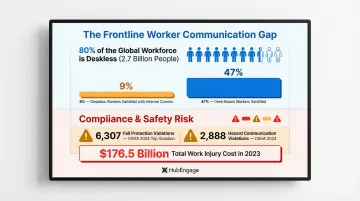
Deskless and frontline workers make up 80% of the global workforce (2.7 billion people), yet are underserved by tools designed for desk-based employees. Only 9% of deskless workers report being "very satisfied" with internal communications, compared to 47% of desk-based workers.
This communication inequity creates measurable business risk. Low reach leads to safety compliance gaps, missed policy updates, and disengaged employees more likely to leave. In 2024, OSHA cited 6,307 fall protection violations and 2,888 hazard communication violations, most traced back to inadequate safety communication with frontline workers. The total cost of work injuries in 2023 was $176.5 billion.
KPIs impacted:
- Message open and read rates
- Communication reach percentage across employee population
- Compliance acknowledgment rates
- Shift-level response rates to operational alerts
When this advantage matters most:
This benefit is most impactful for organizations with large frontline, distributed, or shift-based workforces in industries like healthcare, manufacturing, retail, hospitality, and logistics—where email alone will not achieve adequate message penetration.
HubEngage's one-click multi-channel delivery eliminates the manual effort of managing separate channels—reducing time-to-publish and improving reach rates across every workforce segment.
Lower Costs from Consolidating Communication Tools
Most organizations don't realize how many separate tools they're paying for to manage employee communications: one tool for internal newsletters, another for surveys, a separate intranet, a mobile app, an SMS platform, and a recognition tool—often managed by different teams with overlapping licenses.
How a unified platform creates this advantage:
Consolidating these into one platform eliminates redundant subscriptions, reduces admin overhead, and cuts the IT effort required to integrate and maintain multiple vendor systems.
Why this is an advantage:
Average SaaS spending hit $4,830 per employee in 2024, with IT departments responsible for just 26.1% of SaaS spend while lines of business account for 70%. This decentralized purchasing leads to software sprawl and wasted spend.
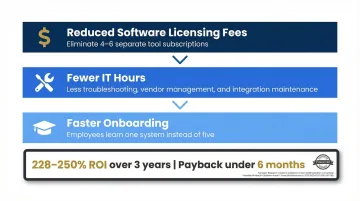
Cost savings come from three specific sources:
- Reduced software licensing fees — Eliminating 4-6 separate tools cuts direct subscription costs
- Fewer IT hours — Less time spent on troubleshooting, vendor management, and integration maintenance
- Faster onboarding — Employees need to learn only one system instead of five
There's also a less obvious cost: knowledge workers toggle between applications up to 1,200 times per day, losing roughly 9% of their annual work time to context switching. Fewer tools means fewer context switches—and fewer messages that never get read.
ROI data:
Forrester Total Economic Impact studies show that consolidating legacy intranets and disparate communication tools into a unified Employee Experience Platform can deliver ROIs of 228% to over 250% over three years, with payback periods under six months. One composite organization eliminated 10 legacy communication systems and saved $7.8 million through platform consolidation.
KPIs impacted:
- Total software licensing cost per employee
- IT maintenance hours per quarter
- Employee app adoption rates
- Time-to-publish for internal communications
When this advantage matters most:
This benefit is highest for mid-to-large organizations that have accumulated tools organically over time—often with no single owner tracking total cost—and for companies undergoing rapid growth or M&A where communication infrastructure is fragmented across legacy systems.
Higher Employee Engagement and Reduced Attrition
Unified communication platforms don't just deliver messages—they create a connected employee experience by integrating recognition, surveys, social channels, learning, and engagement programs into the same environment where employees receive company communications.
How this advantage is created:
When communications, recognition, and feedback are unified, employees participate more consistently because there's no friction switching between platforms. When leadership can see who's engaging and who isn't, they can act before disengagement turns into departure.
Why this is an advantage:
63% of employees considering leaving their jobs cite poor internal communication as a contributing factor. Replacing employees is expensive: frontline workers cost 40% of their annual salary to replace, while replacing managers costs up to 200%.
Platforms with gamification and AI-driven personalization drive higher adoption than passive notification tools—employees earn points, complete challenges, and receive recognition all within the same environment where they read company news. HubEngage is the first fully gamified multi-channel employee communications platform: gamification runs across every module, from communications and surveys to recognition, social engagement, and learning.
Analytics within a unified platform give HR and comms leaders real-time visibility into participation trends, survey response rates, and recognition activity. When engagement drops in a specific team or location, leaders can intervene before that drop shows up in turnover numbers.
Recognition's impact on retention:
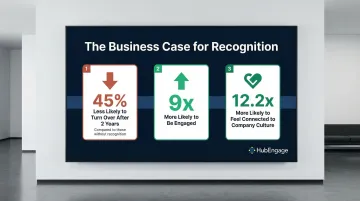
Employees who receive high-quality recognition are 45% less likely to have turned over after two years. Well-recognized employees are 9.0 times as likely to be engaged and 12.2 times as likely to feel connected to their organization's culture.
KPIs impacted:
- Employee engagement scores
- Voluntary attrition rate
- eNPS (employee net promoter score)
- Participation rates in recognition and survey programs
- Manager-to-employee communication frequency
When this benefit matters most:
This benefit is most critical during periods of organizational change—leadership transitions, mergers, policy rollouts, culture transformation programs—and in industries with chronically high turnover rates, where consistent, visible communication is a proven retention lever.
What Happens When Unified Communication Is Missing
When internal communications remain fragmented across separate tools, the consequences reach well beyond operational friction — they compound into culture, compliance, and retention problems that are costly to reverse.
Common consequences organizations experience without a unified platform:
- Desk-based employees receive every update while frontline and field workers miss critical information — creating a two-tier workforce where unequal access breeds resentment
- Safety protocols and policy updates that aren't reliably received or acknowledged drive up compliance exposure and incident rates
- Without consolidated analytics, HR and comms leaders can't identify disengagement until it surfaces as turnover, grievances, or a failed engagement survey
- Each new communication gap gets patched with another point tool — adding cost, complexity, and yet another app employees are expected to check
The financial stakes are real. In 2024, global employee engagement dropped to 21%, with lost productivity costing the global economy $438 billion. Turnover compounds the damage: 42% of employees who voluntarily left say their manager or organization could have done something to keep them.
That window is closing fast. With 45 million U.S. workers quitting voluntarily in 2023, replacement costs reached nearly $900 billion — a figure that makes fragmented communication look like a far bigger liability than any software investment.
How to Get the Most Value from a Unified Communication Platform
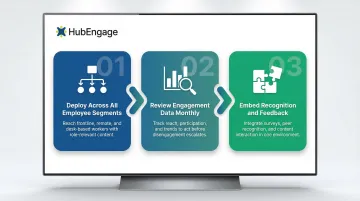
A unified platform delivers its full value when it's treated as ongoing communications infrastructure, not a one-time deployment. Three conditions determine whether organizations get compounding returns or plateau after initial adoption.
1. Deploy across all employee segments consistently
Value accelerates when the platform reaches every employee group—including frontline and distributed workers—and when content is designed for each channel rather than copy-pasted across all of them. Employees engage more when communications feel relevant to their role and location.
2. Review and act on engagement data monthly
Tracking participation rates, message reach, and engagement trends monthly prevents the platform from becoming a passive broadcast tool. HubEngage's AI-powered analytics surface these insights faster, so teams spend less time pulling reports and more time acting on what they find.
3. Embed recognition and feedback into the communication flow
When employees can recognize peers, submit pulse surveys, and engage with content in the same place they receive company updates, participation climbs. Isolated recognition programs and standalone survey tools see lower adoption—integration is what drives consistent use.
Conclusion
A unified communication platform earns its place by delivering consistent, measurable reach across every employee—wherever they work—alongside the engagement infrastructure (recognition, surveys, feedback) that turns routine communication into genuine connection.
The advantages covered in this guide—multi-channel reach, cost consolidation, reduced tool fragmentation, and measurable engagement outcomes—build on each other when applied with consistency. Organizations that treat unified communication as a strategic HR priority, not a one-time IT rollout, are the ones that convert those advantages into lower attrition, stronger culture, and a workforce that actually feels informed and heard.
Frequently Asked Questions
What are unified communication platforms?
A unified communication platform is a single system consolidating all the channels and tools used to communicate with and engage employees—covering mobile apps, email, SMS, intranet, and digital signage—so that every employee can be reached through their preferred or accessible channel.
What are the benefits of unified communication platforms?
The three primary benefits are: expanded employee reach (including frontline and deskless workers), reduced costs from consolidating multiple tools, and higher engagement and retention outcomes from a connected employee experience that integrates recognition, feedback, and social collaboration.
What are the main features and components of unified communication platforms?
Core components span multi-channel delivery (mobile, email, SMS, intranet, digital displays), employee engagement tools (recognition, surveys, social feeds), analytics, AI-powered search, and HR system integrations. Each module is designed to work in concert, giving employees and communicators a single platform rather than a patchwork of separate tools.
Is a unified communication platform worth the investment?
Organizations with large frontline workforces, high turnover rates, or fragmented communication stacks typically see faster payback through reduced tool licensing costs, measurably improved message reach, and lower attrition—all of which carry direct financial value. Forrester studies show ROIs of 228% or higher with payback periods under six months.
What is the importance of communication in remote work?
Remote and distributed employees rely entirely on digital communications to stay informed, connected, and engaged. Without a unified platform, information gaps widen quickly—accelerating disengagement and voluntary attrition among the workers hardest to replace.
What are unified communications as a service (UCaaS) platforms?
UCaaS typically refers to cloud-based telephony and conferencing tools (VoIP, video meetings, chat), while unified employee communication platforms like HubEngage focus specifically on reaching and engaging the internal workforce across all channels—mobile apps, intranet, email, SMS, and digital signage. These serve different but sometimes overlapping organizational needs.