Introduction
Email was never built for the pace of modern teamwork. Knowledge workers spend 8.8 hours per week managing their inboxes, and the average employee receives 117 emails daily — a volume that delays decisions, buries urgent requests, and slows projects to a crawl. For teams spread across remote, hybrid, and frontline environments, those bottlenecks compound fast.
Many organizations try patching the problem with consumer messaging apps or endless reply-all threads. Both approaches create fragmentation, missed messages, and communication blind spots that grow harder to manage as teams scale. This article covers the specific advantages dedicated chat tools deliver: faster decisions, stronger team accountability, reduced information silos, and the cultural shifts that follow when communication actually works.
Key Takeaways
- Dedicated chat tools replace fragmented email threads with real-time, organized conversations that reduce delays and miscommunication
- They are especially critical for frontline, remote, and hybrid teams where timely information directly affects output quality
- Structured channels and searchable message history create accountability and reduce time lost searching for information
- Inside a unified employee experience platform, chat tools connect communication directly with recognition, engagement, and performance data — compounding their impact
- Without a dedicated chat tool, teams suffer slower responses, knowledge gaps, and weaker participation in engagement programs
What Are Dedicated Chat Tools for Team Collaboration?
Dedicated team chat tools are purpose-built platforms designed specifically for structured workplace communication — not repurposed consumer apps or email. They offer features like organized channels, direct messaging, searchable history, and admin controls that consumer apps simply don't provide.
These tools serve teams across industries and workforce types:
- Knowledge workers coordinating projects and timelines
- Frontline employees receiving shift updates and safety alerts
- Managers communicating policy changes to distributed teams
The goal is an operational one — faster decisions, fewer miscommunications, stronger team alignment.
The distinction matters. Unlike WhatsApp or personal SMS, dedicated tools include:
- Admin oversight to manage users and access
- Compliance archiving for regulated industries
- Role-based permissions to control information flow
- Business system integrations that consumer apps don't support
For industries where documented communication is a legal requirement, these capabilities aren't optional extras — they're baseline necessities.
Key Advantages of Dedicated Chat Tools for Team Collaboration
The advantages below focus on measurable, operational impact rather than abstract claims. Each is tied to outcomes HR leaders, operations managers, and communications teams typically track — response time, engagement rates, information accessibility, and workforce productivity.
Advantage 1: Faster, More Structured Communication That Replaces Email Overload
Dedicated chat tools replace the fragmented, delayed communication pattern of email with real-time, organized conversations. Messages arrive instantly, context is preserved in threads, and colleagues respond in seconds rather than hours.
These tools achieve this through:
- Channel organization by team, project, topic, or location
- Message threading that keeps conversations contextual
- Push notifications ensuring the right people get the right information without it being buried in inboxes
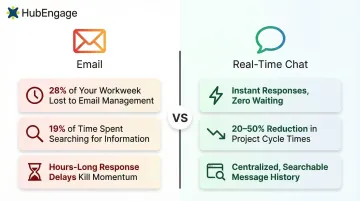
McKinsey research found that knowledge workers spend 28% of their workweek managing email — roughly 13 hours — and another 19% searching for internal information. Delayed approvals, stalled projects, and repeated follow-ups add up fast.
When a frontline manager can confirm a process change in seconds via chat rather than waiting for an email response, operational outcomes improve immediately. McKinsey case studies show that reducing information latency through real-time tools can cut cycle times for transactional work by 20-50%.
KPIs impacted:
- Average response time to internal requests
- Time spent in email
- Number of follow-up messages needed per task
- Project cycle time
- Employee-reported communication satisfaction
When this advantage matters most:
The impact is highest in time-sensitive environments — customer service teams, healthcare staff during shift handovers, manufacturing floor supervisors, hospitality coordinators — where delayed information directly affects service delivery or safety.
Advantage 2: Better Connectivity for Frontline, Remote, and Distributed Teams
Speed matters less if large parts of your workforce can't access the conversation. For frontline employees without desk access, mobile-first chat platforms close that gap — keeping workers connected to managers, peers, and company updates through their smartphones.
These platforms connect deskbound managers with field and floor-level employees through:
- Direct messaging
- Broadcast channels
- Read receipts
- Offline message queuing
Deskless workers represent approximately 80% of the global workforce — 2.7 billion people — yet they're chronically underserved by traditional communication tools. The consequences are measurable: Gallup research shows highly engaged business units experience 21% to 51% less turnover than disengaged ones.
Employees who feel informed and connected are less likely to leave. HubEngage's instant messaging feature is built specifically for organizations with large frontline or distributed workforces, giving every employee — regardless of role or location — the same access to real-time information.
KPIs impacted:
- Message reach rate among frontline staff
- Employee engagement scores
- Turnover/retention rates
- Mobile app adoption rate
- Time-to-information for field employees
When it matters most:
This advantage is most impactful for industries with shift-based or non-desk workforces — manufacturing, hospitality, retail, healthcare — and for organizations managing multiple physical locations or remote teams across time zones.
Advantage 3: Accountability, Transparency, and Searchable Communication Records
Dedicated chat tools create a documented, searchable record of team conversations — unlike verbal discussions or informal consumer apps. Managers gain visibility into how decisions were made, where information was shared, and who has seen critical updates.
How this works in practice:
- Read receipts confirm message delivery
- Channel archives preserve institutional knowledge
- Admin controls allow organizations to set permissions and manage access
- Search functions let employees surface past information without starting a new request
Information loss is a significant hidden cost. McKinsey found that workers spend nearly 20% of their week — about 1.8 hours per day — looking for internal information. A 2023 Gartner survey confirmed 47% of digital workers struggle to find information needed to perform their jobs effectively.
When employees leave, when projects hand over, or when compliance requires proof of communication, searchable records eliminate guesswork and reduce risk. In regulated industries like healthcare, financial services, or energy, documented internal communication isn't just convenient — it's often a legal requirement. The SEC and FINRA have levied over $1.1 billion in combined penalties on firms for failures to preserve 'off-channel' electronic communications on unapproved apps like WhatsApp.
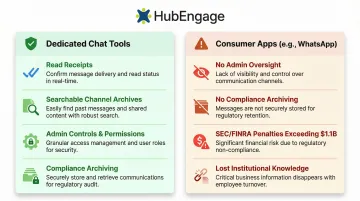
Channel-based organization also prevents the "who said what" confusion that slows decision-making, allowing teams to trace the context of any project decision quickly.
KPIs impacted:
- Time spent searching for past information
- Compliance audit readiness
- Onboarding time for new employees
- Number of repeated questions or duplicated work
- Information-related error rates
When this advantage matters most:
This advantage is highest-impact in larger organizations, multi-location setups, regulated industries, and environments with high employee turnover — where the cost of lost institutional knowledge is most acute.
What Happens When Teams Don't Have a Dedicated Chat Tool
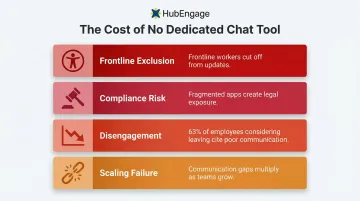
When organizations rely on email, consumer apps, or no structured channel at all, the same communication failures tend to follow. Critical updates get buried, response times stretch, some employees receive information late or not at all, and managers shift into reactive firefighting mode.
The compounding costs include:
- Frontline workers get left out entirely — most aren't connected to company email, so updates never reach them
- Conversations split across WhatsApp, personal email, and text create compliance risks and bury institutional knowledge
- 63% of employees considering leaving cite poor internal communication as a contributing factor — disengagement builds quietly when staff feel out of the loop
- Communication that works for 50 employees breaks down at 500 — scaling without structure means gaps multiply
Each week without a structured communication tool, information gaps widen and the effort to re-align teams compounds. That fragmentation has a direct cost to focus: the average worker is interrupted 275 times a day by meetings, emails, or chats — roughly once every two minutes — making sustained, productive work nearly impossible.
How to Get the Most Out of Your Team Chat Tool
A dedicated chat tool delivers full value only when it is adopted consistently across the organization. Partial adoption creates new silos rather than eliminating them. Leaders and managers must model usage and set expectations for response norms.
Start with clear structure:
- Establish consistent channel naming conventions
- Designate channels by purpose (team updates, casual conversation, urgent alerts)
- Regularly audit which channels are active and which have gone silent
Structure keeps chat organized — but the real gains come when chat connects to the broader employee experience.
The highest-value implementations integrate team chat within a unified communications ecosystem, where messaging connects to recognition programs, HR announcements, surveys, and operational updates in one place. This reduces the number of tools employees must navigate and increases overall participation.
Platforms like HubEngage consolidate instant messaging alongside multi-channel communications, recognition, and engagement within a single experience. One-click multi-channel reach auto-formats content for mobile apps, web, email, SMS, and digital signage — so messages reach employees wherever they work without manual duplication.
Conclusion
Dedicated chat tools are a genuine infrastructure investment — one that shapes how teams communicate daily, how quickly decisions get made, and how consistently people stay informed across every level of the organization.
The advantages — faster communication, frontline connectivity, and transparent accountability — each tie directly to operational outcomes that HR and communications leaders track, from response time and engagement scores to retention and compliance readiness.
Team chat works best not as a standalone app but as part of a broader communication strategy that evolves with the organization's needs. When embedded in a unified employee experience platform like HubEngage, chat connects recognition, engagement, and operational data in one place — giving HR and communications leaders the visibility to act on what employees actually need, not just what they assume.
Frequently Asked Questions
What are the advantages of dedicated chat tools for team collaboration?
Dedicated chat tools deliver faster response times, organized communication channels that replace email overload, and improved connectivity for distributed or frontline teams. These improvements show up in measurable outcomes: shorter project cycle times, higher engagement scores, and reduced turnover.
What are the key features of collaborative platforms and online collaboration tools?
Essential features include organized channels, direct messaging, mobile accessibility, searchable message history, admin controls, read receipts, and integration with other workplace systems. Dedicated platforms also offer compliance archiving and role-based permissions that consumer apps lack.
What are the best collaboration tools for remote teams?
The best tools for remote teams prioritize mobile-first access, real-time messaging, clear channel structures, and integration with broader HR or communication platforms. The right fit varies by workforce type, so evaluate tools against how and where your employees actually work.
Can my employer see or listen to my Slack messages and huddles?
On most enterprise chat platforms, including Slack, administrators in organizations with paid plans can access message data depending on their compliance settings. Org Owners can export public channels and apply for access to private channel and direct message data. Review your organization's privacy policy and data retention settings for specifics.
How is a dedicated team chat tool different from consumer messaging apps like WhatsApp?
Dedicated tools offer admin oversight, compliance archiving, role-based permissions, organized channels, and integration with business systems — features consumer apps lack. These capabilities make them the right choice for business use, particularly in regulated industries where documented communication is required for compliance.
How do dedicated chat tools benefit frontline or deskless workers?
Mobile-first dedicated chat tools give frontline employees direct access to managers, shift updates, policy changes, and peer communication — closing the information gap that leaves non-desk workers disconnected. For the majority of the global workforce that is deskless, this connectivity directly impacts engagement, retention, and day-to-day operational efficiency.