Introduction
HR and communications leaders face mounting pressure when pitching a new employee communications platform to leadership. The demand is clear: show the numbers, not just the intent.
Fragmented communication tools create a hidden ROI problem. Organizations running separate apps for messaging, intranet, email blasts, and digital signage face high software costs, poor message reach, and disengaged employees. The impact hits hardest with frontline and deskless workers (the populations most difficult to connect with and most critical to business operations).
According to Entrepreneur, companies lose 20-30% of annual revenue to operational inefficiencies caused by disconnected systems and data silos.
This guide walks through how to define, calculate, and present the ROI of unified communications — so you can walk into that leadership conversation with the numbers that close the case.
Key Takeaways
- Unified communications ROI spans productivity gains, engagement improvements, and retention outcomes alongside direct cost savings
- Organizations waste up to 30% of SaaS spend on unused licenses and $17 million annually on redundant tools
- Connect communication improvements to business metrics like turnover rate and output per employee for the strongest ROI cases
- Frontline and deskless workers represent the biggest ROI opportunity, as traditional tools consistently leave them underserved
What Is ROI in Unified Communications?
Unified communications ROI measures the financial and operational return generated when organizations replace fragmented, siloed communication tools with a single, multi-channel platform.
Traditional ROI models fall short because they focus only on license cost savings while ignoring productivity losses, compliance gaps, disengagement costs, and the true cost of missed communications — a blind spot that hits non-desk and frontline employees hardest.
IDC research confirms that organizations lose 20–30% of annual revenue to operational inefficiencies from fragmented systems. That's not a rounding error — it's a structural problem that a proper UC ROI model must account for.
A complete UC business case covers two categories of return:
Hard ROI includes:
- Quantifiable cost savings from tool consolidation
- Time saved through automated workflows
- Turnover reduction measured in replacement costs avoided
- License elimination from redundant platforms
Soft ROI includes:
- Culture improvement and trust building
- Employee alignment with company values
- Enhanced collaboration across departments
- Stronger sense of belonging
Both belong in the business case. Hard ROI gets the budget approved; soft ROI is what determines whether the investment sticks — and where most organizations undercount the return.
Key ROI Drivers: Where Unified Communications Creates Value
Cost Savings from Tool Consolidation
Organizations running separate platforms for email newsletters, SMS alerts, intranet, digital signage, and mobile apps pay for redundant licenses, admin overhead, and integration maintenance.
The numbers are staggering:
- Average SaaS spend per employee: $4,830 annually
- Enterprises waste 30-40% of total SaaS spend on unused or underutilized licenses
- IT teams spend 101 hours per app, per year on manual provisioning and management
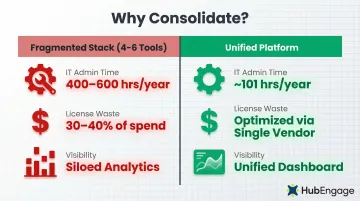
| Cost Factor | Fragmented Stack (4-6 Tools) | Unified Platform |
|---|---|---|
| IT admin time | 400-600 hours/year | ~101 hours/year |
| License waste | 30-40% of spend | Optimized via single vendor |
| Visibility | Siloed analytics | Unified dashboard |
Consolidating 4-6 tools into a single platform eliminates redundant licensing and cuts IT admin time by up to 75%—freeing teams to focus on higher-value work.
Productivity Gains from Reduced Communication Lag
When messages don't reach employees in the right channel, response times slow and decisions stall.
McKinsey research demonstrates that improved communication and collaboration through social technologies could raise the productivity of interaction workers by 20-25%.
Additional productivity drains:
- Employees spend 1.8 hours daily searching for information—nearly 25% of the workday simply vanishes
- Context switching between apps and tasks consumes up to 40% of productive time
For a 500-person organization, that adds up to roughly 450,000 hours lost annually to searching and switching—before a single strategic task gets done.
Employee Engagement and Its Financial Multiplier
Those recovered productivity hours compound when employees are also engaged. Engagement isn't just a culture metric—it has a direct line to profitability.
Gallup's Q12 meta-analysis reveals that business units in the top quartile of engagement realize:
- 23% increase in profitability
- 78% less absenteeism
- 18% higher productivity in sales
- 58% fewer patient safety incidents
Consistent, multi-channel communication plays a direct role in driving engagement. Reaching employees through their preferred channel—mobile app, SMS, email, or digital signage—measurably shifts engagement from passive to active participation.
Retention ROI: The Often-Ignored Cost Center
Higher engagement reduces turnover—and turnover is one of the most expensive line items HR leaders consistently underestimate.
SHRM estimates that total costs associated with turnover range from 90-200% of an employee's annual salary, with direct replacement costs reaching 50-60%. Gallup corroborates this, noting that replacing technical professionals costs about 80% of their salary, while replacing frontline workers costs 40%.
42% of employees who voluntarily left report that their manager or organization could have done something to prevent them from leaving.
To put that in dollar terms:
| Role | Median Annual Wage | Estimated Replacement Cost (Low-High) |
|---|---|---|
| Registered Nurse | $93,600 | $46,800 – $187,200 |
| Retail Salesperson | $34,569 | $13,827 – $69,138 |
| First-Line Retail Supervisor | $37,090 | $18,545 – $74,180 |
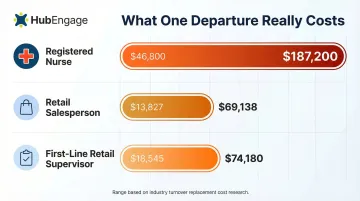
Preventing just two registered nurse departures per year saves enough to fund a mid-market communications platform—without counting productivity losses during vacancy.
Frontline and Deskless Worker Reach ROI
For industries like manufacturing, healthcare, hospitality, and retail, a large proportion of the workforce has no corporate email or desktop access.
Approximately 80% of the global workforce—about 2.7 billion workers—are considered deskless. These employees frequently lack access to corporate communication systems, leading to isolation and disengagement.
Untargeted or non-mobile communication strategies create:
- Compliance risk when safety messages don't reach frontline staff
- Safety gaps that increase incident rates
- Disengagement that drives turnover in hard-to-fill roles
- Operational inefficiencies from missed updates
Reliable reach to these workers pays off in hard numbers. Research published in the Journal of Patient Safety found a direct association between healthcare staff engagement and reduced errors and adverse events—a finding with clear parallels across manufacturing, hospitality, and logistics where frontline communication gaps carry real operational and safety costs.
How to Build a Unified Communications ROI Framework
Step 1: Define the Business Outcomes You're Trying to Move
ROI calculations must start with specific, pre-agreed business metrics—not vague goals like "better communication."
Examples of measurable outcomes:
- Reduce voluntary turnover by 10% within 12 months
- Decrease manager time spent relaying information by 5 hours per week
- Improve policy acknowledgment completion rates from 60% to 90%
- Increase employee engagement survey scores by 15 points
- Reduce safety incident rates by 20%
Each outcome should tie directly to a financial impact that leadership understands and values.
Step 2: Establish a Baseline
Capturing current-state data before implementation is essential. Missing this step is the most common reason UC ROI calculations fall apart post-implementation.
Critical baseline data points:
- Number of tools currently in use and their annual costs
- Adoption and usage rates for each tool
- Employee survey scores (engagement, satisfaction, communication effectiveness)
- Current voluntary turnover rate and cost per replacement
- Manager time spent on manual communication tasks
- Policy acknowledgment completion rates
- Average time employees spend searching for information
Document these metrics before go-live. You'll measure against them at 6, 12, and 24 months post-implementation to demonstrate progress.
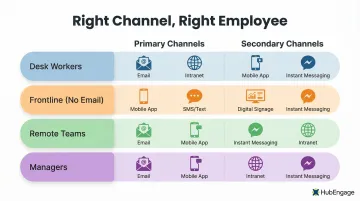
Step 3: Map Communication Channels to Employee Segments
Different employee groups need different channels to receive communications effectively. Desk workers, frontline staff, and remote teams have distinct preferences and access patterns.
Channel mapping example:
| Employee Segment | Primary Channels | Secondary Channels |
|---|---|---|
| Desk workers | Email, intranet | Mobile app, Teams |
| Frontline (no email) | Mobile app, SMS | Digital signage |
| Remote teams | Mobile app, email | Instant messaging |
| Managers | Email, intranet | Mobile app |
ROI is maximized when the right message reaches the right person through the right channel. This step prevents investment in channels employees won't use.
Step 4: Quantify the Value of Time Saved and Costs Reduced
Walk through the core calculation:
Time savings formula:
- Average loaded hourly rate for an employee: $35
- Estimated daily minutes saved by reducing information-searching, re-communication, and tool-switching: 15 minutes
- Annual time savings per employee: 15 min/day × 250 work days = 62.5 hours
- Annual value per employee: 62.5 hours × $35 = $2,187.50
For 500 employees:
- Total annual productivity value: $2,187.50 × 500 = $1,093,750
Beyond productivity, consolidating tools adds direct line-item savings to the model.
License consolidation savings:
- Current spend on 5 separate tools: $40,000 annually
- Unified platform cost: $25,000 annually
- Annual savings: $15,000
Together, these figures build the hard-number foundation of the business case.
Step 5: Incorporate Engagement and Retention Metrics into the Model
Translating engagement score improvements and turnover reduction into dollar terms gives the ROI model its strongest argument with finance and executive stakeholders.
Retention ROI formula:
- Current annual voluntary turnover: 20% of 500 employees = 100 departures
- Average cost of turnover per employee: $30,000
- Current annual turnover cost: 100 × $30,000 = $3,000,000
- Target turnover reduction: 10% (preventing 10 departures)
- Annual retention savings: 10 × $30,000 = $300,000
A 10% turnover reduction alone clears $300,000 annually — often enough to justify the entire platform investment before productivity gains or license savings are even counted.
Calculating UC ROI: A Practical Walkthrough
The Scenario
Mid-size hospitality company with 1,500 employees (1,200 frontline, 300 corporate) currently using:
- Email newsletter platform ($8,000/year)
- SMS service ($12,000/year)
- Paper bulletin boards (printing/distribution: $5,000/year)
- Basic intranet ($15,000/year)
- Manual recognition program (gift card admin: $10,000/year)
Total current annual spend: $50,000
Hidden Costs in Current State
IT and HR admin time:
- 400 hours annually managing 5 separate tools
- Loaded hourly rate: $45
- Annual admin cost: $18,000
Low frontline reach:
- Only 40% of frontline staff regularly see communications
- Managers spend 3 hours/week re-communicating missed messages
- 100 managers × 3 hours/week × 50 weeks × $35/hour = $525,000
Compliance gaps:
- Safety message non-acknowledgment creates risk exposure
- Estimated annual cost of preventable incidents: $75,000
Total current-state cost: $668,000 annually
Benefits After Moving to Unified Platform
Switching to a unified platform eliminates both the tool sprawl costs and the operational drag. Here's where the savings accumulate:
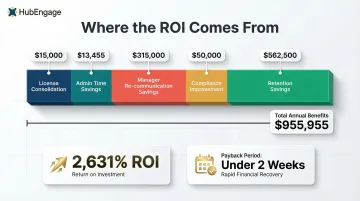
License consolidation:
- Unified platform cost: $35,000/year
- Eliminated tools savings: $50,000 - $35,000 = $15,000
Admin time savings:
- Reduced to 101 hours annually
- Savings: (400 - 101) × $45 = $13,455
Manager re-communication time:
- Message reach improves to 90%
- Manager time reduced by 60%
- Savings: $525,000 × 0.60 = $315,000
Compliance improvement:
- Policy acknowledgment rates increase to 95%
- Estimated incident cost reduction: $50,000
Retention improvement (10% reduction in first-year turnover):
- Current turnover: 15% of 1,500 = 225 employees
- Average replacement cost: $25,000 (blended frontline/corporate)
- Current annual turnover cost: $5,625,000
- Turnover reduction: 10% = 22.5 employees retained
- Retention savings: 22.5 × $25,000 = $562,500
Total annual benefits: $955,955
ROI Calculation
Formula: (Total Annual Benefits - Total Annual Platform Cost) ÷ Total Annual Platform Cost × 100 = ROI %
Calculation: ($955,955 - $35,000) ÷ $35,000 × 100 = 2,631% ROI
Payback period: Less than 2 weeks
Update this model quarterly as actual adoption data comes in. Year-one figures tend to be conservative — the bigger gains emerge in years 2 and 3, as employee adoption deepens and engagement behaviors become consistent.
Common Pitfalls That Undermine UC ROI
Even well-designed UC platforms fall short of their ROI targets when these three execution gaps go unaddressed.
Skipping Adoption Measurement
A platform delivering low adoption rates won't yield projected ROI regardless of its capabilities. Research indicates that 56% of enterprise software deployments fail to reach 50% user adoption within the first six months.
Start tracking these from launch day:
- Channel-level adoption rates (mobile app downloads, intranet logins, email opens)
- Active user percentage by employee segment
- Feature utilization rates
- Time to first action for new users
Research shows that gamified training incorporating progression, instant feedback, and points can significantly improve employee performance and motivation — making gamification a practical lever for closing adoption gaps early.
Underestimating the Full Cost of Change
Training, change management, content migration, and internal promotion are real costs that need to be factored into the denominator of any ROI calculation.
Budget for these before launch, not after:
- Change management consulting
- Employee training time (hours × loaded rate)
- Content migration and formatting
- Internal marketing campaigns
- Executive sponsorship time
- Integration setup and testing
Excluding these line items inflates projected ROI — and creates credibility problems when actual returns don't match the pitch.
Failing to Reconnect Outcomes to Financial Metrics Post-Launch
Many organizations calculate ROI once at pitch stage and never revisit it. Without ongoing reporting that ties platform usage to actual business outcomes, leadership buy-in erodes fast.
Run quarterly reviews that cover:
- Compare actual adoption rates to projections
- Track engagement score changes
- Monitor voluntary turnover trends
- Measure policy compliance completion rates
- Calculate actual productivity gains
This continuous feedback loop refines your investment case and demonstrates ongoing value to leadership.
How HubEngage Can Help
HubEngage consolidates mobile apps, intranet, email, SMS, and digital displays into one platform—cutting tool fragmentation costs while reaching every employee, including frontline and deskless workers, through the channel they actually use.
Built-in ROI accelerators:
- Gamification across the full platform — employees earn points, badges, and leaderboard rankings for communications, recognition, surveys, social engagement, and learning, driving adoption without manual incentive programs
- AI-powered content creation — auto-formats messages for mobile, web, email, SMS, and digital signage in one step, saving HR and comms teams hours of manual formatting work
- Real-time analytics — tracks channel-level adoption, message open rates, and employee segment engagement so teams can measure ROI and refine strategy continuously
HubEngage's modular design lets organizations start with the capabilities most critical to their ROI case—such as mobile communications for frontline reach—and expand as needs grow. This approach limits upfront investment while keeping a clear path to broader platform value.
Customers across healthcare, manufacturing, retail, and hospitality have consolidated multiple tools into HubEngage, with measurable gains in engagement, retention, and operational efficiency.
Conclusion
Unified communications ROI is real and measurable—but only when organizations move beyond cost-avoidance thinking to capture the full value chain. That means tracking tool consolidation savings alongside time recaptured, engagement scores, and the hard dollar cost of preventable turnover.
ROI here is not a one-time calculation — it's an ongoing discipline. The organizations that build the most compelling business cases treat platform data as a continuous feedback loop: they track adoption, surface friction points, and reinvest in what's working.
To make that discipline stick, most high-performing teams focus on three practices:
- Baseline before launch — document current tool costs, turnover rates, and productivity benchmarks so gains are provable, not assumed
- Review quarterly — map platform usage data against engagement scores and retention trends each quarter
- Tie metrics to budget cycles — present ROI findings when headcount or software spend is under review, not after decisions are made
The longer a unified communications platform is in use, the stronger the case for continued investment. Adoption compounds, retention improves, and the cost of switching rises — which means the organizations that start measuring early hold the clearest advantage.
Frequently Asked Questions
What is ROI in communication?
Communication ROI is the measurable business value—cost savings, productivity gains, and engagement improvements—generated by investing in more effective communication tools or strategies relative to the cost of those investments.
How do you calculate the ROI of unified communications?
Take annual benefits (cost savings, time saved, retention improvement) minus total platform cost, divide by total platform cost, then multiply by 100. Establishing a baseline of current-state costs before implementation is essential for accurate measurement.
What are the biggest cost savings from unified communications?
The primary savings come from consolidating redundant tool licenses, reducing IT and HR admin time spent managing multiple platforms, and cutting turnover costs driven by poor communication.
How long does it take to see ROI from a unified communications platform?
Hard cost savings from license consolidation are typically visible within the first year. Full ROI—including engagement and retention improvements—usually materializes over one to three years as adoption rates compound.
What metrics should HR and communications teams track to measure UC ROI?
Key metrics to track include:
- Employee adoption and channel engagement rates
- Message open and read rates
- Voluntary turnover rate
- Manager time spent on re-communication
- Cost per employee of the current communication tech stack
Why do many unified communications ROI projects fail to deliver expected results?
Most failures trace back to three causes: low adoption (the platform goes underused), hidden change management costs that inflate the true investment, and no pre-implementation baseline—making post-launch ROI impossible to prove.