Introduction
Hybrid work promises flexibility, but it also fragments the workforce — creating uneven wellness experiences where remote employees often lack the same support as in-office counterparts. Most wellness programs were designed for single-location workforces and quietly fall apart when staff are distributed across kitchen tables, co-working spaces, and conference rooms at the same time.
The problem is operational, not just cultural. HR leaders struggle to identify who's struggling when employees are physically invisible for much of the week, and wellness benefits go unused when remote workers don't even know they exist.
This article makes the operational case for dedicated employee wellness platforms, explaining what measurable advantages they deliver for hybrid teams specifically, and what organizations stand to lose — in productivity, retention, and engagement — when they rely on legacy approaches.
Key Takeaways
- Employee wellness platforms centralize mental, physical, and social wellbeing support for workers regardless of location
- Hybrid teams face distinct challenges: remote workers experience isolation, frequent context-switching drives burnout, and resource access is rarely equal across locations
- Structured platforms deliver equitable resource access, early burnout detection, and stronger retention through consistent recognition
- Organizations without structured wellness programs typically see absenteeism climb, productivity drop, and voluntary turnover accelerate — often before leadership notices the pattern
- ROI grows when wellness tools connect directly to communications and recognition systems already in use across the organization
What Is an Employee Wellness Platform?
An employee wellness platform is a digital solution that centralizes access to:
- Mental health support and behavioral health navigation
- Physical wellness resources and resilience tools
- Social recognition and peer connection features
- Wellbeing check-ins and engagement surveys
These platforms connect HR benefits administration, employee engagement, and internal communications in one place—serving remote workers who need digital access and in-office employees who need consistent touchpoints.
Unlike traditional Employee Assistance Programs (EAPs)—which offer reactive, short-term counseling—modern wellness platforms integrate preventive care, resilience resources, and ongoing engagement features.
The CDC's Total Worker Health framework defines this broader approach as policies and practices that integrate protection from work-related hazards with promotion of injury and illness prevention to advance overall worker wellbeing.
That framework points to where traditional programs fall short. The real function of wellness platforms isn't to serve as a benefit perk—it's to give HR leaders visibility into workforce health trends and give employees access to support before problems escalate into absenteeism or turnover. While 87% of organizations report having some form of formal wellness initiative, traditional models consistently underserve remote workers and fail to drive consistent participation.
Key Advantages of Employee Wellness Platforms for Hybrid Teams
The three advantages outlined below tie directly to outcomes HR and operations leaders actively track: retention rates, absenteeism, productivity, and engagement scores—not abstract "culture" metrics.
Advantage 1: Equitable Wellness Access Across Locations
One of the most overlooked costs of hybrid work is the disparity in wellness access. In-office employees benefit from on-site programs, ERG events, and manager visibility. Remote employees are often excluded from the same support due to proximity bias—the well-documented tendency of leaders to favor workers they can physically see.
Wellness platforms solve this by delivering the same wellness content, mental health resources, fitness challenges, and counseling access via mobile app, web browser, and SMS—so every employee receives the same baseline of support regardless of location.
The retention impact:
Equitable access reduces the perception among remote employees that they are "second-class" employees—a perception research links directly to disengagement and voluntary turnover. Fully remote workers report higher engagement (31%) but lower overall thriving (36%) compared to hybrid peers (42%), revealing the wellbeing gap that platforms must address.
When remote employees feel equally supported, they demonstrate stronger intent to stay. Among fully remote workers who are both engaged and thriving, only 38% are looking for new job opportunities—compared to 57% of all fully remote workers.
KPIs impacted:
- Employee Net Promoter Score (eNPS)
- Voluntary attrition rate
- Remote vs. in-office engagement gap
- Benefits utilization rate across locations
When this advantage matters most:
This is highest-impact for organizations with more than 30% of the workforce remote or hybrid, particularly in industries like healthcare, retail, and financial services where frontline and desk-based employees coexist. In healthcare, 55% of front-line workers reported burnout, with the highest rate (69%) among the youngest staff. In retail, 34% of frontline workers cited health and wellbeing as their primary reason for considering leaving.
Advantage 2: Early Detection of Burnout and Mental Health Risks
Hybrid work creates a "silent burnout" problem: employees are physically invisible to managers for much of the week, meaning early warning signs—fatigue, disengagement, declining output—go unnoticed until they escalate into medical leave or turnover.
Wellness platforms address this through pulse surveys, mood check-ins, and engagement analytics that surface patterns over time, giving HR leaders early signals to act on before problems compound.
Why early intervention pays off:
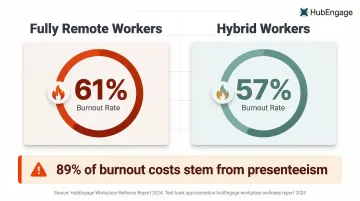
Proactive identification of at-risk employees allows HR to intervene with targeted support—counseling, workload adjustments, or schedule flexibility—before burnout reaches a breaking point. Burnout costs U.S. employers $3,999 to $20,683 per employee annually, with 89% of that cost stemming from presenteeism rather than absenteeism.
The risk is measurably higher for remote workers. Fully remote employees report burnout at 61%, compared to 57% for hybrid employees. Remote work erodes social connection and psychological wellbeing—making managerial invisibility a critical risk factor that platforms are specifically positioned to address.
KPIs impacted:
- Absenteeism rate
- Medical leave frequency
- Manager-reported performance issues
- Employee-reported burnout scores
- Voluntary turnover rate
When this advantage matters most:
This is most acute during periods of organizational change—return-to-office mandates, restructuring, rapid headcount changes—when hybrid employees are most vulnerable to anxiety and disengagement.
Advantage 3: Higher Engagement and Retention Through Continuous Wellness Recognition
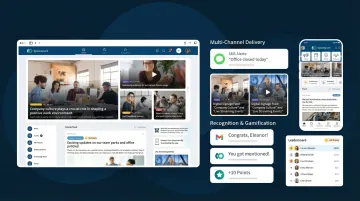
Wellness platforms go beyond passive resource access. The best platforms embed recognition directly into wellness behaviors, rewarding employees for completing health challenges, peer support, or regular check-in participation—reinforcing a culture of wellbeing across every location.
Gamified wellness programs—where employees earn recognition, badges, or rewards for wellness participation—drive ongoing adoption rather than one-time signups, creating sustained behavioral change across the hybrid workforce.
Why recognition multiplies wellness ROI:
Recognition tied to wellness activities creates a dual effect: employees feel seen for contributions beyond work output, and HR gains consistent engagement data to track program effectiveness. Well-recognized employees are 45% less likely to leave after two years, and employees receiving recognition that meets strategic pillars are 9 times as likely to be engaged.
Platforms like HubEngage combine multi-channel wellness communications—mobile app, SMS, digital displays—with gamified recognition so that wellness programs reach and reward employees whether they're at a desk, on a manufacturing floor, or at home. Employees with integrated recognition programs are 21x more likely to be personally invested in the organization's success and 25x more likely to produce great work.
KPIs impacted:
- Wellness program participation rate
- Employee recognition frequency
- 90-day and 12-month retention rates
- Internal mobility rates
- Engagement survey scores
When this advantage matters most:
Highest impact for organizations with large frontline or distributed workforces where employees lack regular face-to-face manager interaction—the digital recognition loop replaces the "hallway visibility" that in-office employees naturally receive.
What Happens When Employee Wellness Is Neglected in Hybrid Teams
When hybrid organizations run wellness programs inconsistently—or rely on in-office-only initiatives—remote employees gradually feel disconnected, undervalued, and unsupported. That sense of inequity doesn't stay quiet. It surfaces as disengagement, then absenteeism, then turnover.
Specific operational consequences HR leaders can expect:
Rising absenteeism and presenteeism
Unaddressed mental fatigue accumulates silently in hybrid settings. Globally, 12 billion working days are lost every year to depression and anxiety, costing $1 trillion in lost productivity. Presenteeism alone costs the U.S. economy more than $150 billion per year.
Accelerated voluntary turnover
Remote employees who perceive a wellness gap relative to in-office peers leave faster. Replacing an employee costs between 50% and 200% of their annual salary—roughly 200% for leaders and managers, 80% for technical roles, and 40% for frontline staff. The financial exposure adds up quickly when attrition is distributed across a hybrid workforce.
Declining manager effectiveness
Without structured check-in and pulse data, hybrid team leaders have no reliable way to identify struggling employees. Remote working reduces organic visibility, making it harder for managers to spot stress or disengagement before it escalates.
Benefits investment waste
Typical EAP utilization sits between 5–10%, and 81% of employees who know they have an EAP say they've never used it. Organizations that fund these programs without a platform to drive awareness and participation are spending the budget—but employees never access the support.
How to Get the Most Value from Your Employee Wellness Platform
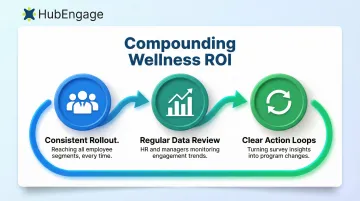
Wellness platforms deliver compounding returns when three operational conditions are in place:
- Consistent rollout across all employee segments, not just office-based staff
- Regular data review by HR and managers to spot trends before they become problems
- Clear action loops where survey insights translate into visible program changes
The adoption challenge specific to hybrid teams: Wellness programs require multi-channel delivery to reach employees where they already are. Over 80% of the global workforce is deskless, yet 69% of organizations rely primarily on email, while 54% of deskless workers have limited email access.
Organizations that push wellness content only through email or intranet will miss the majority of frontline and mobile workers. Effective platforms like HubEngage use mobile apps, SMS, and digital signage to ensure wellness communications reach every employee, regardless of role or location. SMS-only communications have a 90% read rate within five minutes, making it the most reliable channel for urgent updates and frontline reach.
Managers Are the Multiplier: Wellness programs in hybrid environments require active champion networks—managers who surface check-in data, celebrate recognition moments publicly, and model wellness participation—turning the platform from a self-service benefit into a shared cultural practice. 70% of team engagement is attributable to the manager, and in organizations where leaders publicly recognized employees for healthy behaviors, both self-reported health scores and medical costs improved measurably.
Conclusion
For hybrid teams, employee wellness platforms are operational infrastructure — as essential as communications tools or performance systems. They ensure equal access to support, surface at-risk employees before problems escalate, and maintain engagement across workforces that are never all in the same room.
The return compounds over time. Organizations that integrate wellness platforms with their broader engagement and communications systems — and act on the data those platforms surface — see measurable improvements in retention, productivity, and culture. Those that wait aren't avoiding the cost; they're paying it through turnover, absenteeism, and quiet disengagement that rarely shows up on a single line item.
Frequently Asked Questions
Frequently Asked Questions
What is hybrid wellness?
Hybrid wellness is a structured approach to employee wellbeing designed for teams spread across multiple work settings. It ensures remote, frontline, and in-office employees have equal access to mental health, physical, and social wellness support, regardless of where they work.
How do employee wellness platforms support remote workers differently than in-office staff?
Remote workers miss out on on-site wellness perks and face higher risks of isolation and burnout. Platforms close this gap by delivering resources, check-ins, and recognition digitally via mobile apps, SMS, or web, creating a consistent experience regardless of location.
What features should an employee wellness platform have for hybrid teams?
Look for multi-channel delivery (mobile, web, SMS), pulse surveys and mood check-ins, mental health resource access, gamified wellness challenges, and recognition integrations. The best platforms unify these features rather than requiring separate tools, ensuring consistent reach across all employee segments.
How do you measure the ROI of a wellness platform for hybrid employees?
Track metrics like voluntary attrition rate, absenteeism frequency, benefits utilization rate, wellness program participation, and engagement survey scores. Platforms with built-in analytics make it easier to attribute changes to specific wellness interventions and build a clear business case for continued investment.
What happens to employee engagement when wellness programs are absent in hybrid environments?
Without structured wellness programs, remote employees tend to feel invisible and undervalued. The result is measurable disengagement: lower participation in company initiatives, declining productivity, and higher voluntary turnover among distributed team members.
How can HR teams drive adoption of wellness programs across a distributed hybrid workforce?
Use multi-channel communications to reach employees on preferred devices, gamification to sustain participation, visible leadership endorsement, and regular feedback loops that show employees their input is acted upon. Together, these strategies make wellness feel like a genuine organizational commitment rather than a box-checking exercise.