Introduction
Approximately 80% of the global workforce — roughly 2.7 billion people — works without a desk. Yet most internal communication systems are built for the 20% who do. Employees in healthcare, retail, manufacturing, hospitality, and logistics are routinely left out of the loop.
The numbers confirm it: only 9% of deskless workers are highly satisfied with internal communications, compared to 47% of desk-based employees.
The disconnect is stark: 54% of frontline workers have limited or no corporate email access, and 46% don't even know who their CEO is. That gap fuels disengagement, safety incidents, and costly turnover.
This article outlines 8 practical strategies to close that gap and reach every worker, no matter where they work.
Key Takeaways
- Deskless workers represent 80% of the workforce but receive only 1% of enterprise software investment
- Key barriers: no email access, shift-based schedules, manager-dependent information flow, and language or literacy gaps
- Effective solutions require mobile-first channels, relevant segmented content, and two-way communication
- Gamification and peer recognition measurably lift participation rates and daily app engagement
- Strong deskless communication strategies are linked to 20% lower turnover and up to 63% fewer safety incidents
Why Communication with Deskless Workers Falls Short
Traditional communication systems fail deskless workers because they're designed for people who sit at desks. The structural barriers are significant:
Access and Infrastructure Gaps
- No regular computer access during work hours
- Shift-based schedules with limited overlap between teams
- Physically demanding work that prevents frequent message checking
- Geographic distribution across sites, floors, or vehicles
- 54% have limited or no corporate email access
The Manager Dependency Problem
Deskless workers rely heavily on their direct managers for information. Managers account for 70% of the variance in team engagement, and 57% of employees trust their immediate supervisor "a great deal" — more than any other source.
Yet 67% of frontline managers say they're "making it up as they go along" at least some of the time. When managers aren't equipped to communicate effectively, the entire information chain breaks down.
How Deskless Workers Consume Information
Deskless workers process information differently than desk-based employees:
- They consume information verbally and in short bursts
- They have brief windows during breaks or shift changes
- They prefer quick, relevant updates over long emails or reports
- 53% say company-wide updates are only somewhat relevant to their roles
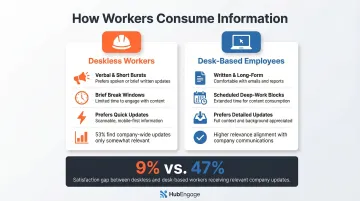
A communication strategy that ignores these patterns won't stick — no matter how good the technology behind it is. The 8 approaches below are built around how deskless workers actually operate.
8 Ways to Improve Communication with Deskless Workers
Way 1: Make Content Relevant to Their Role and Location
Deskless workers don't complain about "too much communication"—they complain about too much irrelevant communication. When 53% of frontline employees say updates are only somewhat relevant and 21% consider them entirely irrelevant, the problem isn't volume—it's targeting.
Relevance determines whether content gets consumed at all. A retail associate on the shop floor needs different information than a warehouse picker or a hospital nurse. Broadcasting the same message company-wide guarantees most recipients will tune out.
Delivering relevant content through preferred channels can triple baseline engagement rates. Phillips 66 used AI-driven message timing based on shift schedules and saw engagement rates double.
Start here:
- Segment content by location, department, role, and shift
- Tag messages with relevant audience attributes
- Use platforms that support dynamic content filtering
- Refine continuously based on engagement data
Way 2: Equip Line Managers to Be Communication Champions
Line managers are the single most trusted source of information for deskless workers. 42% of frontline employees prefer receiving updates directly from their managers, and trust in a manager directly predicts trust in organizational communication broadly.
Investing in manager communication skills delivers outsized returns compared to any channel investment. When managers communicate well, workers feel informed, valued, and engaged. When they don't, even the best technology fails.
Concrete support looks like:
- Ready-to-use message briefs for major announcements
- Team brief templates managers can customize for their crew
- Talking points that maintain consistent messaging across locations
- Training that builds confidence in cascading information
- Tools to track whether their team has actually received key messages
Without this infrastructure, quality varies entirely by individual manager—and 67% admit they're improvising.
Way 3: Go Mobile-First and Reach Workers on Multiple Channels
Deskless workers carry smartphones even when they don't have corporate laptops or email. A mobile-first strategy meets them where they already are.
51% of deskless employees prefer mobile communication methods like text messages or push notifications. For employees who use a dedicated employee app, 60% rank it as their most trusted communication channel—ahead of supervisors or management memos.
Essential channels to cover:
- Mobile app push notifications for timely updates
- SMS text alerts for urgent communications
- Digital signage in break rooms and production floors
- In-app messaging for peer and manager communication
- Email for those with access
Different messages belong on different channels. Safety alerts need immediate delivery via push or SMS. Culture updates work well in mobile apps or on digital displays. Recognition moments shine in peer-to-peer feeds.
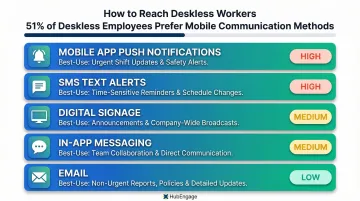
Platforms like HubEngage allow communications teams to publish once and auto-distribute across mobile, email, SMS, and digital displays simultaneously—removing the manual overhead of managing each channel separately while ensuring consistent messaging.
Way 4: Enable Two-Way Communication and Build Feedback Loops
The default in most organizations is top-down broadcasting. For deskless workers, one-way communication breeds distrust and disengagement.
A randomized controlled trial in the garment industry found that giving workers a voice through anonymous surveys reduced their probability of quitting by approximately 20%. Yet 38% of frontline workers say they have feedback for leadership but no way to communicate it, and 25% are rarely or never asked for their opinion on how work gets done.
Building effective feedback loops:
- Deploy pulse surveys with specific, short questions (not annual surveys)
- Provide anonymous suggestion tools that protect worker identity
- Use in-app polls to gauge sentiment quickly
- Enable peer messaging for horizontal communication
- Close the loop—visibly act on feedback or acknowledge it publicly
The last step is non-negotiable. Workers stop responding when feedback disappears into a void.
Way 5: Use Gamification to Drive Participation and Stickiness
Gamification—applying game mechanics like points, badges, leaderboards, and challenges—increases the likelihood that deskless workers interact with communication content rather than ignoring it.
Meta-analytic research shows significant positive effects on both cognitive outcomes (Hedges' g = 0.49) and motivational outcomes (g = 0.36) from gamified learning. The real-world numbers back this up:
- Home decor retailer At Home achieved 98% voluntary participation in gamified microlearning, with a 14% increase in safety knowledge and a 36% drop in safety incidents
- Walmart Logistics deployed gamified safety training to 75,000 associates, achieving 91% voluntary participation and a 54% decrease in recordable safety incidents
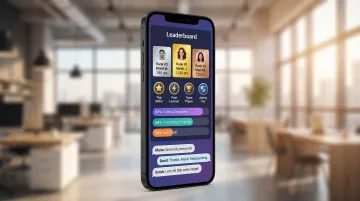
Concrete tactics to apply:
- Award points for reading key updates or completing surveys
- Create team-based challenges tied to communication engagement
- Use recognition mechanics like peer nominations and milestone badges
- Build leaderboards that celebrate participation without punishing non-participants
- Connect achievements to tangible rewards like gift cards or public recognition
HubEngage applies gamification across its entire platform—not just isolated features—driving adoption across communications, recognition, surveys, and learning activities simultaneously.
Way 6: Bring Senior Leadership Closer to the Frontline
46% of frontline workers don't know who their CEO is. That's not an engagement problem—it's a visibility problem. Yet 58% want to hear updates from the CEO, and 12% say they never receive communication from senior leadership at all.
When leadership is absent, workers fill the silence with their own interpretation—usually negative. 72% of employees want candid, conversational leadership communication, and 70% prefer a simple video over anything overly produced.
Practical ways to close the gap:
- Record short video messages from the CEO and share via mobile app
- Schedule regular "rounding" or site visits to frontline locations
- Host all-hands sessions designed specifically for shift workers (not just office staff)
- Create channels for workers to submit questions and receive direct responses
- Share behind-the-scenes updates that humanize the people at the top
Way 7: Segment Your Workforce and Tailor Your Approach
Deskless workers are not a monolith. Research identifies meaningful sub-groups based on how they work:
Three common work environment segments:
- Team-based workers (factory floors, hospital units) share physical space and can process information together
- Solo workers (long-haul drivers, field technicians) work independently with limited peer interaction
- Mixed environments (retail associates) alternate between customer-facing and back-of-house work
Motivation type matters just as much. Some deskless workers are task-motivated—their identity is in the craft, not the brand. Others are brand-motivated—they chose the company because of its values. Over-communicating brand messaging to task-motivated workers can actively disengage them.
Knowing which segment you're addressing changes what you say, not just how you say it:
- Solo workers need asynchronous access and self-service resources
- Team-based workers benefit from manager-led huddles and group channels
- Task-motivated workers want role-specific updates and safety information
- Brand-motivated workers engage with culture stories and mission updates
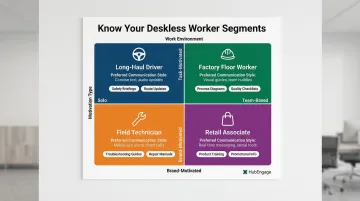
Platforms that support deep segmentation by role, location, shift, and team make this level of customization manageable at scale.
Way 8: Audit Your Current Channels and Measure What's Working
Most organizations deploy communication tools without a clear picture of whether they're reaching deskless workers at all. An audit fixes that.
An audit should answer five questions:
- Which channels do workers actually use and trust?
- What content drives the highest engagement?
- How quickly do critical messages reach their intended audience?
- Where are the gaps? (Messages that never reach the night shift, for example)
- Do workers feel informed and connected—or just messaged at?
Once the audit is done, track these metrics on an ongoing basis:
- Message open and read rates segmented by shift and location
- Survey response rates (SMS surveys typically outperform email by 15-35 percentage points)
- Manager cascade completion to ensure messages flow through the chain
- Safety alert acknowledgment times to measure both accessibility and trust
- Platform adoption levels (successful platforms see at least 60% weekly active usage)
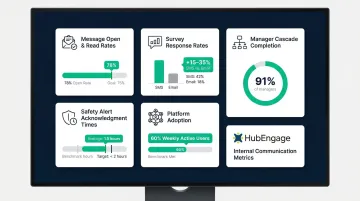
Review these regularly—not just at launch. Strategy should evolve with the data, and consistent measurement gives you the ROI story leadership needs to keep investing.
How to Choose the Right Communication Channels for Your Team
There is no single correct channel mix for deskless workers. The right combination depends on your workforce's daily reality, the type of information you're sending, and when workers actually have time to engage.
Workforce Characteristics
Consider these factors before selecting channels:
- How workers complete their tasks (solo vs. team-based)
- What devices they have access to during their shift
- Whether they're stationary or constantly on the move
- Shift patterns and available communication windows
Information Type and Urgency
- Urgent safety or operational messages require immediate delivery
- Cultural updates and leadership messages can be read at their own pace
- Training content needs focused attention and retention
- Recognition moments benefit from social visibility
Channel Decision Framework
| Message Type | Recommended Channels |
|---|---|
| Urgent safety or operational alerts | Push notifications, SMS |
| Cultural updates and leadership messages | Mobile app, digital signage |
| Training and onboarding | In-app microlearning, gamified modules |
| Recognition moments | Peer-to-peer messaging, public feeds |
| Two-way feedback | In-app polls, pulse surveys |
Validate Your Strategy With Workers Directly
Before locking in your channel mix, run short surveys or focus groups with a sample of deskless employees. Ask:
- Which channels do you check regularly?
- When during your shift can you consume information?
- What types of messages are most valuable to you?
- How do you prefer to give feedback?
Worker input often surfaces gaps that internal assumptions miss — like a shift group that never sees app notifications but consistently checks SMS.
Conclusion
Effective communication with deskless workers comes down to four things: the right channels, genuinely relevant content, managers those workers already trust, and two-way dialogue that makes people feel heard. Get those four things right, and engagement follows.
The organizations getting this right are seeing measurable returns. Companies in the top quartile for employee engagement see 23% higher profitability, 18% higher productivity, and 63% fewer safety incidents. Engaged frontline employees also reduce turnover by 51% in low-turnover organizations.
The cost of getting it wrong is equally clear: in retail, where annual turnover is 42%, the cost of turnover for every 100 employees (averaging $35,000 salaries) is approximately $2.2 million annually.
Organizations that reach frontline workers through mobile, SMS, and digital signage—with feedback loops built in—consistently outperform those still relying on bulletin boards and top-down broadcasts.
See how HubEngage's unified employee experience platform helps HR and internal communications teams reach every deskless worker—across mobile, SMS, digital signage, and email—with one workflow, built-in gamification, and the analytics to prove it's working. Request a demo to see how it works for your team.
Frequently Asked Questions
What is a deskless (non-desk) employee?
Deskless workers are employees who perform their jobs without a fixed desk or regular computer access. Common examples include healthcare workers, retail associates, manufacturing and warehouse staff, truck drivers, and construction workers. They represent approximately 80% of the global workforce.
What are the main types of communication for a deskless workforce?
Primary channels include mobile push notifications and SMS for urgent alerts, in-app messaging for peer and manager communication, digital signage for location-based updates, short video for leadership messages, and pulse surveys for two-way feedback. Multi-channel approaches work best — different workers respond to different channels.
What are the 5 C's of communication for a deskless workforce?
The 5 C's are Clarity (simple, direct messaging), Consistency (regular cadence), Channel-appropriateness (matching message to medium), Connection (two-way dialogue, not broadcasting), and Conciseness (brief messages that respect short attention windows). These matter most when workers lack regular access to email or intranet.
Why is communication with deskless workers so challenging?
Key barriers include shift-based schedules that eliminate shared windows, no corporate device or email access, mobile environments that limit attention for long messages, geographic distribution across sites, and over-reliance on managers as message intermediaries — creating fragile, inconsistent delivery chains.
How can you measure the effectiveness of deskless worker communication?
Track message open and read rates by shift and location, survey response rates, manager cascade completion, safety acknowledgment times, and platform adoption levels. Review these regularly to refine your strategy — measuring once at launch isn't enough.
What is the best app for communicating with deskless workers?
The best tools offer mobile-first multi-channel delivery (push notifications, SMS, in-app messaging), two-way communication features, content segmentation by role or location, and built-in analytics. Purpose-built platforms like HubEngage are designed specifically for this — with gamification, recognition, and workforce segmentation built in — where general tools like WhatsApp or email fall short.