Introduction
Organizations everywhere face the same frustrating reality: critical announcements disappear into overflowing inboxes, important documents hide in scattered folders, and frontline teams remain disconnected from company news. Traditional intranets promised to solve these problems but instead became digital graveyards—static, clunky repositories that employees avoid rather than embrace.
A SaaS intranet platform represents a different approach entirely. Modern cloud-based intranets meet employees where they already work—mobile apps, SMS, email, and digital displays—and continuously evolve alongside changing organizational needs.
This article covers what separates SaaS intranets from legacy systems, which features drive real adoption, and best practices that prevent the typical post-launch drop-off. HR and communications leaders will find a clear framework for evaluating platforms and making a confident decision.
TLDR: Key Takeaways
- SaaS intranets are cloud-hosted, vendor-managed platforms with no on-premise servers or IT overhead
- Deploy in weeks instead of months with lower costs and automatic updates delivered continuously
- Mobile-first architecture reaches frontline workers (70-80% of the workforce) who lack desk or email access
- High-performing platforms combine multi-channel delivery, AI search, gamification, and real-time analytics
- Sustained adoption depends on ongoing communication strategies that keep the intranet active after launch
What Is a SaaS Intranet Platform?
A SaaS intranet is software delivered as a cloud-based subscription service where the vendor hosts, secures, and maintains all infrastructure. Employees access it through web browsers, mobile apps, or integrated channels like Microsoft Teams—no installation required. This contrasts sharply with on-premise intranets from the 1990s and 2000s, which functioned as static file repositories demanding constant IT oversight, server maintenance, and manual updates.
The SaaS model changes how intranet software works in practice:
- Subscription pricing — typically per user/month, with no large upfront capital outlay
- Automatic updates — continuous improvements delivered without downtime or IT projects
- Flexible scaling — adjusts up or down as headcount changes, without hardware purchases
- Device-agnostic access — available from any browser or mobile device with an internet connection
This architecture shifts the operational burden from internal IT teams to the vendor, freeing HR and communications leaders to focus on strategy and employee experience rather than server patches.
Those operational shifts have reshaped what the industry expects from intranet software entirely. According to Gartner's 2025 definition, modern intranet packaged solutions must be "general-purpose, unified, multichannel software products available via public or private cloud deployment" that natively support web, mobile, email, AI assistants, and digital signage. A platform that can't meet employees across those channels isn't competing for the same job a 2005 intranet was.
SaaS Intranet vs. Traditional On-Premise Intranet
| Dimension | SaaS Intranet | On-Premise Intranet |
|---|---|---|
| Infrastructure | Vendor-hosted cloud servers | Company-owned physical servers |
| Cost Model | Predictable monthly subscription | Large upfront capital + ongoing maintenance (50-85% of total cost) |
| Updates | Automatic, continuous improvements | Manual upgrades requiring IT projects |
| Scalability | Instant adjustment to workforce changes | Requires hardware purchases and capacity planning |
| Mobile/Remote Access | Native mobile apps and browser access from anywhere | Limited or requires VPN; often desktop-only |
The operational difference runs deeper than cost. Traditional intranets treat the platform as a finished product—build it once, then manage the slow decline. SaaS intranets operate as living products that evolve continuously with employee needs and new feature releases.
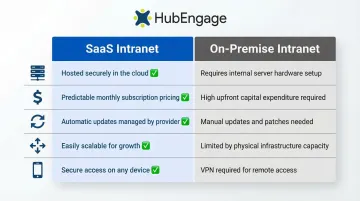
That difference shows up in deployment timelines too. Research by Nielsen Norman Group found it takes an average of 1.2 years to build and deploy a traditional intranet. SaaS platforms launch in weeks through configuration rather than custom development.
Key Benefits of a SaaS Intranet Platform
Faster Deployment and Lower Startup Cost
SaaS intranets launch through configuration, not custom development, enabling organizations to go live in weeks instead of months or years. A Forrester Total Economic Impact study analyzing a 60,000-employee organization found deployment occurred in phases over three months, with initial rollout taking just six weeks. This speed advantage compounds: every month spent building a traditional intranet is a month employees remain disconnected.
Cost savings extend beyond speed. According to Gartner, the annual cost to own and manage on-premise applications can reach four times the initial purchase price, with personnel costs for monitoring, maintenance, and upgrades accounting for 50% to 85% of total ownership costs. SaaS eliminates hardware expenses, licensing overhead, and unpredictable capital expenditure, replacing them with predictable monthly or annual subscription costs.
Reduced IT Burden and Predictable Operating Expenses
Shifting to SaaS moves intranet ownership off internal IT's plate entirely:
- Vendor manages security patches, uptime monitoring, and system updates
- IT teams redirect time toward strategic projects instead of maintenance tasks
- Surprise capital costs—server failures, emergency upgrades, capacity expansions—become predictable subscription line items
Mobile-First Reach for Every Employee Type
Deskless workers comprise 70% to 80% of the global workforce—approximately 2.7 billion people across healthcare, manufacturing, retail, hospitality, and logistics. Yet 46% of frontline workers lack corporate email access, and 62% have no workplace computer access.
Traditional intranets designed for desk workers systematically exclude the majority of most organizations' employees.
SaaS intranets built with mobile-first architecture close this gap. When employees can access the same information on their personal smartphones that office workers see on desktop—through native apps, SMS, and digital signage—the entire workforce operates from a single source of truth.
Research analyzing 800 frontline workers found it takes an average of 4.5 days for frontline employees to receive important company information, creating dangerous delays in safety updates, policy changes, and operational guidance.
Stronger Employee Engagement Through Two-Way Communication
SaaS intranets move beyond one-way announcements to support comments, reactions, surveys, peer recognition, and gamified participation. This shift from broadcast to dialogue matters because Gallup's Q12 Meta-Analysis found business units in the top quartile of employee engagement saw 23% higher profitability, 18% higher productivity, and 18% to 43% lower turnover compared to bottom-quartile teams.
The cost of disengagement is staggering. Global employee engagement fell to 21% in 2024, costing the global economy $438 billion in lost productivity. When employees feel heard and recognized through interactive intranet features, they're more productive and less likely to leave—and the platform becomes measurably responsible for retention, not just communication.
Continuous Improvement and AI-Powered Capabilities
Because SaaS platforms update continuously, organizations benefit from incremental improvements—better search algorithms, smarter content recommendations, AI-assisted HR queries—without planning major upgrade projects. Employees spend 1.8 hours every day—nearly 20% of the workweek—searching for information. AI-powered search that understands intent, not just keywords, reclaims that lost time while reducing the support tickets that overwhelm HR teams.
Must-Have Features of a SaaS Intranet Platform
The strongest SaaS intranet platforms share five foundational capabilities. Each one addresses a distinct failure point that causes intranet projects to stall or get abandoned.
Multi-Channel Publishing and Delivery
Employees don't live in a single channel. High-performing SaaS intranets push content across mobile apps, web browsers, email, SMS, and digital signage—reaching employees in the flow of their work, not just when they remember to log in.
"Publish once, distribute everywhere" means operationally:
- Communications teams create one message
- The platform automatically formats content for each channel's constraints
- Distribution happens simultaneously across all channels with one click
- Employees receive information through their preferred method
Single-channel intranets consistently miss frontline workers—the people who don't have a desk, don't check email regularly, and need information while they're moving.
AI-Powered Search and Knowledge Management
Hunting through outdated or duplicate documents kills intranet adoption. Enterprise-grade search should understand intent—not just keywords—and surface trusted answers from policies, HR documents, and FAQs instantly.
A Gartner survey revealed that 47% of digital workers struggle to find information needed to effectively perform their jobs. AI assistants embedded in the intranet (not bolted on) can answer employee questions proactively, reducing HR helpdesk load significantly. Forrester research on AI platforms found organizations achieved 20% reductions in support requests and saved up to 110 hours per employee annually from improved search and AI assistance.
Employee Engagement, Recognition, and Gamification
Engagement features convert a content repository into an active workplace hub. Peer recognition, badges, leaderboards, surveys, and gamified challenges linked to real behaviors—onboarding completion, training participation, demonstrating company values—drive consistent platform usage.
Surface-level gamification awards points for logging in. Platform-wide gamification reinforces meaningful outcomes—recognizing colleagues, completing important surveys, contributing to knowledge sharing, participating in learning activities. When gamification spans communications, recognition, surveys, and social engagement rather than a single isolated feature, it creates sustained motivation instead of temporary novelty.
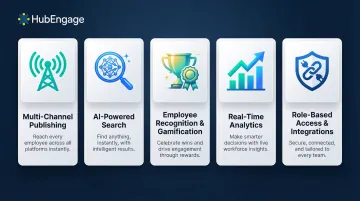
Real-Time Analytics and Communication Insights
Admins and communications leaders need more than page views. Meaningful analytics include:
- Message reach by channel and employee segment
- Engagement rate per content type
- Survey response rates and sentiment trends
- Search query patterns revealing what employees can't find
- Channel effectiveness comparisons
PoliteMail's 2025 benchmark report analyzing over 4 billion internal emails found the average internal email open rate is 64%. Without analytics showing how different channels perform, communications teams operate on guesswork. Analytics shift intranet management from assumptions to data-driven iteration.
Role-Based Access, Governance, and Integrations
Enterprise-grade SaaS intranets support granular permissions, content approval workflows, and multi-admin structures that allow global alignment with local relevance. Integration with existing HR systems, HRIS platforms, and communication tools eliminates duplicate work and ensures consistent employee data.
When the intranet connects with Microsoft Teams, Slack, email systems, and HRIS platforms, employees access everything through familiar tools rather than learning a separate system—which is often the difference between an intranet that gets used and one that gets ignored.
SaaS Intranet Best Practices to Drive Adoption and ROI
Launch with a Clear Internal Communication Plan
Technology alone doesn't create adoption. The most successful SaaS intranet launches are treated like internal marketing campaigns—with launch announcement strategies, employee-facing value messaging ("what's in it for me"), and designated intranet champions in key departments.
Research on over 1,000 intranet professionals identified poor communication planning as a primary driver of intranet failure. When employees don't understand why the new platform matters or how it helps them specifically, they default to old habits and ignore the new tool.
Define Governance Before You Go Live
Content chaos kills adoption. Before launch, establish:
- Content ownership roles (who maintains which sections)
- Update schedules for key pages
- Archiving policies for outdated content
- Clear information architecture
Nielsen Norman Group research shows intranets using distributed content management without central oversight result in significantly slower task completion times (123 seconds) compared to centralized models (78 seconds). Governance decisions made at launch either build that efficiency gain—or erode it. Getting the structure right from day one is far easier than retrofitting it later.
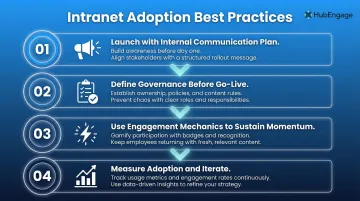
Use Engagement Mechanics to Sustain Momentum
Engagement typically peaks at launch and drops within 60 to 90 days without deliberate intervention. Sustaining momentum requires:
- Gamified activities tied to meaningful behaviors
- Regular leadership posts demonstrating executive buy-in
- Employee recognition campaigns celebrating contributions
- Pulse surveys showing employee voices matter
A systematic review of technology champions found that personnel acting as champions drive adoption when provided with clear mandates, dedicated time, and proper training. Appointing a champion per department—someone who models the platform and fields peer questions—turns passive rollout into active culture change.
Measure Adoption Rigorously and Iterate
Track metrics in the first 30/60/90 days:
- Active user rate by employee segment
- Content engagement by channel
- Search query patterns revealing gaps
- Survey completion rates
Use insights to adjust content strategy, channel mix, or navigation structure. A SaaS intranet's advantage is the ability to iterate without a full rebuild. Analytics pointing to frontline workers favoring SMS over email, for instance, are a signal to shift channel weighting—not ignore it. Search queries showing employees can't locate a critical policy mean it needs to be surfaced higher in navigation, not buried in a subfolder.
How HubEngage Delivers a Complete SaaS Intranet Experience
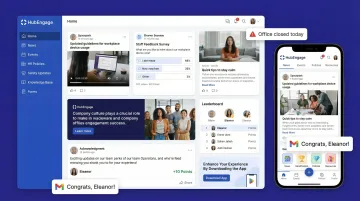
HubEngage is a fully unified SaaS employee experience platform combining intranet, multi-channel communications, recognition, surveys, and gamification in one modular system. Organizations start with the features they need most—perhaps just the intranet and mobile app—then expand over time without switching platforms or managing multiple vendor contracts.
Here's what sets HubEngage apart for organizations with frontline, remote, and hybrid workforces:
- Publish once, reach everyone: One-click distribution sends messages across mobile apps, web, email, SMS, and digital displays simultaneously—auto-formatted for each channel so nothing gets lost in translation.
- Gamification across the full platform: Points, badges, and leaderboards apply to communications, recognition, surveys, social engagement, and learning—not just a single feature. That breadth drives sustained participation rather than one-time spikes.
- AI that works for both employees and teams: Employees get instant answers to policy questions and HR queries. Communications teams get AI-assisted content creation and email drafting, cutting campaign production time significantly.
HubEngage is an Official SHRM and HRCI Recertification Provider—a credential that matters to HR leaders who need a platform built with professional rigor, not just technology features.
If your organization is ready to move beyond patchwork tools, explore HubEngage's intranet solution to see the platform in action.
Frequently Asked Questions
Is intranet a SaaS?
Intranets can be either SaaS (cloud-hosted, vendor-managed) or on-premise (self-hosted). Modern intranets are predominantly SaaS, delivered over the internet on a subscription basis with no company-owned servers or installation required.
What is the main advantage of using SaaS?
The primary advantage is eliminating infrastructure management. Organizations get automatic updates, predictable subscription pricing, instant scalability, and access from any device—without upfront costs or IT overhead of on-premise alternatives.
How is a SaaS intranet different from a traditional on-premise intranet?
SaaS intranets are cloud-hosted and continuously updated by the vendor, while on-premise intranets require the company to maintain servers, manage updates manually, and often lack mobile or remote accessibility for distributed teams.
What features should I look for in a SaaS intranet platform?
Prioritize multi-channel delivery (mobile, web, email, SMS, digital signage), AI-powered search, employee engagement and recognition tools, real-time analytics, and integration with existing HR and communication systems.
How do I drive employee adoption of a new SaaS intranet?
A successful launch depends on an internal communication plan, department-level intranet champions, and gamified incentives for early participation. Ongoing content governance keeps the platform relevant and trustworthy over time.
Can a SaaS intranet work for frontline and deskless employees?
Modern SaaS intranets with mobile-first architecture and multi-channel delivery (including SMS and digital signage) are built to reach employees without desk access. That makes them far more effective than traditional intranets, which assumed everyone had a corporate device and a company email address.