Introduction
Despite tight HR budgets and mounting pressure to improve retention and productivity, many organizations overlook one of the most cost-effective levers available: employee recognition. According to Gallup research, only one in three U.S. workers strongly agree they received recognition or praise in the past seven days. This gap represents a massive missed opportunity.
Recognition is often dismissed as a "nice to have" rather than a measurable business driver. The data says otherwise: employees who don't feel adequately recognized are twice as likely to quit within the year, and organizations with strong recognition practices see 18% higher productivity and 23% higher profitability compared to those without.
What follows covers the concrete outcomes recognition drives — retention, performance, and culture — and how to apply it in ways that compound over time.
Key Takeaways
- Employee recognition acknowledges efforts, behaviors, and results in timely, authentic ways—and doesn't require a large budget
- Unrecognized employees are twice as likely to quit, making recognition one of the lowest-cost, highest-impact retention tools
- Recognition improves productivity by reinforcing behaviors that drive organizational performance
- Memorable recognition is personalized, multi-directional, and delivered consistently throughout the year
- Reaching frontline and deskless workers at scale requires structured programs with the right tools and channels
What Is Employee Recognition?
Employee recognition is the act of formally or informally acknowledging an employee's contribution, behavior, or achievement in a way that feels sincere and tied to organizational values. Unlike compensation or benefits, recognition is about appreciation — not payment.
Recognition spans a wide spectrum:
- Verbal thank-you from a manager
- Peer shoutout on an internal platform
- Formal award or milestone celebration
- Points-based reward system
What these forms share is cadence. Unlike performance reviews that happen annually or quarterly, recognition works continuously. That consistency is what makes it a management tool — one that shapes behavior, signals organizational priorities, and directly influences whether employees stay engaged and committed.
Key Advantages of Employee Recognition
The advantages below focus on measurable, operational impact: the kind HR leaders and managers can track against retention rates, productivity metrics, and culture health scores. Each advantage compounds when recognition is applied consistently and at scale, rather than as a one-off or reactive gesture.
Advantage 1: Reducing Turnover and Improving Retention
Employees who feel unrecognized are significantly more likely to leave. Recognition directly addresses one of the primary drivers of voluntary turnover by fulfilling employees' core need to feel valued. Gallup research confirms that employees who don't feel recognized are twice as likely to say they'll quit in the next year.
What drives the retention effect:
- Builds psychological investment in the organization
- Strengthens the manager-employee relationship over time
- Signals that good work has a future, reducing the pull of outside offers
- Employees receiving high-quality recognition are 45% less likely to have turned over after two years
The financial case:
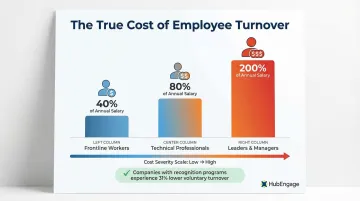
The average cost of replacing an employee varies by role:
| Employee Category | Replacement Cost |
|---|---|
| Frontline Workers | 40% of annual salary |
| Technical Professionals | 80% of annual salary |
| Leaders and Managers | 200% of annual salary |
Even a small improvement in retention delivers outsized ROI compared to the cost of running a recognition program. Organizations with recognition programs have 31% lower voluntary turnover and are 12 times more likely to have strong business outcomes.
KPIs impacted:
- Voluntary turnover rate
- Average tenure
- Offer acceptance rate
- Exit interview themes related to feeling valued
Where this matters most:
Organizations with large frontline or deskless workforces, industries with chronic retention challenges (healthcare, hospitality, manufacturing, retail), and periods of organizational change when employees are most susceptible to disengagement.
Advantage 2: Driving Productivity and Reinforcing Performance
Recognition doesn't just reward past behavior—it shapes future behavior. When employees understand exactly what contributions are valued and see those behaviors acknowledged publicly, they're more likely to repeat and deepen them.
How this plays out in practice:
Timely recognition—ideally within days of the achievement—reinforces the direct link between effort and outcome. Recognition tied to specific behaviors or company values gives employees a clear map of what "good" looks like. Gallup recommends recognition every seven days to ensure employees know the significance of recent achievements.
The productivity premium:
According to Gallup's Q12 Meta-Analysis, top-quartile engaged business units achieve 18% higher productivity (sales) and 23% higher profitability compared to bottom-quartile units. Recognition is a primary driver of this engagement gap.
Field research published in Management Science found that unannounced public recognition increases subsequent performance substantially, driven largely by non-recipients responding to established high-performance norms. Recognition establishes what excellence looks like, triggering conformity and reciprocity across teams.
KPIs impacted:
- Individual productivity metrics
- Quality of output
- Absenteeism rates (81% lower in highly engaged units)
- Performance review scores over time
Where this matters most:
Teams with clearly defined performance standards, environments where peer comparison is motivating, and organizations trying to shift culture or embed new values or behaviors.
Advantage 3: Building a Recognition-Rich Culture That Strengthens Employer Brand
Recognition is not just a bilateral exchange between a manager and an employee. It sends signals to the entire workforce about what the organization values and whether contributions are genuinely seen. That signal starts with day-to-day manager behavior, not top-down mandates.
What a recognition-rich environment looks like:
- Managers model appreciation visibly and consistently at every level
- Peer-to-peer recognition becomes part of daily interactions, not a formal program event
- Employees develop a shared, specific language around what "good work" means
- The result: higher referral rates and stronger candidate quality as recognized employees become informal advocates
The employer brand connection:
Glassdoor research shows that a 0.5-point improvement in overall company rating leads to a 20% increase in job clicks and a 16% increase in apply starts. For frontline workers, recognition directly impacts customer experience. Cineplex's recognition program targeting specific behaviors saw Net Promoter Scores grow by up to 40 points, while a national retailer experienced a 112% increase in customer satisfaction within six quarters.
KPIs impacted:
- Employee Net Promoter Score (eNPS)
- Internal referral rates
- Glassdoor/employer review ratings
- Onboarding satisfaction scores
Where this matters most:
Organizations competing for talent in tight labor markets, companies undergoing cultural transformation, and businesses where frontline employees interact directly with customers.
What Happens When Recognition Is Missing or Ignored
Disengaged employees cost organizations through lost productivity, absenteeism, and turnover — and the numbers are hard to ignore. According to Gallup's 2025 State of the Global Workplace Report, global employee engagement fell to 21% in 2024, with lost productivity costing the global economy $438 billion.
The gap between how often managers think they recognize employees and how often employees report feeling recognized is consistently wide. Nearly 60% of managers believe they effectively recognize their teams, but only 35% of employees agree. Between 2024 and 2025, employee-reported weekly recognition plummeted from 29% to just 15%.
That recognition gap translates directly into operational damage:
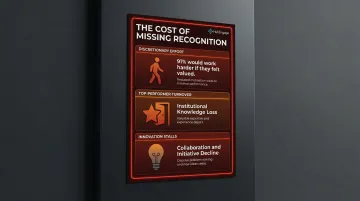
- Discretionary effort disappears — 91% of employees say they'd work harder if they felt valued, but without consistent recognition, most settle for doing just enough
- Top performers leave first — they have the most options and the lowest tolerance for feeling invisible, taking institutional knowledge with them
- Innovation stalls when employees sense their contributions are interchangeable; collaboration and initiative follow the same downward slope
The deeper problem is that missing recognition rarely shows up labeled as such. In exit interviews and engagement surveys, it surfaces as "poor management," "feeling undervalued," or "no growth opportunities." Organizations treat the symptom while the root cause goes unaddressed — which is exactly why recognition gaps tend to widen before anyone notices them.
How to Build a High-Impact, Low-Cost Recognition Practice
Recognition works best when it is consistent, personalized, and multi-directional—flowing from managers, peers, and leadership—not reserved for annual awards or standout achievements alone.
The most memorable sources of recognition:
According to Gallup data:
- Employee's manager: 28%
- High-level leader or CEO: 24%
- Manager's manager: 12%
- Customer: 10%
- Peers: 9%
Nearly one-quarter of employees cite a high-level leader or CEO as their most memorable source of recognition, indicating that even a small amount of time a high-ranking leader takes to show appreciation yields a positive impression.
That data points to a clear opportunity: structured, multi-source recognition programs outperform ad-hoc appreciation. Here's what a repeatable practice actually requires.
Foundational elements of a repeatable recognition practice:
- Tie recognition to specific behaviors that reinforce company values—not generic "great job" praise
- Set a regular cadence: weekly check-ins, monthly shoutouts, milestone acknowledgments. Consistency beats grand gestures
- Mix recognition formats—public and private, monetary and non-monetary—since different employees value different approaches
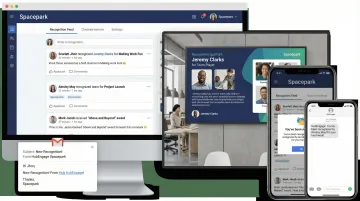
- Extend recognition to frontline and remote workers, who are routinely missed by top-down programs. Platforms like HubEngage deliver recognition across mobile apps, digital displays, SMS, and email simultaneously, so no one is left out by location or role
- Track outcomes: monitor whether recognition frequency moves engagement scores, stabilizes retention in high-turnover roles, and improves "feeling valued" responses in pulse surveys. Measured recognition becomes a strategy; unmeasured recognition stays a courtesy
Even well-intentioned programs fail when they fall into predictable traps. Watch for these:
Common pitfalls to avoid:
- One-size-fits-all programs that feel impersonal to the employees receiving them
- Infrequent recognition tied only to formal reviews or annual cycles
- Vague praise that lacks specificity—"great job" lands differently than "your quick resolution of the client escalation on Tuesday prevented a churn risk and saved the team hours of reactive work"
Conclusion
The importance of employee recognition lies in its compounding impact on retention, performance, and culture — impact that builds when recognition is applied with consistency and authenticity, not just rolled out during annual reviews.
Organizations that make recognition a structured, ongoing practice see these effects stack over time:
- Lower turnover cuts recruiting and onboarding costs
- Higher engagement drives measurable productivity gains
- A recognition-rich culture draws stronger candidates to open roles
Treating recognition as a management discipline — not a quarterly gesture — is what separates high-retention workplaces from those perpetually backfilling roles. The tools and frameworks exist; the differentiator is follow-through.
Frequently Asked Questions
What are rewards and recognition for employees?
Employee recognition refers to acknowledging efforts and behaviors (verbal praise, awards, peer shoutouts), while rewards are tangible incentives (points, gifts, bonuses) that reinforce those behaviors. Together, they motivate performance and signal what the organization values.
What are the benefits of employee recognition and rewards?
Core benefits include reduced voluntary turnover, improved engagement and productivity, stronger culture, and enhanced employer brand—all achievable at low cost when recognition is applied consistently. Research consistently links structured recognition programs to measurably lower turnover and higher productivity across industries.
How do you recognize and reward good performance?
Effective recognition is timely, specific, and personalized—tied to clear criteria aligned with company values. It can include public acknowledgment, private feedback, peer recognition, milestone rewards, or expanded responsibilities, ideally delivered within seven days of the achievement.
What are the 4 pillars of engagement?
Common pillars include connection (to the organization's purpose), contribution (feeling work is valued), clarity (understanding expectations), and growth (opportunities to develop). Recognition directly reinforces the contribution and connection pillars.
What are the 5 C's of retention?
The 5 C's typically include Compensation, Culture, Career growth, Colleagues, and Care/recognition. Recognition directly addresses the "Care" dimension by making employees feel seen and valued, a primary retention driver.
What are the 5 key performance indicators for employees?
Common employee KPIs include productivity output, quality of work, goal completion rate, absenteeism, and engagement scores. Recognition programs directly influence several of these—particularly engagement scores and absenteeism—when applied consistently.