Introduction
More than half (55%) of U.S. employees either do not receive recognition at all or do not receive recognition that satisfies any of the five pillars of strategic recognition, according to 2024 Gallup research. This recognition gap fuels disengagement, attrition, and productivity loss—creating a real crisis in workplaces where employees feel unseen and undervalued.
Most organizations simply lack structured recognition programs—systems that consistently and fairly acknowledge contributions across all employee segments. For distributed, remote, and frontline workforces, the gap widens further: recognition tends to default to desk-based employees while deskless workers go unnoticed.
This article covers what recognition programs are, 10+ actionable program ideas you can implement regardless of budget, and a practical framework for building a recognition system that actually sticks and delivers measurable results.
Key Takeaways
- Employee recognition programs are structured systems for consistently acknowledging contributions, not sporadic praise
- Well-recognized employees are 45% less likely to turn over after two years, making recognition a measurable retention strategy
- Effective recognition is timely, specific, and delivered through multiple methods: peer-to-peer, manager-led, monetary, and non-monetary
- Frontline and deskless employees are the most overlooked; reaching them requires mobile, SMS, and digital display channels
- The blog covers 10+ program ideas and a step-by-step build framework
Why Employee Recognition Programs Matter
Employee recognition programs aren't a "nice to have"—they're a measurable business strategy with direct impact on retention, engagement, and productivity. The numbers back this up:
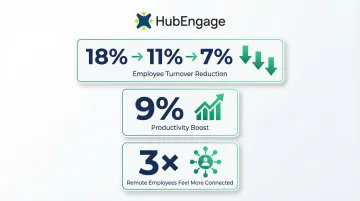
- Turnover drops from 18% to 11% when employees receive recognition versus none — and further to 7% when they both give and receive it
- Doubling the share of employees who strongly agree they were recognized in the last seven days correlates with a 9% productivity increase
- Remote employees who feel recognized are 3x more likely to feel strongly connected to their organization's culture
The stakes are highest for frontline teams. Frontline workers make up more than 70% of the U.S. workforce and 80% globally — roughly 2.7 billion people — yet they're rarely included in recognition programs built for desk-based employees.
The difference between informal appreciation and a structured recognition program is consistency, fairness, and scalability. A quick "thanks" in passing is valuable, but it's inconsistent and often inequitable. Structured programs create repeatable systems that ensure every employee—regardless of location, shift, or role—has equal access to recognition opportunities.
10+ Employee Recognition Program Ideas to Boost Morale
These ideas span monetary, non-monetary, peer-driven, and manager-led approaches—choose what fits your culture and budget.
Peer-to-Peer Recognition Programs
Giving employees the ability to recognize each other through shoutouts, digital badges, or points builds a culture of appreciation that doesn't rely solely on managers. This removes the bottleneck of top-down recognition and increases frequency significantly.
Best-in-class companies are 41% more likely to empower employees to recognize each other. The impact is measurable: a meta-analysis of 79 studies across 45,000+ employees found peer recognition correlates more strongly with engagement (.42) than manager recognition (.37). Employees who give recognition regularly are also 26% more engaged themselves.
Manager-Led Shoutouts and Personalized Praise
Managers calling out specific, timely contributions in team meetings, emails, or company channels is one of the highest-impact and lowest-cost forms of recognition. The key is specificity over generic praise—acknowledging exactly what the employee did and why it mattered reinforces the behavior and makes the recognition meaningful.
Employee of the Month and Quarter Awards
The classic nomination-based award model can be meaningful when executed with clear criteria, public announcement, and tangible rewards. However, it becomes performative when poorly executed—turning into a popularity contest or being forgotten immediately after the announcement. To make it work:
- Establish transparent selection criteria tied to company values
- Rotate nomination sources to prevent favoritism
- Pair the award with both public recognition and a meaningful reward
- Follow up with personalized acknowledgment beyond the announcement
Service and Milestone Recognition
Work anniversary programs, tenure awards, and life milestone recognition (promotions, certifications, personal achievements) reinforce loyalty and signal that the organization values long-term commitment. Acknowledging longevity demonstrates that employee contributions compound over time and that the organization remembers.
Milestone recognition should include:
- Public acknowledgment in company channels
- Personalized messages from leadership
- Meaningful rewards scaled to tenure or achievement level
- Celebration of both professional and personal milestones
Performance-Based Bonuses and Monetary Rewards
Cash bonuses, gift cards, and financial incentives directly tie recognition to outcomes. Monetary rewards are highly motivating as extrinsic rewards but work best when paired with authentic verbal or public recognition—not given in isolation.
Monetary recognition reduces turnover 20% more effectively than digital thanks alone. Combining financial and non-financial rewards consistently drives stronger motivation and performance than either approach in isolation.
Non-Monetary Perks and Privileges
Extra paid time off, flexible scheduling, premium parking, a preferred shift, a "no-meeting" day, or a work-from-home day are highly valued because they give employees time and autonomy—two things money can't always buy.
Up to 55% of employee engagement is driven by non-financial recognition, making these perks surprisingly powerful. Examples include:
- Additional PTO days or half-days off
- First choice of vacation scheduling
- Flexible work hours for a week
- Reserved parking spots
- Early release on Fridays
Gamified Recognition Programs
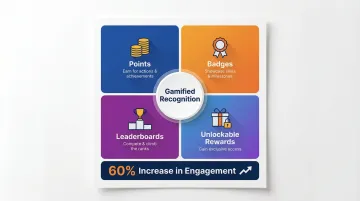
Gamification turns recognition into an ongoing, participatory experience rather than an episodic event. Points, badges, leaderboards, and unlockable rewards drive adoption and frequency of recognition—especially effective for frontline and manufacturing environments.
Research shows that gamified training can lead to a 60% increase in engagement and improve skills retention by 40%. However, overreliance on extrinsic rewards like points and badges can erode intrinsic motivation over time if not balanced with meaningful recognition and purpose.
Team-Based Recognition
Recognizing entire teams—not just individuals—encourages collaboration and prevents the "lone hero" dynamic. Team lunches, group awards, and department-wide shoutouts tied to shared goals or project delivery reinforce collective achievement.
Examples include:
- Team celebration lunches or outings
- Group bonuses for hitting collective targets
- Department-wide recognition in all-hands meetings
- Shared rewards for collaborative project completion
Public Recognition Walls and Announcements
Digital or physical "walls of fame," company-wide announcement boards, and recognition featured in internal newsletters or all-hands meetings amplify the impact of recognition for both the recipient and the broader culture. Public visibility creates social proof that recognition is valued and celebrated organization-wide.
Learning and Development Opportunities as Recognition
Professional development signals long-term investment in the employee. It's highly valued by high performers who see it as both acknowledgment of their contributions and a pathway to advancement.
Organizations that invest strategically in employee development report 11% greater profitability and are twice as likely to retain their people. Development-based recognition options include:
- Conference attendance and industry event sponsorship
- Online course or certification funding
- Mentorship program access
- Stretch assignments or leadership rotations
Digital and Multi-Channel Recognition Platforms
For organizations with frontline, remote, or distributed teams, recognition must be delivered where employees actually are—via mobile apps, SMS, digital signage, or email. Platforms like HubEngage enable recognition to reach every employee across channels simultaneously, removing the "desk gap" where frontline workers miss out on recognition entirely.
HubEngage's Recognition Hub delivers this through one-click multi-channel publishing—mobile apps, web intranet, SMS, digital signage, and integrations with Microsoft Teams and Slack—with built-in gamification features like points, badges, and leaderboards that work across every channel.
Community and Charitable Giving Programs
Recognition tied to purpose—allowing top performers to choose a charity for a company donation, paid volunteer days, or matching employee giving—resonates deeply with employees who are motivated by values-alignment and social impact. This approach connects individual achievement with broader community contribution.
Key Components of an Effective Employee Recognition Program
Top recognition programs share three non-negotiable elements:
- Authenticity: Recognition must be sincere and specific, not scripted. Generic notes and hollow awards often backfire — when employees feel their leaders don't know their preferences, their odds of thriving at work drop by 89%.
- Timeliness: Delayed recognition loses its impact. Gallup recommends recognizing employees every seven days to reinforce recent achievements and signal that contributions are noticed.
- Consistency: Sporadic recognition creates inequity and erodes trust. More than 40% of employees say they need recognition a few times a week or more — which means ad hoc programs aren't enough.
Effective programs balance intrinsic rewards (pride, purpose, belonging) with extrinsic rewards (points, cash, perks) — defaulting entirely to one type leaves a segment of your workforce disengaged.
Inclusivity is the fourth, often overlooked requirement. Recognition programs must be accessible to all employee types — desk-based, frontline, and remote — with no group systematically left out.
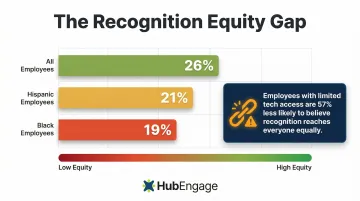
The equity gap is real: only about 26% of employees strongly agree they receive equitable recognition, dropping to 21% for Hispanic employees and 19% for Black employees. Employees with limited tech access are 57% less likely to believe their program reaches everyone equally.
How to Build a Recognition Program: A Step-by-Step Framework
Step 1 — Define Your Objectives
Clarity on goals matters before building anything. Is the goal reducing turnover, improving engagement survey scores, reinforcing specific values, or boosting productivity? The program design follows from the goal.
For example, if turnover reduction is the priority, focus on milestone recognition and tenure awards. If engagement is the goal, emphasize peer-to-peer recognition and gamification to increase participation frequency.
Step 2 — Understand Employee Preferences
Use pulse surveys, focus groups, or informal conversations to understand what types of recognition actually matter to your workforce. A catering company's frontline crew values differently than a tech team—preferences vary by industry, role, and demographic.
HubEngage's Survey/Forms Hub enables HR teams to gather employee feedback through customizable surveys that measure sentiment and preferences, using AI-driven insights to uncover what types of recognition resonate most with the workforce.
Step 3 — Design the Program Structure
Cover the key design decisions:
- Who can give recognition — peers, managers, everyone?
- How often — daily, weekly, milestone-based?
- Through what channels — mobile, email, digital signage, in-person?
- What rewards are available — monetary, non-monetary, experiential?
- Criteria transparency — clear guidelines prevent favoritism and build trust
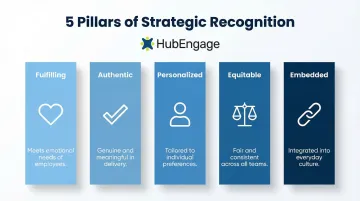
Gallup and Workhuman identify five pillars that separate strategic recognition from ad hoc praise:
- Fulfilling — meaningful to the recipient, not just the giver
- Authentic — specific, timely, and tied to real contributions
- Personalized — delivered in ways that matter to each individual
- Equitable — consistent across roles, teams, and demographics
- Embedded — woven into daily culture, not reserved for annual events
Budget considerations: Workhuman data modeling puts 1% of payroll as the sweet spot for impacting retention, engagement, and performance. O.C. Tanner research points to $250 per employee per year as the threshold where results become measurable.
Step 4 — Choose the Right Technology
For any program to scale and remain consistent, a platform is essential—especially for multi-location or large organizations. HubEngage's recognition module, combined with its multi-channel delivery (mobile app, SMS, digital signage, email), makes it easier for HR teams to run recognition programs that actually reach every employee.
HubEngage's modular architecture lets organizations start with the Recognition Hub and expand from there. Key capabilities include:
- Tango Card integration for e-gift card delivery and flexible reward redemption
- Multi-directional recognition workflows — peer-to-peer, manager-led, and bottom-up
- Gamification features that drive sustained participation across the workforce
Step 5 — Launch, Measure, and Iterate
Track participation rates, recognition frequency, and downstream metrics (engagement scores, turnover) post-launch. Programs need periodic refreshing to avoid recognition fatigue or stagnation.
Key metrics to monitor:
- Percentage of employees giving and receiving recognition monthly
- Average recognition frequency per employee
- Participation rates across employee segments (desk-based vs. frontline)
- Correlation between recognition and engagement survey scores
- Turnover rates for recognized vs. non-recognized employees
Employees are twice as likely to use a recognition platform when they see peers doing the same—which is why visible adoption and leadership modeling matter as much as the program itself.
Conclusion
Done well, employee recognition drives measurable returns on retention, engagement, and culture — not just morale. The ideas and framework above give HR and people leaders a practical starting point, whether you're working with a lean budget or running a global workforce.
Start by auditing your current recognition efforts against three fundamentals:
- Are programs reaching all employee segments, including frontline and deskless workers?
- Is recognition happening consistently, not just during review cycles?
- Are outcomes being tracked so you can prove impact?
From there, HubEngage helps you build, automate, and scale recognition across mobile, web, SMS, and digital signage — so every employee gets seen, regardless of where they work.
Frequently Asked Questions
What is an employee rewards and recognition program?
An employee recognition program is a structured system for acknowledging contributions, unlike informal praise that happens sporadically. It creates consistency and fairness at scale, with direct ties to engagement and retention outcomes.
How do you build an employee rewards and recognition program?
Start by defining clear goals (retention, engagement, culture), then understand employee preferences through surveys or feedback. Design criteria and reward structures, select a delivery platform that reaches all employee types, and measure results over time to refine the program.
What are the types of employee rewards?
Employee rewards fall into four main categories: monetary rewards (bonuses, gift cards), non-monetary perks (extra PTO, flexible scheduling, privileges), experiential rewards (events, learning opportunities, conferences), and social recognition (public praise, digital shoutouts, peer acknowledgment).
What are the most effective employee rewards and recognition methods?
The most effective methods combine timely, specific acknowledgment with a mix of peer-driven and manager-led recognition. Programs that balance intrinsic rewards (purpose, growth, belonging) with extrinsic rewards (monetary, perks) consistently outperform those relying solely on one type.
How do you recognize employee milestones?
Milestone recognition typically covers work anniversaries, promotions, certifications, and personal achievements. Effective milestone recognition includes a public acknowledgment in company channels, a personalized message from leadership, and a meaningful reward scaled to the employee's tenure or contribution level.
What is the best employee recognition platform?
The right platform depends on your workforce size and employee type—desk, frontline, or remote. Prioritize multi-channel access (mobile, web, SMS, digital signage), peer and manager recognition capabilities, rewards integrations, and analytics that track participation. Platforms like HubEngage unify these features in a single solution built for distributed teams.