Yet deploying digital collaboration tools doesn't guarantee results. Success varies dramatically based on tool selection, workforce readiness, and execution strategy. Organizations that simply purchase software without addressing adoption barriers often see minimal engagement and wasted investment. Those that take a strategic approach—auditing gaps, setting clear goals, choosing unified platforms, and driving adoption through training and gamification—transform how their teams work together.
This guide covers exactly what to do, what to prepare, which factors matter most, and what mistakes to avoid when enhancing collaboration with digital workplace solutions.
Key Takeaways
- Digital workplace collaboration uses connected platforms to enable communication, coordination, and shared work across distributed teams
- Success requires clear strategy, workforce-specific channel access, and structured adoption planning—not just tool selection
- Follow five steps: audit gaps, set goals, choose a unified platform, drive adoption through training and gamification, then measure outcomes
- Most rollouts fail due to tool fragmentation, leaving out frontline workers, or skipping change management entirely
- Track engagement metrics, survey response rates, and participation by employee segment to refine your strategy over time
What Is Digital Workplace Collaboration — and Why Does It Break Down?
Digital workplace collaboration is the use of connected platforms—messaging systems, intranets, mobile apps, recognition tools, and shared workspaces—that allow employees to communicate and work together regardless of location or role. These platforms create a unified digital environment where information flows freely, teams coordinate effectively, and employees feel connected to organizational goals.
Collaboration differs from communication. Communication moves information from one person to another. Collaboration requires shared context, aligned goals, and active participation across teams. An email announcing a policy change is communication; a cross-functional team using shared tools to solve a problem together is collaboration.
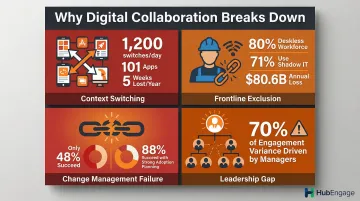
Yet even with the best intentions, digital collaboration breaks down — and it tends to fail in predictable ways:
Employees toggle between applications nearly 1,200 times daily across an average of 101 apps, losing up to five working weeks annually to context-switching and reorientation.
Frontline workers make up 80% of the global workforce, yet most lack access to proper collaboration tools — pushing 71% toward unauthorized shadow IT and costing enterprises $80.6 billion annually in lost productivity.
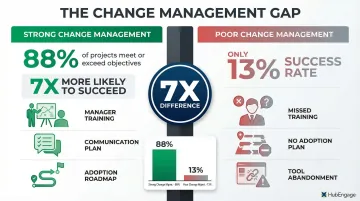
Poor change management sinks most digital initiatives: Gartner finds only 48% succeed, while projects with strong adoption planning are seven times more likely to hit their goals (88% vs. 13%).
When leaders don't visibly use collaboration tools, adoption stalls at every level below them. 70% of team-level engagement variance traces back to the manager alone.
How to Enhance Collaboration With Digital Workplace Solutions
Step 1: Audit Your Current Collaboration Tools and Communication Gaps
Begin by mapping every tool currently used for communication, file sharing, project tracking, and employee engagement. Document where information gets siloed, which employee segments are underserved, and where redundancy or tool overload exists.
What to assess:
- All platforms employees use to communicate, share files, track projects, and engage with company content
- Where information becomes trapped in departmental silos or specific applications
- Which employee groups—particularly frontline, shift, or field workers—lack adequate access
- Redundant tools serving overlapping purposes
Evaluate adoption and usage rates through IT system data or employee surveys. Look for patterns showing where employees disengage or revert to informal channels like personal messaging apps. Research shows employees use approximately 10 different applications daily, switching between them roughly 25 times per day. This fragmentation creates significant productivity drag.
The audit reveals which tools employees actually use versus which ones they abandon — and where communication consistently breaks down. Those gaps define the goals your digital workplace strategy needs to solve for.
Step 2: Define Collaboration Goals Aligned to Your Workforce Structure
Clarify what better collaboration looks like for your specific organization. Vague aspirations like "improve teamwork" don't drive measurable results. Instead, define concrete outcomes tied to business metrics.
Example collaboration goals:
- Reduce decision-making cycle time by 30% through faster information access
- Increase employee engagement scores from 21% to 35% within 12 months
- Achieve 70%+ survey response rates across all employee segments
- Improve cross-department project completion rates by 25%
- Reduce miscommunication-related errors by 40%
Account for workforce segmentation. The collaboration needs of office-based knowledge workers differ significantly from those of deskless frontline employees. A software developer needs project management tools and code repositories; a retail associate needs shift schedules, quick policy access, and peer recognition. Define goals and success metrics separately for each group to ensure your strategy serves everyone.
Step 3: Select a Unified Digital Workplace Platform That Fits Your Workforce
Prioritize platforms that consolidate communications, recognition, engagement, and information access into a single ecosystem rather than adding another point solution. Platform consolidation reduces cognitive load and improves message reach.
The cost case is straightforward: companies spend an average of $40 per user managing multiple fragmented platforms. Unified solutions eliminate that overhead while improving adoption.
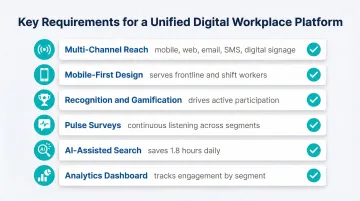
Key platform requirements:
- Reaches every employee via mobile app, web portal, email, SMS, and digital signage — not just desk workers
- Mobile-first design that serves frontline, deskless, and shift workers without desktop access
- Built-in recognition, social feeds, and gamification to drive active participation
- Pulse surveys and feedback forms for continuous listening across all segments
- AI-assisted search so employees stop wasting up to 1.8 hours daily hunting for information
- Analytics dashboards that track engagement, content reach by segment, and participation rates
HubEngage addresses this directly with one-click multi-channel publishing that automatically formats content for each delivery channel. This means a single announcement reaches employees via mobile app, email, SMS, digital signage, and integrated tools like Microsoft Teams or Slack—without manual reformatting for each channel.
Unified platforms deliver proven ROI. Forrester Total Economic Impact studies show returns ranging from 228% to 294% for consolidated employee experience platforms, with payback periods under six months.
Step 4: Drive Adoption Through Training, Gamification, and Inclusive Onboarding
Technology enables collaboration but doesn't create it. Without structured adoption support, even excellent platforms fail. Develop a rollout plan that includes manager-led training, self-service learning resources, and communication campaigns explaining the "why" behind new tools.
Adoption best practices:
- Run pilot programs with representative user groups to build trust and surface issues before full deployment
- Train managers first — manager support drives 2.1 times higher adoption and equips them to support their teams
- Create role-specific training so frontline workers get guidance relevant to their actual workflows
- Lead with employee benefit — explain how the platform makes their work easier, not just what it does for the organization
Apply gamification mechanics to incentivize participation. Point systems, leaderboards, and peer recognition tied to collaboration activities build habits rather than one-time adoption — employees earn points for surveys, social posts, peer recognition, and learning modules.
Research confirms gamification yields positive effects on cognitive, motivational, and behavioral outcomes, with measurable gains in job performance and engagement.
By 2028, 40% of large warehouse operations will have deployed gamification tools to motivate workforces, demonstrating the trend toward engagement-driven adoption strategies.
Step 5: Measure Collaboration Outcomes and Iterate
Define and track collaboration KPIs from launch day. Without measurement, you can't distinguish success from failure or identify improvement opportunities.
Essential collaboration metrics:
- Channel engagement rates — Percentage of employees actively using each communication channel
- Survey response rates — Benchmark: 70% or higher is excellent; census surveys average 72-88% across leading organizations
- Content reach by employee segment — Ensure frontline, remote, and office workers all receive critical information
- Recognition activity — Frequency of peer-to-peer and manager recognition
- Platform participation rates — Active users versus registered users
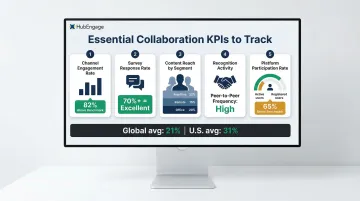
Context matters. Global employee engagement currently sits at just 21%, with 62% not engaged and 17% actively disengaged. In the U.S., engagement averages 31%. Use these benchmarks to set realistic improvement targets.
Schedule regular review cycles—monthly or quarterly—to assess what's working, identify drop-off points, and act on employee feedback. The organizations that see the strongest long-term results treat their digital workplace as a product — one that gets tested, refined, and improved with every review cycle.
What You Need Before Building a Digital Collaboration Strategy
Preparation quality directly determines rollout success. Organizations that jump to tool selection without addressing readiness gaps face low adoption and wasted investment.
Leadership and Stakeholder Alignment
Confirm executive buy-in before launch. Identify cross-functional champions who will co-own the rollout:
- HR — owns culture and adoption messaging
- IT — manages access, integrations, and security
- Internal Communications — drives content and channel strategy
- Operations — ensures frontline and field teams are included
Collaboration initiatives without visible leadership participation rarely sustain momentum. When leaders actively use the same tools — posting updates, recognizing employees publicly, and joining discussions — adoption spreads throughout the organization.
Workforce and Infrastructure Readiness
Assess whether all employee groups have reliable access to devices and connectivity. For frontline or field-based workers, confirm mobile accessibility. Where connectivity is limited, verify that offline-capable or SMS-based features are available in your chosen solution.
The numbers underscore why this matters: only 57% of deskless workers are provided mobile devices by their employers, and 14% report receiving no device at all. Closing these access gaps before launch is non-negotiable for universal participation.
A Baseline for Measurement
Establish pre-launch benchmarks using existing data — employee engagement survey scores, internal email open rates, or Net Promoter Score. Without baseline measurements, you cannot accurately attribute post-launch improvements to your collaboration initiative. Track these numbers by employee segment — corporate, frontline, and remote — so comparisons reflect real differences in reach and engagement across your workforce.
Key Factors That Determine Collaboration Quality in a Digital Workplace
The difference between digital workplaces that transform collaboration and those that simply add noise comes down to four variables. Getting even one wrong limits the others — and most organizations are struggling with more than one.
Channel Accessibility and Mobile-First Design
Frontline, deskless, and shift workers — often the majority in manufacturing, healthcare, hospitality, and retail — have no desktop access. If the platform isn't mobile-first, they're excluded from collaboration entirely. In the U.S., 52% of remote-capable jobs are hybrid and 26% are fully remote, but these figures say nothing about the billions of workers whose roles were never desk-based.
The impact on collaboration quality is direct: teams where all members can participate, regardless of role or location, show stronger headquarters-to-frontline alignment and fewer critical communication gaps. Organizations deploying mobile-first platforms achieve 70%+ active usage rates, with some locations reaching 96% adoption.
Platform Consolidation vs. Tool Fragmentation
Every disconnected tool employees must check — email, Slack, a separate recognition app, a separate intranet — increases cognitive load and reduces the likelihood that critical information is actually seen. The average enterprise now deploys 101 applications, forcing constant context-switching throughout the workday.
The cost adds up fast. Research shows it takes employees 23 minutes on average to resume an interrupted task after switching applications. A unified platform that combines communications, recognition, surveys, and social engagement reduces that friction — and eliminates thousands of those interruptions annually.

Cultural Reinforcement and Leadership Visibility
Technology enables collaboration, but it cannot create it. When leaders visibly use the same tools — sharing updates, recognizing employees publicly, participating in discussions — adoption cascades across the organization. Manager behavior determines 70% of team-level engagement variance, which means leadership participation isn't a nice-to-have.
Collaboration cultures with consistent leadership involvement show stronger psychological safety and higher employee willingness to contribute ideas. The numbers back this up: employees whose managers actively support tool adoption are 2.1 times more likely to use them regularly.
AI-Assisted Information Access and Content Delivery
Employees who can't find information quickly either disengage or escalate to managers for answers that should be self-serve. Knowledge workers spend approximately 30% of their workday searching for information — roughly 2.5 hours daily.
AI-powered search and content tools reduce that friction by surfacing relevant resources and answering policy questions on demand. They also help HR and communications teams create and distribute content faster. The productivity gains are measurable: integrating generative AI into workplace platforms reduces task completion time by 40% and increases output quality by 18%. By 2028, over 20% of workplace apps will use AI-driven personalization to generate adaptive worker experiences.
Common Mistakes to Avoid When Deploying Digital Workplace Solutions
Deploying Multiple Single-Purpose Tools Instead of a Unified Platform
Combining separate apps for messaging, recognition, surveys, and content creates fragmentation that forces employees to context-switch constantly — eroding engagement and building information silos. Employees already toggle between apps 1,200 times daily, losing nearly four hours weekly to reorientation.
Adding more disconnected tools deepens this problem. A unified platform eliminates the switching cost entirely.
Excluding Frontline and Deskless Workers From the Rollout
Collaboration strategies often default to desktop-first designs that leave shift workers, field teams, and manufacturing floor employees without access. This creates a two-tier workforce where office employees have full collaboration capabilities while frontline workers remain disconnected.
The cost is steep: 63% of employees say poor communication contributes to them seeking new jobs. Meanwhile, frontline workers waste 376 hours annually — nearly 10 full workweeks — searching for, waiting on, or redoing tasks due to inaccessible information.
Skipping a Formal Adoption and Change Management Plan
Even the best platform fails without a plan to bring people along. Without manager enablement, training, and a communication campaign explaining the "why," employees default to old habits. Organizations with excellent change management programs see 88% of projects meet or exceed objectives, compared to just 13% for those with poor change management — a sevenfold gap in success rates.
Failing to Close the Feedback Loop
Organizations that collect employee feedback but don't visibly act on results erode trust and participation. Employees who feel unheard disengage from future surveys entirely, making your data less reliable over time.
Break that cycle by following up on every feedback round with three things:
- What you heard — summarize the themes employees raised
- What you're doing — name the specific actions being taken
- What you can't act on — explain why, honestly
That transparency is what turns a survey tool into a genuine collaboration channel.
Frequently Asked Questions
How to improve digital collaboration?
Start with four priorities:
- Consolidate fragmented tools into a single unified platform
- Ensure all workers—including frontline staff—have mobile access
- Drive adoption through structured training and gamification
- Measure engagement regularly and iterate based on participation data
Leadership modeling and a continuous feedback culture keep momentum going.
What are digital collaboration platforms?
Digital collaboration platforms are software ecosystems—ranging from messaging and intranets to recognition, surveys, and project tools—that enable employees to communicate, share information, and work together regardless of location or role. Distributed teams use them to stay aligned, reduce information silos, and coordinate across time zones without depending on in-person meetings.
What are common frameworks or principles for collaboration (like the 5 C's, 7 C's, or 5 P's)?
The 5 C's framework introduced by Tom Peters identifies five characteristics for strong collaboration: effective communication, synchronized coordination, complementarity of skills, mutual trust, and shared commitment. A well-designed digital workplace platform should reflect each of these—enabling clear communication, building transparency, and reinforcing shared goals across every team.
What are the biggest barriers to digital collaboration in the workplace?
Tool fragmentation forcing constant context switching, poor adoption due to inadequate training, exclusion of frontline workers from digital tools, lack of leadership modeling and visible participation, and absence of a feedback and measurement culture that drives continuous improvement.
How do you measure the success of digital collaboration?
Track platform participation rates, survey response rates (70%+ is excellent), content reach by employee segment, and recognition activity frequency. Benchmark against pre-launch baselines and industry averages—global engagement sits at 21%, U.S. at 31%—to gauge real progress.
What features should a digital workplace collaboration platform have?
Essential features include multi-channel delivery (mobile, web, email, SMS, digital signage), AI-assisted search and content creation, recognition and engagement tools, analytics dashboards tracking participation by segment, and the ability to reach deskless or frontline workers. Platforms should consolidate multiple functions rather than adding to tool sprawl.