Introduction
Your sales team is closing deals across three continents. Your manufacturing crew is running night shifts in Ohio while your customer service team logs on from home offices in Texas. Your retail associates are on their feet serving customers while corporate sends another email they'll never see. Everyone's working hard—but are they working together?
Gallup's 2025 research shows that 26% of remote-capable employees now work exclusively remote, with another 52% in hybrid arrangements—meaning nearly 80% of knowledge workers are distributed. Add the 2.7 billion deskless workers who comprise 70-80% of the global workforce, and the scale of the challenge becomes clear: most of today's workforce never shares a physical space.
The problem isn't remote work itself. Most alignment strategies were built for desk workers with laptops and corporate email—leaving frontline employees in manufacturing, healthcare, retail, and hospitality systematically out of the loop.
The 7 strategies below give HR and communications leaders concrete ways to close that gap and keep every employee moving in the same direction.
TLDR
- Communication gaps and unclear ownership are the top alignment killers for distributed teams
- Explicit goals and role definitions stop confusion before it compounds across time zones
- Multi-channel delivery gets messages to frontline workers, not just inbox-checking desk employees
- Async documentation keeps collaboration moving without requiring everyone online at once
- Recognition, feedback loops, and shared rituals hold culture together across distance
What Is a Distributed Team — and Why Is Alignment So Hard?
A distributed team is one where every member works from a different location—often across time zones—with no shared physical office. This differs from remote teams, where employees may occasionally visit a central hub, or hybrid teams, where some employees work on-site regularly. In truly distributed teams, there is no headquarters where "everyone" gathers.
Three core problems make alignment uniquely difficult for distributed teams:
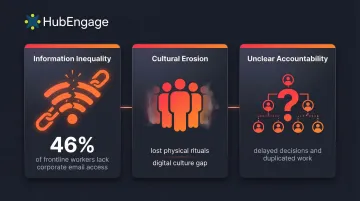
- Information inequality: 46% of frontline workers lack corporate email access, and 62% have no workplace computer. Single-channel organizations systematically exclude deskless employees, creating information haves and have-nots.
- Cultural erosion: Without physical rituals—team lunches, hallway conversations, spontaneous celebrations—culture must be built intentionally through digital touchpoints. Skip that, and distributed employees feel like task executors rather than team members.
- Unclear accountability: Ambiguous ownership lets delays compound. When no one knows who owns a decision and you can't walk over to clarify, projects stall across time zones, handoffs get missed, and work gets duplicated.
Each of these problems carries a real price tag. Companies with highly engaged teams see 23% higher profitability and 18% higher productivity than those in the bottom half. On the other side, employee disengagement costs a median-size S&P 500 company between $228 million and $355 million annually in lost productivity.
7 Ways to Keep Distributed Teams Aligned and Productive
Way 1: Set Clear Goals and Define Roles from Day One
In distributed teams, unclear goals don't just slow things down—they disappear into time zones. A question that takes 30 seconds to resolve in person becomes a day-long email chain when ownership isn't defined.
Use structured goal-setting frameworks: SMART goals (Specific, Measurable, Achievable, Relevant, Time-bound) or OKRs (Objectives and Key Results) make expectations explicit from the start of each project or quarter. Research shows OKRs enhance strategy implementation through facilitated communication, transparency, empowered employees, and cross-functional collaboration.
Define roles explicitly:
- Identify a single decision-maker per workstream
- Document points of contact for each project area
- Make this information visible in a shared digital space—not buried in email threads
- Specify who needs to be consulted versus who simply needs to be informed
This clarity is critical for shift-based or frontline workers who may not attend planning calls. They need written documentation of their role in larger goals, accessible on mobile devices during their shifts.
Way 2: Build a Multi-Channel Communication Strategy
A single communication channel will fail distributed teams. Some employees check email regularly. Others rely on mobile apps. Frontline workers may only see digital signage or receive SMS alerts. Research shows that less than half (46%) of frontline workers said their employers' communications were relevant to their job, and only 40% believed messages were reliable.
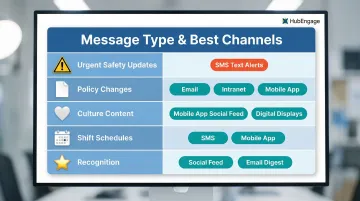
Match channel to message type:
- Urgent safety updates: SMS text alerts
- Policy changes: Email + intranet + mobile app
- Culture content: Mobile app social feed + digital displays
- Shift schedules: SMS + mobile app notifications
- Recognition: Social feed + email digest
Platforms like HubEngage enable one-click multi-channel distribution—auto-formatting content for mobile, web, email, SMS, and digital displays. HR and communications teams can reach their entire distributed workforce without manually reformatting messages for each channel or duplicating effort.
Critical principle: Reach must be measurable. Don't assume employees saw a message. Real-time delivery analytics show who engaged and who didn't, allowing leaders to identify and close communication gaps before they impact operations.
Way 3: Balance Synchronous and Asynchronous Communication
Synchronous communication happens in real-time: live meetings, video calls, instant messaging. Asynchronous doesn't require immediate response: recorded videos, written updates, documented decisions.
The balance between them matters more than most teams realize. Employees are interrupted every two minutes during core work hours—275 times a day. The average knowledge worker also spends 103 hours per year in unnecessary meetings.
Practical framework:
Use synchronous communication for:
- Relationship-building and team connection
- Brainstorming and creative collaboration
- Decisions requiring real-time input from multiple stakeholders
- Conflict resolution or sensitive conversations
Use asynchronous communication for:
- Status updates and progress reports
- Documentation of decisions already made
- Information-sharing that doesn't require immediate response
- Detailed explanations that benefit from written clarity
Establish team norms: Set clear response time expectations for asynchronous channels (for example, reply within 24 hours for non-urgent requests). This prevents employees from feeling perpetually "on call" while ensuring questions get answered.
Way 4: Recognize and Reward Contributions Consistently
Recognition signals what the organization values. When distributed employees see contributions acknowledged regardless of location, it makes clear that output matters more than proximity.
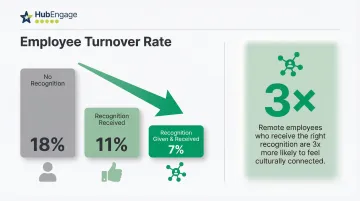
Turnover drops from 18% to 11% when employees receive recognition versus none, and down to 7% for employees both receiving and giving recognition. When remote employees feel they're getting the "right amount" of recognition, they're 3x more likely to feel strongly connected to their organization's culture.
What consistent recognition looks like for distributed teams:
- Peer shout-outs posted to a shared communication feed, visible across the organization
- Manager-led recognition tied to specific achievements, delivered through multiple channels
- Milestone rewards delivered digitally (e-gift cards, points) so remote workers aren't overlooked
- Recognition surfaced in social feeds, mobile notifications, and team dashboards in real time
Emerging approach—gamification: Points, badges, and leaderboards tied to participation in communications, surveys, and learning activities drive engagement with alignment activities themselves. Employees earn recognition not just for performance outcomes but for contributing to team cohesion through communication and collaboration.
Way 5: Create Rituals That Build Team Culture
Culture doesn't form by accident in distributed teams. Without shared physical spaces, culture must be built intentionally through recurring touchpoints.
Teams with a formal hybrid collaboration plan are 66% more likely to be engaged at work and 29% less likely to be burned out. Employees who feel a strong sense of belonging experience a 56% increase in job performance, a 50% reduction in turnover risk, and a 75% decrease in sick days.
Culture-building rituals for distributed teams:
- Monthly or quarterly virtual all-hands where leadership shares updates and celebrates wins
- Team spotlights in newsletters or social feeds highlighting individual contributors or departments
- Short async video updates from leadership—mobile-friendly messages that humanize executives and reinforce values
- A dedicated weekly wins channel where teams share recent accomplishments
For frontline and deskless workforces: Culture content needs to be short, mobile-friendly, and delivered on channels these employees actually use. Don't expect shift workers to log into an intranet from home. Push culture moments to mobile apps, SMS, or digital displays in break rooms.
Create a cadence: Lightweight, high-visibility cultural moments—weekly wins, employee spotlights, milestone celebrations—make distributed employees feel part of a shared story, not just a task list.
Way 6: Invest in Structured Onboarding and Continuous Learning
Onboarding sets the alignment baseline for every new distributed hire. Without it, employees spend their first weeks guessing at expectations instead of contributing to them.
Organizations with structured onboarding see 82% better retention—and avoid the compounding cost of replacing employees who leave before reaching full productivity.
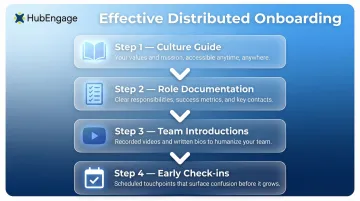
Components of effective distributed onboarding:
- A written culture guide covering values, mission, and behavioral expectations—accessible anytime
- Documented role expectations with clear responsibilities, success metrics, and key contacts
- Introductions to key team members via recorded videos or written bios when live meetings aren't feasible
- Scheduled early check-ins to surface confusion before it compounds
Critical requirement: Onboarding must be self-paced, digitally accessible, and not dependent on a manager being in the same room or time zone.
Connect ongoing learning to alignment: Teams that share a common knowledge base stay aligned on processes and standards over time. 71% of companies say increasing their use of microlearning is important or critical to achieving business goals.
For frontline and deskless teams, mobile-delivered microlearning fits naturally into shift schedules. Short modules accessible on phones let employees train during breaks or between tasks—no desk required.
Way 7: Gather Feedback Regularly and Act on It Visibly
Distributed employees who feel unheard disengage silently. Without structured feedback mechanisms, leaders have no way of knowing which alignment strategies are working and which aren't.
Global employee engagement fell to 21% in 2024, with lost productivity costing the global economy $438 billion. The cost of ignoring employee feedback is measurable and enormous.
Effective distributed feedback cadence:
- Pulse surveys: 2-5 questions sent via mobile or email, deployed monthly or quarterly
- Regular 1:1 check-ins: Between managers and direct reports, scheduled consistently
- Annual engagement survey: Comprehensive assessment with results shared transparently
Critical principle—act visibly: The most damaging outcome of a survey is silence from leadership afterward. 84% of HR leaders rate their organization's use of employee feedback as "effective," while just 43% of employees say they've seen positive change as a result of previous surveys—a 41-point perception gap.
When employees see that their input changed something tangible—a policy, a process, a communication rhythm—they participate more and disengage less. Communicate specifically what you heard and what you're doing about it. That single step closes the gap between leaders who think feedback is working and employees who don't.
How the Right Technology Unifies Distributed Teams
Technology is the connective tissue of distributed teams. The seven strategies above all depend on platforms that work reliably, reach every employee regardless of device or location, and reduce administrative burden on HR and communications teams.
Common pitfall: Using too many disconnected tools creates fragmentation. Employees aren't sure where to find information or which channel is authoritative. The average company now deploys 93 apps, with large companies using an average of 231 apps. 60% of a person's time at work is spent on work about work—toggling between systems, searching for information, and duplicating effort.
What a unified employee experience platform does for distributed teams:
- Consolidates communications, recognition, surveys, learning, and analytics into one system
- Gives employees a single, reliable source for information
- Reduces HR overhead from managing multiple disconnected platforms
HubEngage is built specifically for distributed and frontline workforces. It combines AI-powered content creation, platform-wide gamification, and multi-channel delivery that works whether employees are at a desk, on a manufacturing floor, or in the field.
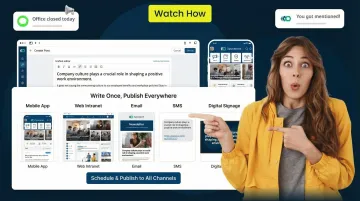
The platform auto-formats content for mobile apps, web intranet, email, SMS, and digital signage—so every employee receives messages through their preferred channel without HR teams duplicating effort.
Evaluate your tech stack against three questions:
- Does it reach every employee on their preferred channel? Frontline workers without access means your distributed team problem remains unsolved.
- Does it show who engaged and who didn't? Delivery confirmation isn't enough—you need visibility into whether employees actually read and responded.
- Does it reduce tool fragmentation rather than add to it? Every new disconnected tool raises the odds that employees miss critical information.
Frequently Asked Questions
What does distributed team mean?
A distributed team is a group where all members work from different locations—often across time zones—with no shared physical office. Unlike hybrid teams (where some employees share a central hub) or remote teams (where employees may occasionally visit headquarters), distributed teams operate entirely without a common workspace.
How to manage a distributed team?
Set clear goals and roles, balance synchronous meetings with async documentation, and build consistent feedback rituals. Making expectations explicit—and ensuring information reaches everyone equally—is what separates high-functioning distributed teams from ones that constantly scramble to stay aligned.
What are three skills distributed teams need?
Three skills matter most:
- Async communication — writing clearly and documenting decisions for people across time zones
- Self-management — meeting deadlines autonomously without in-person oversight
- Digital collaboration — using tools effectively to stay aligned across channels
How to enable cross-team collaboration?
Shared visibility into goals and project status is the foundation—teams can't collaborate on what they can't see. Pair that with clear handoff documentation and defined decision-makers so work doesn't stall at team boundaries.
What is the best way to collaborate on shared tasks?
Use a shared project management system to assign clear ownership and document handoff points. Establish an async communication rhythm so questions get answered without requiring a live meeting, keeping all time zones in the loop.
What is collaborative planning?
Collaborative planning is the process of aligning distributed team members around shared objectives, timelines, and responsibilities through inclusive goal-setting. When done well, every contributor—regardless of location—understands both the plan and their specific role in it, so execution starts without confusion.