Introduction
Frontline workers run the operations that keep businesses alive—yet they're the most underserved employees when it comes to internal communication. Deskless workers comprise 70% to 80% of the global workforce, totaling approximately 2.7 billion people worldwide.
Despite their essential roles in healthcare, manufacturing, retail, and logistics, 60% of deskless workers report being unsatisfied with the technology provided to do their jobs, citing limited access to corporate communication systems like email and intranets.
The core problem is structural: these workers lack reliable access to email, company intranets, or desktop tools, creating information gaps that hurt safety, productivity, morale, and retention. What follows breaks down exactly where communication breaks down, what it costs, and which strategies actually fix it.
TLDR:
- 2.7 billion frontline workers make up 80% of the global workforce but receive minimal tech investment
- 83% lack corporate email; 45% have no intranet access, leaving workers dangerously uninformed
- Poor communication drives $438 billion in annual productivity losses and fuels avoidable turnover
- Mobile-first, multi-channel strategies with two-way feedback close the gap
- Unified platforms cut tool fragmentation while improving communication reach
Who Are Frontline Workers—and Why Is Communicating with Them Different?
Frontline workers are deskless employees physically present in operational environments. Unlike desk-based colleagues, they're mobile, work rotating shifts, and rarely have access to standard corporate communication tools. The category spans a wide range of roles:
- Nurses and healthcare staff
- Warehouse workers and manufacturing line employees
- Retail associates and hotel staff
- Construction crews and field service technicians
Structural Communication Barriers
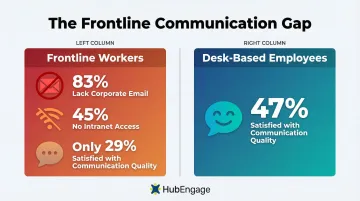
The communication gap isn't just about technology—it's about strategy. 83% of non-desk employees lack a corporate email address, and 45% do not have access to a company intranet. 54% of deskless workers report having limited email access overall. These workers can't stop mid-shift on a factory floor, in a patient ward, or on a retail floor to check email or browse an intranet portal.
Most internal communication strategies are built around desk-based employees and retrofitted for frontline teams, which is why they consistently fall short. The disparity is measurable: only 29% of non-desk employees are satisfied with internal communication quality, compared to 47% of desk-based employees.
Device Realities
While 83% of deskless workers are assigned desktops or laptops, only 57% receive a smartphone or tablet, and 14% get no device at all. To compensate, 46% of employees use their personal phones for work tasks, compared to just 15% who rely on company-issued devices. Any communication strategy that ignores personal mobile devices is already failing more than half the frontline workforce before a single message is sent.
Key Challenges in Frontline Worker Communication
Decentralized and Dispersed Teams
Frontline workers operate across multiple locations, shifts, and time zones, making it difficult for managers and HR teams to ensure everyone receives the same information simultaneously. Information that reaches day-shift employees may never reach night-shift counterparts.
The consequences are measurable. In healthcare alone:
- 67% of communication errors stem from shift handoffs, according to the Joint Commission
- During morning holdovers, on-call trainees omit 40.4% of clinically important issues and fail to document 85.8% of them in medical records
- Transferring to a night schedule carries significantly greater safety risks during the first and second shifts
Connectivity and Device Constraints
Poor or inconsistent internet connectivity—in warehouses, construction sites, hospital wings, or remote facilities—limits access to digital communication tools. Many frontline workers use personal or shared devices rather than company-issued hardware, raising compliance and access concerns.
The result is daily friction: workers miss safety updates, scheduling changes, and operational alerts precisely because the tools to deliver them don't reliably reach the floor.
Over-Reliance on Single Channels (Usually Email)
The core mismatch is clear: 69% of organizations rely primarily on email for internal communications, directly conflicting with the 54% of deskless workers who have limited email access. The result? Critical updates—safety protocols, scheduling changes, policy announcements—go unseen until well after they're relevant.
While average internal email open rates hover around 54.4%, highly segmented and targeted communications can achieve open rates up to 80%. Email has a role, but assuming it will reach frontline workers on its own is where most communication strategies break down.
Information Overload vs. Information Gaps
Frontline workers face a paradox: they're either overwhelmed with a backlog of communications when they do log in, or they simply never receive key updates at all. Neither extreme supports engagement or operational performance.
24% of deskless workers say ineffective communication leaves them feeling disconnected from company culture. This disconnect isn't about preference—it's about access.
Manager Communication Inconsistency
For many frontline workers, the direct supervisor is the primary—and sometimes only—conduit for company information. When managers are poor communicators, untrained in delivering updates consistently, or simply too stretched, entire teams operate in the dark.
The impact is measurable: managers account for 70% of the variance in team employee engagement. That gap has a direct cost: 42% of voluntary turnover is preventable, yet 45% of employees who quit say no manager ever discussed their job satisfaction or future in the three months before they left.
The Real Cost of Poor Frontline Communication
Productivity Impact
When workers don't have the information they need—updated safety protocols, shift changes, product updates—they slow down, make mistakes, or defer decisions. All of this reduces operational efficiency.
The macro impact is significant. Research consistently points to the same conclusion:
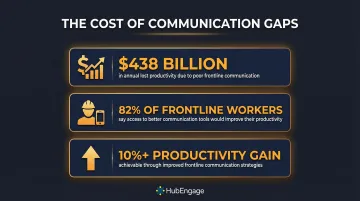
- Low employee engagement drives $438 billion in annual lost productivity globally
- 82% of frontline workers say better technology and communication tools would improve their productivity
- Nearly half of organizations say productivity would increase by at least 10% if communication processes were improved
Retention Cost
Frontline industries already face above-average turnover. Workers who feel disconnected, uninformed, or disrespected by their organization's communication practices are more likely to leave.
63% of employees considering leaving their jobs cite poor internal communication as a contributing factor. The churn is real: 41% of frontline workers changed jobs in the past 12 months.
Industry-specific data reveals the severity:
| Industry | Total Separations Rate (Jan 2026) |
|---|---|
| Total Private (Average) | 3.5% |
| Leisure and Hospitality | 6.0% |
| Retail Trade | 3.7% |
| Manufacturing | 2.3% |
In Leisure and Hospitality—where communication gaps are most acute—turnover runs nearly double the national average. That gap closes when workers feel informed and included.
Safety and Compliance Risks
Retention isn't the only cost. When critical safety information fails to reach workers, the consequences show up in injury reports and incident logs.
Joint Commission 2024 data identifies communication failures as a leading contributor to severe sentinel events, including wrong surgeries (127 events) and patient falls (776 events). A NIOSH FACE report on a manufacturing fatality cited the lack of written procedures and limited training/communication as key contributing factors.
Structured communication protocols make a measurable difference. Implementing the I-PASS handoff bundle reduced the overall medical-error rate by 23% and preventable adverse events by 30%—evidence that the right communication systems directly protect workers and patients alike.
Proven Strategies to Improve Frontline Worker Communication
Adopt a Mobile-First Communication Approach
Frontline workers are almost always on their phones rather than at a desk. Communication strategies must be designed around the mobile experience first—platforms and formats that load quickly, display cleanly on small screens, and don't require desktop access.
The data supports this approach: 91% of U.S. adults own a smartphone, and 98% own a cellphone of some kind. More importantly, 84% of frontline employees explicitly want to access training and company communications on their personal devices.
Platforms like HubEngage are designed mobile-first specifically for frontline, remote, and hybrid teams, enabling workers to receive updates, recognize peers, complete surveys, and access resources directly from their phones.
Use Multi-Channel Delivery to Ensure Reach
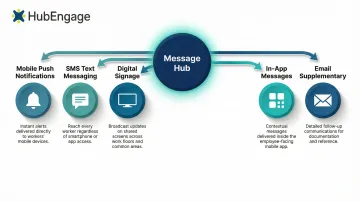
A single-channel strategy will always leave gaps for frontline teams. Effective communication reaches workers through a combination of channels:
- Mobile push notifications
- SMS text messaging
- Digital signage on the shop floor or break room screen
- Brief in-app messages
- Email (as a supplementary channel)
This ensures that no matter where or when a worker is on shift, important information reaches them. HubEngage's multi-channel approach consolidates all these channels into one platform, allowing organizations to distribute messages across mobile apps, web, email, SMS, and digital signage with a single click.
Personalize and Segment Messages by Role, Location, and Shift
Sending the same generic company-wide message to everyone is noise for frontline workers, who need information relevant to their specific role or location. Tailoring messages to shift workers versus full-time staff, or warehouse team versus store team, improves read rates and demonstrates that the organization sees them as individuals.
Segmentation delivers measurable results. Research indicates that highly targeted communications can achieve open rates up to 80%, compared to a 54.4% average for generic broadcasts — a gap that compounds over time as disengaged workers tune out unfocused messaging.
Build Two-Way Feedback Channels
Frontline workers are often the first to spot operational problems, safety hazards, and customer friction points — yet that insight rarely reaches leadership.
39% of frontline workers do not feel heard by their organization, despite 68% stating they have opinions on how to make the organization better or more profitable. Organizations that create easy, mobile-accessible channels for feedback—surveys, quick polls, anonymous comment tools—gain valuable ground-level intelligence while making workers feel heard.
Following up visibly on feedback is what builds sustained trust. HubEngage offers pulse surveys and feedback tools accessible via mobile, enabling frontline workers to share input anytime, anywhere.
Use Visual and Short-Form Content
Frontline workers rarely have time to read long-form updates. Organizations should default to:
- Short video clips
- Infographics
- Visual checklists
- Audio updates that can be consumed quickly during breaks or before a shift begins
These formats respect the time constraints frontline workers face and increase the likelihood that workers absorb and retain critical information.
Recognize and Celebrate Frontline Contributions
Public acknowledgment does more than boost morale — it reinforces culture through the same channels used for operational communication. When workers receive shoutouts, milestone celebrations, or peer-to-peer recognition, they feel connected to the organization's mission rather than just its directives.
HubEngage's Recognition Hub enables peer-to-peer recognition and milestone celebrations accessible via mobile, ensuring frontline workers can both give and receive recognition regardless of their location. Recognition embedded within communication platforms reinforces culture continuously rather than waiting for annual reviews.
Train Managers to Be Consistent Communication Champions
Technology amplifies good communication, but it can't replace a manager who practices it. Organizations should invest in training frontline managers in:
- Active listening
- Delivering consistent briefings
- Cascading information accurately
Brief daily huddles, structured handoff notes, and regular one-on-one check-ins create rhythms of connection that build trust over time.
How the Right Technology Enables Frontline Communication at Scale
Unified, Multi-Channel Platforms
Frontline communication breaks down when workers receive different information through different systems. HR teams end up managing separate tools for each channel, and the result is inconsistency at every level.
A unified, mobile-first platform solves this by consolidating all channels into one place:
- Mobile app and push notifications for real-time updates
- SMS for workers without smartphones or app access
- Digital signage for shared workspaces and break rooms
- Email for formal communications and documentation
Companies currently spend an average of $40 per user managing fragmented platforms. Consolidating into a single platform like HubEngage cuts that cost while improving message reach and consistency across every channel.
AI-Powered Communication Tools
AI-powered platforms can help communications teams auto-format content for different channels, surface relevant information to workers based on their role or location, and enable employees to ask questions and get instant answers without waiting for a manager or HR response.
The impact is measurable. 38% of frontline workers now use AI, and those who do experience a 13-percentage-point reduction in burnout (41% burnout rate for AI users versus 54% for non-users). However, 37% of employees do not use AI because their coworkers are not using it, highlighting the importance of organization-wide adoption strategies.
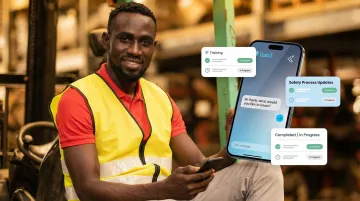
HubEngage's AI Assistant helps employees find information, access company resources, and answer questions instantly, removing daily friction for deskless workers.
Gamification Drives Adoption
Most platforms bolt gamification onto a single feature. HubEngage builds it across the entire employee experience—communications, recognition, training, and surveys—so engagement opportunities don't disappear after onboarding.
Points for reading updates, completing training modules, or responding to surveys give frontline workers a reason to open the platform regularly. That consistent habit is what turns a communication tool into an embedded part of the workday.
Analytics and Measurement
Without data, communication teams are guessing. 19% of communicators do not measure internal communications at all, and 70% report that leadership does not ask for these metrics. That measurement gap makes it impossible to know which worker segments are being left out of the information flow.
Platforms that provide read-rate tracking, engagement data by location or shift, and survey response rates allow teams to spot gaps and correct course before they become retention problems.
HubEngage's analytics dashboards track communication effectiveness across every delivery channel, so teams can make informed decisions about which channels work best for each employee segment—rather than defaulting to what's always been done.
Frequently Asked Questions
What is frontline communication?
Frontline communication refers to the systems and strategies organizations use to exchange information with employees outside a traditional office—retail associates, healthcare workers, factory staff, and field service workers. The goal is reaching them in real time through channels suited to their mobile, on-the-move work style.
What is a frontline workforce?
A frontline workforce consists of deskless employees who deliver direct services, operate physical environments, or interact with customers across industries like healthcare, manufacturing, hospitality, and retail. They typically make up the majority of an organization's headcount yet are the least served by standard internal communication tools.
How to communicate with frontline workers?
Use mobile-first, multi-channel communication that reaches workers where they are; keep messages brief, role-specific, and actionable; create two-way channels for feedback; and ensure consistent delivery through both technology and trained managers.
What is the recommended approach to communicating change initiatives to frontline workers?
Change communications for frontline teams should be delivered early and in simple, jargon-free language through mobile or visual channels. Managers should be briefed first so they can answer questions, and feedback loops should be opened immediately so workers can voice concerns before changes take effect.
What are effective communication strategies for frontline teams?
- Mobile-first delivery across apps, SMS, and digital signage
- Multi-channel reach so no worker is left out
- Role-based personalization to keep messages relevant
- Two-way feedback mechanisms for open dialogue
- Manager-led briefings reinforced by consistent digital updates
What are the key benefits of effective frontline communication?
- Higher productivity and faster change adoption
- Reduced turnover and stronger organizational culture
- Better safety compliance across distributed teams
- Improved customer experience driven by informed workers
- Increased engagement and day-to-day morale