Introduction
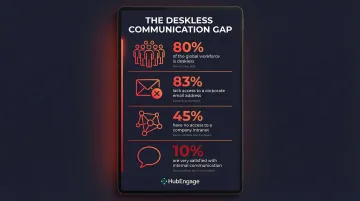
Approximately 80% of the global workforce—roughly 2.7 billion workers—is considered "deskless," spanning industries like healthcare, manufacturing, retail, logistics, and hospitality. These employees are often the face of companies, serving customers, running operations, and driving output. Yet they remain the least reached by internal communications.
The gap is hard to ignore: 83% of frontline workers lack a corporate email address, and 45% have no access to company intranets. Meanwhile, 69% of organizations still rely primarily on email for internal updates.
The result? Only 10% of non-desk employees are very satisfied with workplace communication, with 40% rating it as "fair" or "poor."
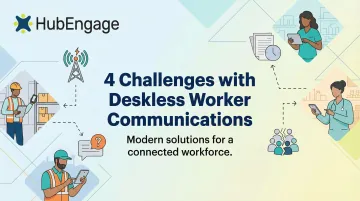
This post covers four challenges that keep deskless workers disconnected — and what leaders can do about each:
- No consistent channel to reach workers without email or intranet access
- Messages that get lost, delayed, or filtered out before reaching the floor
- No reliable way for workers to respond, ask questions, or flag issues
- Lack of visibility into whether communications are actually landing
TLDR
- Deskless workers represent 80% of the global workforce but are systematically excluded from email and intranet systems
- Four core challenges: no reliable channel, manager-as-middleman dependency, no two-way feedback, and cultural disconnection
- These challenges create a cycle of disengagement, higher turnover, and reduced productivity
- Mobile-first, multi-channel strategies are the foundation for closing the communication gap with frontline teams
- Tools built for frontline teams consistently outperform desk-worker platforms retrofitted for field use
Challenge #1: No Reliable Channel to Reach Deskless Workers
Most corporate communication infrastructure—email systems, intranets, team chat tools—was built for desk-based employees. The mismatch is severe: 69% of organizations rely primarily on email, yet more than half of deskless workers have limited email access.
What This Looks Like in Practice
- Warehouse workers with no company device or computer access during shifts
- Nurses moving between wards with no time to check a portal
- Retail associates without desktop access on the sales floor
- Field service technicians working at customer sites without intranet connectivity
The channel simply doesn't exist for them.
Why "Just Use Personal Phones" Fails
Organizations often suggest employees use personal devices for work communications, but this creates serious problems:
- Employees may opt out of using personal devices for work-related purposes
- Privacy concerns arise when company communications mix with personal data
- Message reach becomes inconsistent and unverifiable
- No audit trail exists to confirm critical information was received
The Downstream Effect
When critical updates—safety protocols, policy changes, shift adjustments—don't reliably reach workers, serious consequences follow:
- Poor communication contributed to 24% of patient safety incidents in healthcare settings
- In manufacturing, 70-90% of accidents arise from human errors heavily influenced by communication failures
The perception gap reinforces this: 32% of deskless workers say their organization is less effective at communicating with them compared to office-based employees. The problem is structural, not a lack of effort from communicators.
Challenge #2: Over-Reliance on Managers as Communication Middlemen
Challenge #2: Over-Reliance on Managers as Communication Middlemen
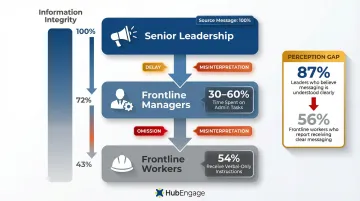
When formal channels don't exist, organizations default to a cascade model: senior leaders tell managers, managers tell their teams. This is inherently fragile. Each handoff introduces risk of delay, misinterpretation, or omission.
The Information Degradation Problem
In a simulated clinical study of sequential handoffs, information retention declined by an average of 4 points (out of 50) per handoff. In frontline operations, 54% of task assignments happen verbally with no verification, no audit trail, and no visibility into whether instructions reached the floor.
The perception gap is significant: 87% of managers say they communicate updates effectively, but only 56% of frontline workers agree. That 31-point disconnect is where strategy becomes inconsistency on the floor.
The Burden on Frontline Managers
Frontline managers are already overwhelmed:
- Administrative work and meetings consume 30–60% of their time, leaving little capacity for meaningful team communication
- Verbal-only task assignments account for 54% of instructions, with no confirmation that the message was received or understood
- Message translation errors compound at each layer of the cascade, so by the time direction reaches frontline workers, key details are often missing or altered