Introduction
Manufacturing floors aren't built for email chains and intranet portals. Workers move constantly between stations, shifts rotate around the clock, and the majority of your team will never sit at a desk or log into a corporate email account. This structural reality creates a communication problem that goes far beyond inconvenience—it directly threatens safety, productivity, and retention.
When safety updates miss the night shift or equipment changes never reach the next team, it shows up in your KPIs:
- Unplanned downtime costs at least 50% more today than in 2019
- 58% of employees considering leaving cite poor internal communication as a deciding factor
This article covers the barriers unique to manufacturing environments, the multi-channel strategies that actually reach frontline workers, and practical ways to measure whether your communication is working.
Key Takeaways
- Email and intranet tools fail because most manufacturing workers lack desk access and company email accounts
- Effective communication requires multiple channels: mobile apps, SMS, digital signage, and face-to-face supervisor touchpoints
- Communication failures during safety updates and shift handovers carry the highest risk of real operational harm
- Two-way feedback loops build trust and catch operational problems before they escalate
Why Communication Breaks Down in Manufacturing
Approximately 80% of the global workforce is considered "deskless", and manufacturing represents one of the largest concentrations of these workers. In the U.S. alone, over 6.2 million production workers operate machinery, assemble products, and maintain equipment—rarely sitting at a computer or checking corporate email. Traditional communication tools weren't designed for this reality, and the disconnect creates dangerous gaps.
Shift-Based and Multi-Location Complexity
When your operation runs 24/7 across multiple shifts and facilities, consistent messaging becomes exponentially harder. A safety briefing delivered at a 7 a.m. supervisor meeting may never reach the team that clocks in at 3 p.m.—or the night crew that starts at 11 p.m. This isn't just an inconvenience; it's a structural vulnerability.
The consequences can be catastrophic. The 2014 DuPont La Porte chemical release that killed four workers was directly exacerbated by reliance on verbal-only communication between shifts regarding equipment troubleshooting. When critical operational information lives only in one person's memory—or gets lost in shift handover chaos—workers pay the price.
Language and Literacy Barriers
Manufacturing workforces are linguistically diverse. The data makes the scale clear:
- Foreign-born workers make up 19.2% of durable goods manufacturing and 22.3% of nondurable goods manufacturing
- 22.3% of the U.S. population speaks a language other than English at home
- 8.6% speak English less than "very well"
English-only written communications exclude a significant share of your workforce. That's why safety signage standards like ANSI Z535.3-2022 mandate pictograms and visual symbols—word-only signs simply don't reach everyone.
The Cost of Communication Gaps
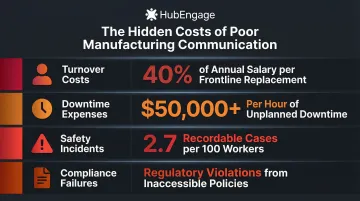
Poor communication carries a hard operational price tag. Communication breakdowns contribute to 48% of workplace incidents, and the financial impact extends across every manufacturing KPI:
- Turnover costs: Replacing frontline workers costs approximately 40% of their salary
- Downtime expenses: Unplanned downtime can cost manufacturers $50,000 or more per hour depending on the operation
- Safety incidents: Manufacturing recorded 2.7 total recordable cases per 100 full-time workers in 2024
- Compliance failures: When workers can't access or understand policies, regulatory violations follow
Strategies That Actually Work for Manufacturing Employees
A deliberate communication strategy accounts for how your workers actually spend their days — not just what tools are available. Effective approaches factor in physical environment, job roles, shift patterns, language diversity, and technology comfort levels.
Prioritize Mobile-First, App-Based Communication
A mobile employee app is the most reliable way to reach workers who are constantly moving. Unlike email, which requires a company account and desktop access, mobile apps deliver alerts, shift updates, and policy changes directly to personal devices at any point in the workday.
Two requirements make or break frontline app adoption:
- No company email required to register — many manufacturing workers have never had a corporate email address
- Multilingual interface support — critical for diverse workforces where language barriers block adoption
HubEngage's mobile app is purpose-built for frontline workers, covering both requirements out of the box.
Deploy Digital Signage for In-the-Moment Messaging
Strategically placed screens in break rooms, near entry/exit points, and along production lines deliver timely information to workers who can't check their phones on the floor. Digital signage works passively—it doesn't require workers to take any action, making it ideal for:
- Safety reminders and countdown timers
- Production targets and real-time dashboards
- Shift schedules and last-minute changes
- Recognition shoutouts that build culture
The advantage: zero employee action required, maximum exposure during natural breaks and transitions.
Use SMS and Push Notifications for Urgent, Time-Sensitive Alerts
For critical communications—shift changes, emergency safety alerts, equipment shutdowns—SMS and push notifications offer the highest reach. SMS achieves a 98% open rate with 90% of messages read within 3 minutes, compared to email's 21-36% open rate.
SMS doesn't require app adoption, making it your emergency broadcast channel. Push notifications through mobile apps provide similar urgency with richer content options. Use both for situations where every second counts.
Structure Communication Around Shift Transitions
Build formal communication touchpoints into shift handovers:
- Supervisor-led huddles at shift start covering what changed in the previous 8 hours
- Digital handoff logs (via mobile app or tablet) documenting equipment status, production issues, and safety concerns
- Automated push summaries delivered to incoming workers 30 minutes before clock-in
This ensures continuity and reduces errors caused by information gaps between teams.
Deliver Safety-Critical Communications with Redundancy
Any update affecting worker safety should be delivered through at least two channels. Multi-channel systems achieve 98% message delivery compared to 76% for single-channel approaches.
Example redundancy strategy:
- Digital signage displays safety alert in break room
- Push notification sent to all affected workers' mobile devices
- Supervisor receives talking points to address in next team huddle
- Follow-up SMS confirmation for acknowledgment
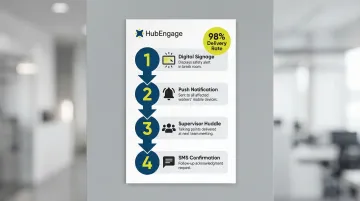
This ensures every worker is reached and creates an audit trail for regulatory compliance.
Best Communication Channels and Tools for Manufacturing Workers
Not every message belongs on every channel. The right tool depends on urgency, audience, and content type. Here's how each channel serves different needs.
Mobile Employee Apps
Mobile apps should be your primary communication hub for frontline workers. Look for these capabilities:
- No-email login: Workers register with phone number or employee ID
- Multilingual support: Interface and content available in workers' preferred languages
- Push notifications: Real-time alerts for urgent updates
- Document access: SOPs, training materials, and policies available on-demand
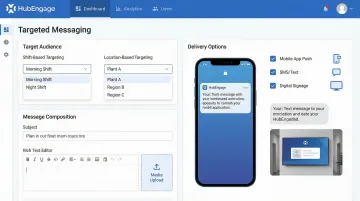
- Targeting by team, shift, or location: Ensure relevant messages reach the right people
HubEngage's platform enables one-click reach across mobile, SMS, and digital displays from a single system. HR and operations teams can send targeted messages to specific shifts or locations without managing separate platforms.
Digital Signage
High-traffic screens deliver passive information consumption. Ideal content includes:
- Safety countdowns ("47 days without incident")
- Production dashboards showing real-time metrics
- Recognition shoutouts celebrating worker achievements
- Compliance reminders and policy updates
- Shift schedules and facility announcements
The key advantage: requires zero employee action while maintaining constant visibility.
SMS and Email
SMS: Reserve for urgent, time-sensitive communications requiring near-instant reach. Use for shift changes, emergency alerts, facility closures, or critical safety updates.
Email: Best for longer-form content like policy updates, newsletters, and detailed announcements—primarily targeting supervisors, managers, and office-based staff who have email access. Most production workers won't see email, so never rely on it as your only channel.
Supervisor-Led Communication Channels
In manufacturing, direct supervisors are the most trusted communication channel for frontline workers. Equip them with tools to be reliable relays:
- Pre-written message templates for consistency
- Mobile broadcasting capability to reach their teams instantly
- Standardized talking points for shift huddles
- Training on how to deliver safety-critical information
Supervisors who receive structured support consistently deliver messages more accurately—and workers respond better when information comes from someone they know.
Intranet and Knowledge Bases
A centralized knowledge hub provides on-demand access to SOPs, training materials, compliance documents, and company policies. For manufacturing, this must be mobile-accessible and searchable—not just a desktop portal.
HubEngage's intranet includes AI-assisted search so workers can type a plain-language question and get the right document immediately—no menu navigation required. That matters on a production floor where time spent searching is time away from the line.
Turning Communication into a Two-Way Conversation
One-way broadcasting—even through the right channels—isn't enough. Manufacturing workers who feel unheard disengage and leave. Two-way communication builds trust and surfaces operational problems before they escalate.
Pulse Surveys and Shift-Level Feedback
Deploy short, mobile-friendly pulse surveys targeted by shift or team to collect real-time sentiment and operational feedback. Key principles:
- Run weekly or bi-weekly check-ins rather than annual surveys — deskless workers need a faster feedback rhythm
- Limit surveys to 3-5 questions, built for 60-second mobile completion
- Act visibly on results and communicate exactly what changed in response
Response rates tend to rise sharply once workers see the loop actually close — not just a survey disappearing into a inbox.
Recognition and Peer-to-Peer Communication
Enable workers to recognize each other's contributions through peer shoutouts, milestone alerts, and gamified recognition on your company app. This creates a culture of appreciation and increases platform adoption.
The data is compelling: employees receiving high-quality recognition are 45% less likely to have turned over after two years. Yet only 11% of manufacturing employees report their organization has a system to recognize personal events or accomplishments—a massive missed opportunity.
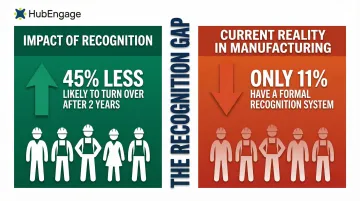
Bridging that gap doesn't require a separate program. Platforms like HubEngage embed peer recognition directly into daily workflows through points, badges, and leaderboards — so appreciation happens in the flow of work, not as a standalone HR initiative.
Measuring What Matters: Communication Effectiveness in Manufacturing
Communication strategy must be tied to measurable outcomes—not just delivery metrics. In manufacturing, the right KPIs connect communication to operational performance.
Key Metrics to Track
Channel Performance:
- Message open rates and read rates by channel (mobile app, SMS, email, digital signage)
- Survey response rates by shift and location
- App adoption rates by team or facility
- Time-to-acknowledgment for safety-critical communications
Operational Impact:
- Safety incident frequency before and after communication improvements
- Unplanned downtime correlation with communication gaps
- Shift handover error rates
- Employee turnover rates by team and facility
Establish a baseline before rolling out new tools so improvement is measurable and attributable.
Using Analytics to Continuously Improve
Communication platforms with built-in analytics—such as HubEngage's real-time dashboards—allow HR and operations leaders to see which channels perform best, which workforce segments remain disengaged, and where to adjust messaging frequency or format.
The goal isn't to report on the last cycle. It's to improve the next one. Use that data to adjust your approach each cycle. Two common signals worth acting on:
- Shift engagement gaps: Night shift workers consistently showing lower engagement points to different channel needs or timing adjustments
- Channel performance gaps: Safety messages via SMS reaching 95% acknowledgment versus 40% for email-only tells you exactly where future protocols should land
Frequently Asked Questions
How to communicate with manufacturing employees?
Use a multi-channel approach combining mobile apps, digital signage, SMS, and supervisor-led touchpoints to reach workers across shifts and locations without requiring desk or email access. Prioritize mobile-first tools and ensure critical messages use redundant delivery across channels for maximum reach.
What is the best software for internal communications in manufacturing?
The best software delivers mobile, SMS, digital signage, and email from a single platform with role- and shift-based targeting built in. Prioritize no-email login, multilingual support, and real-time analytics so you can reach every worker and measure results.
Why is it important to communicate with staff?
In manufacturing, effective communication directly reduces safety incidents, minimizes unplanned downtime, lowers turnover, and strengthens team alignment. Communication gaps in high-stakes environments affect both production output and worker safety, making it an operational priority as much as an HR concern.
What communication channels work best for deskless manufacturing workers?
Mobile apps with no-email login, SMS push notifications, and digital signage are the most effective channels for deskless workers. Pair these with supervisor-led communication at shift transitions to maximize both reach and comprehension.
How can manufacturers improve safety communication with frontline employees?
Deliver critical safety alerts through at least two channels simultaneously, such as push notification plus digital signage. Place visual reminders in high-risk areas and make all communications available in workers' preferred languages to eliminate comprehension barriers.
How do you measure the effectiveness of employee communication in manufacturing?
Track message read rates by channel, app engagement by shift and team, survey response rates, and whether improvements correlate with fewer safety incidents or less unplanned downtime. Establish baseline metrics before implementing new tools to measure true impact.