Research shows that employees are 3x more credible than CEOs when representing an organization, and content shared by employees generates 800% more engagement than identical posts from official brand accounts. Yet most organizations approach employee advocacy backward—launching social sharing campaigns before building the internal culture and communication infrastructure that makes authentic advocacy possible.
This article walks HR and internal communications leaders through a step-by-step strategy for building genuine employee advocacy from the inside out, covering what's needed, how to structure it, and what most programs get wrong.
Key Takeaways
- Employee advocacy is earned through culture, trust, and internal communication—not manufactured through a campaign
- Multi-channel internal comms infrastructure must come before any advocacy program
- Programs need defined goals, identified advocates, and recognition systems to sustain participation
- The most common failure is skipping culture and communication audits and jumping straight to external sharing tactics
- Measurement should track sentiment and engagement quality, not just share counts
What Is Employee Advocacy and Why Does Internal Comms Drive It?
Employee advocacy is the practice of employees authentically representing and promoting their organization's values, culture, and brand—both internally and externally. It's different from forced marketing campaigns or scripted social sharing programs.
True advocacy happens when employees voluntarily share positive experiences, recommend their employer to job seekers, and speak credibly about the organization's mission. Audiences detect manufactured advocacy immediately. When employees share content to hit a quota, the inauthenticity damages both internal trust and external credibility.
The Trust Inversion
The business case for employee advocacy rests on a fundamental shift in institutional trust. Candidates now trust a company's employees 3x more than the employer to provide reliable information about working conditions. Similarly, 83% of global consumers trust recommendations from friends and family over corporate advertising.
That gap has a direct payoff: posts shared by employees generate 800% more engagement than the same content shared by official brand accounts. The multiplier only works, though, when the advocacy is genuine—which brings the focus back to what's happening inside the organization.
Internal Communication as the Foundation
Advocacy is the external manifestation of internal engagement, and engagement relies heavily on communication quality. The data makes the connection hard to ignore:
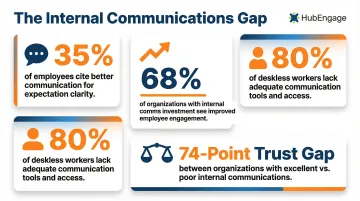
- 35% of employees cite better communication as the primary way organizations can help them understand expectations at work
- 68% of organizations that invest in internal comms report improved engagement and retention
- 80% of deskless workers say they don't receive adequate communication from their employers
- 63% report that messages from leadership simply don't reach them
The Institute of Internal Communication puts a precise number on the consequence: a 74-point trust gap between employees who rate their internal communications as excellent and those who don't. Fix the internal communication problem first—external advocacy follows from there.
How to Build Employee Advocacy Through Your Internal Communications Strategy
Building employee advocacy through internal comms is a sequential process. Skipping early foundational steps leads to programs that generate surface-level participation but no genuine advocacy.
Step 1: Audit Your Culture and Communication Gaps
Before launching any advocacy program, leaders must honestly assess whether the internal conditions for advocacy exist. Do employees feel informed, respected, and proud of their work? Without this foundation, advocacy efforts will feel forced and fail to resonate.
What a Culture and Communication Audit Involves:
- Pulse surveys that measure employee sentiment, satisfaction, and connection to organizational purpose
- Anonymous feedback channels where employees can voice concerns without fear of retaliation
- Communication channel audits assessing whether messages reach frontline and deskless workers, not just desk-based employees
- Engagement data review analyzing participation rates, recognition patterns, and communication effectiveness
The audit reveals whether your organization is ready for an advocacy program or needs to address foundational cultural problems first. Only 1% of company communicators reach frontline workers effectively — these gaps are far more common than most leaders realize.
Framework for Conducting the Audit:
Ragan Consulting Group provides a five-step audit checklist:
- Make the business case — Demonstrate how communication is crucial for retention and recruiting
- Conduct a survey — Ask questions that yield quantitative data to argue for change
- Build focus groups — Create and conduct data-gathering sessions
- Do leadership surveys — Gauge how leaders' views on communication differ from employees
- Conduct content and channel analysis — Determine what needs an overhaul and what to stop doing
Run this audit before investing in any advocacy infrastructure. Skipping it is the single most common reason programs fail within the first year.
Step 2: Define What Advocacy Looks Like for Your Organization
Advocacy looks different depending on organizational context. For some companies it means employees sharing content on LinkedIn; for others it means referrals, peer storytelling, or internal culture evangelism. Leaders must define scope and goals before building the program.
Setting Specific, Measurable Advocacy Goals:
Rather than tracking vanity metrics like post counts, align advocacy goals to business objectives:
- Employer brand: Strong employer brands produce 50% lower cost-per-hire and 2.5x more applicants per job post
- Talent acquisition: A 1-star Glassdoor rating increase reduces the likelihood employees look elsewhere by 6%
- Customer trust: Employee voices build credibility with B2B buyers and consumers who tune out corporate marketing
The Power of Employee Referrals:
When setting advocacy goals, prioritize high-converting outcomes over volume metrics:
| Metric | Employee Referrals | Traditional Job Boards | Business Impact |
|---|---|---|---|
| Application-to-Hire Conversion | 28.2% | 2-5% | Massive reduction in screening time |
| Time-to-Hire | 10 Days Faster | Baseline | Almost 50% faster hiring in healthcare |
| Cost Savings | $1,634 saved per hire | Baseline | Replacing one RN travel staff via referral saves $157,000/year |
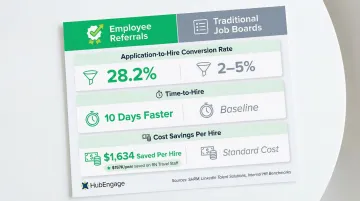
Source: The State of Employee Referral Programs in 2026
The referral data alone makes a compelling case for advocacy — but only if your program is built around outcomes, not activity.
Step 3: Build a Multi-Channel Internal Communication Infrastructure
Advocacy can only happen when employees are consistently informed and connected. This requires a centralized communication system that reaches all employees—including frontline, deskless, and distributed teams who are often missed by email-only strategies.
The Deskless Worker Challenge:
Approximately 80% of the global workforce consists of non-desk or frontline workers. Traditional desk-centric channels fail this demographic. Currently, 55% of frontline workers have had to adapt to digital tools with no formal training or practice.
Industry-Specific Communication Gaps:
| Industry | Primary Communication Gap | Business Consequence |
|---|---|---|
| Healthcare | Delayed care/response and failure to recognize changes in patient condition | 60% of treatment delays result in patient death |
| Manufacturing | Reliance on bulletin boards and word of mouth | Creates safety risks and disconnected employees |
| Retail | Fragmented tools for accessing benefits plans | Contributes to 60% front-line turnover |
Source: Joint Commission, Speakap, SHRM Labs
What Effective Infrastructure Looks Like:
Reaching every employee requires a platform that delivers across mobile apps, web, email, SMS, and digital displays from a single system — without requiring employees to toggle between tools. HubEngage is built specifically for this, with mobile-first delivery designed for manufacturing, healthcare, retail, and hospitality environments.
Key infrastructure components:
- Multi-channel delivery across mobile, web, email, SMS, and digital signage — so channel preference never becomes a barrier
- Consistent messaging cadence that builds trust through predictable, regular communication
- Accessible knowledge bases employees can search quickly, without filing a ticket or asking a manager
- Human leadership communications that feel direct and personal, not polished and distant
- Two-way dialogue channels including commenting, feedback tools, and open conversation threads
Research shows that 91% of HR leaders say SMS increases frontline employee response rates, while only 36% are satisfied with mobile apps as a communication channel. Infrastructure must match the operational realities of your workforce — not the defaults built for desk-based employees.
Step 4: Identify and Activate Internal Advocates
The best advocates are rarely the most senior people in the room. They're the connectors — employees who are already vocal in positive ways, respected by peers, and willing to share their experience without being asked.
How to Identify Natural Advocates:
- Look for employees already active on social media about their work
- Identify storytellers who genuinely love what they do and show it
- Find culture carriers who live organizational values without being prompted
- Recognize the employees peers naturally turn to for advice
Gartner advises using direct employee involvement sparingly to avoid burnout, engaging them directly only for major strategic shifts. Rather than mandatory participation, focus on activating willing advocates.
Practical Activation Tactics:
- Create an internal advocacy cohort or ambassador program
- Give advocates early access to news and updates
- Provide shareable content that feels authentic, not overly branded
- Equip them with tools and talking points rather than scripts
- Enable them to tell stories in their own voice
Real programs show what's possible when activation is done well:
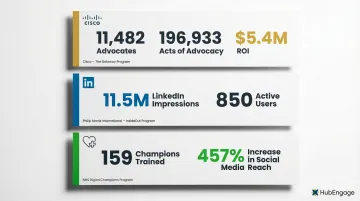
- Cisco ("The Gateway"): Centralized advocacy requests into a single digital portal using gamification. Generated 11,482 advocates, 196,933 acts of advocacy, and $5.4M in ROI value
- Philip Morris International ("InsideOut"): Empowered employees to build personal brands. Generated 11.5 million impressions on LinkedIn from just 850 active users
- NHS (Digital Champions): Trained 159 champions to focus on priorities unique to their practice, resulting in a 457% increase in social media reach
Step 5: Recognize, Reward, and Sustain Advocacy Over Time
Advocacy programs fade without reinforcement. Recognition and rewards convert one-time participation into sustained behavior.
The Impact of High-Quality Recognition:
Gallup and Workhuman research shows that employees who receive high-quality recognition are 45% less likely to have turned over after two years. Employees who receive recognition meeting at least four of Gallup's strategic pillars are nine times as likely to be engaged.
The Role of Gamification:
Gartner predicts that by 2028, 40% of large warehouse operations will have deployed gamification tools to motivate their workforces. Gamification — points, badges, leaderboards applied to operational processes — directly addresses the fatigue that kills most advocacy programs.
HubEngage applies gamification across the entire employee experience: communications, recognition, social engagement, and participation activities. That means advocacy behaviors build into daily workflows rather than sitting as a separate, optional initiative employees eventually ignore.
Recognition Examples Beyond Gift Cards:
- Peer recognition moments highlighting specific employee contributions
- Leadership shout-outs in company-wide communications
- Storytelling spotlights that share employee advocacy stories
- Milestone acknowledgments celebrating advocacy participation anniversaries
- Public leaderboards showcasing top advocates
- Social media features highlighting employee voices
The programs that stick aren't the ones with the biggest rewards — they're the ones where recognition feels personal, public, and connected to something employees actually care about.
Key Factors That Determine Whether Your Advocacy Program Succeeds
A few controllable factors separate programs that build lasting advocacy from those that generate a brief burst of activity and then stall. Get these right, and participation becomes self-sustaining.
Trust and Psychological Safety
Employees won't authentically advocate for an organization where honest opinions carry risk. Harvard Business School professor Amy Edmondson describes psychological safety as a shared belief that the team is safe for interpersonal risk-taking—and Gallup data shows only 3 in 10 U.S. workers strongly agree their opinions count at work.
Building that trust requires consistent action, not statements:
- Transparent leadership communication that acknowledges hard truths
- Follow-through on commitments made to employees
- Visible responsiveness when feedback is shared
When those conditions are absent, employees keep their heads down rather than share company content or speak publicly about their employer.
Content Authenticity and Employee Voice
Advocacy content that feels scripted or overly corporate damages credibility both internally and externally. Give employees the freedom to tell stories in their own voice, with organizational support rather than organizational control.
While 92% of advocacy programs use AI to scale content creation, the most successful programs combine AI efficiency with personalization. Original employee-created content delivers 9x higher engagement than templated content.
The practical implication: give employees story prompts and publishing support, then step back. Curated authenticity outperforms polished corporate messaging every time.
Reach and Accessibility Across All Employee Segments
A program that only activates desk-based employees while leaving out frontline workers leaves real advocacy potential untapped. Multi-channel accessibility—especially mobile-first tools—is non-negotiable for organizations with distributed or deskless workforces.
82% of employees say they would use their personal phone for work communication. That means your advocacy infrastructure needs to work on the device employees already carry, not just the devices IT has provisioned.
Feedback Loops and Measurement
Sustainable programs use advocacy data to improve internal communications, not just to track shares. Meaningful measurement includes:
- Sentiment analysis of employee feedback
- Participation rates by department and employee segment
- Qualitative stories and testimonials
- How feedback shapes the next communication cycle
Currently, 71% of communicators collect data, but only 11% use it to guide decision-making. Closing this gap is essential for continuous improvement.
Common Mistakes That Undermine Employee Advocacy Programs
Launching an Advocacy Program Without Fixing Foundational Culture Problems
No content toolkit or sharing platform will create advocacy in an organization where employees feel disrespected, uninformed, or burned out. Advocacy is a lagging indicator of employee experience—not a shortcut to improving it.
When corporate actions contradict messaging, trust erodes fast. Edelman's Trust Barometer highlights the "say-do gap"—when what an organization says doesn't align with what it does in practice, advocacy programs collapse.
Treating Employees as a Marketing Channel Rather Than as People
Programs that focus on share targets, hashtag campaigns, and branded templates without genuinely understanding the employee experience generate distrust internally and inauthenticity externally.
Audiences—customers, recruits, peers—can detect manufactured advocacy. When employees are treated as distribution channels rather than valued voices, the program backfires.
Measuring the Wrong Things
Optimizing for post volume and click counts feels productive — but it misses what actually matters. Engagement quality, employee sentiment, and whether advocacy reflects genuine organizational pride are the signals that reveal program health.
Surface Metrics vs. Meaningful Metrics:
| Surface Metrics | Meaningful Metrics |
|---|---|
| Number of posts shared | Sentiment in employee feedback |
| Click counts on shared links | Participation rates by department |
| Hashtag usage volume | Quality of employee stories |
| Share counts | How feedback shapes communication cycles |
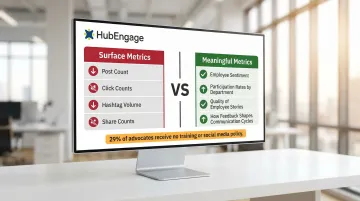
Chasing the wrong numbers also obscures a more practical problem: 29% of advocates receive no training or social media policy, leaving employees uncertain about what they can share. The biggest barrier to participation isn't lack of motivation — it's uncertainty.
Conclusion
Genuine employee advocacy is built from the inside out—starting with a culture of transparency, supported by communication infrastructure that reaches every employee, and sustained through recognition and trust rather than campaign mechanics.
The difference between programs that work and those that fail comes down to preparation and sequencing. Organizations that audit their internal conditions, invest in the right communication channels, and recognize authentic participation will see advocacy emerge naturally—and it lasts.
Without that foundation, any advocacy program produces short-lived social media activity at best. Build the culture first, and your employees become credible voices who reinforce your employer brand because they genuinely want to—not because a campaign asked them to.
Frequently Asked Questions
What are the 7 principles of advocacy?
The seven advocacy principles are clarity of purpose, empowerment, authenticity, trust, accessibility, consistency, and measurability. In an internal communications context, they ensure programs are built on genuine employee connection, supported by transparent communication, and measured by real engagement—not vanity metrics.
What are the 5 C's of employee retention?
The 5C Framework for Employee Retention consists of Commitment, Compensation, Career Growth, Culture, and Communication. Strong internal communication and advocacy programs directly reinforce several of these drivers—particularly Culture, Communication, and Commitment—by creating transparency, connection, and shared purpose.
What is the difference between employee advocacy and employee engagement?
Employee engagement refers to how connected and motivated employees feel internally—the degree to which they are emotionally and behaviorally connected to their organization. Employee advocacy is the outward expression of that engagement: unpaid promotion of a brand through word-of-mouth or social sharing. Without genuine engagement, advocacy tends to feel forced—and audiences can tell.
How do you measure the success of an employee advocacy program?
Measure success through quantitative metrics—participation rates, referral volume, content reach—alongside qualitative signals like sentiment analysis and story authenticity. The strongest programs pair hard business data (cost-per-hire reduction, referral conversion) with indicators of genuine employee pride.
How can internal communications tools support employee advocacy?
The right internal comms platform keeps all employees—including frontline and deskless workers—informed and connected to organizational purpose, which is what makes advocacy genuine rather than performative. Tools like HubEngage support multi-channel communication across mobile apps, web, email, SMS, and digital displays, so advocacy messages reach every employee regardless of role or location.
Can employee advocacy work for frontline or deskless workers?
Yes, frontline workers can be powerful advocates, but it requires reaching them through mobile-first, multi-channel communication tools rather than assuming desk-based channels like email or intranet are sufficient. SMS, mobile apps, and digital signage close that gap—giving frontline teams the same access to information, recognition, and advocacy opportunities as office-based employees.