Introduction
Business communications are fragmented across too many disconnected systems. Organizations juggle separate tools for SMS, voice, video, email, and internal messaging — and the result is missed messages, disengaged audiences, and ballooning operational costs. For companies managing customer interactions or distributed workforces, this fragmentation isn't just inefficient. It's a competitive liability.
CPaaS (Communications Platform as a Service) solves this by letting organizations embed real-time communication capabilities — voice calls, video conferencing, SMS, and chat — directly into existing applications and workflows, without building telecom infrastructure from scratch.
TLDR:
- Embeds voice, video, SMS, and chat APIs into existing apps — no telecom infrastructure required
- The global market will reach $45.3 billion by 2027, growing at 29.4% annually
- Healthcare, retail, banking, and internal employee communications are top use cases
- Developer-centric platforms require coding; no-code options exist for HR and communications teams
- Evaluate platforms on channel coverage, integration depth, and whether to build or buy
What Is CPaaS? A Plain-Language Definition
CPaaS is a cloud-based framework that provides developers and businesses with APIs and software development kits (SDKs) to add real-time communication features—such as voice calls, video conferencing, SMS/MMS, and chat—directly into their applications, websites, or business systems. Organizations gain communication capabilities without needing to build or manage underlying telecom infrastructure.
How CPaaS Differs from Legacy Systems
Traditional communication setups relied on on-premises PBX systems that required significant capital investment, specialized IT staff, and lengthy deployment timelines. CPaaS removes those barriers by delivering communication capabilities as a subscription-based cloud service. Instead of purchasing hardware and managing carrier relationships, businesses access communication tools through simple API calls.
Two Distinct CPaaS Models
CPaaS takes two forms in the market:
- Developer-centric API platforms (like Twilio or Infobip), where engineering teams write code to assemble custom communication workflows
- Ready-to-deploy multi-channel platforms suited to HR and communications leaders, where advanced capabilities come pre-built and configurable without coding expertise
CPaaS Market Growth
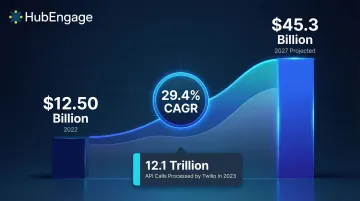
The CPaaS market is growing fast. MarketsandMarkets projects the global CPaaS market to reach $45.3 billion by 2027, up from $12.50 billion in 2022—a compound annual growth rate of 29.4%. To illustrate the scale of adoption, Twilio processed a record 12.1 trillion API calls in 2023.
How Abstraction Works
That scale of adoption is possible because of CPaaS's core architectural principle: abstraction. The platform hides the complexity of carrier networks, device compatibility, and telecom protocols behind a unified interface. Businesses focus on communication strategy rather than infrastructure management. There's no need to understand SIP trunking, codec compatibility, or carrier interconnection agreements.
Core Components of CPaaS Software
Communication APIs
Communication APIs are the foundational building block of any CPaaS platform. These APIs let developers (or pre-built platforms) embed SMS, MMS, voice calling, video conferencing, and social media messaging into applications. They hide the technical complexity of carrier relationships, offering a single interface for managing multiple communication channels simultaneously.
Instead of negotiating contracts with multiple SMS aggregators, voice carriers, and messaging platforms, organizations call a single API endpoint. The CPaaS provider handles routing, delivery, failover, and carrier relationships behind the scenes.
Voice and VoIP Capabilities
CPaaS platforms use VoIP (Voice over Internet Protocol) and SIP trunking to enable internet-based calling—both outbound (reaching customers or employees) and inbound (call routing to the right team or automated system). On-demand SIP trunking allows businesses to scale call capacity up or down based on need, eliminating the fixed costs of traditional phone lines.
Key voice features include:
- Programmable call routing and forwarding
- Interactive Voice Response (IVR) systems
- Call recording and transcription
- Conference calling and call queuing
- Real-time call analytics
Messaging Channels (SMS, MMS, RCS, Chat Apps)
CPaaS platforms support text-based communication across traditional SMS/MMS and newer channels like RCS (Rich Communication Services) and apps such as WhatsApp. Depending on the channel, these connections handle one-way alerts, two-way conversations, and rich media like images, videos, and interactive buttons.
RCS business messaging is projected to reach 50 billion messages globally in 2025 and accelerate to 200 billion by 2029, reflecting the shift toward richer, more interactive mobile messaging experiences.
WebRTC for Browser-Based Real-Time Communication
WebRTC (Web Real-Time Communication) technology allows voice, video, and data sharing to happen directly in web browsers without plugins. CPaaS platforms leverage WebRTC to power capabilities like in-app video calls, screen sharing, and live chat—critical for telehealth, remote support, and virtual collaboration.
The WebRTC market is forecast to grow by $247.7 billion between 2024 and 2029 at a 62.6% CAGR, driven by demand for embedded video and real-time collaboration tools.
Multi-Channel Orchestration and Integrations
More advanced CPaaS platforms coordinate communications across mobile apps, web, email, SMS, and digital displays from a single unified layer. Connecting CPaaS to CRM systems, help desk tools, and HR platforms lets communications trigger automatically from core business workflows.
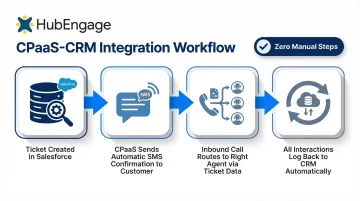
A Salesforce example shows how this works in practice:
- A customer service ticket is created in Salesforce
- The CPaaS platform sends an automatic SMS confirmation to the customer
- The inbound call routes to the right agent based on ticket data
- All interactions log back to the CRM — no manual steps required
Key Benefits of a CPaaS Platform
Scalability Without Infrastructure Investment
Because CPaaS is cloud-native, organizations can scale communication volume—from hundreds to millions of interactions—without provisioning physical hardware or hiring telecom engineers. Businesses pay only for what they use, significantly reducing upfront costs and financial risk.
A company launching a new customer notification service doesn't need to purchase SMS gateways or negotiate carrier contracts. They simply increase their API usage, and the CPaaS provider handles capacity planning and infrastructure scaling automatically.
Speed to Deployment and Competitive Agility
CPaaS dramatically shortens the time needed to add new communication channels or capabilities. Instead of months-long infrastructure projects, businesses can activate new channels in days.
A Forrester Total Economic Impact study found that Twilio Messaging provided 15% productivity improvements among development teams, enabling faster feature delivery and competitive responsiveness. The same study documented $2.1 million in avoided legacy messaging solution costs over three years through platform consolidation.
Omnichannel Reach and Consistency
CPaaS enables organizations to reach customers and employees on their preferred channels, delivering a consistent experience across voice, SMS, chat, mobile, and web.
Channel performance varies sharply—and those differences matter:
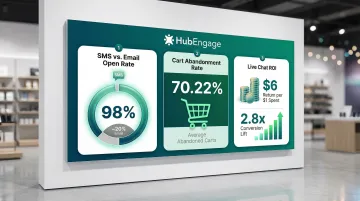
- SMS open rates exceed 98%, compared to roughly 20% for business email
- Voice and chat serve different use cases, from real-time support to async updates
- Multi-channel delivery ensures critical messages reach recipients regardless of where they're most active
CPaaS platforms let organizations route messages to the highest-performing channel for each audience segment, so important communications aren't lost in crowded inboxes.
CPaaS Use Cases Across Industries
Healthcare
Healthcare providers use CPaaS to send automated appointment reminders via SMS or voice, enable telehealth video consultations, and route inbound patient calls intelligently.
Measurable impact: A systematic review and meta-analysis found that SMS reminders decreased patient non-attendance by 23% (Risk Ratio 0.77) compared to no reminders. Telehealth adoption stabilized at 4.8% of all medical visits in 2023, up from 1.8% pre-pandemic, with CPaaS platforms powering the video infrastructure.
Retail and eCommerce
Retailers use CPaaS for order confirmation alerts, shipping updates, cart abandonment reminders, and personalized promotional messages. Click-to-call and in-app chat reduce friction in the purchase journey and support post-sale customer service.
Conversion impact: The average online shopping cart abandonment rate is 70.22%. Forrester research indicates that live chat delivers $6 in ROI for every $1 spent, and customers who use live chat are 2.8x more likely to convert than those who don't.
Banking and Financial Services
Banks and fintechs use CPaaS for real-time transaction alerts, OTP-based two-factor authentication, fraud notifications, and digital onboarding (identity verification via video or chat).
Two trends are reshaping CPaaS requirements in financial services:
- Authentication shift: Regulators are phasing out SMS OTPs due to interception risks. The UAE Central Bank mandated their elimination by March 2026, pushing institutions toward FIDO2, passkeys, and biometric verification.
- Fraud prevention: UK Finance reported that £1.2 billion of unauthorized fraud was prevented in 2023—equivalent to 64p in every £1 of attempted fraud—through real-time alerts and automated intelligence.
Customer Support Operations
CPaaS powers modern contact centers with programmable IVR (interactive voice response), intelligent call routing, AI chatbots, and automated ticket follow-ups. Integration with CRM systems gives agents full context during interactions, reducing handle time and improving resolution rates.
Cost efficiency: AI-powered customer service interactions cost $0.50-$1.00 compared to human agents at $5.00-$12.00 per contact, according to Forrester Research and Juniper Research. AI-powered customer service can cut average handling time (AHT) by 40%, allowing human agents to focus on complex escalations.
Internal Employee Communications
Organizations with large, distributed, or frontline workforces use multi-channel communication platforms to reach employees who don't sit at desks—via mobile apps, SMS, digital signage, and email.
The deskless workforce challenge: Deskless workers comprise 70-80% of the global workforce (approximately 2.7 billion workers), yet traditional communication tools like email and intranet fail to reach them effectively. A 2025 Staffbase study found that 63% of employees considering leaving their jobs cite poor internal communication as a contributing factor.
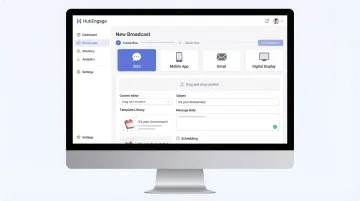
Internal communications remains one of the most underserved CPaaS use cases. Platforms like HubEngage tackle this directly—offering SMS, mobile app, email, intranet, and digital display reach in a single platform that HR and communications teams can deploy without writing a line of code. That matters for organizations that need broad reach but don't have dedicated engineering resources to build it.
CPaaS vs. CCaaS: What's the Difference?
CCaaS (Contact Center as a Service) is a pre-built, ready-to-use cloud platform specifically designed for managing inbound and outbound customer service operations—including call queuing, agent dashboards, and omnichannel ticketing. CPaaS, by contrast, is a developer toolkit for building custom communication workflows from scratch.
The Primary Distinction
| CPaaS | CCaaS | |
|---|---|---|
| Setup | Requires developer resources to build | Ready to deploy out of the box |
| Flexibility | High — fully customizable workflows | Lower — defined use cases only |
| Best for | Custom-built communication features | Standardized customer service operations |
When to Choose Each
Choose CPaaS when:
- You have development resources available
- You need highly customized communication workflows
- You're embedding communications into proprietary applications
- You require unique integrations or specialized routing logic
Choose CCaaS when:
- You need rapid deployment of a standardized contact center
- Your primary use case is customer service operations
- You prefer pre-built agent interfaces and reporting dashboards
- You want vendor-managed infrastructure and updates
Some platforms blend both approaches, pairing pre-built contact center functionality with customizable APIs — worth evaluating if your needs span both categories.
How to Choose the Right CPaaS Software for Your Business
Evaluate Channel Support and Integration Depth
Start by confirming the platform supports every channel relevant to your use case: SMS, voice, video, email, mobile apps, and digital displays. Then verify it integrates cleanly with existing tools like CRM, HRIS, or ERP systems.
Single-vendor consolidation typically reduces cost and technical complexity. Organizations managing multiple point solutions often discover they're spending $40+ per user across fragmented platforms. Unified CPaaS platforms eliminate redundant licensing and simplify administration.
Consider the Build vs. Buy Trade-Off
Developer-centric CPaaS platforms (like Twilio) offer maximum customization but require significant engineering investment. Organizations without dedicated development resources—particularly HR and communications teams—may be better served by ready-to-deploy platforms that offer multi-channel reach out of the box.
HubEngage takes this approach for employee communications. Organizations can launch multi-channel messaging without any custom development, then expand as needs grow. The modular platform lets teams start with what they need and add more over time:
- Mobile app messaging for frontline and remote employees
- SMS, email, and digital display reach in a single platform
- Recognition, Surveys, and AI Assistant modules available on demand
- One-click publishing that auto-formats content across channels
Assess Security, Compliance, and Scalability Guarantees
Review the provider's approach to data encryption, access controls, compliance certifications, and SLA uptime guarantees. Also confirm the platform can handle peak communication volumes without degraded performance — scalability gaps tend to surface at the worst possible moment.
Critical compliance frameworks:
| Framework | Authority | Focus Area |
|---|---|---|
| SOC 2 | AICPA | Security, availability, processing integrity, confidentiality, privacy |
| ISO 27001 | ISO | Information security management system (ISMS) requirements |
| HIPAA | HHS | Protection and privacy of health information |
| PCI DSS | PCI SSC | Protection of cardholder data during storage and transmission |
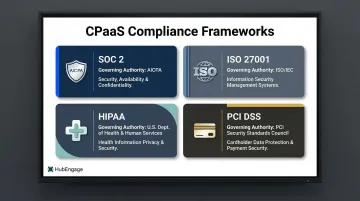
Enterprise CPaaS buyers must ensure vendors comply with these frameworks, especially as authentication standards shift away from basic SMS OTPs toward stronger, phishing-resistant methods.
Frequently Asked Questions
What is a communications platform as a service?
CPaaS is a cloud-based solution delivering APIs and tools that allow businesses to embed real-time voice, video, and messaging capabilities into their applications without building backend telecom infrastructure. Organizations access communication features through simple API calls rather than managing carrier relationships and hardware.
What are the components of CPaaS?
Core components include communication APIs (voice, SMS, video), VoIP/SIP trunking for internet-based calling, WebRTC for browser-based real-time communication, IVR and call routing systems, and multi-channel orchestration tools that tie these capabilities together. These components work as a unified platform rather than separate point solutions.
What is the difference between CCaaS and CPaaS?
CPaaS is a developer toolkit for building custom communication workflows with maximum flexibility but higher development effort. CCaaS is a pre-built cloud contact center solution for customer service operations, offering faster out-of-the-box deployment with less customization. CPaaS requires engineering resources; CCaaS targets business users.
What kind of companies use CPaaS?
CPaaS is used across healthcare, retail, banking, education, logistics, and technology sectors. Any organization needing to embed scalable communication into customer-facing apps, internal systems, or employee engagement workflows can benefit. Companies with distributed workforces, large customer bases, or complex communication requirements benefit most.
What is the best CPaaS software for company communication?
The best choice depends on your use case. Developer-focused platforms like Twilio or Infobip suit organizations building custom API integrations. Purpose-built platforms like HubEngage serve HR and communications teams that need multi-channel internal communications—mobile, SMS, email, and digital displays—without requiring engineering resources.
What is the future of CPaaS?
AI is reshaping CPaaS through smarter routing, sentiment analysis, and automated content generation. On the channel side, RCS and conversational messaging apps are expanding options well beyond traditional SMS. Meanwhile, CPaaS is increasingly converging with employee experience platforms as organizations look for unified solutions covering both customer-facing and internal communications.