Most companies treat AI rollout as a technology deployment, not a change management challenge. This is where adoption breaks down, especially in distributed, frontline, or hybrid workforces. Without structured communication infrastructure, employees never understand why they should use AI tools, how these tools benefit their daily work, or what leadership expects from them.
This article explains the specific, practical advantages that internal communications platforms provide when organizations need employees to understand, trust, and regularly use new AI tools. The difference between AI tools that transform operations and those that gather digital dust comes down to how well you communicate about them.
Key Takeaways
- Internal communications platforms bridge the gap between AI strategy and employee-level adoption
- The biggest barrier to AI adoption isn't technical readiness—it's lack of employee understanding, trust, and perceived value
- Multi-channel, ongoing communication significantly increases the odds employees engage with and stick with AI tools
- Without a structured comms platform, AI rollout messaging becomes fragmented, inconsistent, and unmeasured
- Organizations that treat internal comms as strategic infrastructure see faster AI adoption and stronger ROI
What Is an Internal Communications Platform?
An internal communications platform is a centralized system that enables organizations to create, distribute, and measure messages across multiple employee-facing channels—including mobile apps, email, SMS, digital signage, and web—from a single interface.
These platforms sit between leadership strategy and day-to-day employee experience, making them the natural infrastructure layer through which AI initiatives are introduced and sustained. Beyond messaging, they're strategic assets that directly impact measurable outcomes: adoption rates, engagement, and the speed of organizational change.
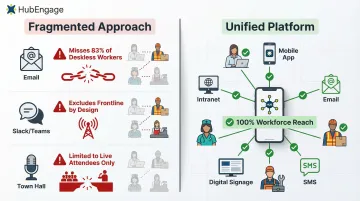
When organizations deploy AI without this infrastructure, they rely on fragmented channels that reach only portions of their workforce:
- Email misses 83% of deskless workers who don't have corporate addresses
- Slack and Teams exclude frontline employees by design
- Town halls reach only whoever can attend at that moment
The result is inconsistent messaging, confusion, and stalled adoption.
That's the gap a purpose-built platform fills: 100% workforce reach across preferred channels, with consistent messaging, built-in analytics, and two-way feedback. This infrastructure becomes essential when introducing AI tools that require sustained behavior change across the entire organization.
Key Advantages of Internal Communications Platforms for AI Adoption
Each advantage below delivers measurable, operational impact: speed of adoption, employee confidence, feedback quality, and the ability to sustain AI usage beyond the initial launch window. These outcomes are what HR and communications leaders are accountable for tracking.
Advantage 1: Building Employee Trust and Clarity Around AI Tools
Before employees will use any AI tool, they need to understand what it does, why the organization is deploying it, and how it affects their responsibilities. Without a trusted communication channel, these gaps fuel confusion and resistance.
Internal communications platforms enable organizations to deliver consistent, values-aligned messaging at scale, surfacing AI success stories, addressing fears directly, and framing AI as a productivity enabler rather than a threat to job security.
Why this is an advantage:
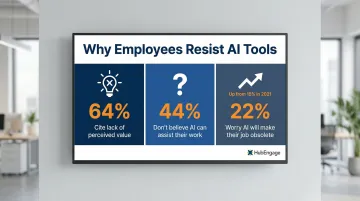
The communication gap is a primary adoption killer. Research shows that 64% of employees cite "lack of perceived value" as a top reason for stalled AI adoption, and 44% of non-users say they don't believe AI can assist with their work. These aren't technology problems—they're communication failures.
Platforms enabling two-way dialogue—pulse surveys, comment threads, or reaction features—allow employees to ask questions and voice concerns safely. This directly builds the psychological safety needed for AI experimentation. When employees trust that leadership is communicating transparently about AI, they're far less likely to delay or resist adopting new tools, which compresses the adoption timeline.
The stakes are real: 22% of U.S. workers worry technology will make their job obsolete, up from 15% in 2021. Addressing these fears through structured communication channels prevents resistance from hardening into organizational habit.
KPIs impacted:
- Employee confidence scores
- AI tool activation rates
- Time-to-adoption
- Internal sentiment survey results
- Reduction in informal resistance or shadow IT behavior
When this advantage matters most:
This trust-building advantage is highest-impact during the pre-launch and early rollout phases of any AI initiative, and especially critical in frontline, healthcare, manufacturing, and hospitality environments where employees have historically had limited exposure to AI tools.
Advantage 2: Reaching Every Employee Through the Right Channel at the Right Time
AI adoption stalls when important updates and training reminders never reach the right employees. Different workforce segments consume information differently, and a one-size-fits-all announcement approach misses most of the audience.
Multi-channel internal communications platforms solve this by auto-formatting and distributing content across mobile apps, email, SMS, digital signage, and intranet simultaneously—ensuring that deskless workers, remote employees, and office staff all receive the same AI guidance in the channel they actually use.
Why this is an advantage:
Channel diversity is not optional when trying to reach 100% of a workforce during an AI rollout. 83% of deskless workers don't have a corporate email address, and 45% lack access to the company intranet. If your AI rollout communication strategy relies primarily on email or intranet announcements, you've already lost four out of five frontline employees before you've started.
Platforms with gamification features—points for completing AI training modules, badges for reading update content, leaderboards tracking participation—create behavioral incentives that unstructured communication efforts cannot replicate. HubEngage applies this across the full employee experience, so recognition, surveys, and AI training all reinforce the same engagement loop, directly increasing training completion and tool activation rates.
This advantage scales with organizational complexity. The larger and more distributed the workforce, the more severe the reach gap becomes without a structured multi-channel platform. Fragmented tool stacks—email-only or Slack-only approaches—break down completely in organizations with significant frontline populations.
KPIs impacted:
- Message reach rates by employee segment
- AI training completion rates
- Tool activation rates within the first 30/60/90 days
- Engagement rates by communication channel
When this advantage matters most:
Organizations with deskless or distributed workforces—healthcare systems, retail chains, logistics companies, manufacturing plants—see the highest relative benefit. These are environments where the majority of employees will never see an email-only AI update.

Advantage 3: Creating Feedback Loops That Optimize the AI Rollout in Real Time
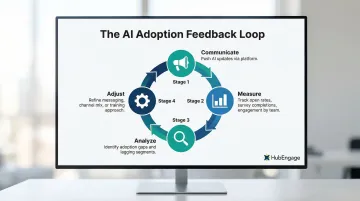
AI adoption is not a one-time launch event—it requires ongoing iteration based on how employees are actually responding, where confusion persists, and which teams are lagging behind. Without structured feedback infrastructure, leaders are flying blind.
Internal communications platforms with built-in analytics and survey capabilities provide real-time visibility into message engagement, sentiment, and participation patterns—enabling HR and communications leaders to identify adoption gaps early and adjust their messaging or training approach before small resistance becomes widespread rejection.
Why this is an advantage:
Platforms providing analytics on content engagement (open rates, click-throughs, survey responses) allow comms teams to test different framings of AI messaging and double down on what works—giving them the same iterative advantage in change management that marketers apply to external campaigns.
Feedback loops also surface use-case insights from employees. Frontline workers often discover practical AI applications that leadership hadn't anticipated, and a two-way comms platform captures this intelligence and routes it back to decision-makers. Organizations that act on these signals consistently find more use cases, faster—and build the kind of ground-level buy-in that top-down rollouts rarely achieve on their own.
Organizations that can quantifiably measure engagement with AI rollout communications are better positioned to report adoption progress to leadership, justify continued investment, and tie communication frequency directly to tool usage metrics—making the internal comms function a demonstrable driver of results, not just a broadcast channel.
KPIs impacted:
- Survey completion rates
- Message engagement rates by department/team
- AI adoption rate trends over time
- Correlation between communication frequency and tool usage metrics
When this advantage matters most:
This advantage is highest-impact in complex, multi-phase AI rollouts and in large organizations where adoption will vary significantly by team, role, or geography—making centralized feedback data essential to keeping the rollout on track.
What Happens When Internal Comms Is Missing from Your AI Strategy
Organizations that deploy AI tools without a structured internal communications strategy typically encounter the same problems. Employees receive one-time announcements with no follow-up, confusion and fear go unaddressed, and usage rates drop sharply after the initial launch.
The consequences follow a familiar pattern:
- AI tools get labeled as "that thing leadership wanted us to use"
- Resistance hardens into habit before workflows ever change
- Adoption stalls — and the organization pays for licenses it barely uses
- Expected productivity gains go uncaptured entirely
Fragmented communication — email here, a Slack message there, an occasional town hall — creates inconsistency. Different teams receive different information, managers interpret AI messaging without guidance, and compliance or training requirements go untracked.
This matters more than most organizations realize. According to Gallup research, employees who strongly agree their manager supports AI use are 8.8 times more likely to say AI gives them better opportunities at work. Manager alignment isn't a soft benefit — it's a multiplier.
Each failed rollout also makes the next one harder. Employee trust in the organization's change management erodes with every under-communicated deployment, and that skepticism carries forward. 63% of employees say poor communication contributes to them seeking a new job, so communication failures during AI rollouts don't just stall adoption — they drive attrition.
How to Get the Most Value from Your Internal Communications Platform During an AI Rollout
Internal communications platforms deliver the highest value when they are treated as a strategic asset from day one of the AI initiative—not brought in after the technology is already deployed to do cleanup communications. The platform should be part of the launch plan, not a reaction to low adoption.
A practical rollout communication approach:
Run a phased campaign across three stages:
- Pre-launch awareness content explaining the why—help employees understand the business case and personal benefits before they're asked to change behavior
- Launch-week training reminders and manager toolkits—equip frontline managers with talking points, FAQs, and recognition tools to champion AI adoption within their teams
- Post-launch pulse surveys and success spotlights—capture feedback, identify lagging teams, and celebrate early wins to build momentum
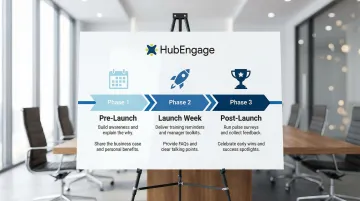
Each stage should reach the right employee segments automatically, through the right channels. HubEngage's one-click multi-channel delivery and AI-assisted content creation let internal comms teams execute this without rebuilding campaigns from scratch for every channel.
The organizations that see the strongest AI adoption results review platform analytics regularly and act on what the data shows—adjusting message frequency, channel mix, or content framing as needed. They also make communications two-way. Instead of only pushing announcements, they collect employee input, surface early wins, and close the feedback loop. That shift from broadcast to dialogue is what turns reluctant users into genuine adopters.
Conclusion
AI initiatives succeed or stall based on how well employees understand, trust, and engage with the tools being rolled out. A purpose-built internal communications platform directly addresses that gap — delivering consistent messaging through the channels employees already use.
The benefits accumulate throughout an AI rollout. Organizations that invest in communication infrastructure before launch — not after — see faster adoption, higher sustained tool usage, and measurable ROI that holds beyond the initial deployment window.
Treat internal communications as the operational backbone of your AI strategy, not a one-time announcement. The organizations that get the most from AI investments are those that keep employees informed, heard, and engaged at every stage — not just at launch.
Frequently Asked Questions
Why do most AI initiatives fail to get meaningful employee adoption?
Adoption failure is rarely a technology problem—it typically comes down to employees not understanding the purpose or personal benefit of the tool. Structured internal messaging closes that communication gap directly.
What is the role of an internal communications platform in an AI rollout?
An internal communications platform serves as the infrastructure for consistent, timely, multi-channel messaging about AI tools. It builds awareness, drives training completion, and sustains engagement well beyond the initial launch.
How can HR teams measure whether employees are actually engaging with AI adoption communications?
Platforms with built-in analytics track open rates, survey completions, and content engagement by team or segment—giving HR leaders quantifiable data to identify which groups are lagging and where messaging needs adjustment.
What is the difference between announcing an AI tool and driving AI adoption?
An announcement is a single event, while adoption is a sustained behavior change. Driving adoption requires ongoing, two-way communication that reinforces value, answers questions, and celebrates early wins over time.
How does gamification help improve AI adoption rates?
Gamification adds behavioral incentives like points, badges, and recognition for completing AI training or using new tools. These mechanics transform passive awareness into active participation and create friendly accountability within teams.
Which types of organizations benefit most from using a comms platform to drive AI adoption?
Organizations with large, distributed, deskless, or frontline workforces—such as healthcare, retail, manufacturing, and hospitality—see the highest relative benefit, because their employees are the hardest to reach through traditional desk-based communication channels alone.