Introduction
Employee stress has reached crisis levels. Nearly one-fifth of U.S. workers rate their mental health as fair or poor, resulting in approximately 12 unplanned absences annually per affected worker—costing the economy $47.6 billion each year in lost productivity. Add financial pressure, caregiving responsibilities, and workplace burnout, and the toll on organizational performance becomes significant.
Employee Assistance Programs (EAPs) represent one of the most proven, cost-effective responses to these challenges. When properly selected and actively promoted, EAPs deliver measurable returns—reducing absenteeism, lowering healthcare costs, and improving retention. Yet choosing the right EAP can be the difference between a benefit employees actually use and one that collects dust and costs money without delivering results. This guide covers 7 of the best EAP providers, what features to evaluate, and how to maximize employee adoption once you've chosen one.
Key Takeaways
- EAPs provide confidential support for mental health, financial, legal, and personal challenges at no cost to employees
- Strong programs cover counseling, work-life services, and crisis support across phone, app, and in-person channels
- Top providers include ComPsych, Lyra Health, Spring Health, Magellan Health, TELUS Health, Cigna EAP, and BHS
- Selection criteria: service breadth, delivery model, utilization reporting, and cost structure
- Without ongoing promotion, even the best EAP goes unused — awareness drives utilization
What Is an Employee Assistance Program (EAP)?
An Employee Assistance Program is a voluntary, employer-sponsored benefit providing confidential assessments, short-term counseling, referrals, and work-life support services—typically at no cost to employees. EAPs help workers address personal challenges that may affect job performance, including mental health concerns, substance use, financial stress, legal issues, and family conflicts.
Most mid-to-large organizations rely on external (third-party vendor) or blended (in-house combined with external) delivery models for scalability and confidentiality. Internal EAPs run by in-house staff are less common due to confidentiality concerns and resource constraints.
The Business Case: $5.39 Return Per Dollar Invested
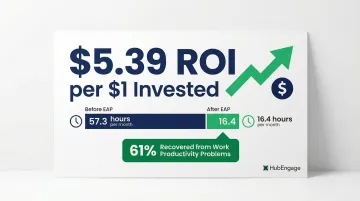
EAPs deliver measurable financial value. A 2024 peer-reviewed study of 166,116 employee cases found an average $5.39 return for every $1 invested, driven primarily by restored productivity. Among those cases, 61% recovered from work productivity problems — with lost productivity hours dropping from 57.3 to 16.4 per month after EAP use.
That ROI flows from multiple sources:
- Reduced absenteeism and presenteeism
- Lower healthcare utilization costs
- Improved employee retention
- Fewer workplace incidents and safety claims
7 Best Employee Assistance Program Examples
The following providers were selected based on service breadth, delivery accessibility, employer reporting capabilities, and demonstrated utilization success.
ComPsych (GuidanceResources)
ComPsych is the world's largest EAP provider, serving more than 160 million lives across 200 countries. Its GuidanceResources platform offers 24/7 counseling, legal and financial consultation, and comprehensive work-life support.
Key differentiator: Unmatched network scale and a single-platform portal giving employees simultaneous access to counselors, online tools, and organizational resources. Average time to connect live with a clinician is just 19 seconds.
| Core Services | Mental health counseling, legal/financial consultation, work-life referrals, critical incident response, management consultation | | Delivery Model | External vendor; phone, digital portal, and in-person sessions available | | Best For | Large enterprises seeking proven, full-spectrum EAP at scale |
Lyra Health
Lyra Health is a technology-driven EAP built to address the gaps in legacy programs. It offers evidence-based therapy, coaching, and medication management through a curated network of more than 25,000 providers globally.
Key differentiator: An AI-powered matching algorithm routes employees to the right care level—coaching, therapy, or medication management—within days. Employer-facing analytics dashboards track outcomes in real time. 95% of members stay with their first matched provider, and care costs average 25% lower than traditional health plan therapy.
| Core Services | Evidence-based therapy, mental health coaching, medication management, digital self-guided tools, family support | | Delivery Model | External vendor; app-first with video, in-person, and text-based care options | | Best For | Employers prioritizing clinical quality, fast access, and measurable mental health outcomes |
Spring Health
Spring Health uses AI-powered assessments to route each employee to the right care pathway—self-guided tools, coaching, or therapy—rather than relying on generic counselor referrals.
Key differentiator: Employees complete an assessment and receive personalized care recommendations within hours. Members connect with therapists in less than one day on average, and a 2025 JAMA study demonstrated a 1.9x ROI with $1,070 net savings per participant in year one.
| Core Services | Personalized mental health assessments, therapy, coaching, crisis support, manager training, digital tools | | Delivery Model | External vendor; digital-first with telehealth and in-person options | | Best For | Data-driven HR teams wanting individualized care pathways and measurable utilization outcomes |
Magellan Health
Magellan Health, operating under Centene's Health Care Enterprises, is a comprehensive behavioral health and EAP provider offering substance use support, disability case management, and organizational consulting alongside standard counseling.
Key differentiator: Deep integration between EAP services and broader behavioral health and disability management programs. The eMpower program specifically supports employees on disability leave due to behavioral health conditions, helping them access treatment quickly to support faster return to work.
| Core Services | Counseling, substance use support, disability management, crisis intervention, organizational consulting, wellness programs | | Delivery Model | External vendor; blended delivery with telephonic, digital, and in-person options | | Best For | Organizations needing integrated behavioral health and EAP services under one vendor |
TELUS Health (formerly LifeWorks/Morneau Shepell)
TELUS Health is a global employee wellbeing platform offering a wide-ranging EAP portfolio covering mental health, financial wellbeing, physical health, and manager support. The platform covers 161.2 million lives across 200 countries and territories, delivering personalized mental health support in over 40 languages.
Key differentiator: A single platform (My TELUS Health app) brings together EAP counseling, wellbeing resources, digital health tools, and recognition programs—making it a strong fit for globally distributed workforces requiring consistent quality across regions.
| Core Services | Mental health counseling, financial wellbeing, physical health support, work-life services, manager coaching, global coverage | | Delivery Model | External vendor; mobile app, phone, video, and in-person globally | | Best For | Multinational employers seeking consistent EAP quality and unified digital experience across regions |
Cigna EAP
Cigna's EAP is an embedded benefit that integrates seamlessly with Cigna health insurance plans, offering short-term counseling, work-life assistance, and legal/financial support. Integrating medical, behavioral, and pharmacy benefits with Cigna yields $193 per member per year in medical cost savings.
Key differentiator: Tight integration with Cigna's broader health plan—employees navigate one system for both EAP and medical benefits, simplifying access and reducing fragmentation for HR administrators. Session limits typically range from 5-8 sessions per issue, with some plans offering up to 12 sessions.
| Core Services | Short-term counseling, legal/financial consultation, work-life referrals, health coaching, online wellness tools | | Delivery Model | Embedded/bundled with health plans; phone, digital portal, in-person | | Best For | Organizations already using Cigna health insurance wanting simplified, integrated EAP administration |
BHS (Behavioral Health Systems)
BHS is a dedicated, independent EAP provider focused exclusively on behavioral health and employee assistance. Unlike bundled insurance EAPs, its standalone structure avoids conflicts of interest. The company serves over 2 million covered lives and reports a 13.2% true utilization rate across its portfolio.
Key differentiator: As a standalone EAP-only company, BHS offers highly customizable program designs with a strong focus on organizational-level services. That includes management consultation, workplace crisis response, and supervisor training alongside individual counseling.
| Core Services | Individual counseling, management consultation, workplace crisis response, supervisor training, work-life services, HR support | | Delivery Model | External vendor; phone, digital, and in-person with flexible session structures | | Best For | Mid-sized employers seeking dedicated EAP vendor with robust organizational consulting and customization options |
Common EAP Services: What to Expect
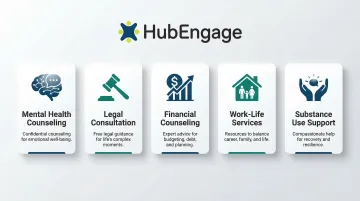
Most EAPs cover five core service categories, though offerings vary significantly by provider:
- Mental health counseling — Short-term therapy (typically 3-8 sessions per issue) for depression, anxiety, stress, relationship problems, and grief
- Legal consultation — Access to attorneys for guidance on family law, estate planning, landlord/tenant disputes, and consumer protection
- Financial counseling — Budget planning, debt management, retirement planning, and tax preparation assistance
- Work-life services — Referrals for childcare, eldercare, adoption support, educational resources, and relocation assistance
- Substance use support — Assessment, counseling, and referrals for alcohol and drug dependency
Individual vs. Organizational Services
EAPs provide two distinct service tiers:
Individual/clinical services support employees and their family members through confidential counseling sessions, consultations, and referrals. These are the most visible and commonly used EAP offerings.
Organizational services support HR teams and managers through management consultations, supervisor training, critical incident response, and educational workshops. Despite clear value for resolving workplace performance issues and crisis situations, these services remain significantly underutilized — in part because employees and managers aren't always aware they exist.
The Digital-First Shift
EAP delivery has shifted dramatically toward digital channels. 80% of EAP tenders now require digital-first service delivery, and for good reason: utilization rates for EAPs using mobile apps are 3x higher than telephone-only programs. Today, most leading providers offer app-based access, video therapy, text-based coaching, and self-guided digital tools alongside traditional phone and in-person channels. 60% of EAP consultations now occur via video or chat, reflecting employee preference for flexible, immediate access.
How to Choose the Right EAP for Your Organization
Start with Your Workforce Profile
The size, location, and nature of your workforce should drive EAP model selection. For distributed or hourly workers without consistent computer access, mobile-first platforms and 24/7 phone availability are essential. Office-based teams may prioritize video therapy and digital self-service tools. Global organizations require multilingual support and consistent service quality across regions.
Understand Pricing Models
HR leaders will encounter three primary pricing structures:
- Capitated — Fixed per-employee-per-year (PEPY) fee regardless of utilization; most common and predictable for budgeting
- Fee-for-service — Pay only for sessions actually used; works for organizations with historically low utilization
- Embedded/bundled — Included with health insurance plans; simplifies administration but may limit customization
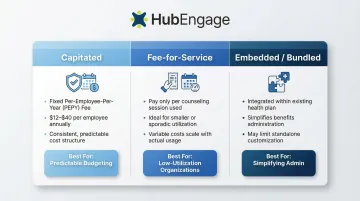
Capitated pricing historically ranges from $12 to $40 PEPY, though modern comprehensive platforms may command higher fees based on service breadth and digital capabilities.
Demand Utilization Reporting and Outcomes Data
A vendor that can't provide real-time dashboards or validated outcome metrics makes it nearly impossible to prove ROI or identify workforce trends. Ask prospective vendors:
- What is your average client utilization rate, and how does it compare to industry benchmarks?
- Can you provide real-time analytics dashboards showing utilization by department, location, and demographics?
- What clinical outcomes data can you share (symptom improvement, return-to-work rates, productivity gains)?
- How do you measure and report ROI for client organizations?
Address the Awareness Gap
The single biggest reason EAPs fail is low employee awareness. While 82% of employers offer EAPs, average utilization rates hover around 5-10%. Low utilization often signals that employees simply don't know the benefit exists or don't understand how to access it.
Even the best EAP requires consistent, multi-channel communication to drive adoption. Effective awareness campaigns typically combine:
- Onboarding materials that introduce the EAP from day one
- Manager toolkits so supervisors can refer employees confidently
- Ongoing reminders via email, SMS, mobile apps, and digital signage
- Targeted outreach for frontline and deskless workers often missed by email-only campaigns
This is where a platform like HubEngage helps HR teams close the gap. By auto-delivering benefit reminders across mobile apps, SMS, digital signage, and web portals simultaneously, organizations reach every employee segment — not just those sitting at a desk.

Conclusion
Choosing the right EAP provider matters—but so does making sure employees actually know it exists. The providers highlighted here represent the strongest options across different organizational profiles, from global enterprises to mid-sized companies seeking specialized support.
Start by auditing your current EAP utilization rates. If the number sits below 10%, the problem usually isn't the program—it's awareness and access. Consider whether your current vendor still aligns with how your workforce actually operates, especially around mobile delivery and on-demand support.
From there, evaluate how well the benefit is being communicated across all employee segments—particularly frontline, remote, and hourly workers who are often the hardest to reach.
For organizations looking to improve EAP awareness and employee engagement more broadly, HubEngage's multi-channel employee communications platform helps HR teams reach frontline, field, and desk-based employees alike—so critical benefits like EAPs don't go unnoticed or unused.
Frequently Asked Questions
What are examples of employee assistance programs?
Well-known EAP providers include ComPsych, Lyra Health, Spring Health, Magellan Health, TELUS Health, Cigna EAP, and BHS. EAPs can be standalone vendors, digital-first platforms, or benefits bundled within health insurance plans, each offering varying levels of counseling sessions, digital tools, and work-life services.
What are the different types of EAP programs?
EAPs are delivered through three models: internal (run by in-house staff), external (third-party vendors), and blended (combination of both). Programs also vary by pricing structure: capitated (fixed per-employee fee), fee-for-service (pay per session), or embedded within health benefits.
What are common EAP services?
Most EAPs provide short-term mental health counseling (3-8 sessions), legal and financial consultation, work-life referrals for childcare and eldercare, substance use support, crisis intervention, and management consultation for supervisors addressing employee performance concerns.
Do all companies have an EAP program?
EAPs are not legally required but widely adopted. Over 97% of U.S. companies with more than 5,000 employees offer an EAP, and 82% of all surveyed businesses provide EAP services. Adoption is lower among small employers, where access rates drop to around 29% for companies with fewer than 50 workers.
How much does an EAP typically cost per employee?
Capitated EAP pricing typically ranges from $12 to $40 per employee per year (PEPY), with costs varying by program scope, session limits, vendor scale, and digital capabilities. Platforms with broader coverage and digital tools sit at the higher end; basic phone-and-referral models at the lower.
How do employees access an EAP?
Most EAPs offer multiple access points: a confidential phone hotline (often 24/7), a digital portal or mobile app, and sometimes direct referral from HR or a manager. All access is voluntary and confidential, with no information shared with employers beyond aggregate, de-identified utilization data.