Introduction
Change is now constant. Organizations face restructuring, technology adoption, process overhauls, and cultural shifts faster than ever—and whether your workforce is office-based, frontline, remote, or hybrid, the pressure on leaders to drive change that holds has never been greater.
Leaders must move fast while bringing people along. Most change initiatives fail not from a flawed strategy, but from poor communication and missing structure. The gap between a well-designed change plan and real adoption is almost always human: unclear messaging, invisible leadership, and underestimating the emotional journey employees go through during transition.
This guide covers the foundational principles that make change succeed, the step-by-step process for managing it, and how to communicate change in a way that drives adoption instead of resistance.
TLDR:
- Most change failures trace back to poor communication and missing structure, not flawed strategy
- Successful change requires five core principles: clear case for change, active sponsorship, stakeholder engagement, behavioral planning, and feedback loops
- The change process spans readiness assessment, planning, transition management, implementation, and reinforcement
- Effective communication requires multi-channel delivery, audience-specific messaging, and more volume than most leaders expect
- Resistance is normal and often signals lack of clarity rather than opposition—address it with stage-appropriate strategies
Why Most Change Initiatives Fail
Less than one-third of organizational transformations succeed at both improving performance and sustaining those improvements over time, according to a 2021 McKinsey Global Survey. The widely cited "70% failure rate" traces back to Michael Beer and Nitin Nohria's 2000 Harvard Business Review article, though the statistic lacks a single empirical foundation. What matters more than the exact number is understanding what "failure" means: objectives not fully realized, momentum lost, or adoption rates far below expectations.
Root causes of failure:
- Missing or unclear communication - Employees don't understand why the change matters or what's expected of them
- Lack of leadership visibility - Sponsors approve resources but don't champion the change publicly or sustain momentum
- Absence of a structured process - Organizations jump to implementation without readiness assessment or planning
- Underestimating the human dimension - Leaders focus on project timelines and miss the emotional journey employees experience
Research consistently shows that transformations failing to engage line managers and frontline employees report only a 3% success rate, compared to 26% and 28% when those groups are engaged. The pattern is clear: when any single component of change management is missing, results suffer.
Seven components form the foundation of any sustainable change effort:
- Vision — without it, employees are left confused about direction
- Skills — gaps here create anxiety and slow adoption
- Incentives — absent incentives breed resistance, even among willing employees
- Resources — teams can't execute without adequate time, budget, or tools
- Action plan — no roadmap means false starts and wasted effort
- Consensus — lack of alignment fractures momentum across teams
- Buy-in — change stalls when people feel done-to rather than involved
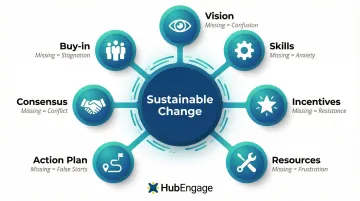
When all seven are in place, sustainable change becomes achievable rather than exceptional.
Core Change Management Principles
Principle 1: Start with a Clear Case for Change
People need to understand the "why" before they can embrace the "what." Leaders must define current-state problems, articulate risks of inaction, and clarify the benefits of moving forward. This isn't a one-size-fits-all message—the case for change must be tailored to each audience group.
What this looks like in practice:
- Frontline employees need to know how the change affects their daily work and makes their jobs easier
- Mid-level managers need to understand how to support their teams through the transition
- Executives need to see strategic alignment and business outcomes
The case for change should be concrete, not abstract. Instead of "we're becoming more agile," explain "we're reducing approval cycles from 10 days to 2 days so customer requests get answered faster."
Principle 2: Secure Active, Visible Sponsorship
There's a difference between nominal and active sponsors. Nominal sponsors approve budgets and sign off on plans. Active sponsors champion the change publicly, communicate consistently, remove obstacles, and sustain momentum long after the initial launch.
Effective sponsorship across phases:
- Pre-implementation: Approving resources, building the coalition, setting expectations
- Implementation: Communicating frequently, being visible, addressing resistance directly
- Post-implementation: Reinforcing new behaviors, celebrating progress, holding teams accountable
Prosci's research shows that projects with extremely effective sponsors are 79% likely to meet or exceed objectives, compared to only 27% for projects with extremely ineffective sponsors. Sponsorship is, in fact, the single most predictive factor of change success — more than methodology, tools, or training combined.
Principle 3: Engage Stakeholders Early and Map Them Strategically
Not all stakeholders are equal. Some will champion your change, some will resist it, and most will sit on the fence until they see evidence of momentum. Strategic engagement means identifying these groups and sequencing your approach intentionally.
Stakeholder types:
- Allies: Early adopters who champion the change
- Neutrals: Wait-and-see employees who need proof
- Fellow travelers: Support the change when it's convenient
- Opponents: Disagree but can be persuaded with the right information
- Adversaries: Actively resist and may undermine efforts
Start with allies and build momentum through their visible adoption. Use that momentum to move neutrals and fellow travelers.
Address opponents with targeted communication that acknowledges their concerns and provides clarity. Don't waste energy trying to convert adversaries early — focus on isolating their influence while building critical mass elsewhere.
Principle 4: Plan for Behavioral Change, Not Just Process Change
Sustainable change requires identifying which specific behaviors must shift and designing systems, training, and reinforcement mechanisms to support those behaviors. It's not enough to announce a new process—you must enable employees to perform it consistently.
Key questions to answer:
- What specific actions do employees need to start, stop, or do differently?
- What knowledge and skills do they need to perform those actions?
- What systems, tools, or resources must be in place to support them?
- How will we measure whether the new behaviors are happening?
- What consequences or rewards will reinforce the desired behaviors?
If you're implementing a new CRM system, the behavioral change isn't "use the CRM"—it's "log customer interactions within 24 hours," "update deal stages weekly," and "pull reports before client meetings." Define the behaviors precisely, then build training, reminders, and accountability around them.
Principle 5: Build in Feedback Loops from the Start
Change is iterative. Pre-implementation, in-flight, and post-implementation feedback allows leaders to course-correct before problems compound. This means creating formal mechanisms—surveys, 1:1 check-ins, team meetings, pulse checks—at every stage.
Feedback timing and purpose:
- Pre-implementation: assess readiness, identify concerns, surface obstacles
- During implementation: monitor adoption, track sentiment, adjust approach
- Post-implementation: measure sustainability, celebrate progress, identify gaps
Without feedback loops, leaders operate blind. They assume adoption is happening when it isn't, miss pockets of resistance until they become crises, and fail to recognize bright spots worth replicating. Feedback is how you steer — and without it, even well-designed change initiatives drift off course.
The Change Management Process: A Step-by-Step Breakdown
Phase 1: Pre-Work and Readiness Assessment
Before launching any change initiative, conduct a change readiness assessment. This baseline evaluation measures stakeholder awareness, desire, knowledge, ability, and reinforcement—dimensions aligned with the ADKAR model developed by Prosci founder Jeff Hiatt.
Assess each ADKAR dimension across your workforce:
- Do employees understand why the change is happening? (Awareness)
- Do they want to support it? (Desire)
- Do they know how to change? (Knowledge)
- Can they perform the required behaviors in practice? (Ability)
- Are systems in place to sustain the change long-term? (Reinforcement)
Use surveys, focus groups, and interviews to gather data. Identify where readiness is strong and where gaps exist. This assessment tells you whether you're ready to launch or need to build more foundation first.
Phase 2: Develop the Change Plan
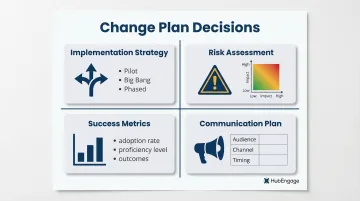
The change plan encompasses implementation strategy, risk assessment, success metrics, and the communication plan. All of these must be decided before go-live.
Key decisions to make:
- Implementation strategy: Pilot (test with one group), big bang (everyone at once), or phased (roll out in stages)?
- Risk assessment: What could go wrong? Which risks are most likely or most damaging?
- Success metrics: How will you measure adoption, proficiency, and business outcomes?
- Communication plan: Who needs to hear what, when, and through which channels?
A strong change plan gives every team member enough direction to execute without waiting for decisions—and enough built-in checkpoints to course-correct when reality diverges from the plan.
Phase 3: Manage Personal Transitions Alongside the Project
The human journey of change runs parallel to the project timeline and must be actively managed. William Bridges' Transition Model describes three stages: Endings (letting go of the old way), the Neutral Zone (uncertainty and confusion), and New Beginnings (embracing the new way).
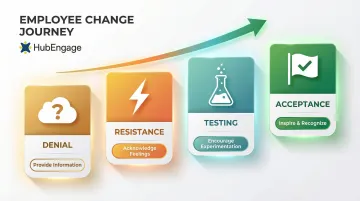
The Kübler-Ross emotional stages—denial, resistance, testing, acceptance—map the emotional arc employees move through. Research shows that acute stress significantly impairs working memory and cognitive flexibility, so employees absorb and retain less information precisely when communication matters most.
What this means for change leaders:
- Acknowledge endings explicitly—don't just announce the new way without honoring what's being left behind
- Expect the Neutral Zone to feel messy and uncomfortable—provide extra support during this phase
- Celebrate early wins to accelerate movement toward acceptance
- Recognize that emotional stages aren't linear—employees may cycle through them multiple times
Phase 4: Implement and Communicate
Launch with clear messaging, visible sponsor support, and pre-planned communication touchpoints. Given how stress limits information retention, communication volume needs to be far higher than most leaders assume.
Implementation best practices:
- Deliver the case for change through multiple channels simultaneously
- Make sponsors visible—have them present at town halls, send personal messages, visit teams
- Provide FAQs, job aids, and quick reference guides
- Establish help channels where employees can ask questions and get answers quickly
- Schedule regular check-ins with managers to surface issues early
The rule of thumb: if you think you've communicated enough, communicate ten times more. Repetition builds comprehension during high-stress periods—don't mistake it for noise.
Phase 5: Monitor, Reinforce, and Sustain
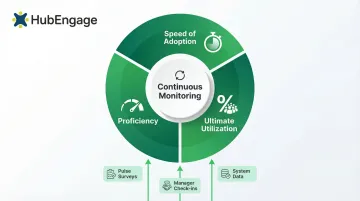
Post-implementation monitoring is an ongoing cycle: track adoption metrics, collect qualitative feedback, iterate the approach, and celebrate bright-spot behaviors to sustain momentum over time.
Track three adoption signals continuously:
- How quickly employees are up and running (speed of adoption)
- What percentage have fully adopted the change (ultimate utilization)
- How well they're performing compared to expectations (proficiency)
Use pulse surveys, manager check-ins, and system data to monitor these metrics continuously. When you spot pockets of high performance, study what's working and replicate it. When you spot lagging adoption, investigate root causes and intervene quickly.
Reinforcement mechanisms include recognition programs, performance metrics tied to new behaviors, ongoing training refreshers, and leadership accountability. Without reinforcement, the brain's natural tendency is to revert to old habits.
Change Management Communication: Strategy and Execution
Why Change Communication Fails
Leaders consistently think they've communicated enough, but employees rarely feel informed—especially under stress. An Axios HQ report found that 80% of leaders believe their internal communications are helpful and relevant, but only 53% of employees agree. This perception gap widens during change initiatives when anxiety and cognitive load are highest.
The principle: If you think you've communicated enough, communicate ten times more.
Key Elements of a Change Communication Plan
A comprehensive communication plan includes:
- Audience identification: Who needs to hear this message? (Impacted employees, managers, executives, external stakeholders)
- Message framing by audience: What will resonate with each group? What's in it for them?
- Messenger selection: Who should deliver the message? (CEO, direct manager, project lead)
- Channel selection: Where will each audience receive the message?
- Timing: When should messages go out relative to the change timeline?
Don't create a single message and blast it to everyone. Segment your audiences and tailor messages to their concerns, priorities, and information needs.
Why Multi-Channel Delivery Is Non-Negotiable
Different employee groups require different delivery formats. Deskless workers account for 70% to 80% of the global workforce—approximately 2.7 billion people—yet many organizations still rely primarily on email and intranet announcements that these employees never see.
Why single-channel communication fails:
- Frontline employees may not have corporate email addresses
- Remote workers may not check the intranet regularly
- Shift workers may miss synchronous town halls
- Deskless employees lack consistent computer access during work hours
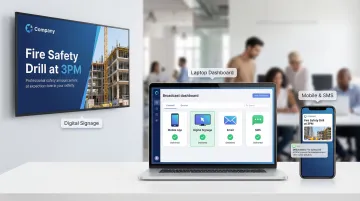
Multi-channel delivery reaches every employee regardless of role or location. Platforms like HubEngage address this challenge by auto-delivering change messages across mobile apps, digital displays, email, and SMS simultaneously. This approach closes the gap for distributed or frontline teams who need information delivered where they actually work.
Communication Best Practices
- Use plain language. Avoid jargon, acronyms, and corporate speak. If a frontline employee wouldn't understand it, rewrite it.
- Lead with "what's in it for me." Be specific about impacts on daily work, job security, workload, and expectations—that's what every employee is actually asking.
- Share what you know, and what you don't. Don't wait for perfect information. Acknowledge gaps and commit to updates as you learn more.
- Open two-way channels. Change communication should never be broadcast-only. Create space for questions and feedback, and respond quickly.
- Align all leaders on language. When executives, managers, and project leads use different terms or emphasize different priorities, employees fill the gaps with rumors.
Communication Types Across the Change Lifecycle
Initial group announcements:
- Deliver the case for change and the vision for the future
- Provide high-level timelines and what to expect next
- Set the tone—acknowledge difficulty while expressing confidence
Ongoing 1:1 conversations:
- Surface individual concerns and commitment levels
- Identify resistance early and address it directly
- Provide personalized coaching and support
Milestone updates:
- Reinforce progress and celebrate wins
- Acknowledge challenges and course corrections
- Maintain momentum by showing forward movement
The mix shifts over time. Group announcements dominate early; 1:1 conversations become critical during implementation when individual resistance peaks; milestone updates carry the load as the change embeds into daily work.
Managing Resistance Through the Change Journey
Resistance is normal and often misread. What appears as pushback is frequently a lack of clarity, exhaustion, or insufficient information rather than genuine opposition. Leaders who treat all resistance as the same tend to escalate it.
Prosci defines resistance as a normal reaction to change that often stems from employees not understanding the 'why' rather than genuine opposition. The key is diagnosing the root cause and responding appropriately.
Practical Strategies at Each Emotional Stage
Once you've identified where someone is in the change journey, your response should match their stage.
Denial — People need information, not pressure:
- Provide clear, frequent updates about what is changing and why
- Make the change tangible with specific examples and timelines
- Give people time to process before pushing for buy-in
Resistance (anger, bargaining, depression) — People need to feel heard:
- Acknowledge feelings without dismissing them
- Clarify the case for change without being defensive
- Listen more than you talk
- Create safe spaces for concerns — don't punish people for voicing them
Testing — People are ready to try, but need support:
- Encourage experimentation and risk-taking
- Celebrate early attempts, even imperfect ones
- Provide coaching to build proficiency
- Share stories of peers who are finding their footing
Acceptance — People are on board; keep momentum going:
- Shift to inspiration and recognition
- Enroll early adopters as advocates and mentors
- Make success visible through metrics and stories
- Reinforce new behaviors through formal recognition programs
What Leaders Must Avoid
- Withholding information until you have all the answers — silence fills with rumor. Share what you know, when you know it.
- Defaulting to toxic positivity — employees who are struggling will tune out leaders who refuse to acknowledge difficulty. Validate the challenge while holding the vision.
- Going invisible — leaders who retreat to their offices during change lose credibility fast. Stay visible, accessible, and present on the floor.
- Looking the other way on non-compliance — when managers cover for people who aren't adopting the change, the message is that adoption is optional. Hold the line.
Measuring and Sustaining Change
Define Success Metrics
Success metrics fall into two categories: quantitative and qualitative. Both are required for a complete picture.
Quantitative metrics:
- Adoption rate — what percentage of employees are actively using the new process or system
- Speed of adoption — how quickly employees reach proficiency with the change
- Operational performance — productivity, efficiency, error rates, and cycle times
- Financial impact — cost savings, revenue growth, and ROI
Qualitative feedback:
- Employee buy-in — sentiment gathered through 1:1s, focus groups, and surveys
- Manager observations — frontline insights about team readiness and real obstacles
- Anecdotal evidence — stories of success or struggle that reveal patterns numbers miss
Track both throughout implementation. Numbers tell you what is happening; stories tell you why.
Pulse Surveys and Continuous Feedback Mechanisms
Pulse surveys during transitions identify emerging issues an average of 45 days before they impact retention metrics, according to Perceptyx research. Use short, frequent surveys to track employee sentiment in real time, spot pockets of resistance early, and share findings transparently with the broader workforce.
That kind of early warning requires the right infrastructure. HubEngage's built-in survey and analytics capabilities let HR teams deploy automated surveys, measure sentiment continuously, and access real-time dashboards that surface patterns leaders can act on. The result: faster intervention when problems emerge, rather than waiting for quarterly engagement surveys to confirm what managers already sensed.
The Continuous Improvement Cycle
Sustaining change means treating it as an ongoing process, not a one-time event:
- Collect data - Adoption metrics, performance data, survey feedback, manager insights
- Analyze - Identify patterns, root causes, bright spots, and gaps
- Iterate - Adjust the change approach based on what you learn
- Close the loop - Share what you heard, what it meant, and the specific steps you're taking in response
Reinforcement keeps the cycle from stalling. That means recognition programs that celebrate employees demonstrating new behaviors, accountability structures that make expectations explicit, and keeping success metrics visible long after launch. John Kotter's research warns that until new behaviors are embedded in social norms, they erode. For deep cultural change, that embedding process can take five to ten years — which is precisely why continuous measurement matters more than a single post-launch survey.
Frequently Asked Questions
What are the key principles of change management?
Effective change management rests on five fundamentals:
- Build a clear case for change that explains the "why"
- Secure active, visible sponsorship from leadership
- Engage stakeholders early and strategically
- Plan for behavioral change, not just process change
- Build continuous feedback loops throughout the initiative
Why do most organizational change initiatives fail?
Most initiatives fail due to missing critical components—poor communication, insufficient leadership visibility, and underestimating the emotional side of change are the most common culprits. Research shows fewer than one-third of transformations succeed at improving and sustaining performance long-term.
What should a change management communication plan include?
A solid plan covers audience identification and segmentation, message framing tailored to each group's concerns, messenger selection, and multi-channel delivery. Timing across pre-implementation, implementation, and post-implementation phases ensures consistent reach.
How do you communicate change to frontline or deskless employees?
Frontline and deskless workers—roughly 70-80% of the global workforce—need information delivered where they work, not just via email or intranet. Multi-channel delivery using mobile apps, SMS, digital displays, and manager huddles is essential for consistent reach.
How do you measure whether a change initiative is succeeding?
Measure both quantitative metrics (adoption rate, speed of adoption, operational performance, financial impact) and qualitative signals (employee sentiment from surveys, manager observations, focus group feedback). Monitoring both together throughout implementation reveals where momentum is building and where intervention is needed.
How do you handle employee resistance to change?
Resistance is normal and usually signals a lack of clarity or change fatigue rather than genuine opposition. Match your response to the stage — inform during denial, acknowledge feelings during resistance, encourage experimentation during testing. The approach that works in one stage rarely works in another.