Introduction
Organizations increasingly rely on both an LMS and a company intranet to manage employee development and communication—but keeping them as separate, disconnected tools creates friction that erodes the value of both. Employees must remember multiple logins, navigate different interfaces, and mentally shift between "work mode" and "training mode." This fragmentation doesn't just frustrate users; it drains up to 40% of productive time through constant context switching and contributes directly to low completion rates and compliance gaps.
Integration changes how employees discover, access, and complete training in their daily workflow. When course content surfaces inside the same intranet they use for company news, policies, and resources, learning becomes part of how work gets done—not a separate task to schedule around it.
This article explains the concrete operational and engagement benefits of LMS-intranet integration, who it matters most for, and how to make it work in practice.
Key Takeaways
- LMS-intranet integration connects your training platform with the central hub employees use daily, removing access barriers and boosting completion rates
- Duplicate data entry disappears, giving HR teams one accurate source for training records and compliance reporting
- Contextual placement of learning content within the intranet increases relevance and knowledge retention
- Without integration, fragmented data and inconvenient access cause employees to skip courses and leave compliance gaps undetected
- Over time, ROI builds through higher completion rates, lower compliance risk, and less administrative overhead
What Is LMS-Intranet Integration?
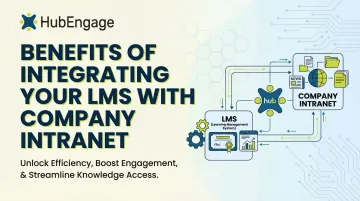
LMS-intranet integration connects a Learning Management System (which delivers, tracks, and manages employee training) with a company intranet— the internal hub for company news, policies, tools, and communications. When integrated, both systems share data and present a unified experience to the employee.
Integration doesn't mean merging two platforms into one. In practice, it typically looks like:
- Single sign-on (SSO) access — one login for both systems
- Embedded course widgets on the intranet homepage or department pages
- Shared user data — employee records sync automatically between systems
- Automated enrollment triggers — new hires or role changes automatically assign relevant training
- Unified reporting dashboards — completion data flows back to HR analytics tools
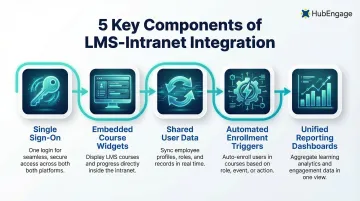
The result: learning becomes part of the workday rather than an interruption to it — which is why HR and communications teams see stronger completion rates when both systems work together.
Key Benefits of Integrating Your LMS with Your Company Intranet
These integration benefits show up in the metrics HR and operations leaders track: completion rates, compliance accuracy, administrative hours, and engagement scores. Each one is measurable and tied to real business outcomes.
One-Stop Access Removes the Friction That Kills Training Completion
Access friction is one of the primary reasons training completion rates underperform. Employees juggle a separate URL, another set of login credentials, and a mental shift into "training mode"—all of which feel disconnected from their actual work.
Integration solves this in practice. When LMS courses are surfaced directly inside the intranet—through a course widget on the homepage, a notification in the company news feed, or single sign-on that requires no separate login—employees encounter training as a natural part of their daily workflow rather than an additional task.
The business case:
Organizations that activate SSO in their LMS see a 15% to 25% increase in training engagement by removing access friction. The business cost of low completion is significant: re-training costs, compliance gaps, and onboarding delays all stem from employees abandoning courses they can't easily access.
For frontline, deskless, and distributed employees who may have limited time at a desk, frictionless mobile access through a unified intranet-LMS experience is especially critical. 81% of frontline workers report a mobile device or app issue at least once per month that prevents them from doing their job—these workers are most likely to skip training when access requires multiple steps.
KPIs impacted:
- Training completion rate
- Time-to-completion
- Onboarding speed
- Course abandonment rate
Unified Data Eliminates Duplicate Work and Strengthens Compliance Reporting
When the LMS and intranet operate as separate systems, HR and L&D teams end up maintaining duplicate records. They manually track completions, cross-reference systems to build compliance reports, and chase employees for certificates the LMS has already issued—but the HR system doesn't reflect.
Integration creates a single source of truth. Employee roster changes in the intranet—new hires, role changes, departures—automatically sync to the LMS, triggering the correct training assignments without manual intervention.
Completion data flows back to HR dashboards, and compliance reports generate automatically.
In regulated industries, this matters because:
Manual data entry carries a human error rate of approximately 4%, costing thousands annually per employee to correct. Modern HRIS-LMS integration implementations report 80% to 90% reductions in payroll discrepancies and manual data errors.
For healthcare, financial services, manufacturing, and energy organizations, automated compliance tracking is a risk management requirement—not a convenience. Auditors flag missing or undocumented training records, which can trigger penalties at scale. FinCEN assessed an $80 million penalty against a broker-dealer in 2026, citing inadequate AML training and under-resourced compliance.
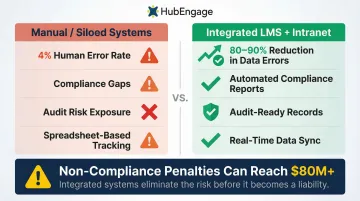
KPIs impacted:
- Compliance completion rate
- Audit-readiness score
- HR administrative hours per employee
- Data error rate across systems
Contextual Learning Surfaces Training Where Work Happens, Driving Engagement and Retention
Knowledge retention drops sharply when training is an isolated event. Employees finish a course, close the tab, and return to work with no reinforcement or connection to what they just learned.
LMS-intranet integration creates contextual learning moments:
- A policy update posted on the intranet automatically links to a related compliance course
- A new product announcement surfaces a short product knowledge module
- Onboarding content embeds within the new hire section of the intranet alongside welcome messages, org charts, and team introductions
Learning becomes part of the information experience, not separate from it.
Why it works:
Learner comprehension and retention improve by up to 40% when training is contextualized—tied directly to real-world applications. Organizations implementing contextual-based learning strategies report a 30% rise in employee engagement and a 25% improvement in knowledge retention.
Platforms like HubEngage extend this further by connecting training activity to recognition. When employees earn points or badges for completing courses—visible to their team inside the same intranet—they're more motivated to engage with learning content as part of their daily experience.
KPIs impacted:
- Knowledge retention rate
- Time-to-proficiency
- Manager coaching hours
- Employee engagement score
- Voluntary course completion rate
What Happens When LMS and Intranet Stay Siloed
Keeping LMS and intranet disconnected creates compounding problems that affect completion rates, compliance accuracy, and operational costs:
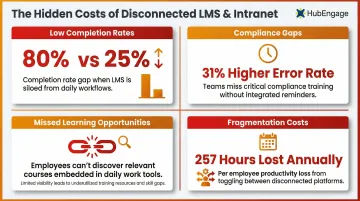
Low training completion — Employees won't log into a separate platform unless forced to. Microlearning achieves 80% completion versus 25% for traditional e-learning, but even short courses suffer when access is a hurdle.
Compliance management gaps — HR teams tracking completions in spreadsheets miss certifications and scramble before audits. Fragmented HR systems generate 31% higher error rates and consume 23% more admin time.
Missed learning opportunities — Training content is invisible to employees browsing the intranet. A new policy or process change gets announced without a linked training module, leaving employees to interpret and apply it inconsistently.
Hidden fragmentation costs — Two disconnected systems mean duplicate user records, redundant reports, and double the admin overhead. Employees lose five working weeks annually to context switching, with 257 hours per year lost to inefficient processes.
How to Get the Most Value from LMS-Intranet Integration
The technical connection between LMS and intranet is only the foundation—the real value comes from how the integration is configured and maintained. Three conditions determine whether organizations capture the full benefit:
- Embed training in high-traffic areas — Surface learning content on the homepage, department pages, onboarding portals, and policy hubs. The course should come to the employee, not the other way around.
- Automate enrollment based on intranet events — New hire profiles, role changes, and department transfers should automatically trigger relevant training assignments, eliminating manual HR intervention.
- Act on completion and engagement data — Use unified reporting to identify drop-off points, update underperforming content, and recognize employees who complete training consistently.
Integration only delivers sustained value when L&D and HR teams close the loop between data and action—not just connect the systems.
Conclusion
LMS-intranet integration is fundamentally about removing the distance between where employees work and where they learn. When those two environments are unified, training stops being an interruption and becomes part of how work gets done.
The advantages compound over time. Higher completion rates reduce compliance risk, automated data sync cuts administrative burden, and contextual learning improves performance in ways that show up directly in productivity and quality metrics.
Organizations that treat this integration as an ongoing employee experience investment, rather than a one-time IT project, will consistently outperform those managing learning and communication as separate functions. Platforms like HubEngage that natively unify intranet, learning, and communications make this kind of integration practical to sustain at scale.
Frequently Asked Questions
Frequently Asked Questions
What are the benefits of integrating an LMS with a company intranet for employee training?
Integration embeds training directly into the tools employees already use daily, which drives higher completion rates. Compliance tracking is automated through unified data, eliminating the manual effort of reconciling records across separate platforms.
How does a custom LMS improve employee training?
A configured LMS lets organizations align course assignments to specific roles, departments, and career paths. Paired with intranet integration, it automatically delivers the relevant training to each employee based on their role and workflow context.
Is integrating an LMS with a company intranet the best solution for employee training for a company with about 200 employees?
Yes, integration is worthwhile even at 200 employees. At this size, HR teams are typically lean and benefit significantly from automated enrollment and compliance tracking. Simpler integration approaches like SSO and embedded widgets are low-cost starting points that scale as the organization grows.
What is the difference between an LMS and a company intranet?
An LMS is purpose-built for delivering, tracking, and managing training content, while an intranet is the broader internal hub for company news, policies, communications, and resources. Integration connects both so employees access learning from within the intranet environment they already use daily.
How do you integrate an LMS with a company intranet?
The most common methods are single sign-on (SSO) for unified login and API-based data sync for shared user records and completion tracking. Organizations also use embedded course widgets within intranet pages and automated enrollment triggers tied to HR events like onboarding or role changes.
Can LMS-intranet integration support frontline or deskless employees?
Yes. Mobile-first intranet platforms that integrate with an LMS are well-suited for frontline and deskless workers without consistent desktop access. Employees can complete training on a device they already carry, with a single login instead of multiple apps.