Introduction
Enterprise organizations invest millions in intranets, yet employees still struggle to find information, engagement remains low, and HR teams are buried in repetitive questions.
47% of digital workers struggle to find the information needed to do their jobs, and employees waste an average of 3.6 hours daily searching for information (up a full hour from the previous year). AI is changing this equation.
This article breaks down the key features that define a modern AI intranet, why they matter for enterprise teams specifically, and what to look for when evaluating a platform that can actually deliver results.
TLDR:
- AI intranets shift from passive content repositories to active tools that answer questions directly
- Critical features include conversational search, personalized content delivery, HR automation, and workflow integration
- Gamification and engagement layers drive sustained adoption beyond basic search functionality
- Governance, role-based permissions, and content trust mechanisms keep AI enterprise-safe
- Multi-channel delivery—especially mobile access—ensures frontline workers aren't left behind
Why Traditional Enterprise Intranets Are No Longer Enough
Legacy intranets fail employees in predictable ways: poor searchability forces workers to hunt through folders and outdated pages, stale content erodes trust, and tool fragmentation creates information chaos. The numbers are stark: employees spend 25% of their work week searching for documents, information, or people, and 43% would consider leaving a job if they couldn't access what they need efficiently.
Distributed and frontline workers suffer most. Traditional intranets were built for desk-based employees with corporate email addresses and desktop computers, a model that excludes the 80% of the global workforce who are deskless.
When employees can't find answers quickly, they create workarounds: private shared drives, group chats, personal notes, and unauthorized apps. Shadow IT accounts for 30% to 40% of IT spending in large enterprises, and 41% of employees acquire, modify, or create technology outside of IT's visibility—a figure expected to reach 75% by 2027.
These informal systems create serious risks:
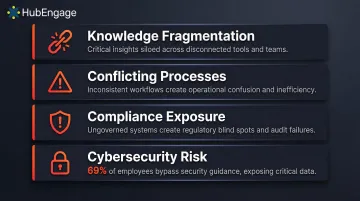
- Critical knowledge fragments across disconnected channels, creating information silos no one can fully see
- Conflicting processes emerge as teams develop their own guidance without a shared source of truth
- Sensitive data flowing through unmonitored tools opens real compliance exposure
- 69% of employees intentionally bypass cybersecurity guidance, compounding security risk with every workaround
The real fix is an intranet employees actually want to use. When the official system is faster and easier than any workaround, shadow tools stop being necessary.
The Core Features of an AI Intranet for Enterprise Organizations
Not all AI intranet features deliver equal value. The features that matter most resolve employee questions quickly, reduce friction, and scale reliably across large, distributed teams. Here's what separates functional AI intranets from expensive experiments.
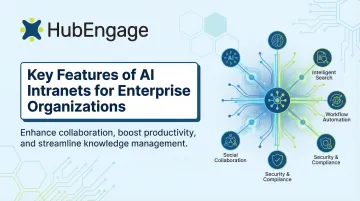
AI-Powered Conversational Search
Traditional keyword search returns a list of links employees must sift through. AI-powered conversational search delivers direct, verified answers to questions asked in plain language—no hunting required.
What this looks like in practice:
- Employees ask questions naturally: "What's our remote work policy?" or "How do I submit expenses?"
- The system returns the answer immediately, not 20 document links
- Time-to-information drops from minutes to seconds
- Employees stop avoiding the intranet and start using it as their first resource
Platforms like HubEngage's AI Assistant enable employees to instantly find information, access company resources, and get HR answers on demand—transforming the intranet from a last resort into the first place employees go when they need help.
When finding information becomes effortless, adoption follows. That behavioral shift is what separates AI intranets with strong usage numbers from ones that collect dust.
Personalized Content Delivery
AI analyzes employee role, department, location, and behavior patterns to surface relevant updates, announcements, and resources automatically. A warehouse supervisor sees safety alerts and shift schedules. A finance analyst sees compliance updates and policy changes. Neither wastes time filtering through irrelevant content.
Why personalization drives results:
- Reduces information overload by showing only what matters
- Increases the likelihood that critical communications are read and acted upon
- Prevents important messages from drowning in generic announcements
- Respects employees' time by eliminating noise
When employees consistently see content that's relevant to their role, they develop the habit of checking the intranet—which is exactly the adoption behavior enterprise organizations need to drive.
Automated Onboarding and HR Self-Service
AI intranets guide new hires through onboarding step-by-step, answering role-specific questions and directing them to relevant documents. HR professionals spend up to 57% of their time on administrative tasks—time that shifts toward strategic work when routine questions are automated.
The 24/7 availability advantage: An AI assistant answers policy questions, locates benefit documents, and supports employees around the clock. Night shift workers get the same instant support as day shift employees. Remote workers in different regions don't wait until business hours for answers.
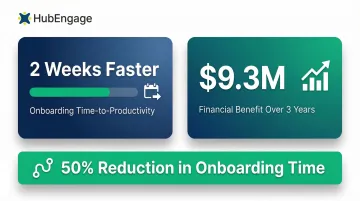
Organizations deploying unified HR service delivery platforms have reduced onboarding time-to-full-productivity by two weeks, yielding financial benefits of $9.3 million over three years. Some platforms have cut onboarding time-to-productivity by 50%.
Workflow Automation
AI intranets automate routine approval workflows—PTO requests, expense submissions, document sign-offs—reducing manual follow-up and eliminating bottlenecks that slow operations.
Why automation matters beyond speed:
- Creates audit trails for compliance-heavy industries
- Enforces consistency in process execution
- Reduces errors from manual data entry
- Frees managers from administrative overhead
For healthcare, financial services, and manufacturing organizations specifically, workflow automation addresses a dual pressure: maintaining compliance standards while keeping pace with operational growth.
Intelligent Analytics and Insights
AI-powered analytics reveal what traditional pageview metrics miss: which content employees engage with, which questions go unanswered, where communication breakdowns occur, and which departments have the lowest information access.
What enterprise leaders gain:
- Identify communication gaps before they become problems
- Understand which resources employees actually use
- Measure whether messages reach intended audiences
- Track engagement patterns across departments and locations
The result is a communication strategy that self-corrects over time—leaders see what's working, fix what isn't, and build toward the engagement numbers that matter to the business.
Integrations Across Enterprise Systems
AI intranets gain real value when connected to existing tools—HRIS platforms, payroll systems, project management software, and communication apps. Large companies deploy an average of 211 apps, and digital workers toggle between applications nearly 1,200 times per day.
Why seamless integrations matter:
- Employees complete tasks without toggling between systems
- AI assistants pull accurate, real-time data from authoritative sources
- Context switching decreases—it takes 23 minutes to fully regain deep focus after a single interruption
- Productivity increases as chronic multitasking can consume up to 40% of productive time
A well-integrated AI intranet becomes the single interface employees trust—because it surfaces accurate data from the systems they already use, without requiring them to leave to find it.
Beyond Search: AI Features That Drive Employee Engagement
Most AI intranet discussions stop at search functionality. But AI-powered intranets should do more than help employees find documents—they should actively drive participation, recognition, and culture. This is where enterprise platforms with gamification and engagement layers stand apart.
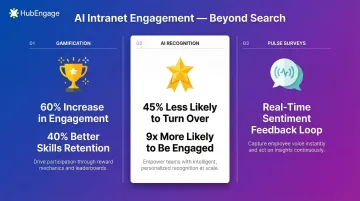
Three capabilities separate engaged AI intranets from basic document repositories:
- Gamification: Employees earn points for completing training, participating in surveys, reading announcements, or recognizing peers. Gamified training can lead to a 60% increase in engagement and improve skills retention by 40%. By 2028, 40% of large warehouse operations will have deployed gamification tools to motivate their workforces.
- AI-driven recognition: AI surfaces recognition moments based on employee milestones, peer nominations, or performance signals—making appreciation timely and consistent at scale. Well-recognized employees are 45% less likely to turn over after two years, and those receiving strategic recognition are nine times as likely to be engaged.
- Embedded surveys and feedback: Pulse tools built into the intranet let HR teams check employee sentiment, collect structured feedback, and close the loop between leadership communication and employee response.
Together, these features create a continuous improvement cycle where employee input directly shapes workplace experience—not just what gets communicated, but how the organization responds.
Governance and Content Trust: The Features That Make AI Safe to Use
The "content junkyard" risk is real: when AI is pointed at unmanaged, outdated, or conflicting intranet content, it scales confusion rather than clarity. Governance features prevent this failure mode.
Essential governance capabilities include:
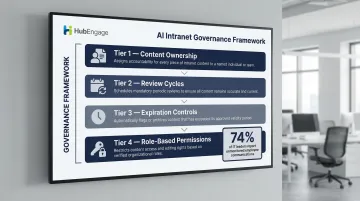
- Content ownership assignment so every page has a responsible maintainer
- Review cycles that ensure information stays current
- Expiration controls that flag or remove outdated content
- Approval workflows that prevent incorrect information from publishing
Employees completed tasks significantly faster on intranets following centralized governance models (average 78 seconds) compared to distributed models (average 123 seconds). Content oversight through centralized or hybrid management is required to preserve findability and ensure high-quality content.
Role-based permissions and access controls are non-negotiable for enterprise use. AI must only surface content employees are authorized to see, especially in organizations handling sensitive HR data, legal documents, or compliance-sensitive processes. 74% of IT and compliance leaders report employees are using unmonitored communications channels, up from 66% in 2022 — a gap that proper access governance directly addresses.
Multilingual support extends governance to global and diverse workforces. Without it, content accuracy breaks down at translation — creating compliance risk and excluding employees from critical information. AI that delivers content accurately across languages removes the manual duplication burden from communications teams while keeping every workforce segment aligned.
How to Evaluate an AI Intranet for Your Enterprise
Apply these evaluation criteria when assessing platforms:
Does the platform provide direct answers or just links? AI that returns search results instead of answers doesn't solve the core problem. Test the conversational search with real employee questions to see if responses are actionable.
Can it reach frontline workers on mobile without requiring corporate email? An AI intranet that only works on desktop fails distributed, deskless, and frontline workforces. Only 23% of frontline workers believe they have access to the technology they need to be productive, and 30% rely on unsanctioned apps like WhatsApp for work communications.
Look for platforms that unify intranet access across mobile apps, SMS, email, and digital displays — ensuring every employee is reachable through their preferred channel. HubEngage, for example, delivers content across mobile apps, web, SMS, email, Microsoft Teams, Slack, and digital signage. Mobile experiences consistently deliver higher employee satisfaction with intranets compared to desktop-only access.
Is the AI grounded in governed, approved content or open-ended? Platforms that pull from unmanaged sources risk delivering incorrect or outdated information. Verify that content governance features—ownership, review cycles, permissions—are built into the platform architecture.
Does the platform support a phased rollout starting with a single use case? Instead of a full platform overhaul, launch with AI-powered HR Q&A or onboarding automation to accelerate ROI and build employee trust in the new system. Modular platforms let you add capabilities as needs grow, reducing implementation risk.
Frequently Asked Questions
What is the difference between an intranet and a digital workplace?
An intranet is a specific internal tool for information sharing and communication, while a digital workplace is the broader ecosystem of all tools, platforms, and practices employees use to do their work. The intranet is one component within the digital workplace.
What is the role of a digital assistant?
A digital assistant on an AI intranet gives employees an always-available resource they can query in natural language to get instant answers, locate documents, complete routine tasks, and access HR or policy information. A digital assistant on an AI intranet gives employees an always-available resource they can query in natural language to get instant answers, locate documents, complete routine tasks, and access HR or policy information. This reduces dependence on human support teams for repetitive queries.
What makes an AI intranet different from a traditional intranet?
Traditional intranets are passive content repositories requiring employees to search and navigate, while AI intranets actively resolve questions with direct answers, personalize content delivery, automate workflows, and continuously improve based on usage data.
How do AI intranets support frontline and deskless workers?
AI intranets with mobile-first design, multi-channel access, and no corporate-email requirement allow frontline workers to get instant answers on shift—addressing a common gap where traditional intranets only serve desk-based employees.
What should enterprises prioritize when choosing an AI intranet platform?
Focus on these priorities when evaluating AI intranet platforms:
- Governed content: The AI should be trained on verified, trusted internal sources to avoid misinformation
- Multi-channel reach: Mobile access is non-negotiable for frontline workers, not just desk-based employees
- Outcome-focused analytics: Look for data that shows real communication impact, not just platform adoption numbers