Introduction
Field service organizations face serious operational pressure from all sides. Teams are managing larger, more distributed workforces while customer expectations climb and service level agreements tighten.
Manual scheduling was once manageable for smaller teams. Now it buckles under the weight of real-time complexity: technicians scattered across regions, urgent jobs disrupting planned routes, and dispatchers overwhelmed by reassignment requests every time a job runs long or a new emergency appears.
AI scheduling is gaining attention across the industry, but its real value shows up in measurable day-to-day outcomes: fewer missed appointments, better technician utilization, and faster response times. Organizations that commit to AI-driven scheduling report 38% more jobs completed per day and 31% less travel time, according to recent utility sector implementations. The question is no longer whether AI scheduling works—it's whether your operation can afford to keep managing schedules manually while competitors optimize theirs in real time.
Key Takeaways
- AI scheduling automatically matches the right technician to the right job by weighing skills, location, availability, and job priority in real time
- Delivers faster dispatch, higher first-time fix rates, reduced travel, and improved customer satisfaction
- Shifts teams from reactive firefighting to proactive service delivery through predictive capabilities
- Applies across utilities, healthcare, telecom, property management, and other service-heavy industries
- Operations that rely on manual scheduling struggle to scale — and pay for it in costs, delays, and inconsistent service quality
What Is AI Scheduling for Field Service?
AI scheduling uses algorithms, machine learning, and real-time data inputs to automatically assign, dispatch, and re-route field technicians based on dynamic variables, replacing manual or rules-based scheduling. The system simultaneously factors in technician skills, certifications, location, traffic conditions, job priority, customer history, and parts availability to make optimal assignment decisions in seconds.
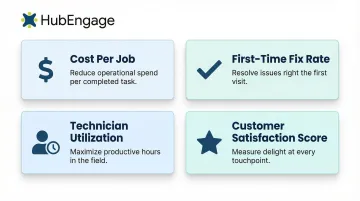
The goal is delivering better service with the same or fewer resources. AI scheduling treats four operational metrics as its primary outputs, with automation serving as the mechanism:
- Cost per job — efficiency of resource allocation per completed task
- First-time fix rate — whether technicians resolve issues on the initial visit
- Technician utilization — how effectively available labor hours are deployed
- Customer satisfaction scores — the downstream result of faster, more accurate service
Key Benefits of AI Scheduling for Field Service
Three capabilities separate AI scheduling from manual dispatch at scale: real-time optimization, predictive intelligence, and workforce efficiency. Each one targets a distinct operational bottleneck with measurable results.
Real-Time Dispatch and Dynamic Optimization
AI continuously matches incoming service requests to the best-available technician based on real-time variables—skills, proximity, current workload, and customer priority—rather than relying on static shift rosters or dispatcher judgment.
When a new job arrives or a technician runs ahead of (or behind) schedule, the system automatically reassigns or re-routes without dispatcher intervention. Dispatchers shift from managing routine assignments to handling exceptions—a meaningful change in how their time gets used.
The results are measurable. Field service organizations using AI-driven scheduling report 38% more jobs completed per technician per day in utilities and 61% more scheduled jobs in home services. Top-performing organizations achieve 39% faster resolution times—which directly affects SLA compliance, customer retention, and contract renewals.
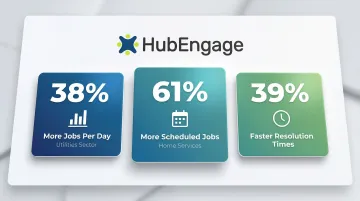
KPIs impacted: jobs completed per day, average response time, SLA compliance rate, dispatcher-to-technician ratio.
This benefit lands hardest in high-volume environments where large teams handle multiple concurrent requests across wide geographic areas.
Predictive Intelligence and Proactive Scheduling
AI analyzes historical job data, asset performance records, and seasonal patterns to anticipate demand before it becomes urgent—enabling proactive scheduling rather than reactive dispatch.
The system identifies assets approaching failure thresholds, flags recurring service patterns, and pre-schedules maintenance visits during low-demand windows. Emergency callouts drop because problems get addressed before they become urgent.
The cost difference is stark. Predictive maintenance cuts overall maintenance costs by 18–25% and unplanned downtime by 30–50% compared to reactive strategies. Proactive repairs cost 4 to 5 times less than emergency repairs on the same asset. For scale, unplanned downtime costs Fortune Global 500 companies $1.4 trillion annually—11% of revenues.
KPIs this moves: unplanned downtime rate, emergency callout frequency, mean time to repair (MTTR), and preventive-to-reactive job ratio.
Asset-heavy industries see the most impact here—utilities, telecommunications, manufacturing, and property management, where a single equipment failure carries significant downstream costs.
Technician Utilization and Workforce Efficiency
AI balances workloads across the technician pool—accounting for skills, certifications, travel zones, and shift patterns—to maximize productive hours and reduce wasted travel or idle time.
Route sequencing, job clustering, and workload redistribution combine to cut the dead time between appointments and ensure the right person handles each job. The impact doesn't always show up directly on a P&L—but it's real.
Most field service companies run billable utilization rates of 75–85%; top performers hit 90.6%. On top of that, mobile workers estimate 18% of their working hours—over 7 hours per week—are lost to admin tasks like form-filling and searching for information. Closing that gap reduces overtime, lowers cost per job, and eases the burnout that comes from chronically uneven workloads.
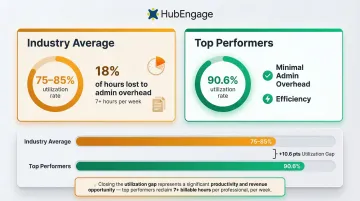
- Technician utilization rate
- Average travel time per job
- Overtime hours
- Cost per completed job
Organizations managing large distributed teams—or a mix of employed and contracted workforces across multiple regions—see the most significant gains here.
AI Scheduling in Action: Use Cases by Industry
The same core AI scheduling capabilities look different in practice depending on the industry. The constraints, priorities, and success metrics shift with each context.
Utilities and Energy
Utilities teams use AI to schedule routine meter inspections, fault response, and infrastructure maintenance across wide geographic territories. The system routes technicians by zone, prioritizes critical fault repairs, and adjusts in real time when outage demand spikes.
Duke Energy reduced shift supervisor time to initiate a callout from up to six hours to less than 30 minutes using automated callout solutions, with the system paying for itself in eight months through labor savings alone.
Telecommunications
Telecom operations depend on matching the right technician — with the right certifications and parts — to each job before dispatch. AI coordinates installation, repair, and upgrade appointments against customer time windows, cutting the repeat visits that erode both costs and satisfaction.
Vodafone deployed an AI-powered Field Technician Assist solution and saw a 28% reduction in repeated site visits, with engineers spending an average of ten minutes less on each incident.
Healthcare and Medical Equipment
In hospitals and clinics, biomedical equipment servicing carries compliance requirements that scheduling errors can't afford to miss. AI assigns only certified technicians, accounts for facility access restrictions and shift constraints, and flags compliance-sensitive jobs for priority treatment.
GE HealthCare used field service management platforms to increase service revenue by $10 million over three years, achieve $1.5 million in field productivity gains in Japan, and reduce call center volume by 40% across Europe.
Property Management and Facilities
Facilities teams managing multiple buildings face a constant balancing act between reactive repairs and preventive maintenance. AI scheduling handles this by:
- Triaging priority repairs against available technician capacity
- Clustering jobs by location to cut travel time between sites
- Surfacing upcoming preventive maintenance before tenant-facing failures occur
City FM implemented resource scheduling optimization and increased same-day work order completion by 26% year-over-year (from 66% to 83%), while reducing average days to complete work orders by 17%.
What Happens When AI Scheduling Is Missing or Ignored
When field service scheduling remains manual or rules-based, several operational consequences compound over time:
Dispatcher overload: Planners spend hours on tasks AI handles in seconds, leaving no capacity for escalations. One major home improvement retailer projected $1.9 million in annual savings and 120,000 hours recovered per year after deploying autonomous scheduling agents.
Technician underutilization: Poor job matching drives excessive travel, idle time, and burnout. Industry estimates suggest AI agents could absorb 35% of admin tasks, freeing roughly 14 hours per technician each week.
Reactive spirals: Without predictive intelligence, teams respond to failures rather than prevent them. Failed service visits account for 44% of total service costs for lower-performing organizations—a direct result of scheduling that can't anticipate demand.
Scaling difficulty: As job volume grows, manual processes crack. Response times slip, SLAs get missed, and SLA breaches cost companies 15-20% of contract value in penalties before accounting for reputational damage.
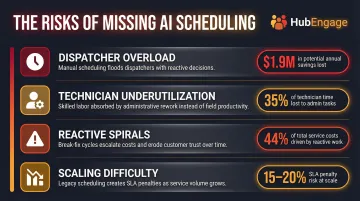
None of these problems stay contained. Each missed SLA, overloaded dispatcher, or wasted technician hour feeds the next one—and over time, the cumulative drag on margins and customer retention becomes harder to reverse.
How to Get the Most Value from AI Scheduling
AI scheduling delivers compounding value when paired with the right operational practices. The technology alone won't move the needle without consistent data quality, consistent processes, and strong team adoption.
Start with data quality. AI is only as good as the inputs it receives. Technician skills databases, customer history, asset records, and real-time status updates must be accurate and consistently maintained. Incomplete or outdated data undermines the system's ability to make optimal assignments.
Team alignment drives adoption. Technicians and dispatchers need visibility into how decisions are made and confidence in the system's recommendations. Platforms that deliver real-time updates, shift information, and recognition to deskless workers — like HubEngage — consistently see faster adoption and stronger sustained performance.
When field workers understand why they're assigned specific jobs and receive recognition for their contributions, they trust the system more and perform better.
Treat it as an ongoing practice, not a one-time setup. AI models improve over time when outcomes — job completion, customer satisfaction, technician feedback — are fed back into the system. Regular reviews of KPIs and system performance ensure the AI continues delivering value as your operation evolves.
Conclusion
AI scheduling is already delivering measurable improvements in response time, technician utilization, operating costs, and customer satisfaction for field service organizations that have committed to it. The gains are cumulative — real-time optimization, predictive intelligence, and workforce efficiency reinforce each other over time, giving early movers a measurable lead.
The core advantages at a glance:
- Faster response times through dynamic, real-time dispatch decisions
- Higher technician utilization by eliminating idle time and travel inefficiencies
- Lower operating costs as predictive scheduling reduces overtime and emergency dispatches
- Better customer satisfaction from accurate arrival windows and fewer repeat visits
Organizations still relying on manual scheduling face rising costs and growing difficulty scaling. The gap between manual and AI-driven operations widens with every passing quarter — and it's one that becomes harder to close the longer the switch is delayed.
Frequently Asked Questions
What are the benefits of AI software for field service operations?
AI software in field service delivers automated dispatch, predictive maintenance scheduling, route optimization, and reduced administrative overhead—translating to lower costs, faster response, and better customer outcomes. Most organizations see measurable gains in first-time fix rates, technician utilization, and SLA compliance within the first year.
How does AI scheduling improve first-time fix rates?
AI matches technicians based on the specific skills and certifications required for each job, while confirming parts availability before dispatch—reducing the likelihood of return visits caused by skill mismatches or missing equipment. Top-performing organizations achieve first-time fix rates of 76%, compared to 55% for bottom performers.
What is the difference between AI scheduling and traditional scheduling in field service?
Traditional scheduling is static, dispatcher-dependent, and slow to adapt to real-time changes. AI scheduling is dynamic, continuously optimized, and self-adjusting to changes in job status, traffic, and technician availability—eliminating manual reassignment bottlenecks and enabling dispatchers to handle more technicians per planner.
Which industries benefit most from AI scheduling for field service?
Utilities, telecom, healthcare/medical equipment, property management, and manufacturing see significant ROI from AI scheduling. Any industry with large distributed service teams, time-sensitive SLAs, or high job volumes benefits—particularly those where equipment failures carry significant downstream costs.
How does AI scheduling handle last-minute cancellations or emergency jobs?
When disruptions occur, AI re-optimizes the entire schedule in real-time: re-routing available technicians, adjusting ETAs, and notifying customers automatically—no manual dispatcher intervention required.
What should companies consider before implementing AI scheduling for field service?
Start with data readiness: clean technician profiles, asset records, and job history are essential. From there, confirm integration compatibility with existing FSM or CRM systems, build a change management plan for dispatcher and technician adoption, and define clear KPIs to track progress as the model improves over time.