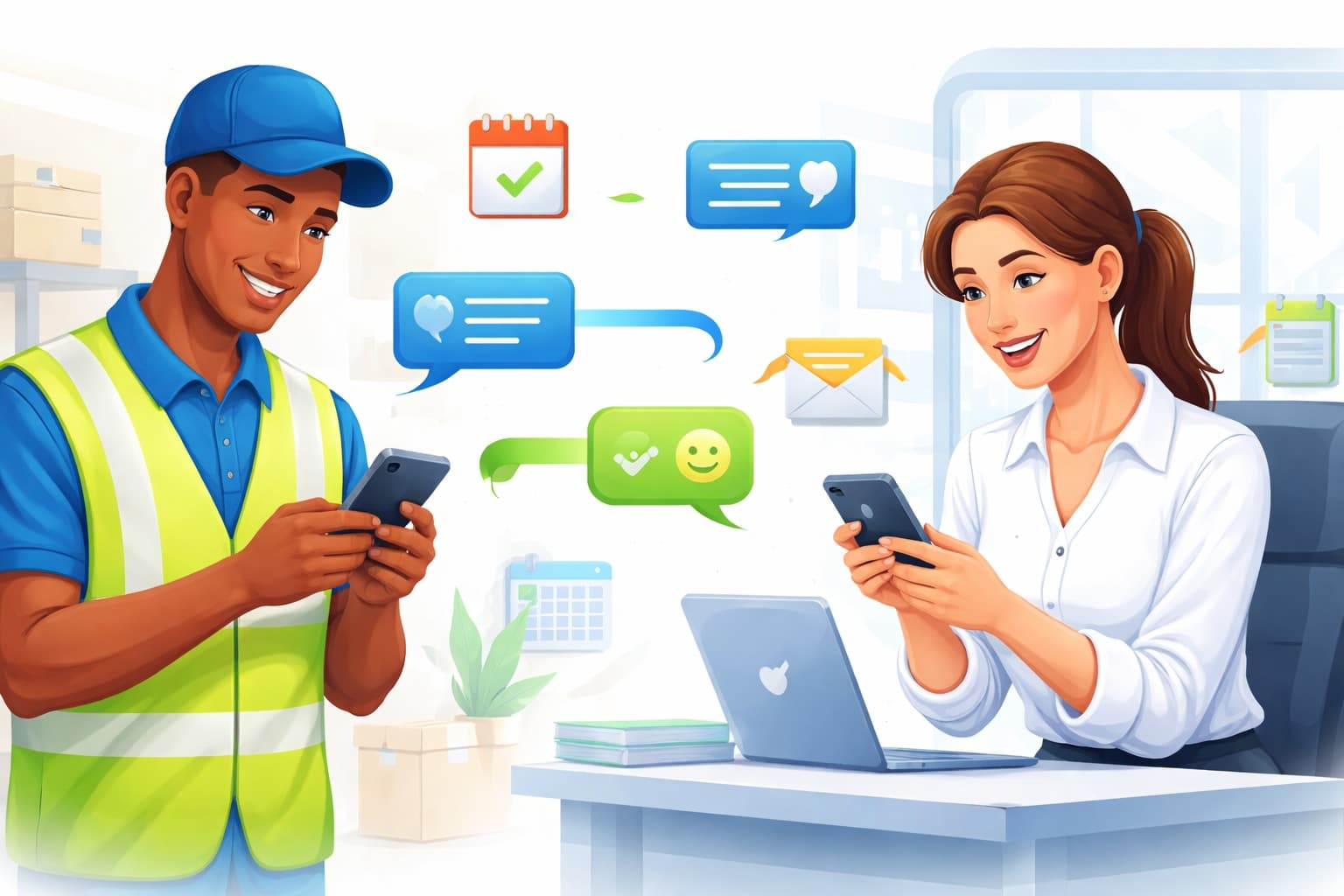
Two way text messaging has become one of the most common ways for companies to communicate with employees in real time. Many companies are increasingly using modern text messaging communication methods to reach employees quickly, especially to in-office and ground workers who may not regularly check email or internal app.
Unlike common SMS alerts that only send notifications, two way SMS lets employees to reply, ask questions, and take part in discussions with their companies. This shift from one‑way messaging to a more active communication that helps companies with better replies, support ground team, and make the employee engagement better.
Research from the Pew Research Center shows that text messaging is one of the best ways of mobile communication, making SMS a great way to quickly reach out to employees.
In this blog, we will explain what two way SMS messaging is, how it works, and why most of the companies are using it. You will also learn about common employee communication use cases, important features of the platform, automation, and best ways to setup two way SMS.
Key Takeaways
- Two way text messaging helps with having real-time discussion between companies and employees with the help of SMS.
- Employees can reply directly to messages, allowing HR teams, managers, and internal communications teams to answer questions quickly.
- Two way SMS messaging platforms comes with automation, process, and common inboxes to handle large amount of team discussions.
- Companies use two way texting for internal communication, good teamwork, and better engagement, mostly for ground team.
- Enterprise platforms also helps with setup, connecting to other tools, compliance, and security controls, so that messaging is safe and easy to handle.
How Does Two-Way SMS Work?
Two way text messaging allows a company and its employees to use SMS that lets them exchange messages in real time. Instead of sending one‑way updates, companies can start discussions where employees can reply easily and discuss quickly.
Most platforms use phone number, short code, and a landline with an option to send message. When an employee replies to a message, the reply is shared into a common messaging dashboard where HR teams, managers, or internal communications teams can read and reply.
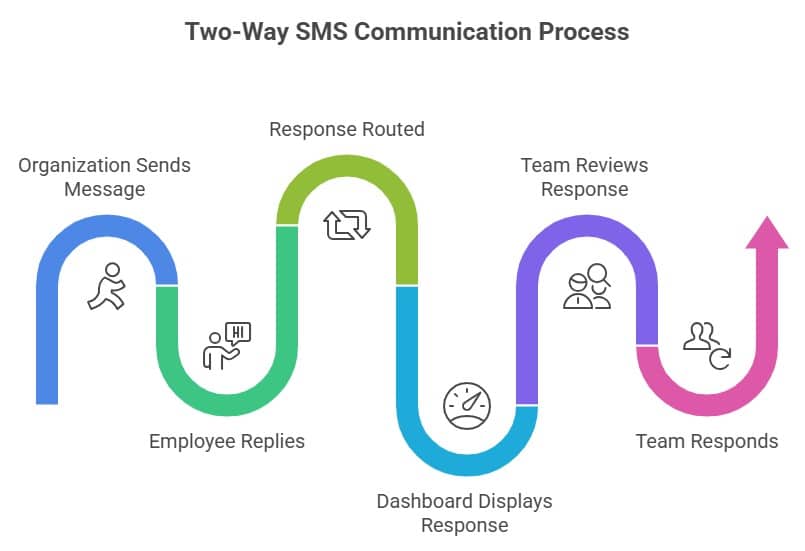
Two way SMS works by connecting SMS gateways, messaging APIs, and employee communication software. These systems take up the new messages, start the automated workflows, and set discussions to the correct team when needed.
Industry standards and rules for SMS messaging and communication are given by companies such as the GSMA which make sure there is good mobile messaging channel everywhere. This conversational model can change simple notifications into high engaging internal communication.
Use Cases of Two-Way Messaging
Organizations across industries use two way text messaging to improve employee communication and workforce coordination.
Common use cases include:
- HR questions and employee support
- Shift confirmations and schedule changes
- Employee feedback and pulse surveys
- IT support requests
- Workplace announcements with reply capability
Two way texting is especially valuable for reaching deskless workers who may not have access to email or collaboration tools during their workday. Platforms designed for employee text messaging allow organizations to connect with frontline employees quickly and reliably.
In urgent situations, organizations may also combine SMS conversations with emergency alerts. Platforms that support crisis communication software enable both alerts and follow‑up conversations so employees can confirm safety, ask questions, or request help.
Two-Way SMS for Deskless Workforce Communication
A large portion of today’s workforce is deskless employees who work on the frontline, in the field, on factory floors, or in retail and healthcare environments. These workers often do not have consistent access to email, intranets, or collaboration platforms during their shifts.
Two way text messaging helps organizations close this communication gap. Because SMS works on any mobile phone, companies can instantly reach employees regardless of location, device type, or internet access.
For deskless teams, two way SMS messaging enables organizations to:
- Send shift updates or schedule changes
- Coordinate field teams or distributed workers
- Provide quick HR or IT support
- Collect real-time employee feedback
- Confirm message receipt during emergencies
Unlike traditional internal communication channels, two way texting allows frontline employees to ask questions and receive answers immediately. As a result, organizations can reduce delays, improve operational coordination, and strengthen workforce engagement.
Platforms built specifically for employee communication such as employee text messaging systems are designed to support large frontline workforces while maintaining compliance, automation, and conversation management.
Core Features of HubEngage’s Two-Way Text Messaging Platform
HubEngage provides a modern two way SMS messaging platform designed for employee communication and engagement.
Key capabilities include:
- Shared messaging inboxes for team collaboration
- Automated responses and keyword triggers
- Conversation routing and assignment
- Message templates and personalization
- Engagement reporting and analytics
These capabilities help organizations manage employee conversations efficiently while maintaining personalized communication across large workforces.
One-Way vs Two-Way Text Messaging
Traditional SMS communication often relies on one‑way messaging. In this model, organizations send alerts or announcements without expecting a reply.
Two way SMS messaging enables interactive communication where employees can respond directly.
| Feature | One-Way SMS | Two-Way SMS |
|---|---|---|
| Employee replies | Not supported | Supported |
| Conversation management | Not required | Required |
| Engagement level | Low | High |
| Use cases | Alerts and announcements | Support, engagement, coordination |
While one‑way alerts are useful for broadcasting information, two way SMS creates stronger engagement because employees can ask questions, confirm updates, or request assistance.
Employee Texting Platforms vs Generic SMS Tools
Not all SMS solutions are designed for employee communication. Many generic SMS tools focus primarily on marketing campaigns or mass notifications. While those tools can send messages, they often lack the features required for secure, scalable workforce communication.
Employee texting platforms are purpose-built to support internal communication, HR interactions, and frontline workforce engagement.
| Capability | Generic SMS Platforms | Employee Texting Platforms |
|---|---|---|
| Two-way employee conversations | Limited | Built for conversations |
| Conversation routing | Minimal | Advanced routing and assignment |
| Team collaboration inbox | Usually unavailable | Included |
| Employee data integration | Rare | HRIS and internal system integrations |
| Security and compliance | Basic | Enterprise-grade compliance |
| Internal communication workflows | Not supported | Built for employee communication |
Employee-focused platforms also provide tools for managing conversations across HR, IT, operations, and leadership teams. This ensures employee questions are routed to the right department and resolved quickly.
Solutions designed for employee text messaging help organizations move beyond basic SMS alerts and build real-time communication channels that improve workforce engagement and operational efficiency.
How HubEngage Helps Improve Employee Engagement With Two-Way SMS?
HubEngage helps organizations build stronger connections with employees through scalable two way texting capabilities.
Instead of managing messages across multiple devices, teams can manage all SMS conversations from a unified dashboard. Incoming messages are automatically organized, routed, and tracked so that employee questions never go unanswered.
Automation tools also help teams respond faster. For example, organizations can configure keyword‑based replies, automated acknowledgements, and workflow triggers for common requests.
Together, these tools transform SMS from a simple notification channel into a powerful employee engagement platform.
Why choose HubEngage for Two-Way Messaging?
Organizations choose HubEngage because the platform combines messaging, automation, and engagement tools into one employee communication platform.
Teams can manage both internal and external messaging from a single solution. For example, organizations can use text messaging communication tools to connect with employees while enabling internal sms messaging to support workforce communication across departments and locations.
This unified approach simplifies communication management while ensuring messaging remains secure and compliant. Organizations looking to implement these capabilities can explore HubEngage’s employee text messaging platform or schedule a demo to see how two way SMS can support real‑time employee engagement.
See HubEngage in Action
Learn how organizations use HubEngage to power secure two way SMS communication for employees, frontline teams, and distributed workforces.
Request a demo: https://www.hubengage.com/schedule-a-demo/
Benefits of Two-Way Messaging
Two way text messaging offers several advantages for internal communication.
Faster response times – Employees can quickly reply to messages without logging into apps or checking email.
Higher engagement rates – SMS messages have extremely high open rates, ensuring employees see important updates.
Improved employee satisfaction – Real‑time conversations help resolve HR or operational questions quickly.
Better workforce coordination – Managers can communicate instantly with distributed teams and frontline workers.
Because of these benefits, many organizations are adopting two way SMS messaging as part of their employee communication strategy.
Automation and Conversation Management
Managing employee conversations at scale requires automation and intelligent routing.
Advanced two way SMS messaging platforms include features such as:
- Automated keyword responses
- Chatbots for common HR questions
- Queue management and message routing
- Conversation tagging and categorization
These capabilities ensure that incoming employee messages are quickly directed to the right department or team.
Integrations and System Connectivity
Two way texting platforms often integrate with HR systems, helpdesk tools, and internal communication platforms. These integrations allow organizations to sync employee data, automate messaging workflows, and maintain consistent conversation records across systems.
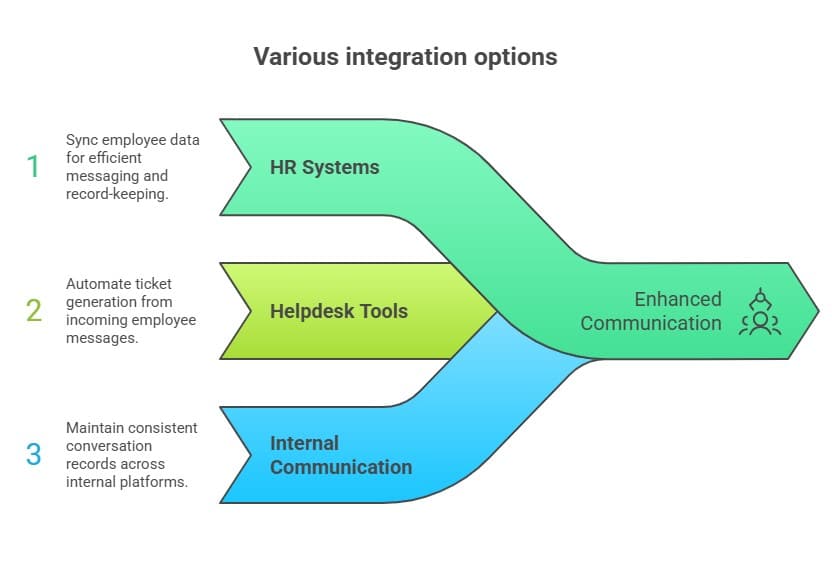
For example, SMS platforms can connect with HR or support systems so incoming employee messages automatically generate service tickets.
Compliance, Security, and Data Privacy
When implementing two way SMS messaging for employees, organizations must ensure strong compliance and security controls. Important considerations include:
-
Employee consent and opt-in management: Employees must agree before messaging; ensures legal permission and respects individual communication preferences.
-
Message logging and audit trails: Recording messages helps track communication history, resolve disputes, and support compliance reviews.
-
Secure data storage: Protects employee message data from unauthorized access, leaks, or cyber security threats.
-
Compliance with GDPR regulations: Ensures employee data privacy rights are protected and organizations avoid legal penalties.
Enterprise messaging platforms also support role‑based permissions and secure authentication to protect sensitive employee communication data.
Best Practices for Two-Way Text Messaging
Companies can increase engagement and response rates by following some simple ways.
- Get clear permission of employee before messaging.
- Keep messages short that are easy to understand.
- Reply quickly to the latest employee messages.
- Use automation for common HR or support requests.
- Create a path for escalation having the correct teams.
Following these practices helps organizations to have a good employee communication with high trust.
FAQs
Can employees reply to messages using the same phone number?
Yes, in most of two way SMS systems, employees reply to the same phone number that sent the message. The reply automatically goes to the organization’s messaging platform where teams can carry the communication.
How are incoming messages routed to teams or agents?
Incoming messages are generally routed using automation rules that may mark communication based on keywords, employee needs, and the process of the department.
Can multiple agents respond within the same conversation?
Yes, shared messaging inboxes allow HR teams or managers to communicate in the same discussion while keeping a single message history.
How does two-way text messaging handle high message volumes?
Platforms can handle high number of messages with the help of automation, queue management, and routing. These systems make sur that employee messages goes to the right team as well as follow the process.
Can conversations be transferred between teams?
Yes, many enterprise messaging platforms allow messages to resend or shared to other department when escalation or a particular help is needed.
How are missed or unanswered messages managed?
Platforms generally use alerts, waiting time, and escalation rules to make sure that the messages that are not answered are flagged and handled quickly.
Does two-way text messaging support conversation history?
Yes, messaging platforms save conversation histories so that teams can see old communications of an employee and keep up the context during current discussions.