Finding the best text messaging service for business can feel overwhelming. Pricing structures vary, compliance requirements add complexity, and the number of platforms can make the decision harder. Nevertheless, Sourceforge data shows the demand has been high SMS having a 98% open rate. Consequently, text messaging has become one of the fastest, most reliable ways to reach employees and customers alike.
In this guide, we will explore the leading platforms, compare pricing and features, address compliance considerations, and demonstrate how some solutions can go beyond SMS to create a complete multi-channel strategy.
👉 If you’re still exploring broader use cases, start with our guide on using text messages to communicate with employees.
Key Takeaways
- SMS remains one of the fastest and most reliable communication channels, with very high open rates compared to email.
- The best text messaging service for business balances pricing, compliance, scalability, and ease of use.
- Always consider hidden costs like carrier fees, compliance requirements, and message limits other than base pricing.
- Enterprise platforms go beyond SMS with multi-channel communication, automation, and advanced segmentation.
- Compliance (A2P 10DLC, opt-ins, audit trails) is critical to ensure message delivery and avoid penalties.
- Integration with HRIS, CRM, or internal systems improves efficiency and reduces manual work.
- Advanced features like analytics, security controls, and automation help scale communication effectively.
Why Businesses Need a Text Messaging Service?
Here are some of the key reasons that we believe why every business should have employee text messaging.
-
Reach employees and customers instantly – Text messages are usually read within minutes, making SMS one of the fastest ways to share important updates, alerts, or announcements with both employees and customers.
-
Higher ROI than email marketing – SMS has an open rate of around 98%, compared to about 34% for email. This means your messages are more likely to be seen, improving engagement and overall return on investment.
-
Perfect for deskless and frontline teams – Employees in retail, healthcare, or logistics may not check emails regularly. SMS ensures everyone receives important information, improving communication across all levels of the organization.
-
Easily scalable for large campaigns – Bulk text messaging platforms allow businesses to send thousands of messages at once. This makes SMS ideal for announcements, alerts, and large-scale communication campaigns.
-
Built-in compliance support – Modern SMS platforms help businesses follow regulations like A2P 10DLC by guiding them through registration, opt-in management, and messaging rules to ensure smooth delivery.
-
Flexible and affordable pricing options – Businesses can choose from pay-as-you-go pricing or monthly plans based on their needs. This makes it easy to find a cost-effective SMS solution that fits different budgets.
For internal communication use cases, check our Crisis Communication Toolkit.
Top 7 Best Text Messaging Services for Business
We analyzed feature sets, user feedback, and affordability to bring you this updated 2026 comparison.
| Platform | Starting Price | Free Trial | Best For | Key Highlights |
|---|---|---|---|---|
| SimpleTexting | $29/mo for 500 credits | 14 days | SMB starter kit | Unlimited keywords, polls, MMS |
| SMSBump (Yotpo) | $0.0165 per SMS | Free plan | E-commerce | Abandoned cart flows, Shopify sync |
| EZ Texting | $25/mo | 14 days | Marketing starter kit | QR codes, Shutterstock integration |
| Textedly | $24/mo for 1,000 credits | 14 days | Growing SMBs | Instagram integration, voice services |
| SlickText | $29/mo for 500 messages | 14 days | Loyalty programs | Website popups, rewards, automation |
| TextMagic | $0.04 per SMS | 30 days | Pay-as-you-go users | Email-to-SMS, text-to-speech |
| Attentive | Custom pricing | Demo required | Enterprise/e-commerce | Journeys, segmentation, MMS |
| HubEngage | Custom pricing | Demo required | SMB / Enterprise – Employee Texting, Internal SMS | Segmentation, Scheduling, Integrations with HRIS / Payroll, SSO, Transparent pricing, no caps |
Real-World Insights And Pain Points
Businesses often face several recurring challenges:
| Challenge | Explanation |
|---|---|
| Cost frustration | Many businesses look for pricing below 1.5¢ per SMS or unlimited plans, but carrier fees make truly unlimited messaging unrealistic and often lead to hidden costs. |
| Compliance delays | SMS providers must follow A2P 10DLC regulations. Businesses need EINs, campaign details, and approvals, which can take several days or even weeks. |
| Bulk sending limits | Some platforms limit batch sends (e.g., 200 messages at a time), which creates challenges for businesses managing large contact lists of 50,000+ users. |
| Need for Twilio-friendly UIs | Many organizations prefer platforms that allow Twilio API integration, helping reduce costs while providing a simple interface for managing messages. |
As a result, affordability and compliance are just as important as features when evaluating the best text messaging service for business. To address these pain points, HubEngage offers transparent usage-based pricing, removes caps on text messages, manages compliance approvals, and provides an intuitive user interface.
Key Features to Look For
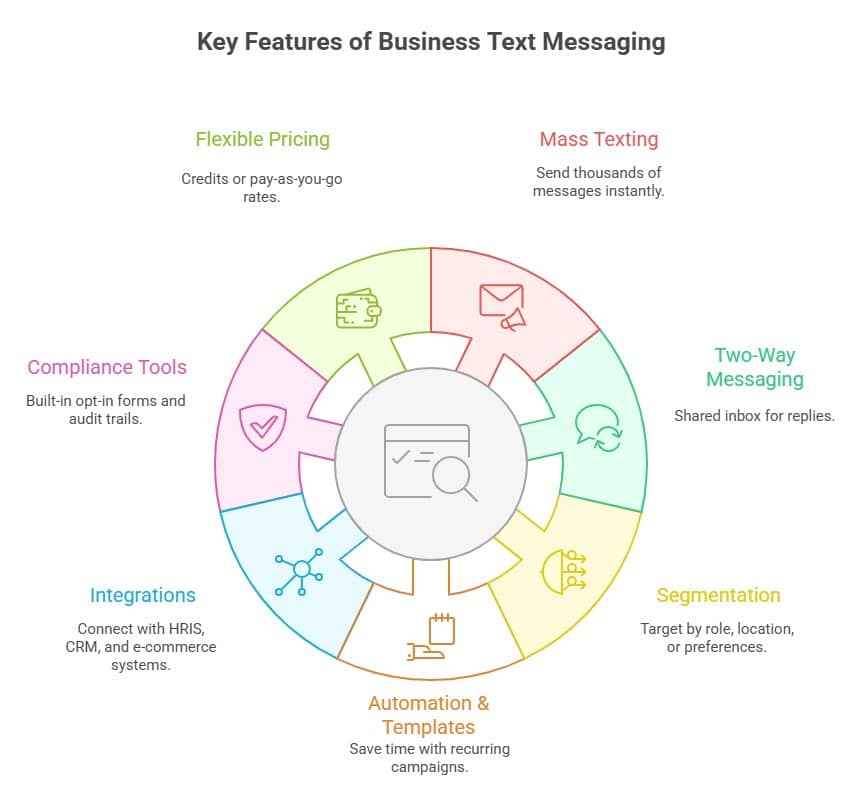
We have shortlisted the most common features that the best text messaging service for business must have.
- Mass Texting – Ability to send thousands of messages instantly.
- Two-Way Messaging – Shared inbox for employee or customer replies.
- Segmentation – Target by role, location, or preferences.
- Automation & Templates – Save time with recurring campaigns.
- Integrations – Connect with HRIS, CRM, e-commerce systems and much more.
- Compliance Tools – Built-in opt-in forms, audit trails, and A2P registration support.
- Flexible pricing – Look for bulk text messaging platforms with credits or pay-as-you-go rates.
For internal use cases, see our SMS for HR guide.
Pricing Models Explained
Understanding SMS pricing models is important when choosing the best text messaging service for business. Different providers offer flexible plans based on usage, scale, and features. The best pricing model depends on your monthly message volume, budget, and scalability needs.
| Pricing Model | How It Works | Best For |
|---|---|---|
| Credit-based pricing | Businesses pay per SMS segment (usually 160 characters). Typical cost ranges from $0.015 to $0.04 per message. | Companies with predictable messaging volume |
| Subscription tiers | Monthly plans include a set number of message credits, often with rollover options. | Small to mid-sized businesses with regular campaigns |
| Pay-as-you-go | No monthly commitment. You only pay for the messages you send, but rates are usually higher. | Businesses with low or irregular usage |
| Enterprise contracts | Custom pricing based on high-volume messaging (50k+ texts per month). Includes negotiated rates and advanced features. | Large organizations and enterprises |
Important note:
If a provider claims “unlimited SMS,” it usually comes with hidden limits such as fair usage policies, character restrictions, or carrier caps. Always estimate your actual monthly messaging volume before choosing a plan..
Best Options for Twilio-Friendly Platforms
Many businesses look for Twilio-friendly SMS platforms that allow them to “bring your own Twilio” for better pricing and flexibility. These platforms combine Twilio’s API with easy-to-use dashboards for managing messages. Tools like MessageDesk and SalesMessage allow businesses to plug in their Twilio API while providing features like shared inboxes, campaign tools, and messaging dashboards.
Twilio-Friendly Platforms vs All-in-One SMS Platforms
| Feature | Twilio-Friendly Platforms | All-in-One Platforms |
|---|---|---|
| Setup | Requires API integration | Ready-to-use platform |
| Cost | Lower per SMS | Bundled or subscription pricing |
| Flexibility | High control and customization | Limited customization |
| Compliance | Limited built-in support | Full compliance tools included |
| Best For | Tech-savvy teams | Businesses needing simplicity |
Pros and Cons of Twilio-Based SMS Solutions
Pros:
- Lower SMS costs using Twilio API
- Flexible and customizable setup
- Better control over messaging infrastructure
Cons:
- Requires technical expertise or developer support
- Compliance setup may need manual effort
- Not ideal for beginners or non-technical teams
When Should You Use Twilio-Friendly Platforms?
Twilio-based solutions are a good fit if you want to reduce messaging costs and have the technical resources to manage API integrations. However, if you need a simple, ready-to-use platform with built-in compliance, an all-in-one solution may be a better choice.
👉 For businesses that want scale plus simplicity, HubEngage employee texting platform bundles compliance, templates, and multi-channel outreach on top of SMS.
Benefits of Employee Texting Platforms vs Generic SMS Platforms
Employee texting platforms are better than generic SMS tools because they offer secure, scalable, and integrated communication with advanced features like automation, segmentation, and compliance support:
Enterprise-grade security and compliance
Employee texting platforms provide built-in compliance with standards like ISO, SOC 2, and GDPR. Features such as Single Sign-On (SSO) and secure data encryption help protect sensitive employee information.
Seamless HRIS and payroll integrations
These platforms integrate directly with HR and payroll systems, enabling automatic employee data sync. This ensures accurate contact lists, easy onboarding and offboarding, and better targeting based on roles or locations.
Advanced segmentation for targeted communication
Businesses can send messages to specific employee groups based on department, region, role, or other attributes. This improves message relevance and avoids unnecessary communication.
Automation and governance controls
Employee texting platforms simplify workflows with automation, scheduled messaging, and compliance tools like opt-in tracking and audit trails. This reduces manual effort and ensures regulatory adherence.
Detailed analytics and reporting
Advanced reporting tools provide insights into message delivery, engagement, and usage across departments. This helps organizations measure communication effectiveness and improve strategies.
Consequently, employee texting platforms are ideal for organizations seeking a secure, scalable, and fully integrated communication hub rather than just a basic SMS tool.
Common Mistakes Businesses Make When Choosing SMS Platforms
Choosing the best text messaging service for business isn’t just about pricing. It is about long-term scalability, compliance, and usability. However, many businesses make avoidable mistakes during evaluation:
1. Focusing only on price per SMS
Low per-message pricing can be misleading. Hidden carrier surcharges, compliance fees, and feature limitations often increase total costs. Always calculate your total monthly usage instead of just comparing base rates.
2. Ignoring compliance requirements
Many businesses underestimate A2P 10DLC registration and opt-in management. Without proper compliance, messages may be blocked or delayed, impacting communication reliability.
3. Overlooking scalability limits
Some platforms restrict batch sending (e.g., 200–500 messages per send), which becomes a bottleneck for organizations with large employee or customer lists.
4. Choosing SMS-only tools
Basic SMS platforms lack integrations, automation, and analytics. As communication needs grow, businesses often outgrow these tools quickly.
5. Not considering integrations
Failing to connect SMS with HRIS, CRM, or internal systems results in manual data management and inefficiencies.
6. Ignoring user experience
Platforms that require technical setup (like raw Twilio usage) can slow adoption. Teams benefit from intuitive dashboards and ready-to-use templates.

Advanced Features That Differentiate Enterprise-Grade Platforms
Not all business texting platforms are created equal. While basic tools focus on sending messages, enterprise-grade platforms offer advanced capabilities that transform communication into a strategic function.
1. Multi-channel communication
Leading platforms combine SMS with email, intranet, push notifications, and chat. This ensures messages reach employees or customers on their preferred channel.
2. Intelligent segmentation
Enterprise tools allow targeting based on role, department, location, or behavior which improves the context of message as well as engagement.
3. Workflow automation
Automated campaigns, triggers, and scheduling reduce manual effort. For example, onboarding messages, shift reminders, or emergency alerts can be pre-configured.
4. AI-powered personalization
Modern platforms use AI to tailor messages, optimize timing, and improve response rates.
5. Deep analytics and reporting
Beyond delivery rates, enterprise platforms provide insights into engagement, response trends, and communication effectiveness across teams.
6. Enterprise-grade security
Features like Single Sign-On (SSO), encryption, and role-based access ensure secure communication at scale.
Compliance & Governance
Understanding SMS compliance and governance is essential when choosing a business text messaging service. Regulations and carrier rules ensure messages are delivered properly while protecting users from spam and privacy violations.
| Compliance Area | Explanation | Why It Matters |
|---|---|---|
| A2P 10DLC Registration | Mandatory registration in the U.S. for business messaging to reduce spam and improve message deliverability. | Without it, messages may be blocked or heavily filtered by carriers. |
| Carrier Vetting Process | Businesses must submit details like EIN, website, privacy policy, and sample campaigns. Approval can take up to 20 days. | Ensures legitimacy of messaging campaigns and avoids delays in sending messages. |
| Carrier Surcharges | Additional fees charged by carriers per SMS segment (e.g., ~$0.003 by AT&T). Similar charges apply from Verizon and T-Mobile. | Impacts overall messaging cost and should be included in budget planning. |
| Legal Regulations (TCPA & GDPR) | Laws like TCPA (U.S.) and GDPR (Europe) regulate consent, data usage, and messaging practices. | Non-compliance can result in heavy fines and legal issues. |
| Privacy and Consent Risks | Using third-party or purchased contact lists violates carrier policies and regulations. | Can lead to message blocking, penalties, and FCC fines. |
Always choose a platform that helps manage compliance, approvals, and consent tracking to avoid delays, extra costs, and legal risks. For crisis-specific communication, check our Crisis Communication Software guide.
Data Retention, Audit Trails, and Admin Controls
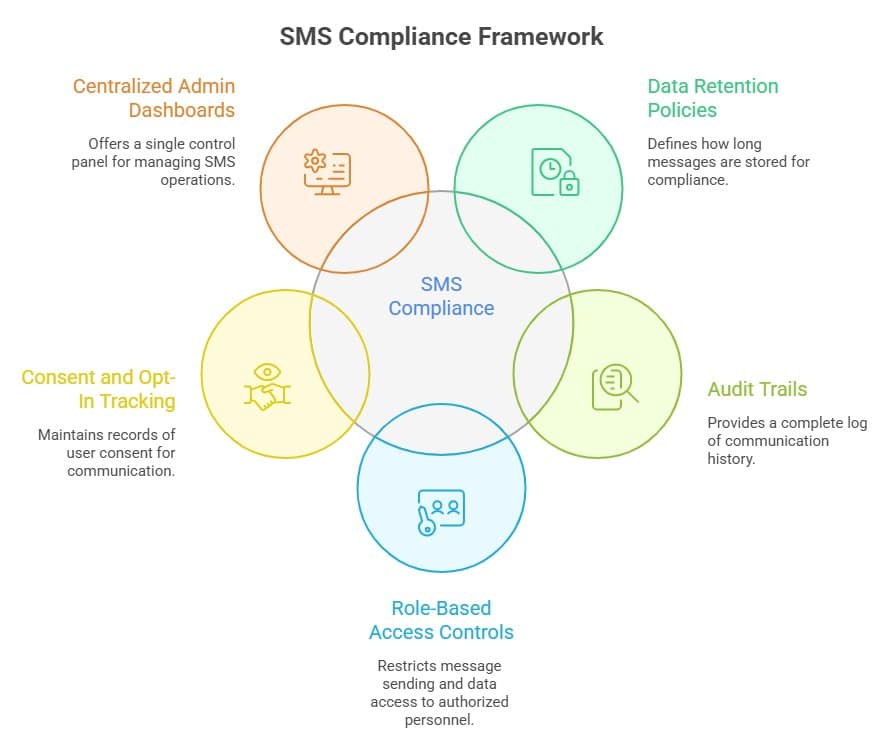
Businesses in regulated industries should prioritize SMS platforms with strong compliance, audit, and data control features.
Data retention policies
Enterprise platforms allow organizations to define how long messages are stored. This is essential for compliance with regulations like GDPR and internal data policies.
Audit trails
A complete log of sent, received, and deleted messages ensures transparency. Audit trails help organizations track communication history and resolve disputes if needed.
Role-based access controls
Admins can define who can send messages, access data, or manage campaigns. This reduces the risk of unauthorized communication.
Consent and opt-in tracking
Maintaining records of user consent is crucial for compliance. Advanced platforms automatically track opt-ins and opt-outs.
Centralized admin dashboards
A single control panel helps IT and HR teams manage users, monitor campaigns, and enforce governance policies efficiently.
How HubEngage Offers the Best Text Messaging for Business?
When evaluating the best text messaging service for business, many organizations struggle with fragmented tools, compliance challenges, and limited scalability. HubEngage’s Instant Messaging platform addresses these challenges by combining SMS with a powerful, all-in-one communication ecosystem.
1. Unified communication platform
HubEngage goes beyond SMS by integrating text messaging with email, intranet, surveys, push notifications, and employee recognition. This ensures consistent communication across multiple channels from a single platform.
2. Designed for employee communication
Unlike generic SMS tools, HubEngage is built specifically for internal communication. It helps organizations reach deskless and frontline employees instantly with critical updates, alerts, and announcements.
3. Advanced segmentation and targeting
Communicate with precision by targeting employees based on department, location, role, or custom attributes. This improves engagement and reduces message fatigue.
4. Seamless HRIS and payroll integrations
HubEngage integrates with HR systems to automatically sync employee data. This eliminates manual updates and ensures accurate communication lists.
5. Compliance made simple
The platform helps manage A2P 10DLC registration, opt-ins, and audit trails thereby reducing administrative burden and ensuring regulatory compliance.
6. No message caps with transparent pricing
Unlike many providers, HubEngage offers flexible pricing without restrictive message limits, making it ideal for organizations with large-scale communication needs.
7. Automation and scheduling
Send recurring messages, emergency alerts, or campaign-based texts with built-in automation tools.
8. Enterprise-grade security
With features like SSO, role-based access, and secure infrastructure, HubEngage ensures data protection and controlled communication.
9. Actionable analytics
Measure communication effectiveness with detailed reports on delivery, engagement, and usage across teams.
Conclusion
The best text messaging service for business balances affordability, compliance, and scalability. While platforms like SimpleTexting, SlickText, and Textedly shine for SMB use cases, enterprise-ready solutions such as HubEngage stand out for internal SMS by combining SMS with multi-channel tools and HRIS integrations.
If your goal is to mass text employees or engage customers at scale, choose a provider that aligns with your budget as well as your strategy. Since compliance is tightening and AI personalization is rising, 2026 is the year to elevate your texting strategy.
👉 Ready to explore more? See our full using text messages to communicate with employees.
FAQs About Business Text Messaging Services
What is the best text messaging service for business?
The best service depends on your needs. If affordability is your priority, TextMagic offers pay-as-you-go. When it comes to e-commerce, SMSBump integrates tightly with Shopify. Meanwhile, for all-in-one internal and external communication, HubEngage stands out as unmatched.
Which texting app is best for bulk messages?
For businesses sending 50k+ texts monthly, look for bulk text messaging platforms like Textedly or enterprise plans from HubEngage. They provide higher throughput and compliance handling.
Are there texting services that don’t charge per SMS?
All providers ultimately pay carriers per SMS segment. Some bundle credits or offer subscription tiers, but true unlimited plans are unsustainable.
Can I use Twilio directly to save costs?
Yes, but Twilio requires developer expertise. Many small businesses use interfaces that connect to Twilio APIs for ease of use. Therefore, look for platforms advertising “bring your own Twilio” or easy to use platforms like HubEngage.
How do compliance rules affect bulk texting?
U.S. carriers require A2P 10DLC registration with business details and sample campaigns. Without it, your messages may be blocked or throttled. Always ensure employees and customers have opted in.
Is mass texting good for employee communication too?
Yes! SMS works for both customer engagement and employee updates. For instance, see our article on using text messages to communicate with employees for internal use cases like shift scheduling and HR alerts.
Which business texting service is most affordable?
Pay-as-you-go providers like TextMagic are cost-effective for small volumes. However, for larger organizations, platforms like HubEngage scale costs efficiently with credits and multi-channel bundling.
Which business texting service is best for small business?
For small businesses, platforms like EZ Texting and SimpleTexting offer easy onboarding and low entry-level pricing. On the other hand, HubEngage is a great option if you want to start with SMS and scale into broader employee communication tools.
What features should a business texting app include?
The best business texting apps should include mass texting, two-way communication, compliance support, segmentation, automation, and integrations with other tools. Moreover, HubEngage goes further by bundling recognition, surveys, and intranet features.
What is the difference between business SMS and conversational messaging?
Business SMS is mainly used for one-way alerts, notifications, or bulk campaigns. Conversational messaging enables two-way communication, allowing real-time replies, support, and engagement. It helps businesses build stronger relationships through interactive and personalized conversations with employees or customers.
Can business text messaging platforms support multiple departments?
Yes, modern business texting platforms support multiple departments through segmentation and role-based access. Teams like HR, IT, and operations can send targeted messages, manage campaigns, and track responses independently while maintaining centralized control and visibility.
What security features should enterprises expect from SMS platforms?
Enterprises should expect features like data encryption, Single Sign-On (SSO), role-based access controls, and secure data storage. Additionally, audit trails, compliance support, and permission-based messaging help protect sensitive information and ensure secure, controlled communication across the organization.
Related Links:
text messaging communication | employee texting platform | crisis communication software | internal sms